

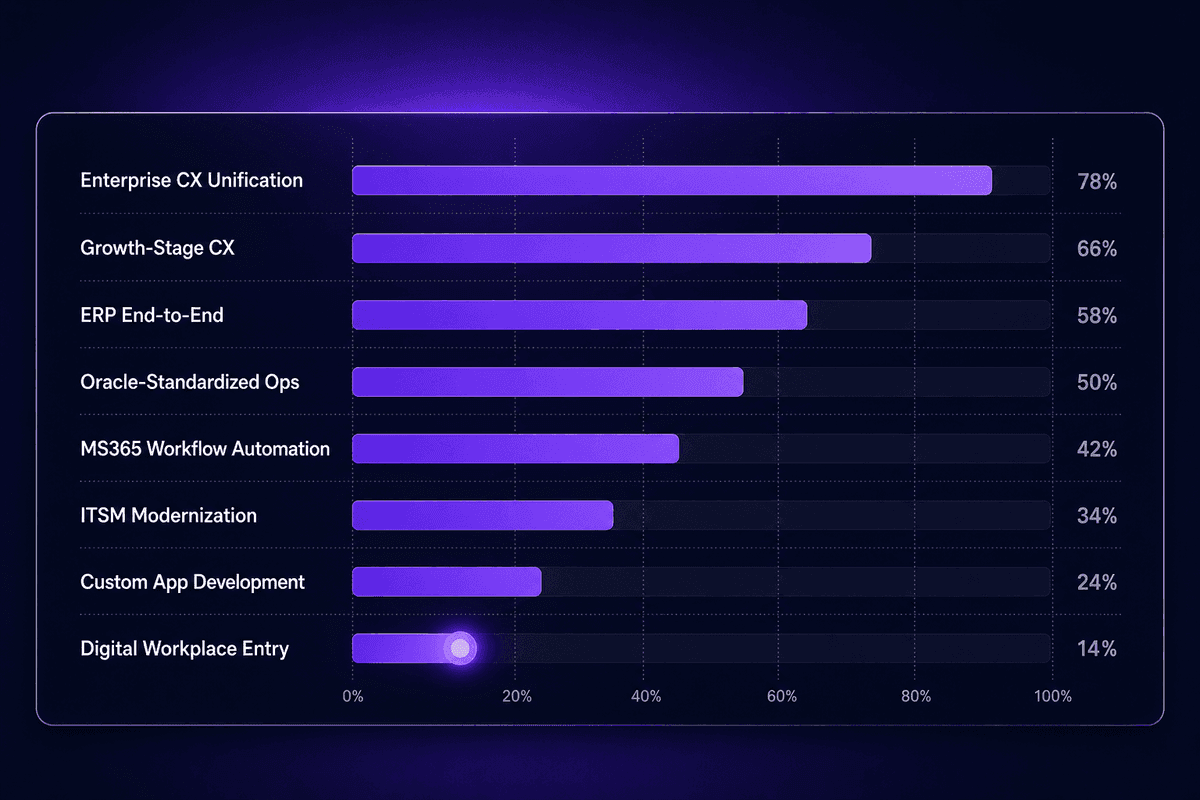
Best Digital Transformation Platforms for 2026: Top Tools by Use Case and Scale
A head of operations at a 300-person logistics company spent six months evaluating digital transformation software. She sat through 14 demos, built three comparison spreadsheets, and got budget approval for a platform her team still barely uses. The problem was not the tool. The problem was that she chose it by category - "we need a workflow platform" - rather than by the specific job it needed to do: replace a Friday approval queue that had somehow survived three reorganizations and was still running on a shared inbox and a color-coded Excel file.
I want to say the wrong platform is just a waste of money. It is worse than that. A platform that does not match your actual transformation category creates integration debt, forces workarounds, and eventually gets abandoned - but not before someone has built six months of process logic inside it. That is the quiet disaster most digital transformation platform decisions are walking toward.
The claim I will defend throughout this article: the right way to shortlist digital transformation platforms is by job-to-be-done - customer experience, core operations, workflow automation, or digital workplace - not by feature lists or analyst rankings. Every section of this guide is organized around that framework.
Key takeaways:
- Digital transformation platforms fall into four distinct categories - customer experience, core operations, workflow automation, and digital workplace - and choosing by job-to-be-done produces better outcomes than choosing by feature list or analyst ranking alone.
- No single digital transformation platform covers all four categories equally; most organizations end up running two to four specialized tools in parallel.
- Licensing cost is only one layer of total cost of ownership - implementation, change management, and adoption training frequently exceed the software spend itself.
- The digital workplace category (Microsoft 365, Google Workspace, Slack) is often the lowest-risk starting point because employee adoption is shaped by existing habits rather than IT mandates.
- According to Deloitte, only 34% of organizations are genuinely reimagining their business models - the majority of digital transformation customer experience and operations work still stops at efficiency gains rather than structural change.
Why Choosing a Digital Transformation Platform Is Harder Than It Looks
There are hundreds of platforms competing in this space, and the category boundaries are genuinely blurry. A CRM vendor will tell you it handles workflow automation. A workflow automation vendor will tell you it transforms customer experience. An ERP suite will tell you it does everything. Some of that is marketing. Some of it is technically accurate. None of it helps you shortlist.
The dominant search behavior around digital transformation tools and digital transformation software is list-based - people are actively shortlisting, not just learning. That tells me buyers already know they need something; they are trying to figure out which thing. The problem is that most comparison lists rank platforms by general capability, not by the specific initiative they serve best. That mismatch is where expensive mistakes happen.
A wrong platform choice does not just cost the licensing fee. It costs the implementation months, the internal political capital spent convincing skeptical department heads, and the organizational change management effort required to shift behavior. According to McKinsey, data-intensive transformation programs that use reusable workflow building blocks can deliver applications up to 90% faster at 30% lower cost - but that efficiency only materializes when the platform architecture matches the transformation goal. When it does not match, those gains evaporate into custom integration work and migration projects that were never in the original budget.
AI is accelerating the complexity here. Deloitte reports that worker access to AI rose by 50% in 2025, and the number of companies with at least 40% of AI projects in production is expected to double within six months - meaning enterprises are moving from experimentation into production at a pace that makes platform selection more consequential, not less. Choosing infrastructure for a pilot is a different decision than choosing it for an initiative that will run at scale across 400 employees.
The top digital transformation strategy question is not "which platform is best?" It is "best at what, for which transformation category, at what organizational maturity?" The rest of this article is built around that question. Every digital transformation begins with a business process someone wants to stop doing by hand, and the platform that fits one category often actively interferes with another.
💡 Licensing is only one cost layer. Implementation and change management frequently exceed the software price itself - especially for ERP and enterprise workflow platforms where deployment timelines run 12-24 months. The total cost of ownership calculation needs to include internal staff time, external consultants, training, and the cost of low adoption if the platform is not intuitive for the people who will actually use it daily.
How We Evaluated These Platforms
Every platform in this guide was evaluated against six criteria. Here is what each one measures and why it matters for real digital transformation outcomes.
- Integration breadth. A digital transformation solution that cannot connect to the tools you already run will create a new silo rather than eliminating old ones. Integration breadth determines how much of your existing stack a platform can absorb without custom development.
- Scalability. A platform that handles 50 users or 50,000 monthly records but breaks at 500 users or 500,000 records is not a transformation tool - it is a pilot tool. Successful digital transformation requires infrastructure that grows with the workload, not infrastructure that gets replaced at the next growth threshold.
- Usability and adoption. Analytics dashboards no one opens and workflows no one follows are the leading cause of platform underperformance. Enterprise automation decisions increasingly require evidence of business-user adoption, not just technical capability. If the platform cannot be used without a developer for every change, the adoption ceiling is low.
- Security and compliance. Data residency, access controls, audit logs, and compliance certifications are not optional in enterprise digital transformation. A platform with weak governance becomes a liability the moment it touches customer data or financial records, regardless of how well it automates the workflow.
- Total cost of ownership. Per-seat pricing, per-execution billing, implementation fees, consulting costs, training time, and migration effort all compound. Evaluating transformation goals against licensing-only price comparisons is systematic underestimation. The full number is rarely what the vendor website shows.
- Vendor ecosystem and roadmap. A platform whose AI roadmap is twelve months behind the market is a platform that will require replacement or supplementation within 24 months. Business intelligence, automation depth, and the vendor's commitment to integrating new capabilities - particularly AI and machine learning - determine whether today's investment remains useful at scale.
💡 Low-code and no-code usability is increasingly a board-level requirement in transformation programs, not just an IT preference. The most common reason enterprise platforms underperform is not that the software lacks capability - it is that the people who need to use it daily cannot change anything without filing an IT ticket. Adoption failure is an upstream design problem, and it should be weighted heavily in the evaluation.
Quick Picks: Best Digital Transformation Platforms at a Glance
The table below maps each platform to its primary transformation category and strongest use case. Use it as a shortlisting tool, not a ranked list - a platform that sits at the top of its category may be entirely wrong for a different one.
| Platform | Best For | Transformation Category | Pricing Tier | Standout Strength |
|---|---|---|---|---|
| Salesforce Customer 360 | Customer-centric organizations at SMB-to-enterprise scale | Customer Experience | Per-user SaaS | Unified CRM + AI + analytics across sales, service, and marketing |
| HubSpot | Growth-stage companies focused on acquisition and retention | Customer Experience | Freemium to mid-market | Fast time-to-value for CX and marketing automation |
| Zendesk / Intercom | Support and engagement-focused CX teams | Customer Experience | Per-seat SaaS | AI-assisted support workflows and real-time customer engagement |
| SAP S/4HANA | Large enterprises running end-to-end process transformation | Core Operations / ERP | Significant implementation investment | Finance, supply chain, manufacturing, and analytics on one platform |
| Oracle Fusion Cloud | Enterprises standardized on Oracle for finance, HR, and operations | Core Operations / ERP | Subscription-based enterprise pricing | Integrated ERP + HCM + CX with built-in AI |
| Microsoft Power Platform | Microsoft 365 organizations building apps and workflow automation | Workflow Automation / Low-Code | Per-user / per-app licensing | Power Apps + Power Automate + Power BI in one integrated low-code suite |
| ServiceNow | Large organizations modernizing ITSM and HR service delivery | Workflow Automation | Enterprise SaaS modular pricing | Cross-department workflow digitization with AI-native process management |
| Mendix / OutSystems / Tadabase | Teams building custom apps when standard SaaS does not fit | Low-Code Development | Freemium to paid tiers | Visual designer with strong integration capabilities for custom workflows |
| Microsoft 365 / Google Workspace / Slack | Knowledge-work productivity and hybrid/remote team collaboration | Digital Workplace | Freemium to per-seat SaaS | Highest-adoption entry point for transformation programs |
No platform in this table covers all four transformation categories equally well. An enterprise-grade digital transformation program almost always requires more than one of these tools working in parallel. The table is a starting point for elimination, not a final answer.
Best Platforms for Customer Experience Transformation
Digital transformation efforts in customer experience share a common failure mode: the data about customers lives in four different systems, and the person trying to help the customer cannot see all of it at once. The platforms below are built around solving that specific problem - pulling customer data, interactions, and history into a place where teams can actually act on it. Each one emphasizes a different stage of the customer relationship and a different point in the growth curve.
Salesforce Customer 360
Salesforce is the most frequently cited platform in enterprise digital transformation CRM discussions, and the reason is straightforward: it connects sales, service, marketing, and analytics into a single customer data layer with AI running across all of it. The Customer 360 model means a support agent and a sales rep are looking at the same record, with the same history, instead of comparing notes from two separate systems that have not synchronized since Tuesday.
The AI layer - Einstein - handles predictive scoring, case classification, and personalized recommendations. For organizations that want to use digital technology to understand and respond to customer behavior at scale rather than just log interactions, that AI and analytics combination is the core value. Salesforce also functions as a digital experience platform layer for customer-facing portals and self-service channels when extended with Experience Cloud.
The pricing model is per-user SaaS, which means costs scale directly with headcount and can become significant for larger teams. The implementation complexity is real. I would not treat Salesforce as a fast-start tool for a 15-person team. For customer-centric organizations between 50 and 50,000 employees that want their CRM to also carry their customer relationship management software, analytics, and AI decision-making in one place, the footprint makes sense. For a 12-person startup, it is almost certainly architectural overreach.
HubSpot, Zendesk, and Intercom
These three platforms appear consistently in CX-focused transformation roundups for one reason: they have freemium entry points that get teams moving in days rather than months. HubSpot covers the acquisition-through-retention arc - marketing automation, CRM, sales sequences, and customer feedback in one system. For a growth-stage company trying to personalize outreach, automate follow-up, and stop losing deals to missed timing, HubSpot is often the fastest path to visible results.
Zendesk and Intercom live further down the funnel. Zendesk is built around support ticket management, service-level agreements, and AI-assisted agent workflows - a good fit when the volume of customer contacts is high enough that manual handling creates backlog. Intercom adds real-time messaging and product-led engagement on top of support, which makes it useful when digital transformation can help a SaaS product team build in-product guidance and proactive support alongside reactive service.
The automation depth in all three platforms has expanded significantly. HubSpot's workflow builder, Zendesk's AI triage, and Intercom's resolution bot are all accelerating toward outcome-based automation rather than simple rule-based triggers. For companies focused on customer acquisition, engagement, and retention as the primary transformation goal, any of these three is a faster and cheaper starting point than Salesforce - and in many cases, a more appropriate one. Digital solutions do not need to be the heaviest ones on the market to do the job.
One practical note: CX platform decisions frequently get made by marketing or CX leads rather than IT. That is efficient in the short term and painful later, when someone discovers the new platform does not connect to the ERP or the data warehouse without custom work. Building integration breadth into the vendor conversation early - before the contract is signed - is worth the extra procurement friction.
Best Platforms for Core Operations and ERP Transformation
ERP transformation is where the stakes and the costs are both the highest. A business process that runs through finance, supply chain, and HR simultaneously cannot be fixed with a SaaS point solution. These platforms are built for organizations willing to make a multi-year commitment to restructuring transformation efforts at the core operational layer.
SAP S/4HANA
SAP S/4HANA is the most cited platform in enterprise digital transformation examples that involve large-scale operational overhaul. Finance, supply chain, manufacturing, procurement, and analytics all run on one in-memory database, which means real-time reporting replaces the overnight batch jobs that many finance teams are still running in 2026. The AI capabilities inside S/4HANA cover cash flow prediction, inventory optimization, and anomaly detection across procurement - areas where manual review cannot scale.
The best-fit profile is clear: globally complex enterprises with multiple legal entities, currencies, and regulatory environments that need an overall digital transformation of their back-office processes. This is not a digital transformation solution for a company with 80 employees. The implementation investment is significant - both financially and organizationally - and the deployment timeline for a full rollout is typically measured in years, not quarters. Digital transformation examples of successful SAP S/4HANA deployments almost always include a dedicated change management program running parallel to the technical implementation.
The analytics and business process integration depth is real. What SAP delivers that point solutions cannot is a single source of reconciled operational truth across every major business function. That is worth the complexity - for the organizations that actually need it.
Oracle Fusion Cloud Applications
Oracle Fusion Cloud sits in the same enterprise tier as SAP, but with a different center of gravity. Where SAP's heritage runs through manufacturing and supply chain, Oracle's runs through financials and HR. For enterprises that have been standardized on Oracle databases and want their ERP, HCM, and CX to share data without integration middleware, Oracle Fusion Cloud delivers that continuity.
The AI and analytics capabilities are embedded across the suite - predictive financial planning in EPM, intelligent HR recommendations in HCM, and real-time operational dashboards in ERP. Oracle regularly appears in analyst reports as one of the primary platforms for large enterprises undertaking business model transformation, particularly where finance and workforce management are the core drivers.
Pricing is subscription-based at enterprise scale, meaning it is negotiated rather than listed. The digital transformation technologies Oracle has embedded into Fusion Cloud - including AI-assisted journal entries, automated reconciliation, and skills matching in HR - are genuinely production-grade, not demo features. The implementation timeline and cost pattern mirrors SAP: significant upfront investment, multi-year deployment for full capability, and a need for program-level governance throughout.
The honest tension here: both SAP and Oracle are extremely capable, extremely expensive, and extremely demanding on the organizations deploying them. Choosing between them is less about features and more about which ecosystem your organization is already inside.
Best Platforms for Workflow Automation and Low-Code Development
Not every digital transformation requires an ERP overhaul or a new CRM. Many of the most impactful process automation wins happen at the workflow layer - approval flows, data routing, application-to-application handoffs, and the kind of custom internal tools that standard SaaS can never quite fit. The platforms in this section are built for those problems.
Microsoft Power Platform
Power Platform - Power Apps, Power Automate, and Power BI - is the most underutilized digital transformation platform in most Microsoft 365 organizations. It is already licensed. The automation capabilities are already available. And a significant portion of the teams that could automate their workflows with it are still doing those workflows manually, because nobody told them what they already had.
Power Apps lets business users build custom applications without deep coding skills. Power Automate handles multi-step workflow automation across Microsoft and third-party services, with AI capabilities added through Copilot. Power BI turns operational data into dashboards that update in real time rather than waiting for someone to rebuild a spreadsheet. Together, the suite is a low-code platform that covers a wide automation surface for organizations already running Azure and Microsoft 365.
The pricing model is per-user and per-app, which makes it accessible for department-level pilots before enterprise rollout. The best fit: Microsoft-standardized organizations where IT wants to give business users the ability to automate and build without creating ungoverned shadow IT. Power Platform provides the guardrails. The software helps teams move from "we should automate this" to "it is automated" within days rather than months for medium-complexity workflows. Because it integrates deeply with Teams, SharePoint, and Dynamics, the ecosystem continuity is a genuine advantage that reduces integration friction.
ServiceNow
ServiceNow started as an ITSM platform and has expanded into a company-wide workflow automation layer covering HR, customer service, legal, and facilities alongside IT. The core proposition is cross-department workflow digitization - a single platform where a process that touches IT, HR, and Finance can be designed, automated, and tracked without building three separate systems and a fourth system to connect them.
The AI capabilities in ServiceNow are production-grade: intelligent automation for ticket classification, predictive routing for service requests, and virtual agents that handle resolution paths before a human needs to intervene. For large organizations where ITSM modernization is part of a broader digital transformation framework, ServiceNow is one of the most common platforms in analyst recommendations. The drive transformation use cases tend to involve consolidating multiple departmental service desks into one governed platform - which means fewer portals for employees to navigate and better SLA visibility for leadership.
The pricing is enterprise SaaS modular, meaning organizations pay for the modules they deploy. This makes it possible to start with ITSM and expand into HR or legal service delivery over time rather than buying the full suite upfront. The initiative usually begins in IT, and then the business case for expansion becomes visible once people see the workflow logic working cleanly in one department. ServiceNow is not a small-company platform. The minimum viable commitment - in spend and implementation effort - is substantial.
Mendix, OutSystems, and Tadabase
These platforms exist for a specific situation: you need a custom application that no off-the-shelf SaaS product handles correctly, but you do not want to wait eighteen months for a development team to build it from scratch. Low-code development platforms like Mendix, OutSystems, and Tadabase give developers and technically capable business users a visual designer with strong integration capabilities that accelerates custom software development without eliminating the ability to write code when the workflow demands it.
Mendix and OutSystems target enterprise and mid-market teams building complex custom apps - supply chain visibility tools, compliance workflows, field service applications - where the business logic is too unique for standard SaaS. Tadabase sits at a more accessible price point with a visual database and app builder that works well for operations teams building internal tools without a full development team. All three have freemium-to-paid pricing tiers that make piloting accessible.
The transformation projects that fit this category well are the ones where a team has been running on a spreadsheet or a legacy database for years, knows exactly what a better tool would do differently, and has not found a SaaS product that covers it. Low-code development is not a substitute for thoughtful software design - I would not recommend using any of these platforms to automate a process you do not fully understand yet. But when the workflow is well-defined and the customized digital requirement is specific, these platforms can move significantly faster than traditional development. Software that integrates visual design with real custom logic is genuinely useful when the alternative is a two-year development backlog.
Organizations already running Microsoft 365 should audit existing Power Platform entitlements before purchasing Mendix or OutSystems licenses. In many mid-market organizations, the capability gap is smaller than the licensing vendor implies.
Best Platform for Digital Workplace and Collaboration Transformation
The case for digital workplace tools as the starting point for many transformation programs is not that they are the most powerful - it is that they are the most adopted. Microsoft 365, Google Workspace, and Slack are digital transformation platforms that employees use because their coworkers use them, not because IT issued a mandate. That adoption dynamic is rare in enterprise software and worth taking seriously.
Microsoft 365 covers document creation, email, Teams meetings, SharePoint collaboration, and - increasingly - AI assistance through Copilot embedded directly into Word, Excel, Outlook, and Teams. The digital employee experience in a Microsoft 365 environment, when it is configured thoughtfully, removes a significant amount of the friction that makes hybrid and remote work inefficient: chasing document versions, hunting for meeting recordings, missing context in handoffs. The project management layer through Planner and Project connects daily tasks to broader initiative tracking without requiring a separate tool.
Google Workspace covers the same collaboration surface with different design assumptions. Real-time co-editing in Docs and Sheets, video conferencing software through Meet, and AI writing assistance through Gemini are now standard across the suite. Slack sits slightly differently - it is primarily a communication layer that integrates deeply with whatever else the team runs, rather than a full productivity suite. For organizations that want using digital communication to feel conversational and low-friction rather than formal and threaded, Slack often wins on adoption metrics even when Microsoft 365 is also deployed.
The important distinction between this category and the others in this guide: digital workplace tools are collaboration infrastructure, not process transformation platforms. Integrating digital technology through Microsoft 365 means teams can work more effectively - but a Microsoft 365 deployment does not fix a broken approval workflow, automate a lead routing process, or replace an ERP. These tools are complementary to the other categories, not substitutes. The digital transformation goal of replacing manual work with governed, automated processes requires something beyond a shared inbox and a video call.
What the digital workplace category provides that the others do not is a low-resistance entry point. The AI capabilities embedded in Microsoft 365 Copilot and Google Gemini mean that the productivity gains can be real and immediate - summarizing email threads, drafting documents, generating meeting notes - without an implementation project or a change management program. That makes it the right place to start building organizational confidence in digital tools before moving into heavier-weight workflow automation or ERP transformation. And frankly, for some organizations, streamlining collaboration and communication captures most of the value they were hoping to get from a more expensive program.
How to Choose the Right Platform for Your Organization
The right digital transformation platform is the one that matches your primary job-to-be-done, your organizational maturity, and your existing technology stack. Here is a scenario-based framework for choosing the best fit across the four categories.
- Choose Salesforce Customer 360 if you are a customer-centric organization at mid-market to enterprise scale that needs to unify sales, service, and marketing data into a single CRM with AI and analytics running across it. Particularly strong when the business goal is personalizing customer interactions at volume.
- Choose HubSpot if you are a growth-stage company with a CX-focused transformation initiative and want fast time-to-value on marketing automation and customer retention without the implementation complexity of enterprise CRM. The freemium tier makes piloting before commitment straightforward.
- Choose Zendesk or Intercom if your primary business process transformation goal is support efficiency or customer engagement. Both fit CX teams that measure outcomes in resolution time and customer satisfaction rather than sales pipeline.
- Choose SAP S/4HANA if you are a large enterprise running multiple business units, locations, or regulatory environments and need end-to-end finance, supply chain, and operations on a single real-time data model. Not the right choice if the digital transformation efforts are scoped to one department.
- Choose Oracle Fusion Cloud if your enterprise is already standardized on Oracle infrastructure and wants to consolidate ERP, HCM, and CX into a single subscription without rebuilding the database layer. Strong AI capabilities in financials and HR are the differentiating argument.
- Choose Microsoft Power Platform if you are a Microsoft 365 organization where business users need to automate workflows and build internal tools without depending on developer capacity for every change. Audit existing entitlements first - this platform is frequently already licensed and underused.
- Choose ServiceNow if you are a large organization with complex ITSM, HR, or cross-department service workflows that need a single governed automation layer rather than separate departmental systems. The enterprise commitment is real; the operational clarity that emerges is also real.
- Choose Mendix, OutSystems, or Tadabase if your transformation projects require custom applications that standard SaaS cannot handle and you need to streamline development without a multi-year build queue. Strong fit for operations teams with clear workflow logic and no off-the-shelf match.
- Choose Microsoft 365, Google Workspace, or Slack first if the organization is in the early stages of its digital transformation journey and needs a high-adoption, low-risk starting point that builds digital habits before heavier platform investments. The right digital place to begin is where people will actually show up.
One thing I would push back on in most shortlisting processes: organizations tend to choose by eliminating the "obviously wrong" options and picking from what remains. That process works better when the selection starts from the transformation category, not from the feature checklist. Business goals define the category. The category defines the shortlist. The shortlist defines the evaluation. Running that sequence in any other order produces either the wrong platform or a correct platform chosen for the wrong reasons - which tends to look the same until it does not.
References
- McKinsey & Company - stat - Date: 21/07/2025
- McKinsey & Company - stat - Date: 19/06/2023
- Deloitte - stat
- Reddit - discussion - Date: 11/02/2026
- Reddit - discussion - Date: 05/01/2026
- Reddit - discussion - Date: 25/03/2026
- Hacker News - discussion - Date: 07/11/2021
- McKinsey & Company - author - Date: 07/05/2026
- Deloitte - author - Date: 09/12/2025
- McKinsey & Company - author - Date: 19/06/2023