

10 Best Digital Transformation Software Platforms for 2025
A program manager at a 600-person manufacturing company spent eleven months building a business case for a new ERP. The implementation kicked off in Q1. By Q3, the project was behind schedule, over budget, and the factory floor supervisors had quietly gone back to their laminated checklists and shared Excel files. The software was technically deployed. Almost no one was using it.
That story is not unusual. It is the baseline. Picking the right digital transformation software matters enormously, but it matters in a very specific way: the wrong pick does not just slow you down, it creates institutional skepticism that makes the next initiative harder to fund and harder to staff. This guide is designed to help CIOs, operations leaders, and mid-market decision-makers shortlist the platforms most likely to fit their actual execution reality, not just their slide deck vision.
Quick summary:
- Digital transformation has a persistently high failure rate - consulting synthesis from Integrate.io puts it at 70%, meaning a successful digital transformation is the exception, not the rule when organizations skip fit analysis and go straight to vendor demos.
- The vendor landscape spans full ERP suites, workflow orchestration platforms, no-code tools, and data observability products - all marketed as digital transformation platforms, which makes shortlisting genuinely difficult.
- This guide covers 10 platforms: Salesforce Customer 360, Microsoft Dynamics 365 + Power Platform, SAP S/4HANA, ServiceNow, Oracle NetSuite, Appian, Kissflow, Odoo, Tadabase, and Acceldata.
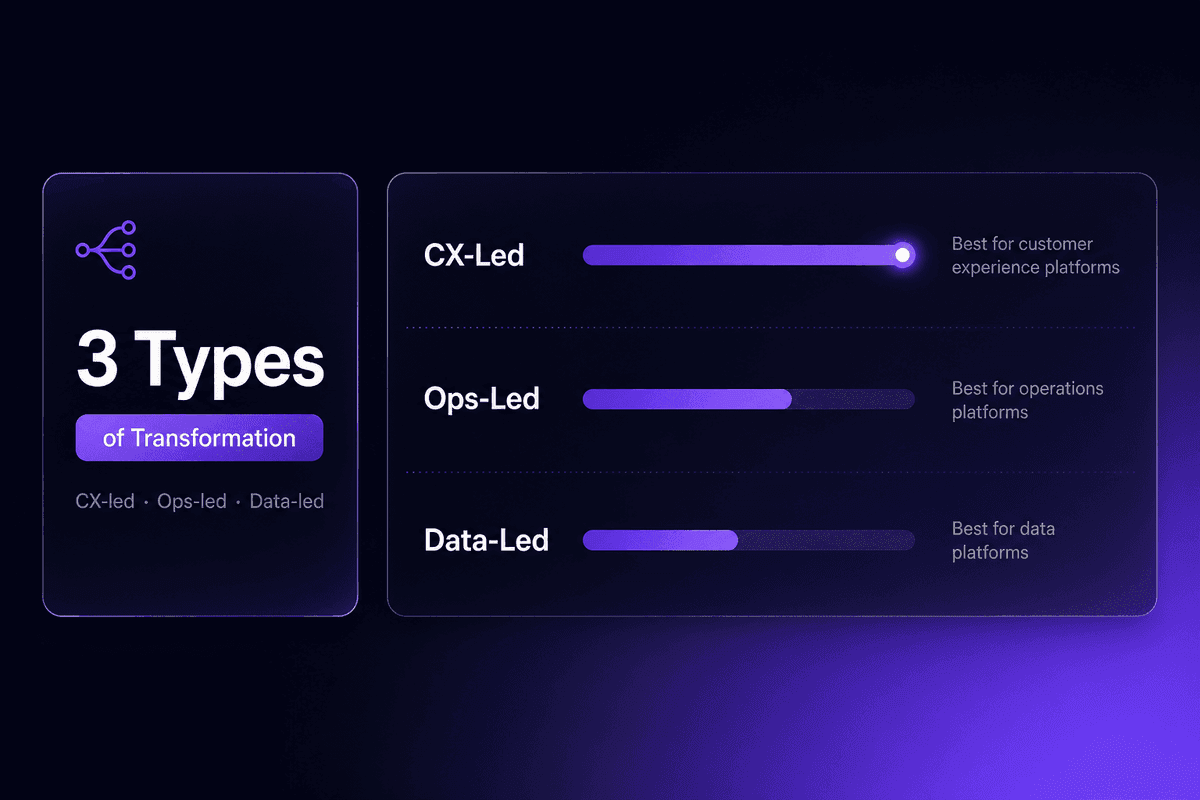
- Platform selection is a risk-reduction decision first. The right digital transformation platform for your organization depends on transformation type (customer-experience-led, operations-led, or data-led), existing ecosystem, company size, and how much implementation risk you can absorb.
- This guide targets CIOs, RevOps and operations leaders, and SMB owners at organizations between 50 and 10,000 employees who are actively shortlisting or re-evaluating their digital transformation platform choices.
Why Choosing the Right Digital Transformation Platform Is Hard
Global spending on digital transformation is projected to reach somewhere between $3.4 and $4 trillion across this decade, which sounds like an industry with a confident sense of direction. The actual execution data tells a different story. Consulting research synthesized by Integrate.io, drawing on published work from McKinsey, BCG, and Bain, puts the failure rate for digital transformation efforts at around 70%. A separate McKinsey figure, as aggregated by Ztabs, found that under one-third of enterprise digital transformations meet their objectives on time and on budget. These numbers measure two things: the gap between what organizations expect when they launch a transformation initiative and what they actually deliver, and the extraordinary pressure that creates on the platform selection decision.
The risk is not that organizations buy bad software. The risk is that they buy a brand-name platform that is genuinely good, then deploy it into a process environment that was never ready for it, and call the outcome a technology failure when it was really an organizational one. I have seen this pattern described often enough at the practitioner level that I treat it as the default assumption going in: the tool is rarely the primary cause when a transformation goal goes sideways.
That said, choosing the right digital transformation platform is still consequential. The wrong architectural fit - say, a workflow orchestration layer where a full ERP was needed, or an enterprise suite where a no-code tool would have gotten adoption in a week - creates real compounding costs. Modular licensing, implementation timelines, and change-management investments can collectively exceed the software licensing cost by a factor of two to three. The decision carries unusually high stakes precisely because it locks in not just features but an entire transformation strategy for the next three to five years.
💡 BCG research and broader consulting synthesis consistently show that 60-70% of digital transformations fail primarily due to people and culture issues, not technology gaps. When you are comparing platforms, treat implementation risk and adoption support as heavily weighted criteria - not footnotes.
How We Selected and Evaluated These Platforms
Five criteria drove the selection and ranking of these platforms. Each one maps to a real failure mode I wanted to avoid just listing features against.
- Strategic fit and breadth: Does the platform address the actual transformation type - customer experience, back-office operations, or data modernization - or is it solving an adjacent problem while the core one stays broken?
- Time-to-value and implementation risk: How long before frontline teams see a tangible change in their daily work? Transformation initiatives that take 18+ months to show any visible result tend to lose organizational support before they deliver anything. Effective digital transformation requires early wins.
- Scalability and ecosystem depth: Can the platform grow with the organization, and does it connect to the tools already in place? A digital transformation framework that requires ripping out existing infrastructure raises adoption resistance immediately.
- Total cost of ownership: Licensing is only the beginning. Implementation, customization, training, and ongoing administration costs shape the real TCO. The transformation process is expensive even when the software is well-chosen.
- Change-management and adoption support: Does the platform provide tooling, training resources, or community support that helps non-technical users actually change their behavior? Transformation efforts that score high on features and low on adoption tooling tend to become expensive shelf-ware.
💡 Only 30-35% of digital transformations fully succeed. When shortlisting, weight implementation risk and adoption support at least as heavily as feature breadth - those two factors predict outcome more reliably than the product roadmap.
Quick Comparison: Top Digital Transformation Platforms at a Glance
The table below covers all 10 platforms across the dimensions that matter most at the shortlist stage. Pricing tiers are directional; actual contracts vary significantly based on modules, user counts, and implementation scope. Use this as a starting filter, not a final decision tool.
| Platform | Best For | Core Strength | Pricing Tier | Ideal Company Size |
|---|---|---|---|---|
| Salesforce Customer 360 | CRM-anchored enterprise digital transformation | Unified customer data, AI via Einstein, ecosystem depth | Mid-High (per user/month, multiple editions) | Mid-market to enterprise |
| Microsoft Dynamics 365 + Power Platform | Microsoft-stack organizations | Integrated ERP/CRM/low-code platform on Azure | Mid-High (modular per-app) | Mid-market to enterprise |
| SAP S/4HANA | Complex global enterprise operations | In-memory ERP for multinational, industry-specific processes | High (enterprise contracts) | Large enterprise |
| ServiceNow | Cross-department workflow modernization | Workflow orchestration across IT, HR, and operations | High (subscription, negotiated) | Mid-market to enterprise |
| Oracle NetSuite | Growing mid-market companies digitalizing finance and commerce | Cloud-native ERP built for mid-market scale | Mid (base subscription + user add-ons) | SMB to mid-market |
| Appian | Regulated industries needing governed process automation | Low-code BPM with case management and compliance controls | Mid-High (per user/month) | Mid-market to enterprise |
| Kissflow | Business teams needing no-code workflow automation | No-code digital workplace with fast deployment | Low-Mid (per user/month) | SMB to mid-market |
| Odoo | Cost-conscious SMEs needing unified ERP/CRM | Modular open-source architecture, low TCO | Low-Mid (free community; paid enterprise tier) | SMB |
| Tadabase | Ops and IT teams building internal tools fast | No-code app and workflow builder for SMB speed-to-value | Low-Mid (tiered plans) | SMB |
| Acceldata | Data-heavy enterprises modernizing pipelines | Data observability and pipeline reliability | Enterprise (negotiated) | Large enterprise |
One cost pattern worth flagging before going deeper: both Dynamics 365 and SAP use modular licensing, which means the per-user rate in a vendor deck often does not reflect what you will actually pay once you add the modules your transformation actually requires. Implementation and change-management costs routinely exceed software licensing costs in enterprise digital transformation solution deployments - I would budget for that before the first sales call.
The 10 Best Digital Transformation Platforms Reviewed
The reviews below go beyond feature checklists. For each digital transformation platform, I have focused on what problems it actually solves well, what it does not solve, and where the implementation risk concentrates. The overall digital transformation outcome you get from any of these depends heavily on how you deploy them, not just what version you buy.
1. Salesforce Customer 360 - Best for CRM-Anchored Enterprise Transformation
Salesforce Customer 360 connects sales, service, marketing, commerce, and analytics into a single platform anchored around customer data. For large and mid-market organizations where the transformation goal is improving customer experience - faster response, more complete customer history, AI-driven personalization - it is the most mature choice in this category. Einstein, Salesforce's AI layer, powers predictive scoring, automated case routing, and personalized recommendations across the product suite.
The best-fit use case is an organization that has already committed to customer-experience-led transformation and needs a CRM that can also automate service, marketing, and commerce without multiple disconnected vendors. Salesforce's integration ecosystem is genuinely deep, with thousands of AppExchange partners covering most verticals.
Key strengths: Ecosystem depth, Einstein AI embedded across modules, strong digital experience platform capabilities for enterprise-scale personalization, and a large talent market for implementation resources.
Genuine weaknesses: Cost complexity is real. Multi-cloud implementations - Sales Cloud plus Service Cloud plus Marketing Cloud, for example - can reach six figures annually before customization. Implementation timelines for full enterprise rollouts are long. The platform heavily rewards organizations that invest in data quality and administration from day one; teams that automate broken CRM processes will get faster broken processes.
Pricing: Per-user per-month SaaS pricing with multiple cloud editions. Enterprise tier pricing requires a sales conversation.
Verdict: The strongest platform for customer relationship management software at scale and for customer-experience-led digital transformation. Worth the complexity if customer data is genuinely at the center of your transformation strategy - and genuinely hard to justify if it is not.
2. Microsoft Dynamics 365 + Power Platform - Best for Microsoft-Stack Organizations
Dynamics 365 is a modular ERP and CRM suite. Pair it with Power Platform - Power Automate for workflow automation, Power BI for business intelligence, Power Apps for low-code app building - and it becomes a reasonably full digital technology stack for organizations that are already deep in Azure and Microsoft 365. The key differentiator here is tight native integration across the Microsoft ecosystem, which meaningfully lowers implementation friction if you are already running Teams, SharePoint, and Azure.
Integrating digital technology into existing Microsoft workflows is where this platform earns its place. Power Automate handles mid-complexity automation without needing a separate integration platform. Power BI turns Dynamics data into operational dashboards without custom development. The AI layer - Copilot embedded across Dynamics modules - is advancing quickly, though maturity varies by module.
Key strengths: Single-vendor relationship, Azure and M365 native integration, Power Automate reduces dependency on third-party automation tools, strong business intelligence through Power BI.
Genuine weaknesses: For organizations outside the Microsoft ecosystem, the benefits narrow considerably and implementation complexity rises. Modular per-app pricing adds up quickly once you cover sales, finance, and operations.
Verdict: The strongest choice for organizations already committed to Microsoft infrastructure. A harder sell if your stack is primarily Google Workspace, Salesforce, or mixed SaaS.
3. SAP S/4HANA - Best for Complex Global Enterprise Operations
SAP S/4HANA is the enterprise backbone for organizations running multinational, industry-specific operations - manufacturing, chemicals, utilities, logistics, pharmaceuticals - where the real-time processing of high-volume transactional data across business operations is the transformation goal. The HANA in-memory database gives it genuine performance advantages over legacy SAP deployments for financial close, supply chain analytics, and cross-regional consolidation.
The digital transformation claim here is direct: replacing fragmented, industry-specific legacy systems with a single platform that can streamline business process management across dozens of subsidiaries and regulatory environments. SAP has deep vertical expertise and a partner ecosystem built over decades.
Key strengths: Proven at global scale in complex industries, strong AI integration for predictive maintenance and demand planning, best-in-class for organizations where the transformation is fundamentally a back-office and supply chain modernization problem.
Genuine weaknesses: Implementation cost and timeline are the primary adoption risk - large S/4HANA programs routinely run multi-year and eight figures. It is the wrong tool if your transformation goals are relatively narrow or your organization is below a few hundred million in revenue. People migration from legacy SAP or older ERP systems requires careful change management; that is where most S/4HANA programs stall. The transformation goals need to be enterprise-wide for this investment to pay.
Verdict: The right digital solutions choice for global enterprises with complex, multi-subsidiary operations. A significant over-investment for most companies under 1,000 employees.
4. ServiceNow - Best for Cross-Department Workflow Modernization
ServiceNow started as an IT service management platform and became something larger: a workflow orchestration layer that spans IT, HR, customer service, finance, and operations from a single cloud instance. Its core claim for digital transformation initiatives is that it removes the hand-off friction between departments - the place where a request disappears for 11 days because nobody knows whose queue it is in right now.
The single-platform model is real. IT incident management, HR onboarding requests, facilities work orders, and customer service escalations can all run on the same workflow engine, with shared reporting and a consistent digital employee experience. ServiceNow's process automation is strong for structured, multi-step approval workflows across organizational silos.
Key strengths: Genuine single source of truth across departments for workflow status, strong process automation for IT and HR service delivery, increasingly capable for customer service operations.
Genuine weaknesses: ServiceNow is primarily a workflow orchestration and service management layer - it is not a full ERP or CRM and does not try to automate manufacturing, finance close, or customer marketing. Organizations expecting it to replace back-office ERP will be disappointed. Subscription costs are enterprise-tier, making it harder to justify as a single initiative investment.
Verdict: The strongest platform for cross-department workflow modernization and digital employee experience. Complements an ERP or CRM strategy but does not replace one.
5. Oracle NetSuite - Best Cloud ERP for Growing Mid-Market Companies
NetSuite is the cloud-native ERP that growing mid-market companies reach for when their business model transformation has outpaced spreadsheets and entry-level accounting software but does not yet require SAP-level complexity. It covers financial management, inventory, order management, and e-commerce in a unified cloud platform, with real-time dashboards across the business built in.
The deployment story is one of NetSuite's actual differentiators versus SAP: mid-market companies with relatively standard process requirements can go live in weeks rather than years, making it a genuinely faster path to new digital operations in finance and inventory. The analytics layer gives finance and operations teams direct access to data without custom reporting development.
Key strengths: Purpose-built cloud ERP for mid-market scale, faster time-to-value than enterprise ERPs, unified financial and operational data, streamline-friendly for companies consolidating multiple systems.
Genuine weaknesses: Limited CRM and marketing depth compared to Salesforce. Not built for complex multinational compliance scenarios. Customization costs accumulate as the business scales beyond standard configurations.
Verdict: The clearest digital business ERP choice for growing mid-market companies that need cloud-native finance and operations and do not need the full complexity of Dynamics or SAP.
6. Appian - Best for Automating Complex Regulated Business Processes
Appian calls itself a low-code automation platform, but its real identity is business process management with governance built in. Financial services firms, insurance companies, government agencies, and healthcare organizations use it to automate case management, loan origination, claims processing, and compliance workflows - scenarios where the process involves many steps, multiple reviewers, regulatory audit requirements, and a mixture of structured data and documents. Intelligent automation sits at the center of its architecture: AI is used for document extraction and decision support, but human review gates stay visible and auditable.
The transformation platform claim Appian makes is that it serves as a centralized layer for digitizing processes that are too complex for simple no-code tools and too governance-sensitive to rebuild inside a general ERP. That is a real and underserved niche. Software helps regulated industries automate without losing the audit trail.
Key strengths: Strong process governance and case management, AI-assisted document handling, good compliance tooling for regulated industries, workflow automation with human-in-the-loop design.
Genuine weaknesses: Steeper learning curve than Kissflow or Tadabase. Implementation requires technical investment. Pricing is mid-to-high per user, which limits its appeal for SMBs without compliance complexity to justify it.
Verdict: The right choice for regulated industries where process governance and audit trails are as important as automation speed.
7. Kissflow - Best for Business Teams Needing No-Code Workflow Automation
Kissflow positions itself as the digital workplace platform that business teams - not IT - can actually deploy and manage. Its no-code workflow builder covers purchase requisitions, leave approvals, onboarding checklists, and similar structured internal processes without requiring a developer or a ServiceNow administrator. The pitch is adoption speed: teams can build and launch a workflow in hours, not months.
Compared to ServiceNow, Kissflow trades enterprise depth for accessibility. It will not handle the complexity of multi-department ITSM or cross-subsidiary compliance workflows. But for growing SMBs or individual departments inside larger organizations trying to automate paper-based or email-based approvals, digital transformation can help exactly here - removing friction from processes that are too small to justify an enterprise platform but too repetitive not to automate. Digital tools like Kissflow exist precisely in that gap.
Key strengths: Fast deployment with low IT dependency, intuitive workflow and form builder, reasonable cost for the capability delivered.
Genuine weaknesses: Limited enterprise scalability, less ecosystem depth than ServiceNow or Dynamics, not suited for complex multi-system integrations or regulated industry compliance.
Verdict: A solid starting point for SMB and departmental workflow automation. Outgrown eventually, but that is a good problem to have.
8. Odoo - Best Open-Source ERP for Cost-Conscious SMEs
Odoo's appeal is architectural: it is a modular open-source platform where a small business can start with CRM and invoicing, then add inventory, e-commerce, HR, and project management as business needs grow, all from one vendor. The community edition is free. The enterprise tier adds hosting, mobile access, and additional modules at per-user pricing that remains significantly below SAP or NetSuite for comparable SME functionality.
The digitalization story for SMEs is real. A 30-person distributor replacing separate accounting software, a shared spreadsheet for inventory, and manual invoice emails with a connected Odoo stack sees a tangible reduction in manual work across the business. That said, customizing Odoo beyond its standard modules requires software development resources - the community edition especially assumes someone technical will handle configuration and integrations. Budget for that. The tools that work best for SME digital transformation tend to be the ones where someone owns the configuration actively.
Key strengths: Low TCO, modular flexibility, covers CRM to ERP in one platform, strong community and partner ecosystem.
Genuine weaknesses: Customization needs developer resources; community edition support is limited to forums; best digitalization results require active configuration ownership.
Verdict: The strongest open-source ERP option for cost-conscious SMEs with technical capacity to manage implementation and customization.
9. Tadabase - Best No-Code Platform for Internal Tools and Custom Workflows
Tadabase is a no-code app builder for teams that need custom internal tools without custom software development. Ops managers, IT coordinators, and small business owners use it to build client portals, project management dashboards, inspection checklists, and field data collection apps on top of a relational database without writing code. The manual-to-digital shift it addresses is specific: replacing Google Sheets and email chains that have grown too complex for what they were designed to do, but not complex enough to justify a full ERP.
Speed-to-value is where Tadabase earns its place in this list. A new software tool that takes six weeks to build and deploy has a much higher adoption hurdle than one a team member built themselves in two days. Tadabase clearly prioritizes the latter. It appears primarily in digital transformation listicles rather than analyst quadrants - which is an honest positioning signal, not a criticism.
Key strengths: Fast app building without code, built-in workflow automation, accessible to non-developers, good for highly specific internal process digitization.
Genuine weaknesses: Limited enterprise scalability, shallow ecosystem compared to platforms above, not suited for multi-department enterprise transformation programs.
Verdict: A practical choice for SMBs and ops teams that need to move specific manual-to-digital processes quickly without a development budget.
10. Acceldata - Best for Data-Driven Transformation at Data-Heavy Enterprises
Acceldata is a data observability platform: it monitors data pipelines, detects data quality issues, and helps data and analytics teams understand why pipeline performance degrades before those problems hit business reporting. For enterprises whose digital transformation is fundamentally a data modernization challenge - moving from fragmented legacy data warehouses to a unified data platform that can support real-time analytics and AI - reliable pipeline infrastructure is the foundation everything else depends on.
This is a narrow focus compared to the other nine platforms, and that narrowness is the point. Acceldata does not try to be a full digital transformation solution. It solves the specific, painful problem of data quality and pipeline reliability at enterprise scale, which is the category of problem that makes other transformation investments fail quietly. An AI initiative built on unreliable data produces confidently wrong recommendations, which is its own kind of drive transformation story - just not the one anyone wants.
Key strengths: Data observability, pipeline reliability, real-time data quality monitoring, AI-ready data infrastructure.
Genuine weaknesses: Narrow scope - not a full transformation suite. Requires a broader data analytics and platform strategy to justify the investment.
Verdict: The right digital transformation solution for enterprises where data reliability is the primary bottleneck. A complement to other platforms, not a replacement.
How to Match a Platform to Your Organization's Profile
The single most useful question before shortlisting is: what type of transformation is this actually? Customer-experience-led, operations-led, or data-led. That distinction drives more of the right digital platform decision than any feature comparison. Here is a choose-the-right-digital framework based on the five criteria above.
Choose Salesforce Customer 360 if your digital transformation strategy centers on customer experience - you sell to many customers, customer retention and lifetime value are primary metrics, and your biggest data problems involve fragmented customer history across channels. It is the strongest choice when the CRM is the system of record and everything else connects through it. This is the digital transformation company-defining move for customer-driven industries: retail, financial services, B2B SaaS.
Choose Microsoft Dynamics 365 + Power Platform if your organization is already deeply committed to Azure and Microsoft 365 and you need a platform that reduces integration friction rather than adding it. The ecosystem lock-in that some treat as a risk is also a feature: organizations too deep in Microsoft infrastructure rarely get better ROI by shifting to a competing suite. Every additional Microsoft product in the stack makes Dynamics 365 relatively more rational than it looks from the outside. Use this to accelerate an operations-led digital transformation journey where Power Automate replaces manual approval chains and Power BI replaces disconnected spreadsheet reporting.
Choose SAP S/4HANA if you are a large enterprise with genuinely complex global operations - multiple subsidiaries, multi-currency consolidation, industry-specific compliance requirements - and the transformation is fundamentally about replacing legacy back-office systems. Do not choose it if scope discipline is weak. The transformation journey with SAP is long and expensive by design; it rewards organizations that have defined their digital transformation goal with precision and have executive sponsorship that will hold through a multi-year initiative.
Choose Oracle NetSuite if you are a growing mid-market company - roughly 50 to 1,000 employees - that has outgrown entry-level accounting and needs a cloud ERP to support a business model transformation. Faster time-to-value than SAP, more financial and operational depth than Odoo.
Choose ServiceNow if the transformation problem is cross-department workflow chaos - IT, HR, and operations running separate ticketing and approval systems with no shared visibility. It excels at digital transformation initiatives that are primarily about process standardization and inter-departmental coordination rather than financial or CRM modernization.
Choose Appian if you operate in a regulated industry with complex, multi-step case management and compliance requirements. Choose Kissflow if you need business teams to own and operate workflow automation for standard internal processes without IT involvement. Choose Odoo if you are an SME that needs full ERP/CRM capability with low licensing costs and have technical capacity to manage the customization. Choose Tadabase if the immediate need is replacing specific manual processes with custom internal tools quickly. Choose Acceldata if enterprise data reliability is the constraint blocking your broader AI and analytics digital strategies.
One honest caveat: the most expensive mistake I see in digital transformation company planning is choosing based on analyst quadrant position rather than execution fit. A Gartner Leader designation does not mean the platform fits your team size, your IT capacity, or your 18-month runway. The enterprise platforms on this list - SAP, Salesforce, ServiceNow - are genuinely powerful. They are also genuinely expensive to deploy and maintain. The decision to accelerate with a smaller, faster platform and upgrade later is often more defensible than the decision to start ambitious and stall.
Key Features Every Digital Transformation Platform Should Have
Regardless of which platform you shortlist, these capabilities separate platforms that enable digital transformation from platforms that just describe it in their marketing. Weight them against your specific use case and risk tolerance.
- Cloud-native architecture: The platform should run on modern cloud infrastructure with version control, automatic updates, and API-first design - not a legacy system with a cloud wrapper. Digital innovation compounds when the infrastructure is maintained without scheduled downtime.
- AI and machine learning integration: AI and machine learning should be native to core workflows - not a separately purchased add-on. Predictive analytics, intelligent document processing, and anomaly detection belong inside the process, not bolted on afterward.
- Workflow automation at the process level: The platform should automate entire business processes, not just trigger simple if-this-then-that rules. Multi-step approval flows, exception routing, and SLA tracking are the baseline requirement.
- Integration and API layer: Software that integrates with the tools your organization already runs is worth far more than software that requires replacing them. A strong API layer and pre-built connectors reduce implementation risk and protect existing investments.
- Low-code or no-code customization: Operations and business teams should be able to configure workflows, forms, and reports without submitting development tickets. Process automation that requires engineering resources for every modification is too brittle to maintain long-term.
- Role-based access and governance: Data access, workflow permissions, and audit trails should be configurable at the role level, not just the individual user level. Digital transformation at scale requires governance from day one.
- Real-time data and analytics reporting: Dashboards should reflect current state, not last night's batch job. Real-time visibility into process performance, pipeline health, and customer metrics drives the decisions that justify transformation investment.
- Change-management and adoption tooling: In-app guidance, training resources, adoption analytics, and user feedback mechanisms belong in the platform evaluation, not in a separate workstream. This is the most under-evaluated feature category on most shortlists - and the one most likely to determine whether the initiative succeeds or not.
References
- Integrate.io - stat - Date: 08/01/2026
- Ztabs - stat - Date: 13/03/2026
- Reddit - discussion - Date: 18/05/2026
- Rep Order Management - stat - Date: 13/11/2023
- Reddit - discussion - Date: 10/02/2026
- Reddit - discussion - Date: 22/02/2026
- LinkedIn - author - Date: 11/01/2026
- LinkedIn - case - Date: 10/06/2025
- ARDEM - case - Date: 09/04/2025
- PythonRPA - case - Date: 09/06/2025
- LinkedIn - author - Date: 04/04/2025
- HDI - author - Date: 16/04/2025
- Jousef Murad - author - Date: 03/02/2025