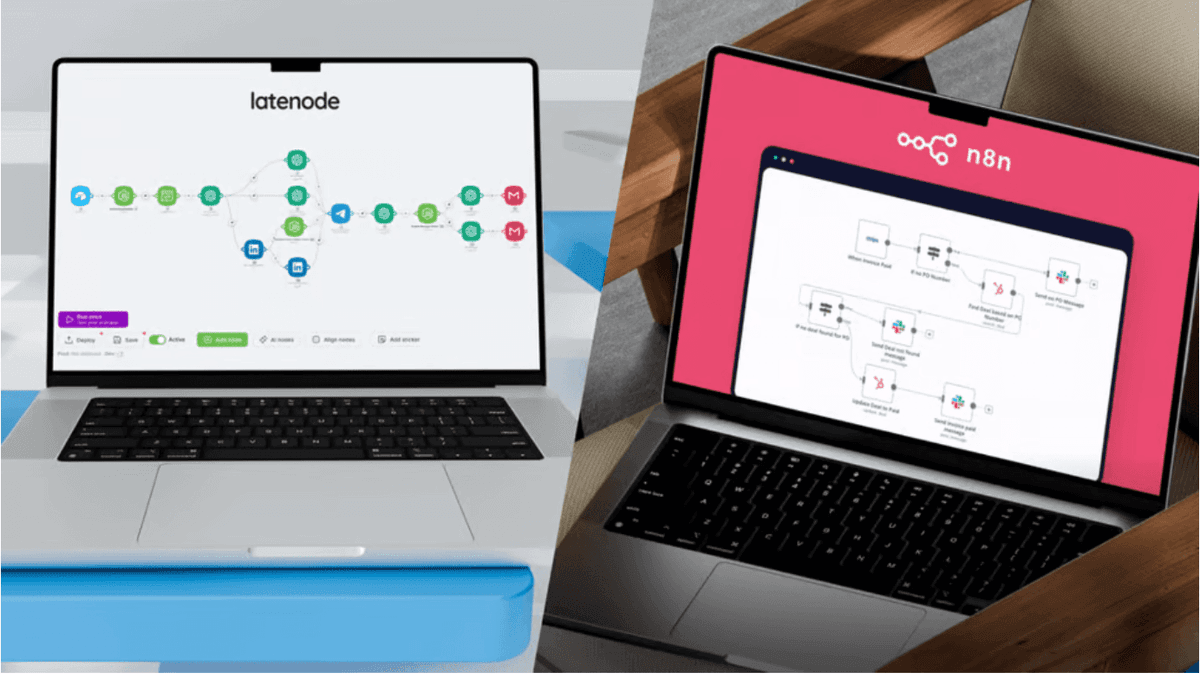
Latenode's Vision: Surpassing n8n Enterprise 2025 Features Today
Compare anticipated n8n Enterprise 2025 features with Latenode’s current AI-native capabilities. Discover why unified AI access and autonomous agents make Latenode the future-proof choice now.


Introduction
The automation landscape is shifting beneath our feet. For years, the industry created linear workflows—simple triggers followed by predictable actions. But as we look toward the horizon, the buzz surrounding n8n enterprise 2025 features suggests a massive pivot is coming: a move away from static automation toward dynamic, AI-governed systems.
While verified reports indicate that competitors are racing to patch AI capabilities into their legacy Version 2.0 architectures, smart enterprises aren't waiting. Why? Because the features promised for late 2025—autonomous agents, unified AI management, and self-healing workflows—are already the core DNA of Latenode today.
The Future of Automation is Already Here
The gap between "good enough" and "cutting edge" is widening. To understand where your enterprise needs to be, you have to look at where the industry is heading versus where the innovators already are.
The 2025 Automation Landscape
The automation industry's move toward 2025 is characterized by a focus on stability, security, and the integration of AI nodes. Competitors like n8n are rolling out updates that emphasize better Python support and improved stability for self-hosted instances. These are necessary updates, but they represent a catch-up mechanic.
The industry standard is shifting from "automating tasks" to "automating decisions." While others are updating their platforms to support AI nodes, Latenode was built on a serverless, AI-native infrastructure designed to handle this complexity from day one.
Why "AI-Native" Matters More Than "AI-Enabled"
There is a critical difference between a platform that adds AI as a feature and a platform designed as an AI ecosystem. "AI-Enabled" tools treat Large Language Models (LLMs) like any other third-party integration—forcing you to manage connections, keys, and data formats manually.
Latenode’s AI-native philosophy breaks down the barriers between logic, code, and LLMs. Here, the AI isn't just a node on the canvas; it's an assistant that writes your JavaScript, structures your data, and optimizes your workflow logic in real-time.
Unified AI Access – Solving the Enterprise API Nightmare
One of the most significant friction points for enterprise automation is the "Bring Your Own Key" (BYOK) model, which creates security liabilities and administrative headaches.
The "Bring Your Own Key" Bottleneck
If you are managing an enterprise team on legacy platforms, you know the struggle. You have marketing wanting Claude 3.5, developers wanting GPT-4o, and data teams asking for Gemini. This results in a sprawl of API keys, scattered credit card billing, and zero central oversight.
Looking at n8n's 2025 enterprise updates, the focus remains heavily on self-hosting and bringing your own credentials. While this offers control, it creates a governance nightmare where a single revoked key can crash production workflows across the entire organization.
Latenode’s Unified Subscription Model
Latenode solves this immediately by simplifying procurement and vendor management through a unified access model. Instead of juggling keys, Latenode provides access to over 400 AI models (including OpenAI, Anthropic, Llama, and Deepseek) under a single subscription.
Why this outpaces the competition:
- No API Key Sprawl: You don't need to issue individual keys to team members.
- Seamless Switching: If OpenAI goes down, switch your workflow to Claude in one click.
- Cost Efficiency: Latenode's execution-based pricing is approximately $0.004 per execution on Team plans, nearly 5x cheaper than comparable self-hosted maintenance costs.
Compare Latenode Unified Access vs n8n Enterprise
| Feature | Latenode AI-Native | Legacy Enterprise (n8n/Make) |
|---|---|---|
| AI Model Access | 400+ Models included in plan | Bring Your Own Key (Separate Billing) |
| Model Switching | Instance Dropdown Change | Requires Re-authentication |
| Format Handling | Auto-formatting via AI Router | Manual JSON formatting required |
| Cost Structure | Unified Platform Fee | Platform Fee + Multiple AI Vendor Bills |
Beyond Basic Workflows: True Multi-Agent Systems
The upcoming trend for 2025 is the "AI Agent"—software that can plan its own tasks. However, most platforms currently only offer linear automation.
From Linear Automation to Autonomous Agents
Competitors are updating their roadmaps to include better agent functionalities in late 2025. Latenode already empowers you to build sophisticated, non-linear multi-agent systems right now.
Utilizing what we call Supervisor Architecture, you can create a central "Manager" agent that delegates tasks to specialized worker agents (e.g., a researcher, a coder, and a reviewer). Unlike standard linear workflows that break if step 2 fails, Latenode's agents perform Message Passing to self-correct errors or retry tasks using different parameters before notifying a human.
Context Retention and "Memory"
A major limitation in standard automation is "amnesia"—the workflow forgets the context once the execution finishes. Latenode allows for the creation of custom AI workflow assistants that maintain state via StateGraphs. This means your agents can handle long-running processes, remembering conversation history or project context over days, not just seconds.
The Developer Experience: AI as the Coder
One of the most anticipated n8n enterprise 2025 features is improved support for Python and code nodes. Latenode has already solved the "coding barrier" by integrating AI directly into the development environment.
No-Code when you want it, Code when you need it
In Latenode, you don't need to be a developer to write custom scripts. The platform features an AI Code Copilot that generates robust JavaScript for you. You simply describe what you need ("Filter this array for emails ending in .edu and sort by date"), and the AI writes, tests, and implements the code using access to over 1 million NPM packages.
Visualizing the Complex
While competitors are introducing features like "Grid View" or specific folders to manage complexity, Latenode's visual builder is designed for high-complexity logic from the ground up. It handles branching logic, loops, and error handling natively without the visual clutter often associated with "spaghetti workflows."
Enterprise Governance and Reliability
For the enterprise, stability is not optional. This is often where the debate between self-hosted and cloud-native heats up.
Stability and Scalability
Much of the buzz around n8n v2.0 concerns "breaking changes" to improve security. While self-hosting offers control, it comes with significant self-hosting maintenance debt. Your team becomes responsible for uptime, server scaling, and security patches.
Latenode operates on a serverless architecture. This provides enterprise SLAs and auto-scaling capabilities that handle spikes in workload without your engineering team needing to spin up new Docker containers. We handle the infrastructure; you handle the business logic.
Data Privacy and Control
Data governance is paramount. Latenode offers Headless Browser capabilities, allowing for secure data interaction and scraping without exposing internal APIs. Combined with built-in support for GDPR and CCPA compliance, enterprises can automate with confidence regarding data sovereignty.
Building Your 2025 Roadmap with Latenode Today
The features you are waiting for—unified AI, autonomous agents, and scalable infrastructure—are available now. There is no need to delay your innovation roadmap waiting for competitors to catch up.
Transitioning from Legacy Tools
Migration is often feared, but it is easier than maintaining legacy debt. You can migrate logic from Make/Zapier/n8n to Latenode by focusing on your most complex, high-cost workflows first. By moving your heavy AI operations to Latenode, you immediately benefit from the unified subscription model and cost savings, often seeing ROI in the first month.
What’s Next for Latenode?
We aren't standing still. While we have delivered on the features others are promising for the future, our roadmap is focused on deepening the symbiotic relationship between human intent and AI execution. Our goal is to help you build your own AI agent in 2025 that acts not just as a tool, but as a proactive member of your workforce.
Guide: Build Your First AI Agent on Latenode
Frequently Asked Questions
How does Latenode's AI access differ from n8n?
Unlike n8n, where you typically need to purchase and manage separate API keys for every AI model you use (OpenAI, Anthropic, etc.), Latenode provides meaningful unified access. A single subscription unlocks over 400 AI models, handling all the billing and authentication for you.
Can I build autonomous agents on Latenode?
Yes. Latenode utilizes a Supervisor Architecture that allows for the creation of multi-agent systems. You can build agents that plan tasks, execute code, pass messages between each other, and self-correct errors without human intervention.
Is Latenode suitable for enterprise use?
Absolutely. Latenode is built for the enterprise with SOC 2 considerations, headless browser capabilities for secure automation, and a scalable serverless infrastructure. It eliminates the maintenance debt associated with self-hosted solutions while providing enterprise-grade security.
Do I need to know how to code to use Latenode?
No. While Latenode supports JavaScript for unlimited flexibility, you do not need to write it yourself. The built-in AI Copilot can write, test, and fix code for you based on simple natural language instructions.
What are the cost benefits of switching to Latenode?
Latenode uses an execution-based pricing model rather than a workflow-based one. Internal data suggests this results in costs around $0.004 per execution on Team plans, which can be up to 5x cheaper than maintaining self-hosted infrastructure when factoring in server costs and engineering hours.
Conclusion
The automation features that n8n and other competitors are promising for late 2025—centralized AI, autonomous agents, and seamless code integration—are not futuristic concepts. They are the current reality on Latenode. By waiting for legacy platforms to update, enterprises risk losing a year of innovation.
Don't let your automation roadmap be dictated by a competitor's release schedule. Experience the power of unified AI access and true multi-agent orchestration today. Sign up for a free account and start building the future.