


Most digital transformation roadmaps fail before anyone admits they've failed. The initiative keeps moving. Reports get filed. The steering committee meets quarterly. And then, somewhere between the pilot and the second phase, the energy dies - not dramatically, but quietly. The KPIs don't move. The tools get used by three people instead of thirty. The executive sponsor gets promoted or moves on, and suddenly you're the only one who remembers what the roadmap was supposed to do.
I've seen the pattern described enough times - in support queues, in onboarding conversations, in rooms where someone is explaining why a major investment didn't deliver - that I can usually spot the source. It's almost never a technology problem. It's a sequencing problem: the roadmap was built from a list of technology projects instead of from the capability gaps and business outcomes the organization actually needed to close.
That's the argument this article makes. A digital transformation roadmap only delivers measurable results when it's built from capability gaps and business outcomes first. Not from a vendor demo. Not from what the competitor announced. Not from what the CTO read on a flight. Build it backwards from that and you get a plan that looks coherent on a slide and collapses in practice.
The part teams learn late
- Roadmaps built from tech project lists rather than capability gaps stall when priorities shift and no one can defend the spend.
- Sequence matters more than scope: front-loading everything creates overload; phasing by dependency and impact creates momentum.
- People and metrics must be defined before tools - adoption determines whether the transformation happened at all.

What a Digital Transformation Roadmap Actually Is (and What It Is Not)
A digital transformation roadmap is a sequenced, capability-driven plan that connects business outcomes to the initiatives required to reach them. That definition matters because the most common version of a digital transformation roadmap is something else: a list of digital projects someone in IT or strategy assembled after a planning cycle, loosely organized by quarter and assigned to a budget code.
Those two things are not the same. A project list tells you what the organization plans to buy and deploy. A roadmap tells you why, in what order, and how you'll know it's working. The distinction sounds obvious until you're three months into an implementation and someone asks why a particular system was prioritized. If the answer is "we needed to modernize" or "the vendor had a good offer," you're working from a project list. If the answer traces back to a specific capability gap with a measurable business consequence, you're working from a roadmap.
The failure mode that results from skipping this definition has a useful name: "random acts of digital." Individual digital projects that each make sense locally but don't connect to anything at the organizational level. A new CRM here. An AI tool there. A process automation initiative that runs alongside (and duplicates) a separate ops efficiency program nobody told the first team about. Each one might technically succeed. Together they produce noise, not transformation.
A genuine digital transformation roadmap starts with the question: what business outcome are we not achieving because of a capability we don't have? Everything else - the tools, the timeline, the budget ask - flows from the answer to that question.
Digital Transformation Strategy vs. Roadmap: Where One Ends and the Other Begins
This conflation shows up more often than I'd expect given how clearly the distinction can be stated. The digital transformation strategy defines where you're going and why: the markets you want to reach, the operational model you want to run, the customer experience you need to deliver, the competitive position you're defending or attacking. It sets direction. It names outcomes. It answers "what does winning look like?"
The digital transformation roadmap sequences the initiatives that close the capability gaps between where you are and where the strategy says you need to be. It answers: what do we need to build, change, or retire - and in what order - to get there? A strong roadmap links each initiative to at least one strategic objective. If an initiative can't be traced to an objective, it doesn't belong in the roadmap. It belongs in a backlog, a wish list, or a polite "no."
The digital transformation plan is often used interchangeably with roadmap, but when the terms are distinct, the plan is the operational execution detail: resourcing, timelines, dependencies, owners. The roadmap is the strategic sequencing layer above it. You need both. But you need the roadmap before the plan, and the strategy before the roadmap. Building down from there is the only order that holds up when someone later asks why you're spending what you're spending.
What You Need Before You Start Building the Roadmap
Four things. If any of them are missing, you're not building a roadmap - you're building a presentation that will generate confusion at the next leadership review.
A clear business strategy with named outcomes
Without this, there is nothing to align digital initiatives to. If the organizational strategy is vague ("grow faster," "be more efficient"), every initiative will seem relevant and none of them will be prioritized clearly. The practical check: can someone on the team write a single sentence explaining the strategic objective each proposed digital initiative serves? If no, the strategy isn't specific enough yet. Don't start the roadmap until you can answer that question for at least three to five core objectives. Digital transformation initiatives without this foundation become the organizational equivalent of random acts of digital - busy, expensive, and directionally unclear.
A baseline capability assessment across people, process, and technology
This is where most organizations skip ahead to prioritization and later pay for it. Digital maturity varies enormously across functions within the same organization. What your finance team can execute with is different from what your sales team can execute with, and both are different from what the underlying technical infrastructure can support. A baseline assessment maps the gaps between current capabilities and the capabilities the strategy requires. Without it, initiatives get prioritized by politics or enthusiasm rather than by where the actual constraint is. The check: have you assessed digital maturity by function, not just across the organization as a whole?
Executive sponsorship with governance authority
Not support. Sponsorship. The difference is funding authority and the ability to remove cross-functional blockers. A transformation initiative without executive sponsorship stalls the moment it requires one function to change how it works for the benefit of another function - which is almost always. The barriers to digital transformation are rarely technical. They are organizational. Someone with actual authority needs to be accountable for removing those barriers, or the roadmap becomes a list of things teams tried but couldn't finish. The check: is there a named executive whose role includes removing blockers for this program, not just approving it?
Defined success metrics and KPIs for organizational change
This is the prerequisite that gets skipped most often, and its absence is what creates the most painful post-mortem conversations. Digital skills and capability investments take time to show up in outcome metrics. If the only measures of success are final business outcomes (revenue, NPS, cost), the roadmap will be declared a failure before it has had time to work. Define leading indicators: adoption rates, process cycle times, pilot completion, dependency resolution. These are what you track in the first one to two years. The check: are there two layers of metrics - leading indicators for the first year and lagging outcome metrics for years two and three? If the only answer to "how will we know if this is working" is a business outcome you won't have data on for 18 months, that's a gap.
How to Build Your Digital Transformation Roadmap: Six Steps That Hold Up Under Scrutiny
Most teams jump to step four. They skip the capability assessment, assume the strategy is clear enough, and go straight to "identifying the initiatives" - which in practice means listing the things people already wanted to do and calling it a roadmap. Then they wonder why the prioritization doesn't stick and why the initiatives seem disconnected three months into execution.
The sequence below is a sequencing problem before it's a content problem. Each step creates the inputs the next one needs. Skip one and the step after it generates noise instead of clarity.
Step 1 - Clarify the Strategic Drivers and Define Business Outcomes
Start by naming why transformation is necessary right now. Competitive pressure. Shifting customer expectations. Margin compression that current processes can't address. A new business model the current operating infrastructure can't support. The reason matters because it determines which capability gaps are urgent versus which are genuinely optional.
Then translate that reason into concrete desired outcomes. Not "improve customer experience" - that's a direction, not an outcome. The outcomes need to be measurable: reduce customer onboarding time from 14 days to 5 days, increase digital revenue share from 12% to 35%, cut order-to-cash cycle from 22 days to 10. These are the targets the roadmap is designed to hit. Every initiative you later add to the roadmap should connect to at least one of them.
Business transformation at this level is not purely a technology decision. It's a choice about competitive positioning in a specific digital age environment - and the roadmap should describe that choice explicitly. Organizations that skip this articulation end up with digital transformation efforts that are technically competent and strategically orphaned.
Step 2 - Assess Current Digital Capabilities Across People, Process, and Technology
This is your baseline. Before you can sequence anything, you need to know where the gaps actually are - not where people assume they are. Map current capabilities against what the business outcomes in step one require. The gap is your work list. Everything else is optional.
A useful capability assessment covers three dimensions. People: digital skills, change readiness, and learning capacity by function. Process: which workflows are documented, automated, and integrated versus manual, fragmented, and paper-based. Technology: what exists, what integrates with what, and where the technical debt creates real constraints on what's buildable next. The gap between an organization that's just starting its digital transformation journey and one that's actively undergoing digital transformation is usually most visible in the process layer - not in the tech.
Skipping this step is exactly how you end up with random acts of digital. If you don't know what you have, you can't know what you need. You'll make tool choices based on what's available, not what addresses the actual gaps. And you'll discover the real constraints six months into implementation when they become visible problems rather than preventable ones. New technologies are not the input to this step. The capability gap is the input. New technologies come later, in step three.
Step 3 - Define Target State and Success Metrics Before Picking Tools
What does the organization look like when it's working the way the strategy requires? Answer that question before you open a vendor shortlist. This is the target state: a future-state capability model that describes how each function operates, what data flows where, how decisions get made, and what the customer experience looks like. It doesn't have to be exhaustive. It has to be specific enough that you can test whether an initiative moves you toward it or just looks like it does.
Define transformation success in KPI terms at this stage: customer NPS at a specific target, digital revenue share percentage, cycle time reduction by process, and automation coverage of a defined set of workflows. This is also the step that prevents the single most common mistake I've watched unfold - adopting digital tools for decision-makers rather than end users. When the target state is defined in terms of what people actually do, you build for adoption. When it's defined in terms of what the dashboard looks like for leadership, you build something nobody uses.
The digital future you're describing here should be operational, not aspirational. "Achieve its digital transformation goals" means nothing without a specific before/after for a specific process. A good target state describes what a customer does differently, what an employee does differently, and what a key process looks like end-to-end. If it doesn't, it's a vision slide, not a target state.
Step 4 - Identify, Group, and Prioritize Initiatives for Maximum Value
Each capability gap from step two generates one or more potential initiatives. Your job here is to derive them systematically - one gap, one or more possible interventions - then group related initiatives into programs so that dependencies become visible. A standalone initiative is manageable. Fifteen standalone initiatives that share infrastructure, talent, and change management capacity are a disaster waiting to be scheduled.
Prioritization should use impact-vs-effort scoring anchored to the strategic objectives from step one. An initiative that scores high on effort but low on strategic impact is not urgent, regardless of how visible it is. This is where the "transform everything at once" mistake lives, and it's worth naming directly. Organizations that try to run five major transformation initiatives simultaneously don't produce five times the value - they produce five competing drains on the same pool of change management capacity, technical talent, and leadership attention.
The competing mistake is launching disconnected digital initiatives with no path back to strategic objectives. Treating each one as its own project creates the conditions for random acts of digital even when the individual initiatives are well-designed. A quick-win initiative (high impact, low effort, visible early results) belongs in your first phase. A larger bet (high strategic impact, significant effort, 18-month horizon) belongs in phase two or three, with the quick wins creating the organizational credibility and funding confidence to support it. Innovation and digital transformation aren't separate tracks. Quick wins fund the bigger bets. Sequence them accordingly.
A compact prioritization filter worth applying before anything gets scheduled:
| Initiative | Strategic objective | Impact (1-5) | Effort (1-5) | Dependencies | Phase |
|---|---|---|---|---|---|
| [Name] | [Objective] | [Score] | [Score] | [What must be true first] | [1/2/3] |
Fill this out for each initiative before locking the roadmap. Anything that can't be placed in the table doesn't belong in the roadmap yet.
Step 5 - Build and Socialize the Roadmap With Stakeholders
Sequencing initiatives into a realistic multi-year horizon requires two constraints most organizations underweight: dependencies and resource capacity. Dependencies first - a data governance initiative must precede an AI analytics program, not because it's more important, but because the analytics program produces nothing useful without clean data. Document those dependencies explicitly. They determine your phase structure more than anything else.
Resource capacity is the constraint that makes roadmaps fiction when ignored. How much change management capacity does the organization have? How much technical implementation bandwidth? How much executive attention can realistically be sustained across parallel workstreams? Answer honestly, then cut the roadmap to fit. A clear roadmap that's achievable is worth ten times a comprehensive one that collapses six months in because three initiatives simultaneously hit the same capability bottleneck.
Socializing the roadmap is not a communication task you do after the planning is finished. It's part of the planning. Executive sponsorship legitimizes organizational change - and it does that by being visible and active, not by signing off on a document once. Across the organization, people need to understand what's changing, what's expected of them, what the timeline looks like, and who owns what. The failure mode of skipping stakeholder communication until rollout is already underway is one I keep seeing replayed: teams build a technically sound roadmap, brief leadership, assume alignment, and then discover six months later that several functions had no idea what was coming. A successful digital transformation roadmap is one that people broadly understand before it starts, not one that surprises them at implementation.
As a practical check before you lock the roadmap, run through this:
- Does every initiative have a named owner and a named executive sponsor? - Are dependencies mapped and sequenced correctly? - Can you trace every initiative to at least one strategic objective? - Does the resource load per phase fit within realistic capacity? - Have the functions most affected been briefed and given input?
If any answer is no, the roadmap isn't ready to lead transformation - it's ready to generate questions at a steering committee meeting.
Step 6 - Execute, Measure, and Keep the Roadmap Current
Start with lighthouse projects: narrow, visible pilots that prove the new approach works before you scale it. A lighthouse project is not a proof of concept buried in a test environment. It's a real business process, run by real people, in one team or location, with defined success criteria and a clear decision point. The decision point is what separates a lighthouse from an endless pilot. After 90 days, you should know whether this is ready to scale or needs to be rethought.
Agile ways of working matter here not as a methodology label but as a practical input: the roadmap needs to update based on what you learn. New digital operating models don't emerge fully formed from a planning document. They get built iteratively, with regular cadences for reviewing what's working, adjusting what isn't, and dropping what's no longer relevant. Organizations that sustain lasting transformation are those that build the habit of updating the roadmap - treating it as a new digital business capability, not a one-time planning exercise.
Monitor KPIs against the targets from step three. Benchmark against your own baseline first, peer performance second. An initiative that showed 40% cycle time improvement in the pilot and 8% at scale tells you something about the scaling assumptions, not about the technology. Adjust the roadmap based on ROI and learning, not just on schedule completion. A phase completed on schedule with KPIs that didn't move is not a success. Getting it in the dashboard does not mean the organization for continuous change was built. That part takes longer. Build it intentionally, or watch the roadmap's gains slowly revert to the old operating model when no one's watching.
📊 In practice:
According to PwC's 2026 Digital Trends in Operations Survey of 767 US operations leaders, 85% say they're ahead of most competitors in digital transformation, yet 89% say their tech investments haven't fully delivered expected results. That gap isn't a measurement problem. It's an execution model problem: pilots ran, dashboards went green, and the operating model didn't actually change.
Building a People-Centric Roadmap: The Part Most Plans Under-Invest In
Roadmaps regularly arrive at the change management section with three bullet points and a promise to "communicate early and often." That's not a people plan. That's a placeholder for a people plan.
The people dimension of a digital transformation isn't soft. It's structural. If the workflows change but the behaviors don't, the transformation didn't happen. You just added tools to the existing way of working, which is how you get a CRM that salespeople log into reluctantly and export to spreadsheets for the real work.
A people-centric roadmap treats communication, training, incentives, and behavioral change as distinct workstreams running in parallel with the technical phases - not as a launch activity tacked on during go-live. Communication should begin before the first initiative kicks off and continue through each phase, naming what's changing, what employees will be asked to do differently, and why. Training should be designed around the actual end user - not around the capabilities the tool has, but around the tasks the person needs to do. Incentives need to be examined and adjusted: if the performance metrics people are evaluated on don't reflect the new way of working, they'll optimize for the old way of working. That's rational behavior, not resistance.
Digital solutions don't fail because people are change-averse. They fail because the change was designed around the technology and the people were expected to adapt. In the digital era, the organizations that sustain transformation results are those that explicitly embrace digital as a human change backed by technology, rather than a technology deployment supported by humans. The transformation efforts that collapse are usually the ones where someone decided training could wait until after go-live, or that adoption would follow naturally once the tool was live. It won't. And it doesn't.
Why Ignoring the People Side of Digital Transformation Stalls Successful Transformation
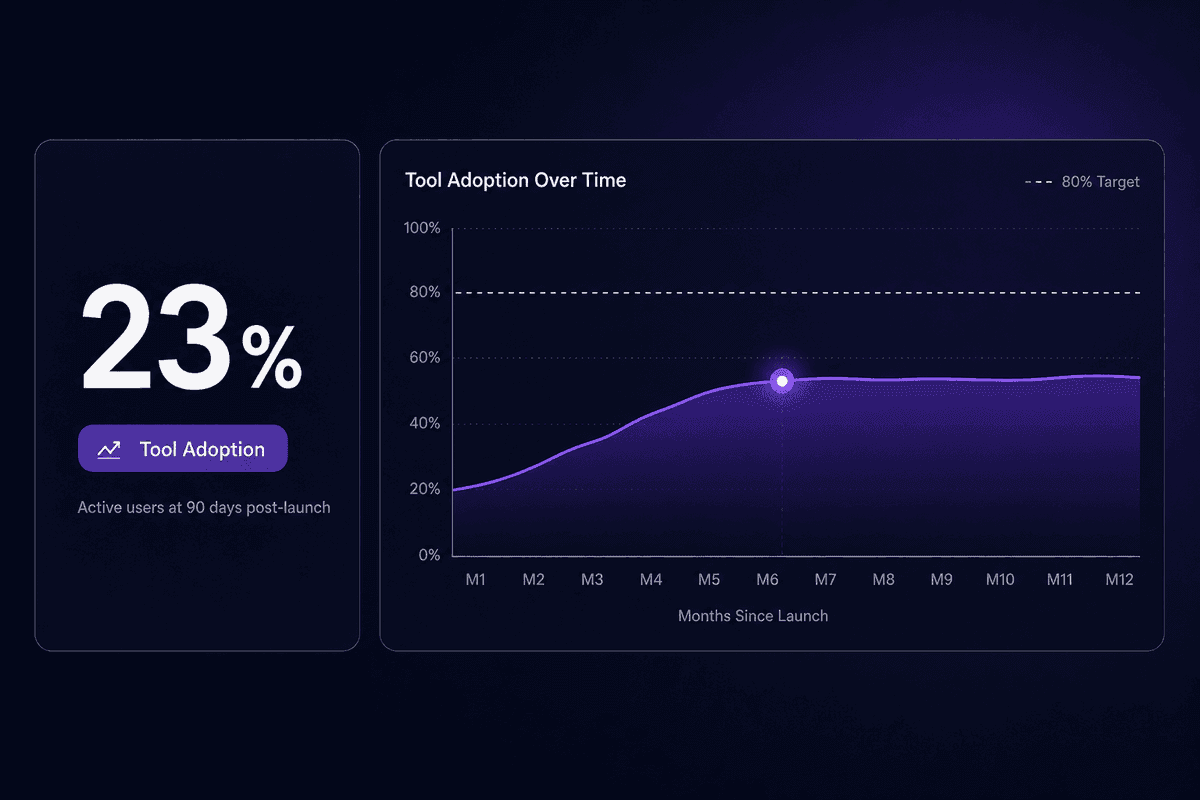
The failure mode is specific. Tool adoption hits 20% of the intended user base. The people who adopted it adapt their workflows around it. The 80% who didn't continue as before. Six months later, the sponsor asks why the KPIs haven't moved. The answer is that the KPIs measure organizational behavior, and most of the organization's behavior didn't change.
David Rogers, in his work on digital transformation, frames the challenge clearly: organizations fail not because they lack digital tools but because they haven't changed the underlying decisions, processes, and value propositions those tools should be enabling. The practical version in comes to digital transformation is this: when tools are adopted for decision-makers - because they generate better reports for leadership - rather than for the end users doing the daily work, adoption collapses. The people who were supposed to input the data, close the loop, and change their process never saw a reason to. Leadership's dashboard was beautiful. The underlying data was sparse.
This is the failure mode that comes back as a funding conversation. If adoption is low and KPIs didn't move, the argument for phase two becomes very difficult. The roadmap doesn't lose credibility because the technology was wrong. It loses credibility because the rapidly evolving digital landscape it was designed for turned out to require human behavior change, and no one planned for that explicitly.
Common Digital Transformation Roadmap Mistakes That Show Up After the Plan Is Approved
These are the mistakes I keep watching organizations make, usually after a successful planning cycle. The plan was approved. The budget was allocated. Then one of these.
Trying to transform everything at once
Random acts of digital at scale. The digital transformation roadmap lists 14 major initiatives across six functions, all starting in the same fiscal year. The symptom is three months in: every initiative is partially underway, nothing is complete, every team is stretched, and the transformation initiative has become a source of organizational exhaustion rather than momentum. The fix is brutal sequencing: pick two or three initiatives per phase, sequence the rest, and defend the decision against the pressure to add more. If everything is urgent, nothing is urgent - and your roadmap to digital transformation needs to say that explicitly.
Skipping the capability baseline
Prioritizing without a capability assessment means prioritizing by opinion. The failure mode: new technologies get selected based on vendor demos and competitor moves rather than on where the actual gaps are. Six months in, the implementation hits a constraint that the assessment would have revealed upfront - data quality, legacy system dependencies, skill gaps, integration limitations. The fix is the baseline assessment before any initiative selection. This is foundational work, not preparation work. It doesn't delay the roadmap. It defines what the roadmap can realistically contain.
Ignoring the people side until rollout
Treating digital transformation as a technology deployment only, with people considerations as a launch communications plan. The symptom: adoption rates stay low, workflows revert, and the digital revolution promised in the original business case doesn't appear in the KPI review. The fix is treating change management as a parallel workstream from day one, with named owners, defined training programs, and incentive structures reviewed before the first initiative launches, not after.
Adopting tools for decision-makers instead of end users
This is the pattern where transformation efforts collapse at the point of adoption. A reporting dashboard is built for the CMO. The people who generate the underlying data are salespeople who have no reason to change how they log activity. The dashboard is accurate for the first two weeks after launch, when everyone is paying attention, and then degrades. The fix is designing for the end user's job first. Ask: what does this tool ask this person to do differently? Is that change easier or harder than what they do now? If it's harder and there's no incentive tied to it, you're building a reporting tool for your executives that your ops team will learn to work around.
Failing to define success metrics before investment decisions are made
This is the one that makes the post-mortem conversation most uncomfortable. The digital transformation initiative completed on schedule. The team celebrated. Six months later, nobody can explain whether it worked. The failure mode was building metrics around delivery milestones ("Phase 1 complete") rather than business outcomes ("customer onboarding time reduced by X days"). Define both layers before committing budget: leading indicators for the first year and outcome KPIs for the full horizon. The digital transformation initiative has no business case anymore if the organization can't answer the question it was always going to be asked: what did it actually change?
🤔 Wait.
You approved the roadmap. Phase one completed on schedule. The steering committee presentation looked solid. But the outcome KPIs didn't move. The reason is almost always the same: success was measured by delivery milestones, and nobody defined what "working" looked like before the investment was made. A completed phase isn't a transformation. It's a deployed tool waiting to see if behavior changes.
How to Tell Whether Your Digital Transformation Strategy Roadmap Is on Track

A digital transformation roadmap that's on track looks like several things at once, and they aren't all visible in the same place.
Outcome KPIs matter but they're a lagging signal. In the first year of a multi-year roadmap, the leading indicators are what tell you whether you're building toward something real or running an expensive pilot program that will generate a slide about lessons learned. Watch adoption rates for deployed tools and processes - not just whether the tool is available, but whether the intended users are using it for the work it was supposed to support. Watch cycle time improvements in the specific processes the roadmap targeted. Watch pilot scalability: an initiative that worked for one team but can't be transferred to three more teams has a design problem, not a scope problem.
Every major initiative should remain traceable to a strategic objective. If someone on the steering committee asks "what does this advance?", there should be an immediate, specific answer. The moment an initiative is defended by its own logic rather than by its strategic purpose, it's drifting. That's when funding conversations get difficult and talent gets reassigned. Linking initiatives to KPIs doesn't just simplify funding decisions - it makes defunding bad initiatives easier, which is at least as important as justifying good ones.
For an enterprise digital transformation, the governance signal matters too. Are there regular review cadences where KPI progress is assessed against the roadmap targets? Is the roadmap itself treated as a living document that gets updated when assumptions change, or is it a static plan that people refer to less and less as the quarters pass? An effective digital journey is not a linear march from approval to completion. It's a sequence of learn-and-adjust cycles, and the governance structure either supports that or it doesn't.
A practical set of checkpoints worth running quarterly:
| Checkpoint | What to look for | Signal of a problem |
|---|---|---|
| Tool adoption rate | % of intended users active | Below 50% at 90 days post-launch |
| Process cycle time | Before/after on target processes | No measurable change after 3 months |
| Pilot scalability | Can the pilot expand to 3 more teams? | Expansion blocked by dependencies |
| Initiative traceability | Each initiative maps to a strategic objective | Any initiative that can't be traced |
| Roadmap review cadence | Is the roadmap updated regularly? | No updates in the last two quarters |
If your digital transformation efforts show consistently green lights on delivery milestones but the checkpoints above are raising flags, the roadmap is on schedule but not on track. Those are different things. A technological transformation that lands on time but doesn't shift how the organization operates isn't leveraging digital for business value - it's updating software. The difference is visible in the checkpoints, usually before it's visible in the outcome metrics. That's the point of the leading indicators.