The Future of iPaaS: Merging Code and No-Code for Hybrid Automation
Discover the future of iPaaS in 2025. Learn why the war between code and no-code is ending, giving rise to hybrid, AI-driven automation platforms like Latenode.

Introduction
For years, businesses have been forced to choose sides in a technological tug-of-war. On one side, "No-Code" tools promised accessibility but hit hard ceilings when complexity increased. On the other, "Code-First" development offered infinite power but came with maintenance nightmares and high technical barriers.
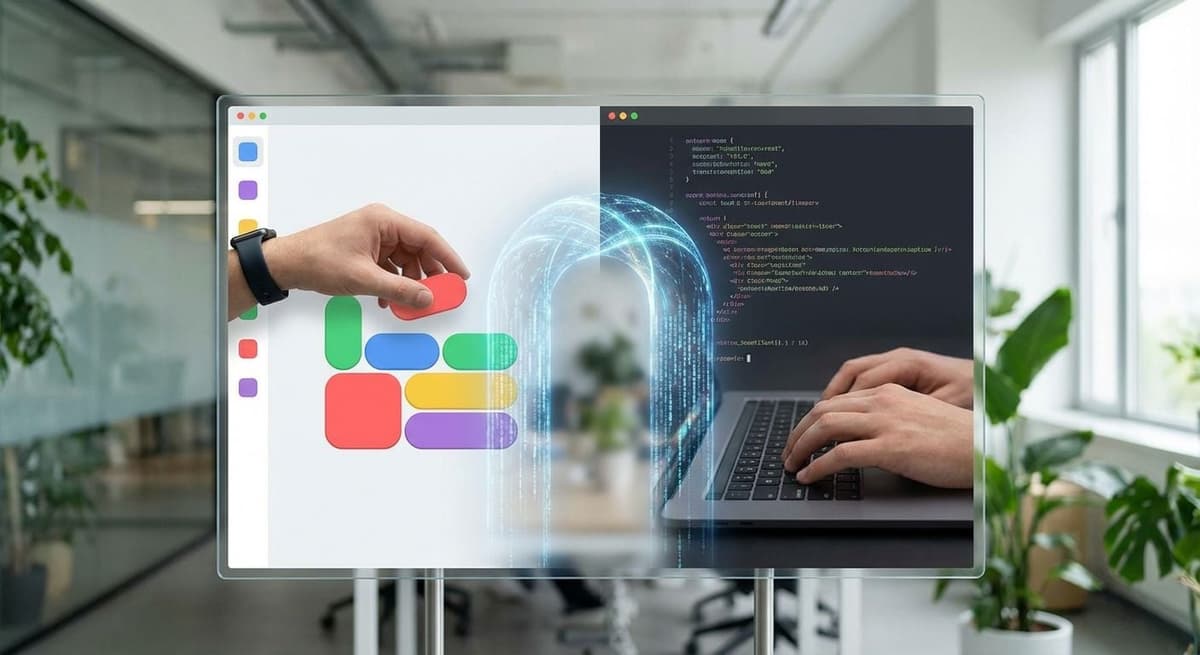
That binary choice is disappearing. The future of iPaaS isn't about choosing between a drag-and-drop interface and a code editor—it's about merging them into a unified workflow. As we move toward 2025, a new generation of hybrid platforms is emerging. These tools use AI to bridge the syntax gap, allowing operations managers to architect complex systems while automated agents handle the heavy lifting. Here is why the convergence of code and no-code is the inevitable next step for business automation.
The Evolution of iPaaS: From Simple Connectors to Intelligent Orchestrators
To understand where the industry is going, we have to look at the rapid maturation of Integration Platform as a Service (iPaaS). The technology has moved through distinct generations, each solving the bottlenecks of the previous one.
Generation 1: Linear Connectors
Think back to the early days of IFTTT or basic Zapier setups. These were simple: "If I receive an email, save the attachment to Dropbox." They were strictly linear (Trigger → Action) and lacked any real business logic or data transformation capabilities.
Generation 2: Logic-Based Workflows
Platforms introduced routers, iterators, and filters. You could build branching paths, but you were still limited to the "blocks" the vendor provided. If you needed to perform a complex mathematical operation or parse a non-standard JSON file, you were often out of luck.
Generation 3: AI-Native Hybrid Systems
This is the current frontier. Modern platforms act as orchestrators for autonomous agents. They don't just move data; they analyze it, make decisions, and execute code when necessary.
This shift represents the future of iPaaS—moving from rigid pipes to intelligent nervous systems. The market is already signaling this change. Even established players are scrambling to bolt "AI" onto their legacy architectures.
However, newer platforms built from the ground up for this hybrid model differ significantly from legacy tools adapting to the trend. A Make vs Latenode comparison reveals a critical distinction: while older platforms treat code and AI as add-ons, next-gen platforms treat them as core structural components.
The "No-Code Wall" and Why Users Hit It
Every power user eventually hits the "No-Code Wall." This occurs when you build 90% of a critical workflow using visual nodes, only to find the final 10% is impossible because a specific feature doesn't exist in the library.
Real-world example:
Imagine you are processing customer data. A visual builder easily pulls the data from Shopify. But then you need to:
- Decrypt a custom hash string.
- Calculate a weighted average based on inventory age.
- Format the result into a proprietary XML schema for a legacy ERP.
In a pure no-code environment, this is where you stop. You either hire a developer to build a separate microservice (breaking your workflow) or you abandon the automation. Understanding the difference between no-code and low-code is vital here: low-code architectures anticipate this wall and provide a door through it.
The Code Barrier and Maintenance Hell
The reaction to the "No-Code Wall" is often to swing to the other extreme: "We'll just write it all in Python on AWS Lambda."
This solves the capability issue but introduces "Maintenance Hell." Now you are managing server instances, rotating API keys, debugging timeouts, and handling DevOps. For a marketing operations team, this is unsustainable. The debate of low-code vs. traditional coding often comes down to Total Cost of Ownership (TCO). Pure coding requires expensive engineering hours for minor updates; hybrid platforms empower the operations team to own the process.
The Rise of Hybrid Automation (Low-Code)
The standard for 2025 is Hybrid Automation. This approach accepts a simple truth: Visual interfaces are superior for architecture, but code is superior for transformation.
Why this works:
Seeing a workflow's path visually (Trigger → Filter → Router → CRM) makes logic flow instantly understandable to the human brain. However, trying to perform complex data manipulation using visual blocks results in "spaghetti workflows"—hundreds of nodes to do what three lines of JavaScript could accomplish.
Low-code iPaaS platforms solve this by offering a visual canvas for the big picture, with "Code Nodes" for the complex details.
Discover Why Low-Code is the Bridge for IT & Business
Breaking the "Black Box" of Proprietary Modules
One of the biggest frustrations with traditional iPaaS is the "Black Box" problem. If a platform's "HubSpot Update Company" node doesn't include a specific field you need, you are stuck waiting for the vendor to update their integration.
In a hybrid environment like Latenode, you aren't limited by the vendor's roadmap. If a pre-built node lacks a feature, you can simply swap it for an HTTP request node or a JavaScript node. You have direct access to the API payload. This future-proofs your business against platform stagnation.
Standard Libraries over Proprietary Functions
Why learn a proprietary formula language that only works on one SaaS platform? The hybrid future embraces standards.
Latenode's Approach:
Instead of inventing a new scripting language, Latenode supports standard JavaScript and the ability to import NPM packages. This gives you instant access to over 1.2 million existing libraries.
- Need advanced cryptography?
import crypto-js - Need to parse complex dates?
import moment - Need heavy math functions?
import mathjs
This allows functional capabilities that purely no-code platforms will never natively support.
AI as the Universal Bridge: Coding Without Being a Developer
The most significant catalyst in the "Code/No-Code Merger" is Generative AI. Historically, "low-code" still required you to know syntax. You had to know where the semicolon went. Today, AI code suggestions have largely removed that barrier.
From "Drag-and-Drop" to "Describe-and-Deploy"
We are shifting from a paradigm of manually assembling logic blocks to a workflow of "Describe-and-Deploy." In Latenode, users can drag a JavaScript node onto the canvas and use the AI Copilot.
The Workflow:
- User Prompt: "Take the data from the previous node, filter out any email addresses that don't end in @company.com, and format the names to Title Case."
- AI Action: The Copilot writes the actual JavaScript code to perform this transformation perfectly.
- User Verification: The user tests the node to ensure the output is correct.
This provides the surgical precision of custom code with the accessibility of no-code. It is the perfect entry point for those looking to build your first AI agent without a computer science degree.
AI Agents as Autonomous Workers
The merged future isn't just about linear tasks; it's about loops and autonomy. Standard automation follows a set path. AI Agents follow a goal.
In Latenode, you can architect systems where a "Manager Agent" breaks down a task and delegates it to "Worker Agents." Because Latenode provides a unified subscription model—giving you access to GPT-4, Claude, and Gemini without managing individual API keys—you can build these complex, multi-step agent systems cost-effectively.
For those evaluating the landscape, checking the best AI agent builder platforms reveals that seamless access to multiple LLMs is a non-negotiable feature for 2025.
2025 Tech Trends: What Defines the Modern iPaaS?
As we look toward the immediate future of AI-powered automation in 2025, two major trends are redefining what constitutes an "Enterprise-Grade" platform.
Stability and Enterprise-Grade Features
The era of "hacking together zaps" is over. Businesses are demanding production-grade environments for their automations. This means:
- Dev/Prod Environments: The ability to build and test safely without breaking live workflows.
- Version History: Rollback capabilities when logic changes fail.
- Headless Browser Capabilities: This is a Latenode specialty. Unlike standard iPaaS tools that rely solely on APIs, Latenode's environment can launch a headless browser to interact with legacy web apps that lack APIs, simulate user actions, or scrape data dynamically.
Pricing Models Shifting from "Per Task" to "Compute Power"
This is perhaps the most significant economic shift. Traditional platforms charge per "task" or "operation." If you have a loop that processes 10,000 rows of data, a task-based model penalizes you with a massive bill.
Modern platforms like Latenode utilize a Compute Credit system. You are charged based on the execution time and resources used. Optimized code runs faster and cheaper. This incentivizes efficient automation rather than punishing high-volume workflows.
| Feature | Legacy iPaaS (Task-Based) | Modern Hybrid iPaaS (Latenode) |
|---|---|---|
| Pricing Model | Per Interaction/Step (Expensive for loops) | Compute Time (Cost-effective for heavy logic) |
| Code Support | Limited / Proprietary Scripting | Full Node.js + NPM Packages |
| AI Integration | Bring Your Own Key (Extra Cost) | Unified Subscription (Models Included) |
| Web Interaction | API Only | Headless Browser Support |
Compare Pricing Models: Latenode vs. The Industry
Latenode’s Unique Position in the Hybrid Future
Latenode isn't just participating in this hybrid trend; it was architected to enable it. By positioning itself as the "JavaScript + AI" powerhouse, it removes the friction that typically forces companies to abandon iPaaS for custom development.
The Ecosystem of Possibility
With the combination of visual organization and code-level execution, the use cases expand dramatically. We are seeing AI agent examples that go far beyond simple data syncing:
- Autonomous SDRs: Agents that research leads via headless browser, qualify them using GPT-4, and draft personalized outreach.
- Customer Support Triage: Multi-agent systems that categorize tickets, reference internal documentation via RAG (Retrieval-Augmented Generation), and draft replies for human approval.
- Financial Reconciliation: Scripts that pull messy CSV exports, use Python libraries to normalize the data, and reconcile transactions against bank APIs.
Removing the "API Key Tax"
A hidden cost in the current AI boom is the management of multiple subscriptions. To build a robust workflow, you might need an OpenAI account, an Anthropic account, and a scraping tool subscription. Latenode consolidates this. One platform provides the canvas, the compute power, and the AI tokens. This removes administrative friction and democratizes access to the most powerful models available.
Frequently Asked Questions
Will I need to learn coding to use future automation tools?
No. With feature sets like Latenode's AI Copilot, the platform writes the code for you. You simply need to understand the logic of your business process (what needs to happen); the AI handles the syntax (how to write it in JavaScript).
Why is "Hybrid" better than pure No-Code?
Pure no-code hits a "ceiling" or "wall" when you need unique logic, complex math, or unsupported integrations. Hybrid platforms allow you to bypass these limitations instantly by injecting custom code snippets, offering the best of both flexibility and speed.
What is the benefit of Latenode’s credit system vs Zapier tasks?
Task-based systems charge for every single step, which penalizes efficient loops and data processing. Latenode’s credit system charges for compute resources (time and power). This often makes high-volume or complex logical workflows significantly cheaper, as simple code executes in milliseconds.
Can I use external JavaScript libraries in Latenode?
Yes. Latenode supports NPM packages, allowing you to import over 1.2 million standard libraries. This gives you immediate access to tools for encryption, date formatting, higher-level math, and data validation that no-code platforms rarely support natively.
How do AI Agents differ from standard automations?
Standard automation follows a linear path: "If A happens, do B." AI Agents act autonomously based on a goal. They can reason, make decisions, loop through attempts, and adapt to unstructured data, making them capable of handling "fuzzy" tasks like support replies or research.
Conclusion
The war between developers and citizen integrators is officially over. The winner is the hybrid user.
The future of iPaaS is not about simplifying software until it loses its power; it is about keeping the power and using AI to simplify the access. We are entering an era where the visual canvas serves as the architecture for sophisticated, code-driven, AI-empowered systems.
Flexibility is the new currency. Whether you need standard libraries, headless browser automation, or multi-agent orchestration, your platform should never tell you "no." Latenode is built for this reality offering a seamless blend of no-code speed and full-code potential. Stop hitting the wall with traditional tools. Experience the freedom of hybrid automation and build your future-proof workflow today.