

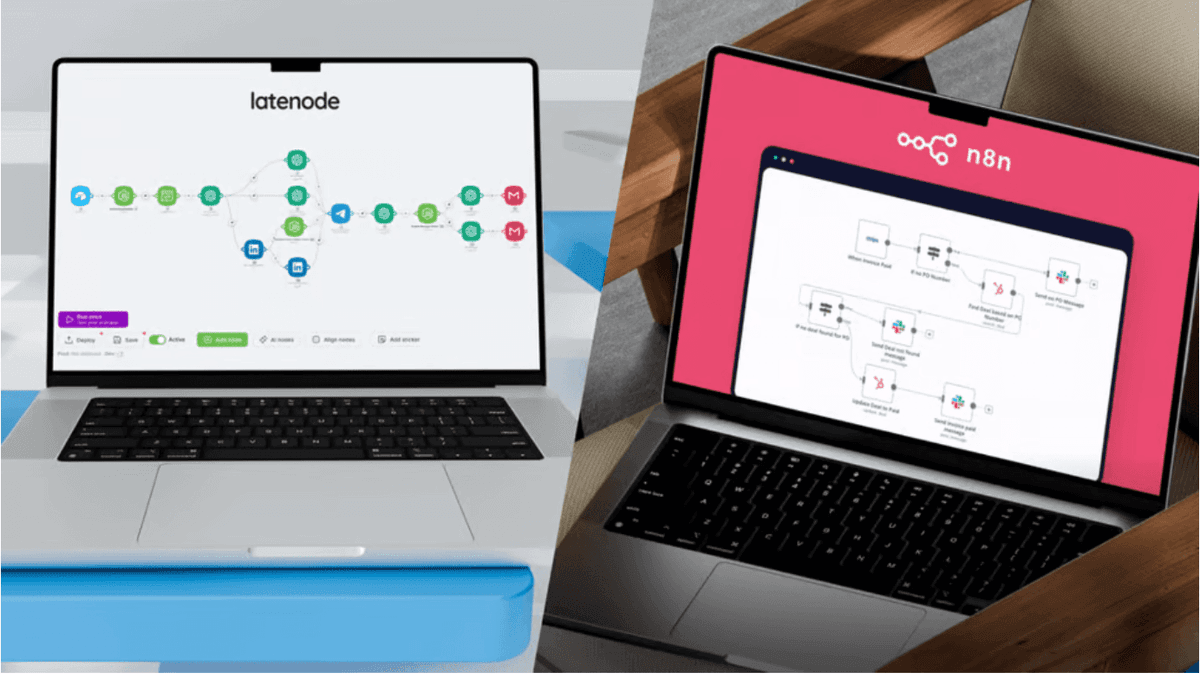
Ready to take your workflow automation to the next level? If you value control over your data and infrastructure, you're likely exploring the world of self-hosting. And if you've landed here, you're probably thinking about using the n8n self-hosting setup. This is a powerful, open-source platform that helps you automate practically anything. It gives you a level of flexibility that’s hard to beat.
Nevertheless, it’s going to be beaten in 2025, and this article shows why. Self-hosting has its drawbacks and hidden costs. Look at this article as your guide on what matters when you're making a balanced decision.
Start building with Latenode now
What is Self Hosting n8n?
Self hosting n8n means installing and running automations on your own infrastructure, rather than using a cloud-based service provided by the platform. The management process includes setting up the server, installing the necessary software, handling security, configuring the database, and ongoing maintenance. It requires a significant level of technical proficiency and resources.
This approach also provides granular control, allowing you to fine-tune everything, from server resources to integration configurations. Additionally, it’s free for internal business, non-commercial, or personal use. So, it grants total control over your data and setup, but it also demands that you're fully responsible for keeping it running smoothly and securely.
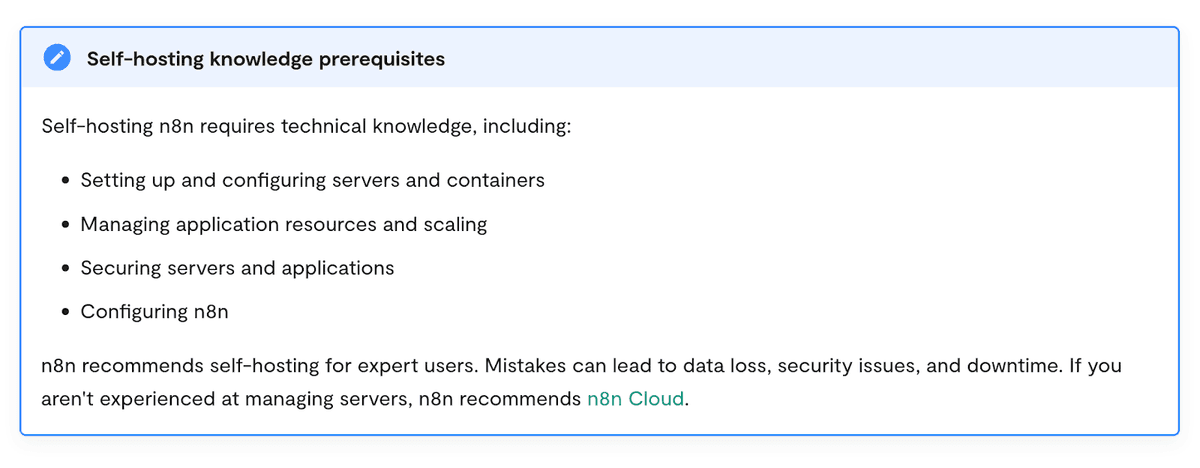
These responsibilities mean that if you're not comfortable with command-line interfaces, managing firewalls, and debugging server problems, this route is likely not the most efficient use of your time and resources. Many users hire developers and sysadmins to manage servers and automation on n8n self hosting. Thus, the benefit of free access is nullified by the cost of outsourcing.
Why Choose n8n Hosting (And When It’s Best to Be Cautious)
Self hosting n8n certainly offers compelling advantages: complete oversight of your data and entire environment. After all, this is the main reason for many; organizations with strict data privacy requirements or those needing highly customized setups often choose this path. Let's explore a few specific scenarios where it proves beneficial:
- Agencies That Handle Confidential Data: Data analytics agencies, consulting companies, accounting firms all handle highly sensitive or confidential data. They require absolute control over data, and must adhere to stringent compliance regulations that demand complete isolation of their networks;
- Companies in Highly Regulated Industries: Corporations within highly regulated sectors, such as finance or healthcare, that must comply with very specific data handling requirements. They often need to integrate with their internal systems, which might be hard to do with a cloud-based system;
- Hardware Manufacturers with Direct Device Control: Companies that manufacture hardware devices that require direct and automated interaction with the physical machines. These institutions benefit from systems that are directly connected to their equipment.
These cases show that n8n self hosted is only truly viable if you have a dedicated and skilled technical team with the expertise to manage the complexity. For the vast majority of other use cases, this is simply not the most efficient or budget-friendly approach. Here are a few examples:
- Small to Medium Businesses (SMBs) Without Dedicated IT Departments: SMBs that are still growing and simply cannot afford the overhead of managing complex IT systems. They usually lack a dedicated IT staff, and setting up and maintaining a server infrastructure would divert their focus from their core business activities, such as sales, marketing, or other operational areas;
- Independent Professionals and Freelancers: Independent professionals that focus on developing their core competency and might not want to dedicate their time to maintain a server. They require solutions that are easy to use, reliable, and cost-effective;
- E-commerce Businesses Focusing on Fast Growth: E-commerce companies that are focused on rapidly expanding their business and automating different areas of their operations. These businesses often prioritize fast integration and scalability over fine-grained control. This means that their system must be easy to set up and requires a minimal learning curve.
Be realistic about your tech skills and resources when considering self hosting n8n. If it seems beyond your reach, opt for Latenode. It offers the similar no-code integrations, JavaScript, scenario-based branched logic, and multiple triggers, and it’s up to 5x cheaper as shown below.
Comparison of n8n Self-Hosting and Latenode Cloud in 2025
| User | Task | Solution |
|---|---|---|
| Agencies Handling Confidential Data | Data automation with strict data control and compliance | Self-Hosted n8n |
| Companies in Highly Regulated Industries | Data automation with specific integration and security needs | Self-Hosted n8n |
| Hardware Manufacturers with Direct Device Control | Automate interaction with physical machines | Self-Hosted n8n |
| SMBs without Dedicated IT | Data automation focusing on core business tasks | Latenode |
| Independent Professionals and Freelancers | Streamlined data automation, cost-effective | Latenode |
| E-commerce Businesses Focusing on Fast Growth | Rapid data integration and automation for scaling | Latenode |
Start building with Latenode, use low-code or write your own code with AI Copilot.
Drawbacks of Self Hosting n8n (And How Latenode Solves Them)
Self hosted n8n offers a high level of flexibility, but it is also constrained. The Community Edition lacks some key features.
1. Collaboration
- n8n: Collaboration is limited on n8n hosting. Sharing workflows and credentials is restricted, which makes team projects clunky and slows down your team. You can only share with the owner or the user who created the workflow, which means that if someone leaves, nobody else will have access;
- Latenode: Latenode streamlines the entire collaboration process. Sharing is easy and seamless, with templates and 10 connected accounts even on the basic plan;
- 2025 and Beyond: As workflows become complex and teams grow, n8n’s limitations will be painful. Latenode is designed to scale effectively as your team grows; the number of connected accounts in the basic plan is 10, while other plans offer unlimited connections.
2. Authentication Setup
- n8n: the platform removed simpler authentication methods (Basic Auth, JWT) in version 1.0. Moreover, most integrations with basic apps, such as Google Sheets or Trello, require individual manual OAuth configuration, adding considerable overhead and technical challenges.
- Latenode: All OAuth integrations are pre-configured as you join Latenode without technical hurdles. It’s designed to work from the get-go, which makes it easy to use.
- 2025 and Beyond: As more services come online, and as integrations become more complex, relying on manual OAuth configurations will become a major bottleneck for n8n self-hosting. Latenode's plug-and-play approach to authentication gets to be a benefit.
3. Workflow Management
- n8n: Features such as workflow and credential sharing, more than 1 day of execution history, multiple environments (development, staging, production), and external secret store integration are absent in the Community Edition. These things make it challenging to manage complex systems and collaborate efficiently within teams.
- Latenode: Full support for custom variables, streamlined environment settings (Dev/Prod versions), robust version control (Rerun, review and share past version), and at least 3 days execution history.
- 2025 and Beyond: By 2025, the demand for robust workflow management will be even higher. Latenode is positioned to lead by providing features for managing complex scenarios and collaboration, while n8n self hosted struggles with the basics.
Looking ahead to 2025, these collaborative and authentication challenges are expected to become more painful as workflows become more intricate and team sizes expand.
Latenode vs n8n Self Hosted: Final Thoughts on The Operational Differences
Users frequently report numerous challenges with n8n hosting. These include a steep learning curve, requiring advanced technical skills. Forum discussions highlight ongoing issues related to performance with large datasets and complex workflows. Error handling lacks real-time alerts, making debugging difficult and time consuming.
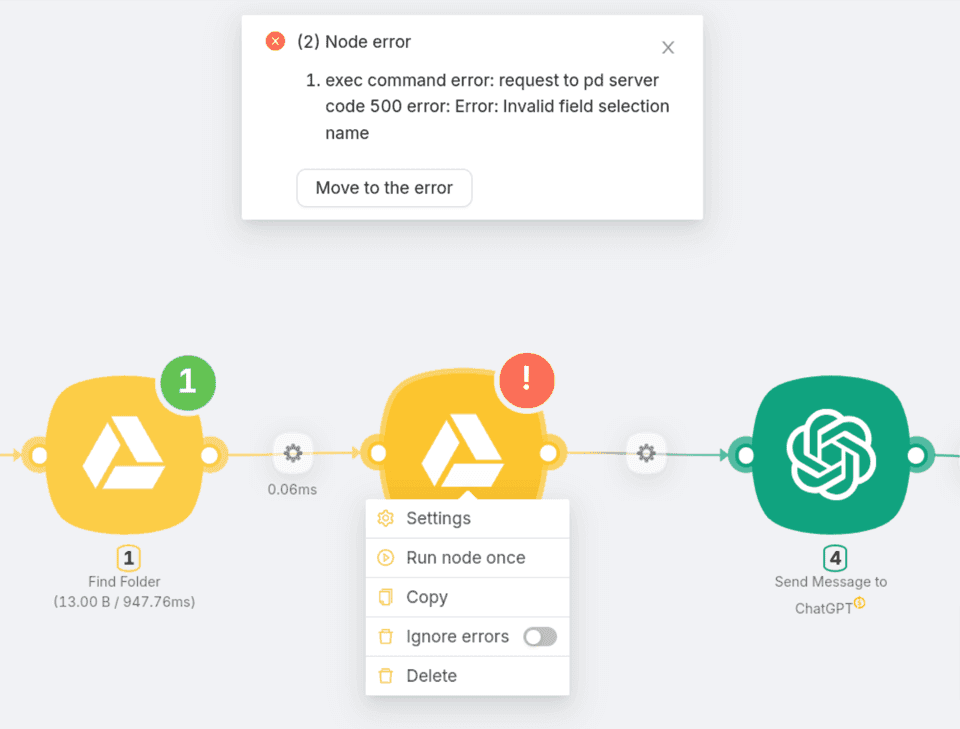
On the other hand, Latenode solves this with a fully managed, low-code platform and an easy-to-use interface - no command line needed. YouTube users often mention n8n's challenges, like no error notifications and tricky debugging. Latenode, in its turn, offers real-time alerts to instantly notify you of any issues, making error handling much smoother than n8n. Here is what it looks like:
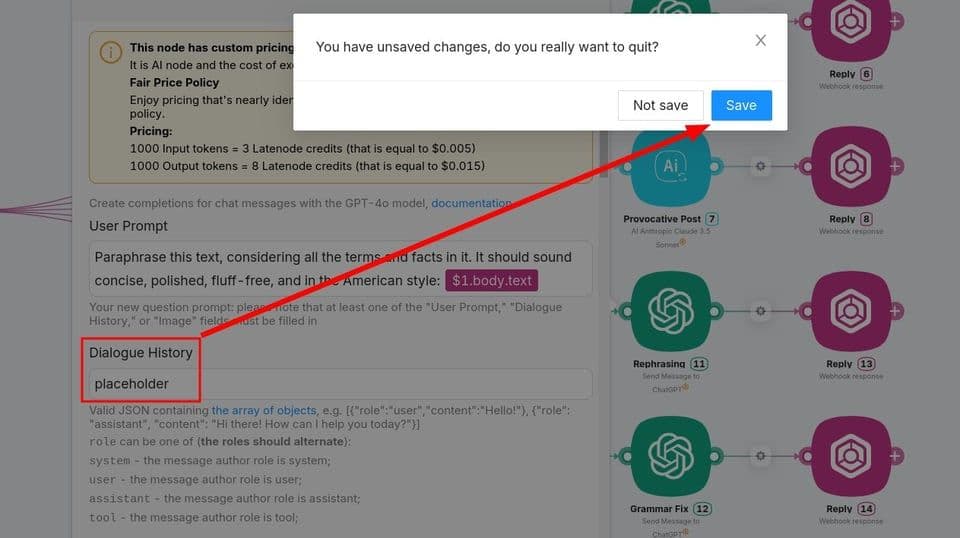
In addition, Latenode ensures data safety with a ‘save’ feature, making it impossible to exit the scenario editor with your data being added but unsaved. Strangely, n8n lacks such a simple yet crucial functionality.
Latenode also provides a Puppeteer-based Headless Browser, which is not a feature in n8n. This allows you to automate tasks on websites without APIs, simplifying web scraping and form submissions. Additionally, our platform supports sub-scenarios and a JavaScript AI assistant, adding even more flexibility. We manage all infrastructure, allowing you to focus solely on automation.
The Hidden Cost Of n8n Free Hosting (And How it Compares to Latenode)
While the Community Edition of n8n is "free," the reality of n8n self hosting paints a different picture. The promise of free software often attracts users, but the catch is in the details – or in this case, in the costs that quickly accumulate beyond the initial software license. To make a clear decision, understanding the total cost of ownership is critical, and that's where a clear comparison with Latenode is essential.
The Hidden Cost of n8n Self Hosted
Let's break down where those expenses come from:
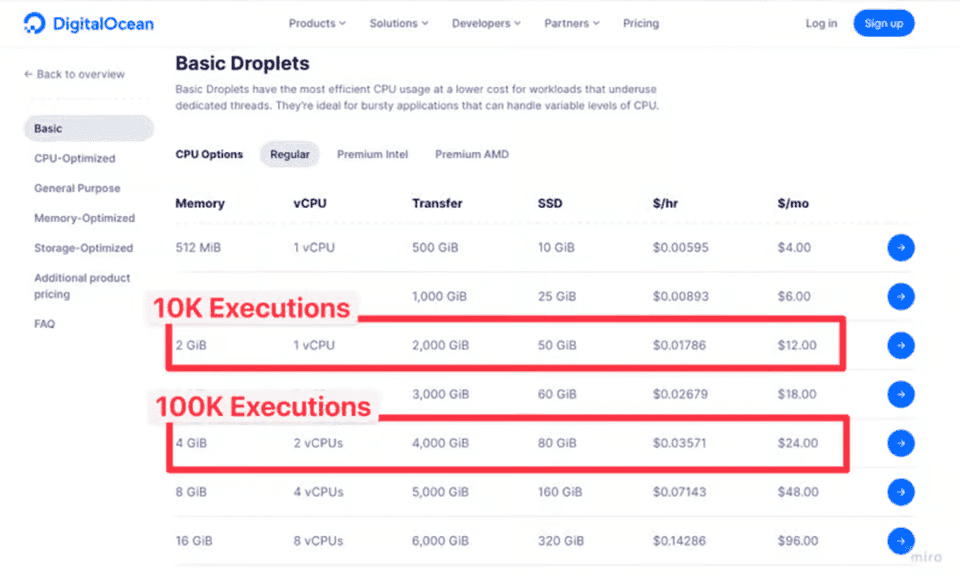
- Server Infrastructure: You'll need to rent a server, whether it's a virtual private server (VPS) from DigitalOcean, an EC2 instance on AWS, or a VM instance on Google Cloud. A basic VPS server with sufficient memory and transfer caps will cost you around $12+ per month, which is the lowest baseline you can expect.
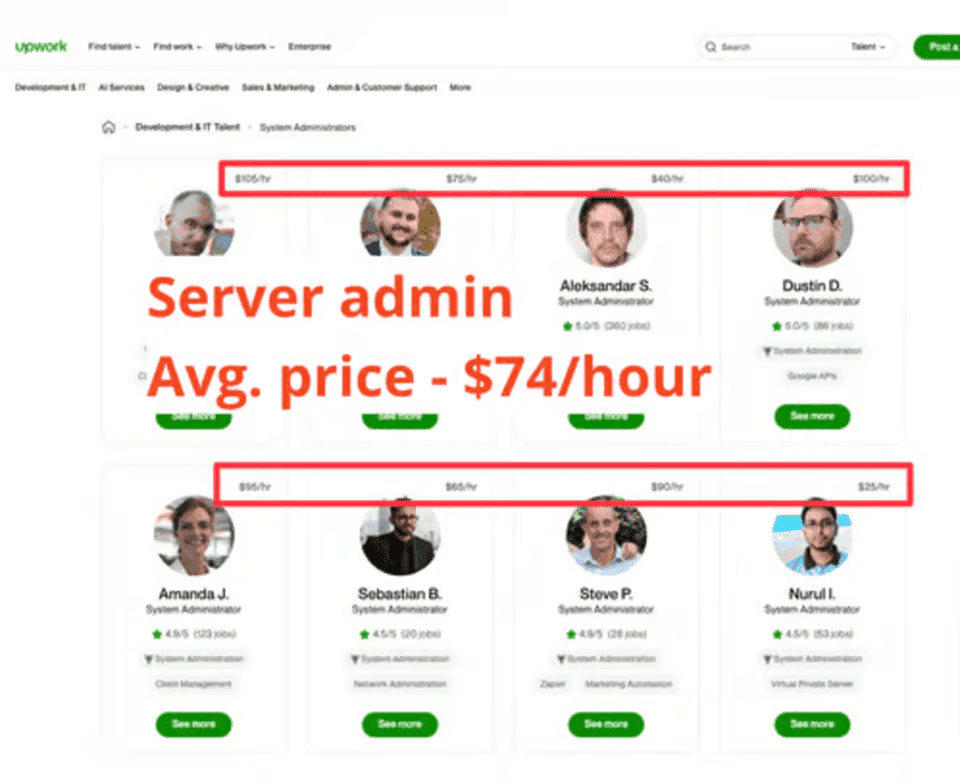
- Ongoing Maintenance: You'll need to factor in the time and effort to maintain your server, install updates, and ensure the stability of your system. This is where the need for a sysadmin may arise, with hourly rates starting at around $74 per hour.
- Security Measures: You need to implement security measures such as firewalls, SSL/TLS certificates, and regular security audits. While you can do all of this yourself, you also need to have a deep understanding of security, or need to pay an expert to set all of this up.
- Troubleshooting and Downtime: When something breaks (and it will), you'll need to troubleshoot and fix the problem, which can lead to unexpected downtime and additional costs. You won’t be able to run any automations on self hosted n8n when your server is down.
- Scaling Complexity: As your needs grow, setting up queue mode, webhook processors, and multi-main setups all come with their own set of complexities and costs.
- Time Commitment: Managing a self-hosted environment is a big investment in time and effort. This is the single most undervalued cost, because it is not directly quantifiable. Time spent on maintenance and troubleshooting cannot be used for other, more profitable tasks.
For instance, if you were to run 10,000 executions with 5 nodes, the price on the n8n self hosted version would be around $86, including the cost of a basic server and an average hourly rate for a sysadmin. It's clear that the initial cost savings are quickly eaten up by these additional expenses.
Latenode's Transparent and Cost-Effective Pricing
Latenode, in contrast, has a credit-based system that focuses on actual execution time. This approach leads to several key benefits:
- Transparent Pricing: You pay only for the time your automation scenarios are running, with each credit equivalent to 30 seconds of runtime at a cost of $0.0019. This is highly predictable and allows you to estimate costs before even starting the automations. Read this guide to learn more about Latenode's pricing policy with a case study on generating 2,000 cold outreach emails.
- No Hidden Costs: There are no server rental fees, no maintenance costs, no security overhead. Everything is handled by Latenode with the help of Microsoft Azure.
- Cost-Effectiveness: Latenode's pricing model is up to 5x cheaper compared to n8n self host. For example, 10,000 executions with 5 nodes will only cost you $17. This article further explores the advantages of a credit-based system over other platforms.
- Scalability: With Latenode, you can scale your automations without the worry of additional infrastructure costs or complexities. Your scenario might include dozens of nodes and repeat hundreds of times, but as long as it takes 30 seconds to complete, it will cost just $0.0019.
- Lifetime Deal Option: Latenode even offers a lifetime deal, starting at $497, which will give you unlimited access to the platform without monthly payments, reducing the overall cost even further.
Start building with Latenode, use low-code or write your own code with AI Copilot.
Self-Hosting n8n vs Latenode: What to Choose In 2025?
Choosing between self hosted n8n and Latenode ultimately depends on individual needs and priorities. Self-hosting provides total control, which is essential for users who have a high level of technical expertise and for very specific use cases. It requires a serious investment in time, effort, technical skills, and resources.
Latenode presents a streamlined approach, making automation more accessible, manageable and cost-effective. Its managed environment, user-friendly interface, and transparent pricing are great for most businesses. Therefore, evaluating your technical expertise, resources, and long-term automation objectives will make it easier for you to choose the correct path forward.