


There are at least six credentials that show up when you search "BPM certification," and they are not remotely the same thing. Some require years of documented work experience. Some are training-based programs that hand you a certificate at the end of a course. Some measure whether you can model a process in BPMN notation. Some measure whether you can eliminate variance in a manufacturing line. The job posting that says "BPM certification preferred" could mean any of these. It usually doesn't specify.
The most common mistake I see candidates make is treating these as interchangeable. They're not. Confusing a standards-based credential with a practitioner credential - or confusing either of those with a Six Sigma qualification - is how you spend six months studying for the wrong exam.
The mistake that costs candidates months
- CBPP is the dominant employer-recognized BPM professional certification; it requires documented experience, not just exam readiness.
- OCEB 2 is the right credential when the role centers on process modeling and BPMN standards, not enterprise process leadership.
- Entry-level practitioners should start with CBPA before attempting CBPP - skipping this step is the most predictable way to be ineligible on your first application.
- Six Sigma Green Belt and Black Belt are process improvement credentials, not BPM certifications. Treat them as adjacent, not equivalent.
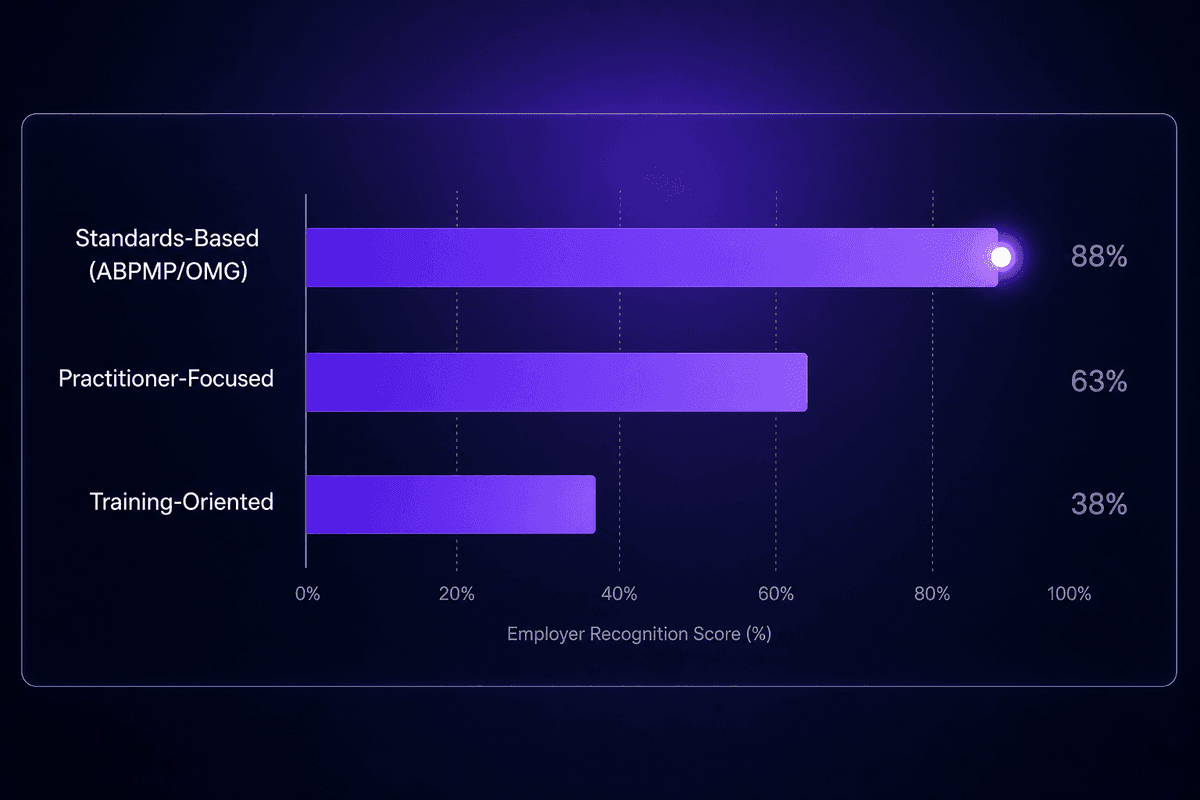
What a BPM Certification Actually Signals to Employers
A credential's issuing body matters more than the certificate name itself. This is the part most candidates miss.
When a hiring manager sees "CBPP" from ABPMP International on a resume, they're reading something specific: this person demonstrated real BPM work experience, passed a structured exam covering the full BPM lifecycle, and is recognized by the field's primary professional association. That's a different signal than seeing a training-based certificate from an online learning platform - which may represent genuine learning, but doesn't carry the same body-of-knowledge backing.
In today's rapidly evolving business landscape (that phrase is overused, but the BPM market growing toward USD 64 billion by 2033 is genuinely not hyperbole), the field of business process management has enough credentialing options that the credential category matters as much as the credential name. Three categories exist: standards-based credentials tied to a recognized professional body (ABPMP, OMG), practitioner-focused certifications that validate BPM expertise across a defined competency model, and training-oriented certificates that document structured learning without the same eligibility gates.
Employers hiring for BPM roles that involve process governance, enterprise BPM programs, or leading business processes change generally recognize the first two categories. The third category serves a real learning purpose. It just reads differently in a hiring context.
That's not a knock on training certificates. It's a useful framework for choosing which credential to pursue based on what you actually need it to do for your career.
How to Choose the Right Business Process Management Certification
The honest version of this decision comes down to five practical checks, not five abstract values. Run these before enrolling in anything.
- Your current BPM work experience
CBPP requires documented experience in business process management - candidates who haven't spent real time in process roles get turned away at application. Check the eligibility requirements for your target certification before studying for the exam. Finding out you're ineligible after six weeks of prep is a specific kind of frustrating.
- Employer recognition in your actual target market
Look at 10-15 job postings for the roles you want in the next 12 months. Which certifications appear? CBPP shows up consistently in enterprise and mid-market BPM roles. OCEB 2 appears in roles that involve process modeling, BPMN, and technical process design work. BPM training certificates appear less frequently. This is your primary signal. BPM training and certification choices should follow market demand, not prestige rankings.
- Whether the role centers on process modeling, process improvement, or enterprise BPM
These are different bodies of knowledge. OCEB 2 is built around process modeling and BPMN standards. CBPP covers the full BPM lifecycle including strategy, design, analysis, and management. Six Sigma and Lean address quality management and defect reduction. Picking the wrong one for your actual role means spending months on material that won't map to your day-to-day work, and then wondering why best practice from your certification doesn't fit what your organization actually needs.
- Recertification burden over time
ABPMP credentials including CBPP require periodic recertification to remain valid. This adds an ongoing maintenance cost and time commitment that candidates rarely factor into their initial decision. Ask whether you're prepared to sustain this, not just the initial exam.
- Cost tier relative to your situation
CBPP runs approximately $500-$650 depending on ABPMP membership status. OCEB 2 levels range from roughly $200-$350. BPMInstitute.org certificate programs are course-based and priced accordingly. These are not trivial differences, especially if your employer isn't subsidizing the cost. Check the full cost including study materials and prerequisites, not just the exam fee. Certification programs vary more than their listed prices suggest.
BPM Certification Comparison: Entry Level vs. Practitioner vs. Standards Track
This table uses only pricing and level data supported by the pre-research. Fields without confirmed data are marked accordingly.
| Certification | Issuing Body | Level | Best For | Approximate Cost | Recertification Required |
|---|---|---|---|---|---|
| CBPA | ABPMP | Entry | Early-career BPM practitioners | Varies | Yes |
| CBPP | ABPMP | Practitioner | Experienced BPM professionals, process leaders | ~$500-$650 | Yes |
| OCEB 2 Fundamental | OMG | Entry | Analysts and modelers entering BPMN standards track | ~$200 | Yes |
| OCEB 2 Intermediate | OMG | Intermediate | Process analysts deepening BPMN and standards expertise | ~$275 | Yes |
| OCEB 2 Advanced | OMG | Advanced | Technical practitioners and advanced BPM modelers | ~$350 | Yes |
| BPMInstitute.org Certificate | BPMInstitute.org | Varies by program | Mid-career professionals building structured BPM foundations | Course-based, varies | Varies |
One clarifying note before moving on to the ranked section: the online BPM certification exam model varies significantly by issuing body. CBPA and CBPP are administered through ABPMP. OCEB 2 exams are administered by Pearson VUE. BPMInstitute.org assessments are integrated into their course delivery. A business process management specialist role might legitimately require any of these, depending on the company and the function.

The Best BPM Certifications, Ranked by Real-World Fit
The ranking logic here is: employer recognition first, then fit for a specific role and specialization, then how accessible the credential is for someone at an earlier stage. I'm not ranking by difficulty or prestige. I'm ranking by how often the credential actually helps someone get the BPM role they're aiming for.
Advancing a BPM career and finding options to advance in business process management generally means targeting the credential your market recognizes for the role you want, not the credential that sounds most impressive. Those are occasionally the same thing.
ABPMP Certified Business Process Professional (CBPP)
The CBPP from ABPMP International is the credential that appears most consistently across employer recognition rankings and BPM role requirements. When I look at BPM-focused job postings and filter for which certifications appear with any regularity, CBPP leads.
What it actually signals: the holder has documented real-world BPM work experience, has passed a 140-question, three-hour exam, and meets the knowledge standards defined in the BPM CBOK (Common Body of Knowledge) that ABPMP maintains. This is a practitioner credential. It's designed for BPM practitioners who have already been doing the work.
That last part is where candidates get caught. CBPP requires documented BPM experience - not just general business experience, not a certification in a related area. Candidates who come from adjacent roles (project management, business analysis, operations management) sometimes assume their experience counts as-is. Sometimes it does. Sometimes it doesn't. Documenting it against the CBOK knowledge areas is part of the application process, and the process of mapping your experience to the right categories takes real work.
Exam cost: approximately $500 for ABPMP members, $650 for non-members. Recertification is required to keep the credential active.
A mid-level analyst moving into a dedicated BPM role recently came to me after spending almost two months in exam prep before realizing she didn't meet the documented experience threshold yet. That's a prep investment that could have gone toward building the CBPA credential first, earning your business process management credential in the right order. The eligibility check should happen before week one.
OMG-Certified Expert in BPM 2 (OCEB 2)
OCEB 2 is structured as a three-level progression: Fundamental, Intermediate, and Advanced. They share the same standards grounding - the Object Management Group's BPMN specification - and are designed to be taken in sequence rather than as independent credentials.
Who benefits: analysts, process designers, and technical practitioners who work directly with process models and need to demonstrate BPMN fluency. If your work involves process analysis and design at the modeling layer - drawing BPMN diagrams, specifying process semantics, designing business process model structures for implementation - OCEB 2 validates that work in a way no other credential does as specifically.
The pricing is accessible compared to CBPP: approximately $200 for Fundamental, $275 for Intermediate, $350 for Advanced. The level progression means you can start without the experience gatekeeping that CBPP requires.
What OCEB 2 doesn't do: it isn't a substitute for CBPP in enterprise BPM or process leadership roles. OCEB 2 doesn't cover the full BPM lifecycle the way CBPP does. Advanced BPM governance, process strategy, and organizational change management aren't what this credential was designed to validate. Narrow specialization is a strength if your role genuinely centers on modeling and process design. It's a gap if the job posting wants broader process management capability.
BPM concepts covered in OCEB 2 are deep but specific. If your work sits at the intersection of technical process design and standards compliance, this is the right track. If you want to lead enterprise process transformation programs, CBPP is a better fit.
ABPMP Certified Business Process Associate (CBPA)
CBPA is the entry-level credential from ABPMP - the same body that issues CBPP. It's designed for practitioners earlier in their BPM careers who aren't yet eligible for CBPP.
The logical path is CBPA first, CBPP when your experience qualifies. They're not competing options. They're a sequenced track within a single framework, and treating them as alternatives is one of the more common mistakes I see candidates make.
The mistake I keep seeing: candidates who have two years of experience and strong exam readiness decide to attempt CBPP directly, discover they're ineligible, and end up spending time they've already spent. CBPA is the right landing point while you're building documented experience for CBPP eligibility. It also carries real signal - it demonstrates engagement with the ABPMP framework and business process improvement methodology at a level that's appropriate for your stage. It's not a consolation prize. It's a legitimate credential with a logical home in a BPM career.
For someone building toward a BPM center of excellence role or working to formalize their BPM foundation, CBPA provides the credential while the experience accumulates.
BPMInstitute.org Business Process Management Professional Certificate
BPMInstitute.org positions itself as the industry's top BPM educational organization, and their certificate programs are built around structured learning delivered through live online courses with assessments. This is a different class of credential than CBPP or OCEB 2.
The distinction matters. BPMInstitute.org offers a business process management professional certificate that demonstrates structured learning and course completion. It's not issued by a standards body. It doesn't carry the same employer recognition weight as CBPP in enterprise BPM hiring.
That said, it serves a real purpose. Mid-career professionals who need a structured BPM foundation - who want to understand process improvement frameworks, methodology, and BPM discipline before committing to the CBPP exam track - get something genuinely useful from certificate programs with this structure. The course-based pricing varies, which means you're paying for education plus the credential, not just the exam fee.
Think of it as preparation and professional development rather than the credential that will appear most prominently in a hiring manager's shortlist. If you already know you're targeting CBPP, BPMInstitute.org course material can be a legitimate study path. Just don't conflate completing the certificate program with having the CBPP in hand.
Six Sigma Green Belt and Lean Six Sigma Black Belt
These appear in BPM certification roundups because they overlap with process improvement and because employers sometimes list them in the same job posting breath as CBPP. They're worth addressing directly, because the substitution mistake is real.
Six Sigma and Lean Six Sigma measure quality management methodology and defect-reduction capability. The framework is data-driven, statistically grounded, and focused on reducing variation in process performance. That's legitimate and valuable. It's also not what CBPP or OCEB 2 assess.
CBPP assesses the full BPM lifecycle: process strategy, design, analysis, transformation, and enterprise process governance. OCEB 2 assesses process modeling competency and BPMN standards fluency. Six Sigma assesses in-depth knowledge of process improvement and management through a quality methodology lens. These are related fields, not the same field. Workflow management and business process automation competency aren't embedded in Six Sigma curricula the way they are in BPM-specific credentials.
In practice: if a role requires process improvement projects and statistical quality methods, Six Sigma is probably the right credential to pursue. If a role requires enterprise BPM governance, BPMN process design, or managing a BPM program, CBPP or OCEB 2 is the better match. The problem isn't Six Sigma. The problem is when candidates (or hiring managers) assume they're interchangeable.
🤔 Think about this:
Six Sigma credentials appear regularly in job postings for roles that explicitly require BPM skills. This creates a practical problem on both sides: candidates with Six Sigma credentials apply to roles that actually need BPMN literacy or BPM lifecycle knowledge, and hiring managers who don't distinguish between the two end up with mismatched expectations six months in. Before applying, check whether the role describes core BPM responsibilities - process modeling, governance, automation lifecycle - or process improvement projects. The answer tells you which credential actually applies.

Which BPM Certification Should You Actually Pursue First
No hedging here. Use this as a direct decision framework.
Choose CBPP if you have documented BPM work experience - at least a few years of real process management, process improvement, or BPM transformation work - and you're targeting roles that involve business process manager responsibilities at an enterprise or mid-market level. CBPP is what those employers expect to see. The recertification requirement is real, the experience gate is real, and the study commitment is real. Go in with that knowledge.
Choose CBPA if you're earlier in your BPM career and don't yet meet CBPP eligibility. This is also the right move if you want to signal formal BPM grounding while you're building qualifying experience. Business processes aren't mastered in a semester, and the CBPA-to-CBPP track is designed for exactly this situation.
Choose OCEB 2 Fundamental if your role centers on process modeling, BPMN design, or technical process specification. If you spend real time drawing process models or specifying process semantics for implementation, this is the credential that validates that work. Start at Fundamental and progress from there.
Choose a BPMInstitute.org certificate if your immediate need is structured BPM education and you're not yet ready for the CBPP exam track. This is a reasonable path for professionals who want a formal business analysis and process improvement foundation before committing to a body-issued credential.
Don't treat Six Sigma as a BPM substitute if the role actually requires BPM lifecycle skills. Six Sigma and Lean are about quality methodology and defect reduction. Establishing process governance and organizational change management experience requires a different credential. If the posting is ambiguous, look at the actual job responsibilities, not just the listed credentials.
Business transformation and business strategy roles that include BPM often list multiple credential types. The strategy fit still follows this logic: match the credential to what the role actually asks you to do, not to what the job title sounds like.
📊 In practice:
Across employer recognition rankings and BPM job posting analysis, CBPP from ABPMP consistently appears as the most broadly recognized practitioner-level BPM credential for enterprise roles. OCEB 2 is the strongest credential specifically for roles where process modeling and BPMN standards expertise are the primary requirement. When a posting lists both, the employer usually prioritizes CBPP for senior roles and OCEB 2 for modeling-specialist positions.