


Most buyers landing on a business rule engine comparison already know roughly what a BRE does. The question isn't "what is this category" - it's "which of these eight tools is actually right for our stack, our team, and the governance requirements our compliance team will ask about six months into deployment." That's a harder question, and feature lists don't answer it.

The central claim here is one I'll defend: the right business rule engine depends on governance needs, rule ownership model, and deployment constraints more than on feature count. A tool with fewer native integrations but a business user who can safely publish rule changes without a developer deploy cycle will outperform a more capable engine where every policy tweak generates a Jira ticket. I've seen both patterns play out. The ticket pile is more expensive than it looks.
The expensive part is ownership, not licensing
- No single BRE fits every stack; deployment model eliminates half the candidates before features matter.
- Rule ownership - who changes rules, how fast, without breaking production - is the selection criterion most shortlists skip.
- A SaaS-first BRE in a regulated environment will hit audit trail gaps that no feature set compensates for.
- Governance maturity narrows the real shortlist faster than any comparison table.
- Pilot stalls almost always trace to mismatched rule authoring assumptions, not integration failures.
Why Choosing a Business Rule Engine Is Harder Than It Looks
The global BRMS market was valued at USD 1.9 billion in 2023 and is projected to grow at over 7% CAGR through 2032. That growth has pulled a lot of vendors into the space with overlapping terminology. Tools that are fundamentally different in architecture and governance model all call themselves "business rule engines." Some are decisioning suites. Some are business process management systems with a rules module bolted on. Some are workflow automation platforms that happen to support conditional logic. A few are genuine standalone BREs.
Buyers conflate BRE with BPM, with workflow automation, and with broader decisioning suites. The conflation is understandable - the marketing language invites it. But it produces mismatches. A team that needs a lightweight rules layer for a digital product evaluates Pega (a full process automation suite designed for enterprise deployment teams) because it appeared on the same shortlist as DecisionRules. That evaluation wastes three weeks and produces no useful signal.
The BRMS category is forecast to reach USD 3.6 billion by 2034, which means more entrants and more overlapping claims ahead. The tools that dominate shortlists are often architecturally mismatched to the teams evaluating them. A business rules management system with a full BPMN engine is not the right answer for a startup externalizing discount logic from code. A freemium SaaS BRE is not the right answer for a healthcare insurer with audit trail requirements. This comparison maps the actual alignment, not the aspirational positioning.
Selection Criteria That Actually Narrow the Shortlist
Run these filters in order. The ones higher on the list eliminate more candidates faster. Don't start with features - start with constraints.
- Non-developer rule authoring safety.
Can a business analyst or operations manager make a live rule change without triggering a developer deploy cycle? This is the single most commonly misunderstood dimension on BRE evaluations. The risk it addresses: pilot adoption stalls when every rule change requires IT involvement. Practical check: ask the vendor to demonstrate a rule change in their tool made by a non-developer, end-to-end, in a test environment. Time how long it takes and who touches the deploy button.
- Deployment model fit.
SaaS, on-premises, or hybrid? This eliminates half the candidates immediately for teams in regulated industries or with data sovereignty requirements. The decision risk: choosing a SaaS-first tool and discovering later that decision requests route through vendor infrastructure, which fails an audit. Practical check: ask specifically where rule execution happens and whether on-prem or private cloud deployment is in scope for your pricing tier.
- Governance and version control depth.
Does the tool support rule versioning, rollback, approval workflows, and audit logging out of the box, or are these add-ons? The decision risk: regulatory compliance failures or silent production changes with no traceable record. Practical check: review the audit log format - can it be exported in a format your compliance team will accept?
- Business user vs. IT rule ownership model.
Who actually owns rule changes in production? Some BREs claim business user ownership but require IT to publish changes. Others genuinely decouple rule authoring from the deployment pipeline. The risk: buying a "business user-friendly" tool that generates 80% of the same support tickets as a developer-centric one. Practical check: run a simulated policy change with an actual business analyst from your team during the trial.
- Integration and stack fit.
How does the BRE's runtime connect to your existing applications? REST API, embedded library, or native connector? The risk: choosing a tool whose integration model adds significant engineering overhead to every new connection. Practical check: map your three most critical data sources and confirm the integration pattern before the shortlist decision.
- Total cost of ownership beyond licensing.
Operational efficiency gains on paper often disappear when you account for implementation, training, and ongoing rule maintenance by qualified staff. The risk: licensing cost looks reasonable; total deployment cost does not. Practical check: ask for a realistic implementation timeline for your first use case, including any required professional services, and whether that's billable.
Business Rule Engine Comparison: 8 Tools Mapped to Use Case and Stack
Use this table as a first filter. It won't replace a vendor trial, but it will tell you which tools to spend time on and which to skip based on your actual deployment context.
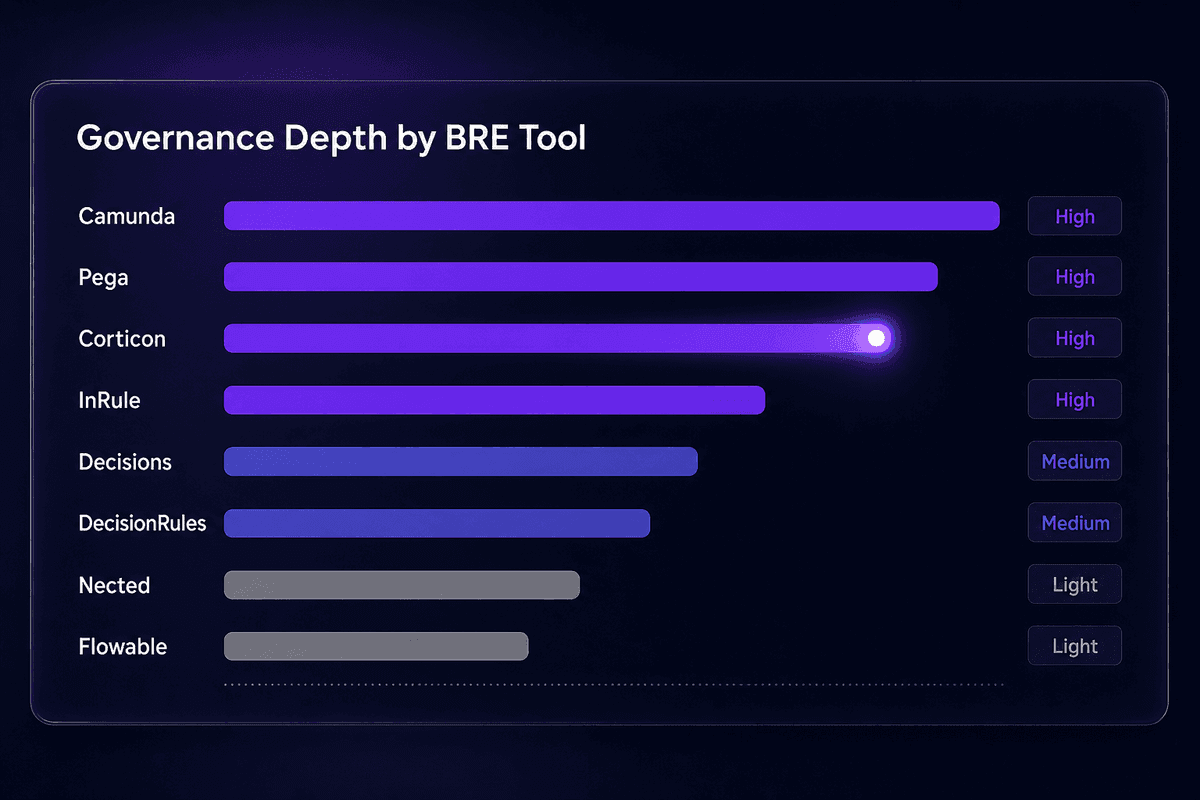
| Tool | Best-fit use case | Rule ownership model | Deployment model | Pricing tier | Governance level |
|---|---|---|---|---|---|
| Camunda | BPMN/DMN process automation, microservices | IT/developer-led | SaaS / self-hosted | OSS free; paid commercial | Medium-high |
| Pega | Enterprise case management + decisioning | IT-led with low-code UI | Cloud / on-prem / hybrid | Enterprise (high) | High |
| Progress Corticon | Regulated industries, claims, underwriting | Business analyst-capable | On-prem / cloud-native | Enterprise | Very high |
| InRule | Analyst-owned rules, .NET environments | Business analyst-first | Cloud / on-prem | Enterprise subscription | High |
| Decisions | Complex logic + workflow combined | Low-code, mixed ownership | Cloud / self-hosted | Enterprise | Medium-high |
| DecisionRules | Real-time API decisioning, pricing, credit | Product/engineering teams | Cloud-native / self-hosted | Freemium to paid | Medium |
| Nected | Startups externalizing business logic | Mixed; web-based interface | Cloud-native | Freemium to paid | Light |
| Flowable | Open-source BPM/DMN, standards-first teams | IT/developer-led | Self-hosted / cloud | OSS free; enterprise paid | Medium-high |
| Salesforce (native BRE) | Salesforce-native workflow and decision logic | Admin / declarative | SaaS (Salesforce org) | Included in Salesforce tiers | Medium |
Pricing and governance depth shift with tier and configuration. Treat this as a starting orientation, not a contract.
The 8 Best Business Rule Engines Reviewed
Tools are ordered strongest broad fit first, then by archetype: enterprise suites, analyst-owned BREs, developer-facing SaaS, and open-source. Tool #1 gets the most depth because it represents the most common shortlist winner for teams that need both workflow and rules in one place. Use the archetype framing to identify which category applies to your team, then read that section carefully and skim the rest.
Camunda: Best Business Rule Engine for BPMN-Centric Process Automation
Camunda combines BPMN for process automation with DMN (Decision Model and Notation) for decision modeling - two open standards in one engine. That combination is the main reason it leads shortlists for teams in Java or microservice environments who want end-to-end workflow orchestration with embedded decision logic. The DMN engine handles decision tables and rules in a standardized format; the BPMN layer handles process orchestration around those decisions. You can embed decision steps directly inside a process definition, which keeps rule evaluation in context rather than as a disconnected call to an external system.
Best-fit signal: Java-centric teams, microservice architectures, and any organization that wants to version control both their process definitions and their rule tables using the same developer toolchain. The open-source Camunda engine (Zeebe/Camunda 7) is free and production-capable. The commercial Platform edition adds SaaS deployment, enhanced monitoring, and enterprise support.
Pros: Open standards (DMN 1.3 compliant), strong developer ecosystem, works well with Spring Boot and cloud-native deployments, process + decision in one model.
Cons: Business analyst rule authoring requires familiarity with DMN table format, which has a learning curve for non-technical users; commercial edition pricing reflects enterprise positioning. The pattern I see in support-adjacent conversations: teams adopt Camunda for the BPMN workflow layer and then discover the DMN authoring interface is more developer-friendly than their ops team expected.
That's not a feature gap. That's a Monday morning ticket waiting to be opened.
Verdict: The strongest broad-fit choice for development teams who want process orchestration and rule evaluation under one open standard. Not the right answer if business analysts need to own live rule changes without developer support.
Pega Platform: Decisioning and Case Management for Large Enterprises
Pega is a unified platform that combines case management, rules, and decisioning under one enterprise umbrella. It is not a standalone business rule engine - it is a full digital process automation suite that happens to include a rules engine as one of several major components. That distinction is the most common buyer mismatch I see when Pega ends up on a shortlist alongside standalone BREs: the buyer wanted a rules layer; Pega wants to be the platform. The evaluation timelines and procurement processes are correspondingly different in scale.
For large enterprises needing to automate millions of decisions across business operations - insurance claims routing, credit decisions, customer service case management - Pega's depth is genuinely appropriate. Its AI-driven next best action capabilities, combined with rules-based decisioning, address enterprise complexity that lighter tools can't touch. Enterprise licensing reflects this, sitting firmly at the high end.
Pros: End-to-end case management plus decisions in one governed platform, strong AI decisioning layer, established enterprise track record.
Cons: Overkill for teams that need a rules layer only; implementation timelines and costs reflect the platform's scope; business rules model is complex to maintain without specialized Pega-certified staff.
Verdict: Right for large organizations that need an integrated decisioning and process platform. Wrong for teams that just need to externalize pricing or eligibility logic from a codebase.
Progress Corticon: The BRE Built for Regulated Industries
Corticon is the tool I'd point to first for financial services teams, insurance operations, and government agencies where regulatory requirements mean every rule change needs a traceable approval chain, a rollback path, and an audit log a regulator can read. Its focus on rule correctness, testability, and change management is not marketing copy - it's architectural. Corticon's decision tables support conflict detection and completeness checking, which means the tool tells you when two rules contradict each other before they contradict each other in production. For claims processing and underwriting workflows, that's not a feature; it's the whole point.
The decision service model (Corticon runs as a stateless decision service called by applications via API) keeps rule logic cleanly separated from surrounding application code. Financial institutions running complex underwriting or regulatory compliance rules tend to find that separation valuable as their rule libraries grow into the hundreds.
Pros: Best-in-class rule governance and testability, strong regulated industry reference base, clean decision service architecture, business analyst-capable authoring environment.
Cons: Enterprise pricing has a meaningful floor; startup or mid-market teams may find the governance apparatus heavier than their actual rule volume requires.
Verdict: Primary recommendation for regulated environments where rule correctness and audit compliance are non-negotiable selection criteria.
InRule: When Business Analysts Need to Own the Rules
InRule's core design assumption is that business analysts - not developers - should own rule changes in production. The rule authoring environment is built with that audience in mind: familiar spreadsheet-style interfaces, natural language rule expression, and a decoupled decision engine model that lets business teams modify rules without touching application code or triggering a release cycle.
The .NET integration depth makes InRule a sensible choice for enterprises already running Microsoft stack environments. The cloud deployment options extend that beyond on-prem. Where I see this tool earn its keeps: mid-to-large enterprises where a defined set of predefined rules governs things like insurance eligibility, product configuration, or pricing, and where the business team managing those rules genuinely cannot wait for a developer sprint to publish a policy change. The tooling makes that ownership model viable. User-friendly is usually marketing vapor; in InRule's case, the specific claim about analyst ownership reflects an actual architectural commitment.
Pros: Genuinely analyst-accessible rule authoring, decoupled engine model supports live rule changes, .NET ecosystem fit.
Cons: Enterprise subscription pricing; less suited for cloud-native, API-first architectures where DecisionRules or Nected would integrate more naturally.
Verdict: The first recommendation when business analyst rule ownership is the primary selection criterion and the environment is enterprise-grade.
Decisions: Low-Code Rules and Workflow for Complex Decision Logic
Decisions combines complex decision logic with process automation in a visual, low-code environment. That combination - rules plus workflow in one tool - is its main differentiator. Where other BREs focus on decision execution and leave orchestration to separate systems, Decisions handles approval workflows, routing logic, and conditional branching inside the same platform as the rules themselves. For teams whose use cases involve decisions embedded in multi-step processes (expense approvals, compliance routing, document review workflows), that unified model reduces integration surface area.
The platform is enterprise-oriented in both capability and pricing. The visual builder is adaptable enough for non-developers to participate in rule design, though complex configurations still benefit from someone who understands the underlying logic model.
Pros: Combined workflow and decision logic reduces integration overhead, visual environment accessible to mixed technical teams, handles complex routing and approval scenarios well.
Cons: Enterprise pricing; the combination model can become unwieldy when rule logic and workflow logic grow independently, which some teams prefer to keep separated.
Verdict: Strong fit when complex decision logic and process workflow genuinely need to live together. Less compelling when the use case is purely decision execution without an orchestration layer.
DecisionRules: API-First Decision Automation for Product and Engineering Teams
DecisionRules is cloud-native and built for teams that want to call decision logic via API without standing up enterprise infrastructure. Real-time use cases - dynamic pricing, credit scoring, risk evaluation - are where it earns its positioning. The decision table interface is clean and fast to onboard; engineering teams can be publishing rule changes within hours of account creation rather than weeks of implementation.
The platform supports decision tables, decision trees, and scripting rules, which covers most rule pattern types product teams need. Freemium to paid tiers make it accessible for smaller teams evaluating before committing. The self-hosted option extends the deployment model for teams with data residency concerns.
Pros: Fast onboarding, clean API integration, real-time decision execution, freemium entry point, self-hosted option available.
Cons: Governance and audit tooling is lighter than enterprise BREs; not the right fit if compliance audit trails and governed rule change processes are mandatory from day one.
Verdict: Best choice for product and engineering teams that need a modern, API-first decisioning layer without enterprise procurement overhead.
Nected: Rules-as-a-Service for Startups Scaling Decision Logic
Nected takes a rules-as-a-service approach: the primary value proposition is externalizing business logic from your codebase into a web-based interface that non-engineers can access and update dynamically. For fast-growing digital products where discount rules, feature flag logic, or eligibility conditions change frequently and developers are a bottleneck for every update, that model addresses a real pain point.
The freemium-to-paid tier structure suits early-stage to growth-stage companies that want to execute rule changes without a full enterprise procurement cycle. The important caveat for compliance-heavy buyers: Nected's governance depth is lighter than Corticon or InRule. If your industry requires formal rule approval chains, versioned audit logs, and rollback capabilities for regulatory review, this tool's current governance apparatus won't satisfy that requirement without significant workaround.
Pros: Quick setup, web-based rule management, designed for non-engineering ownership, startup-friendly pricing.
Cons: Governance tooling is light compared to enterprise BREs; not the right choice for regulated industries without additional compliance infrastructure.
Verdict: Right for digital product teams and startups that need to execute rule changes fast. Evaluate governance depth carefully before committing in regulated contexts.
Flowable: Open-Source BRE with BPMN, CMMN, and DMN Standards
Flowable combines BPMN for process automation, CMMN for case management, and DMN for decision rules in an open-source foundation. The appeal for teams that prefer open standards before commercial commitment is real: the community engine runs in production, the codebase is visible, and the standards compliance means portability if you need to migrate later. Flowable is a credible choice for teams that want to automate complex business rule execution across cases and processes without locking into a vendor.
The open-source core is free. The commercial Flowable Work and Design products add process modeler tooling, enterprise support, and governance features. Teams that start with the community engine and grow into compliance requirements tend to reach for the enterprise tier eventually. The stateless DMN engine handles rule execution cleanly separated from process state.
Pros: Open standards, free community engine, active developer community, BPMN/CMMN/DMN in one stack, self-hosted by default.
Cons: Business analyst authoring is less polished than commercial BREs; operational risk increases without enterprise support for complex deployments; governance tooling in the free tier is limited.
Verdict: Best for developer teams that want open standards and community foundations before committing to commercial support. Not the recommendation for teams where business analyst rule ownership is the primary criterion.
🤔 Wait.
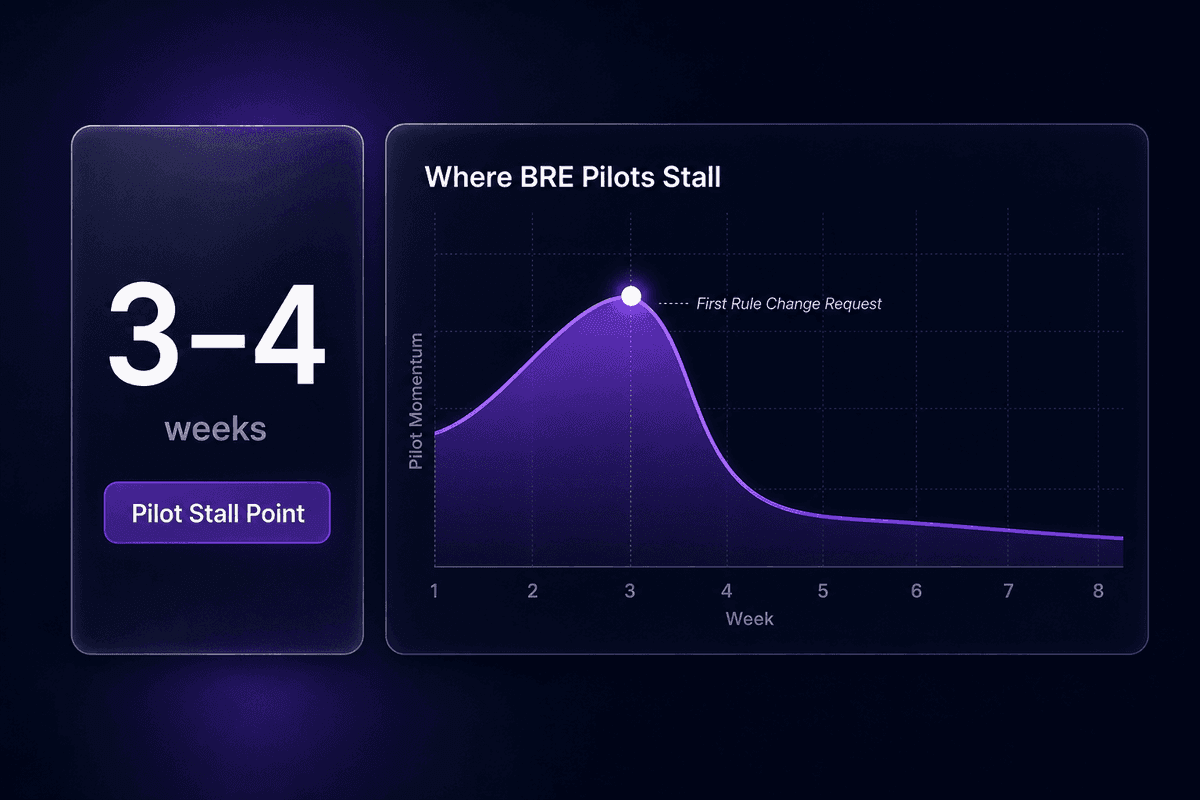
Every tool above claims to support both technical and business-user rule authoring. But "support" often means the runtime can technically be configured by either - not that a business analyst can safely publish a live rule change without triggering a deployment. The gap between "our tool supports business users" and "your business analyst can change a pricing rule on Friday afternoon without filing a ticket" is where BRE pilots stall. Ask your vendor to demonstrate the latter. Specifically. With a timer.
How to Deploy and Evaluate a Business Rule Engine Without Stalling the Pilot
Most BRE pilots fail at a predictable moment: three to four weeks after initial setup, when the first real rule change request comes in from a business user and the team discovers the deploy process is not what the sales demo implied. The evaluation phase should test for that moment explicitly, not discover it after the contract is signed.
Picking the Right First Use Case for Your BRE Pilot
The single best predictor of a successful BRE pilot is choosing a use case where the underlying decision changes frequently. Pricing rules, credit eligibility, loan approval thresholds, fraud detection criteria, and dynamic routing logic are all strong candidates because they generate real rule change requests within weeks of deployment. A static process with rules that haven't changed in eighteen months proves nothing about the tool's suitability. It just demonstrates that the integration works.
The Beeck Center's work on benefit eligibility rules as code identifies the same pattern: high-frequency policy changes are the use case where a centralized BRE generates the most measurable value versus ad-hoc rule management. Automate something that will require a rule update within 30 days of go-live. That's your real test.
Quick pilot scoping checklist:
- Does the decision change at least monthly? (If not, consider whether a BRE is the right tool at all.)
- Is there a business owner who will be responsible for rule updates - not IT?
- Can you define 3-5 measurable success signals before the pilot starts?
- Is the integration to your core data source document and testable within two days?
- Do you have a rollback plan for the first rule change that breaks something?
Measuring ROI Before You Commit to a Full Business Process Rollout
The ROI signals worth tracking at pilot stage are not revenue numbers. They're operational indicators that will still be meaningful six months into a full business process rollout: rule change cycle time (how long from policy update to live rule, measured in hours not weeks), error rate on automated decisions versus manual decisions over the same period, and the cost of a compliance audit relative to what it cost before versioned, logged rules existed.
The analytics that matter most are the ones tied to the original pain. If the pain was "developers bottleneck every rule change," the metric is rule change cycle time. If the pain was "we can't prove to the auditor which rule was live at the time of a specific decision," the metric is audit trail completeness. Streamline operations is a direction; pick one observable signal before you pilot and make it the go/no-go criterion.
What I've seen in practice: teams that define ROI checkpoints before the pilot ends up with useful data. Teams that wait until the end of the pilot to define success criteria usually find they can justify any outcome. That's not useful for a budget conversation.
On the topic of connecting BRE output to downstream processes: if your BRE exposes decision results via API, a workflow automation layer like Latenode can pick up that output and execute downstream steps without additional engineering. The Latenode JavaScript node handles edge case logic inline; the 5,500+ integrations cover most downstream systems your loan applications, credit workflows, or approval processes need to touch. The per-execution pricing model keeps multi-step decision-plus-action workflows economical - a six-step workflow from BRE output to CRM update to Slack notification counts as one execution rather than six tasks.
Decision Framework: Which Business Rule Engine Fits Your Situation
Pick the one description that matches your situation most closely. If two match, read both tool recommendations and compare on deployment model first.
If you're in a regulated industry (insurance, financial services, healthcare, government) and your compliance team will audit rule changes: Start with Corticon and InRule. Both have governance depth and business analyst authoring that can satisfy regulatory requirements. Corticon has the stronger rule correctness apparatus; InRule has a stronger analyst ownership model. Run a trial of both against a real compliance scenario - specifically, produce an audit trail of a rule change and show it to your compliance team before you buy.
If you need to underwrite loan applications or evaluate debt-to-income ratios at volume with real-time API response times: DecisionRules is the first evaluation, with Corticon as the governance-heavy alternative if audit requirements are strict. DecisionRules handles high-volume, real-time decision rules with low implementation overhead; the API-first model fits modern lending and credit product architectures cleanly.
If you're a startup or growth-stage digital product team where business logic lives in code and engineers are the current bottleneck for every rule update: Nected or DecisionRules. Both support rules-as-a-service with fast onboarding. Nected is slightly more oriented toward non-engineer ownership; DecisionRules is more engineering-first. If your use case involves credit, risk, or pricing at volume, DecisionRules' decision table model is more structured.
If your team runs a Java-heavy or microservice architecture and needs workflow orchestration plus rule evaluation under one model: Camunda. The BPMN/DMN combination is the strongest open standards answer for this stack. Be honest about whether your business users will actually author DMN tables or whether rule changes will always go through developers - if the answer is "always developers," that's fine, but it shapes how you evaluate the tool.
If your business analysts need to own rule changes in production without developer involvement and your environment is enterprise-grade: InRule is the primary recommendation. The decoupled authoring model is genuinely built for this. Decisions is a secondary option if the use case also involves complex approval or routing workflows that benefit from being in the same tool as the rules.
If you want open standards, community foundations, and self-hosted deployment before you commit to commercial support: Flowable. The BPMN/CMMN/DMN combination is mature, the codebase is visible, and the community engine is production-capable for teams with the internal capacity to run it. Budget for eventual enterprise support as governance requirements grow.
If you're running on Salesforce and your business rules primarily govern Salesforce objects, workflows, and processes: Evaluate the native Salesforce BRE capabilities before adding a third-party tool. Salesforce's declarative rule engine handles a significant portion of standard business needs within the org. Bring in a dedicated BRE only when the native tooling hits its ceiling on rule complexity or cross-system logic.
📊 In practice:
One pattern I see recur: an enterprise in a regulated industry picks a SaaS-first BRE because onboarding looked fast, then discovers six months later that the tool's audit trail format doesn't satisfy their regulator's requirements and the on-prem deployment option wasn't available at their pricing tier. The shortlisting conversation should include a compliance person from the start, not after the pilot. The audit trail gap isn't a surprise - it's a known risk of SaaS-first BRE architecture in regulated environments, and it shows up in support escalations with uncomfortable regularity.