

Quick answer: the best embedded iPaaS for each need
Paragon fits a white-labeled marketplace for enterprise SaaS, Prismatic a developer-first workflow engine, Cyclr a low-code embedded iPaaS with published plans. Pandium runs an in-app marketplace with predictable pricing, Alloy Automation quote-based embedded integrations. Nango is an open-source auth and sync layer, Merge a unified API for whole categories, Ampersand a SaaS-to-SaaS layer for AI and product teams, hotglue embedded ETL for customer data. Tray.ai or Workato Embedded cover enterprise automation. Latenode is a low-code workflow platform for customer-facing automations beside your product, with an embedded option for in-product integrations.
Prices carry the vendor's unit and billing period. Vendors that publish nothing are described by their billing model, not an estimate. Latenode is our own platform: a low-code workflow platform that also sells an embedded iPaaS, with no published price for the embedded offer, and its section covers both.
What an embedded iPaaS is and how it differs from an iPaaS
An embedded iPaaS is an integration platform a software company puts inside its own product, so its customers connect Salesforce, HubSpot, QuickBooks or Slack without leaving the app. The vendor delivers what a native integration needs: connectors, authentication, a workflow or sync engine, a configuration or marketplace UI, and monitoring.
A regular iPaaS answers a different question: it wires a company's own systems together for its own staff, and nobody outside sees it. A unified API normalizes a category behind one schema. Our guide to API integration platforms compares iPaaS, developer tools and unified APIs.
The practical difference is who runs the integration. With a regular iPaaS, your ops or IT team configures each workflow and fixes it when it breaks, and end users never touch it. With an embedded iPaaS, your customers switch integrations on and set them up inside your product, while your team owns the layer underneath. That changes the requirements: credentials and settings stored per customer, rate limits shared by many tenants syncing at once, and errors your support team can trace to a customer account rather than to a workflow ID.
The embedded iPaaS examples here are Paragon, Prismatic, Cyclr, Pandium, Alloy Embedded, Tray Embedded, Workato Embedded and Latenode's embedded offer. Merge is the unified API, Nango the auth and sync layer, hotglue the ETL variant. Meters differ: per connection, per customer, per action, per connector, per API call, flat plan or quote. Every price below names its unit.
Embedded iPaaS platforms at a glance
'Quote only' means the vendor publishes no price. Self-hosting shows up on Nango Enterprise, Cyclr's Self-Hosted Enterprise plan and Paragon Enterprise, though those pages cover deployment, not licenses.
| Platform | Best for | Meter | Published price |
|---|---|---|---|
| Paragon | White-label marketplace | Connected Users | Quote only |
| Prismatic | Developer-first builds | Instances | Quote only |
| Nango | Self-host auth and sync | Connections | $50 per month PAYG |
| Merge | Unified API categories | Linked Accounts | $650 per month |
| Cyclr | Low-code, self-hosted | Active connectors | From $1,595 per month |
| Alloy Automation | Flow and Embedded | Not published | Quote only |
| Pandium | In-app marketplace | Tenants | From $499 per month |
| Ampersand | SaaS-to-SaaS syncs | Actions | Custom plans |
| hotglue | Embedded ETL | Active tenants | Quote only |
| Tray.ai Embedded | Enterprise marketplace | Tasks | Quote only |
| Workato Embedded | Workato customers | Not published | Quote only |
| Latenode | Customer-facing flows | CPU seconds (workflow platform) | Embedded: quote only; workflows: $0.00012/CPU second |
| Boomi Embedded | OEM and reseller routes | Not published | Quote only |
| Jitterbit | White-label OEM | Not published | Quote only |
1. Paragon: best full white-labeled integration marketplace for enterprise SaaS
Paragon publishes no prices: Pro and Enterprise end in 'Get a quote', the Connected Users card says 'Get Custom Quote' and the Enterprise card 'Talk to sales'.
All plans include the three products, Managed Sync, ActionKit and Workflows, plus unlimited integrations and custom connectors, managed authentication, an embedded UX component or headless SDK, and event logs.
The three products split the work. Managed Sync runs and maintains the connectors that pull customer files and records into your app, whether the data feeds a RAG feature, a record sync or third-party analytics. ActionKit gives an AI agent product 1,000+ integration actions through one API or MCP. Workflows builds event-driven automations between your app and your customers' apps, triggered by third-party webhook events, events in your app, a CRON job or an HTTP request. Paragon's homepage lists 130+ pre-built connectors, and you can build custom connectors for any third-party API.
Paragon meters Connected Users, which the page defines as tenants: the customer organizations using integrations. According to Paragon's pricing page as of September 2026, they show as 'Custom' on both plans, with no per-user rate published. The quote sets what a Connected User costs.
Enterprise adds self-hosting or forward deployment, dynamic field mapping, priority support with SLAs, SAML-based SSO and professional services. It also lifts task history retention from 90 days on Pro to unlimited. Confirm those limits with Paragon before you rely on them. The page offers a free trial without publishing its length, whether a card is needed or which products it covers.
2. Prismatic: best developer-first embedded iPaaS
Prismatic calls itself an embedded integration platform for B2B SaaS companies whose integrations deploy to many customers, each with its own configuration and credentials. It publishes no prices: Scale, Enterprise and Custom all end in 'Schedule my demo', with a free trial at the top of the page.
Scale includes code-first and low-code building tools, AI-enabled development with MCP server support, an embedded integration marketplace, managed authentication and a dedicated account manager. Enterprise adds high execution concurrency, private and GovCloud hosting, the embedded workflow builder, on-prem connectivity, team member SSO and custom log retention. Custom adds custom concurrency limits, instance pricing and SLAs.
Prismatic's billing unit is the instance. Scale and Enterprise show 'Volume per-instance pricing' and Custom 'Custom instance pricing', while team members, customers, integrations and connectors are unlimited. Nothing is billed on API calls or executions. As of September 2026 it publishes neither the per-instance rate, the volume tiers nor how an instance is counted, so ask for all three in the quote.
3. Nango: best open-source auth and sync layer
Nango's pricing page covers deployment, not license terms, so check the self-hostable edition's license on Nango's site. Free costs $0 a month and hard-caps usage at 10 connections, 10 compute hours and 10 GB of transfer a month, reset monthly. Confirm that cap with Nango before you rely on it.
Pay-as-you-go costs $50 a month including $50 of credits, then $0.29 per connection per month, $0.72 per compute hour and $0.5 per GB of transfer. One connection is one API key or access token of the external API, prorated for the time it is stored. Runs round up to the nearest second, only egress counts, and rollover is unstated.
Enterprise is quoted, with commitment discounts, self-hosting, an MSA and an SLA. 'As low as $0.01 per connection per month at scale' is Nango's own example of a discounted rate, not a list price, and the minimum commitment is unpublished (as of September 2026). A $450 a month Growth add-on brings a private Slack Connect channel and faster delivery of requested integrations. Confirm what it covers before you budget for it.
Nango's homepage lists 1,000+ APIs with 7,000+ reusable templates, and treats integrations as code, with local development, CI/CD and environments. It handles OAuth, API keys and token refresh for every API, plus retries and rate limits.
4. Merge: best unified API for whole categories
Merge Launch links 3 production Linked Accounts free, then costs $650 a month for up to 10 and $65 for each Linked Account above that, with volume discounts on request. Merge prints that $65 under a $650-a-month plan without a period of its own, so confirm whether it is charged once or monthly before you size a bill. The pricing page counts production Linked Accounts without defining one on the page itself, but it links to Merge's documentation, where a Linked Account is a connection between your app and one third-party platform, created when your end customer finishes Merge Link. Read that way, one customer wired to three systems is three Linked Accounts, and dashboard test accounts sit outside the production count (as of September 2026).
"Contract-based pricing ... Access custom fields ... Custom sync frequencies ... Enterprise security features like Audit Trail ... Unlimited access to sandboxes ... Dedicated account manager with shared Slack channel ... Support and uptime SLAs"
Source: merge.dev
Professional and Enterprise are contract-based, with no number published. Professional adds custom fields, field-level scopes and custom sync frequencies. Enterprise brings an audit trail, unlimited sandboxes, a dedicated account manager and support and uptime SLAs.
Launch gets 3 days of log retention and 100 requests per minute, Professional 30 days and 400, Enterprise 90 or more days and 600, all with unlimited data usage. Merge's plan comparison table lists those as of September 2026.
The API covers whole categories: accounting, ATS, CRM, file storage, HR and ticketing, with an embedded Merge Link component and a Magic Link flow. The plan table itself promises only 'Access to all production integrations'.
5. Cyclr: best low-code embedded iPaaS with published plans
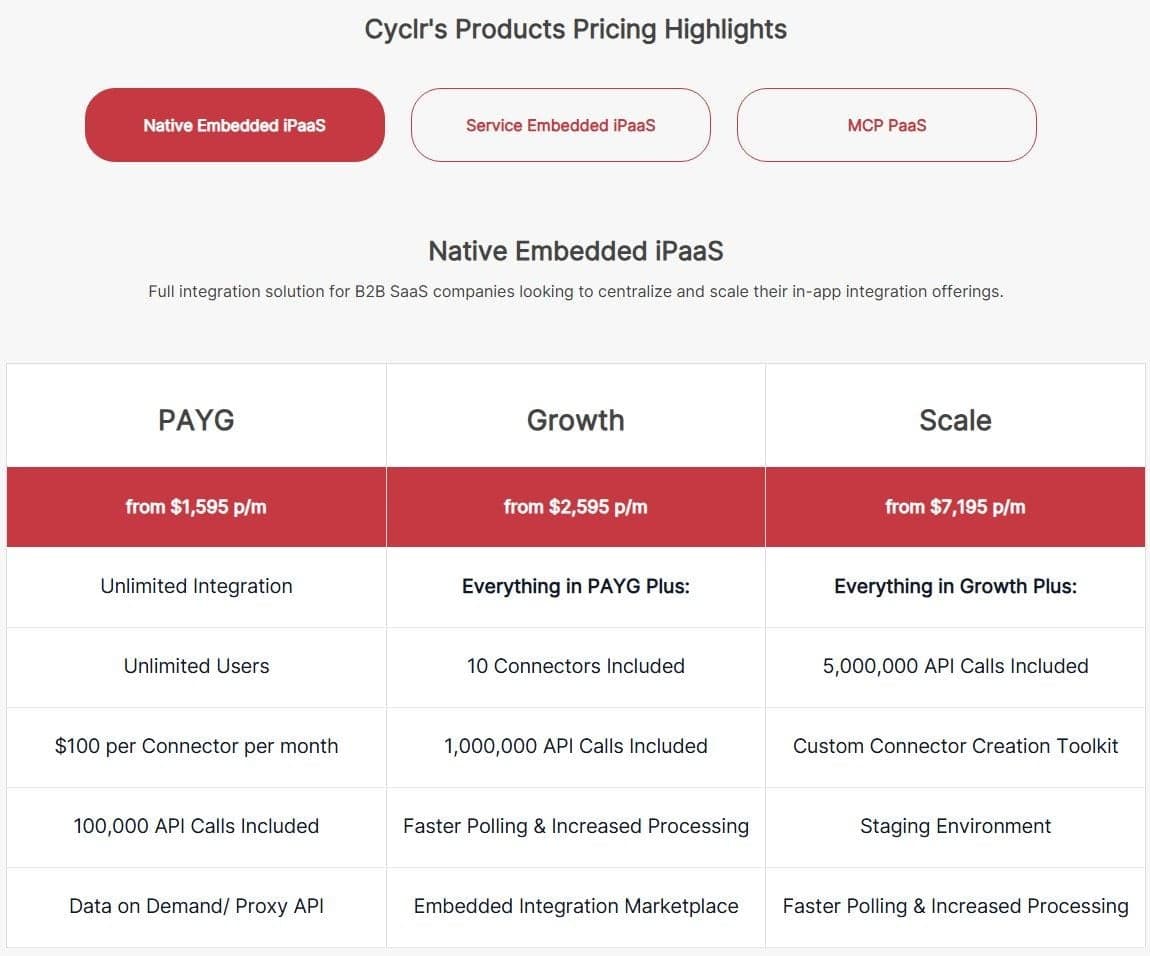
Native Embedded iPaaS runs from $1,595 a month on PAYG, with 100,000 API calls, and charges $100 per connector per month. Growth from $2,595 a month adds 10 connectors, 1,000,000 API calls and the embedded integration marketplace. Scale from $7,195 a month adds 5,000,000 API calls, the custom connector toolkit and a staging environment. Service Embedded iPaaS starts at $1,495 a month on shared hosting in a US, UK or EU region, with a quote-only Private Cloud tier. All four are 'from' prices as of September 2026, printed on the plan cards, exclusive of local taxes.
"charged once per month for each active Connector used in your account in the last 30 days ... Each Connector can be used in unlimited workflows and by unlimited users. ... no longer actively being used then it will be removed from your billing"
Source: cyclr.com
The meter is the active connector: Cyclr bills monthly for each connector used in the last 30 days, with unlimited workflows and users per connector, and drops it once unused. API allowances reset monthly. Calls above them are billed at published rates added to next month's subscription, a rate the page never shows.
Cyclr's FAQ ties unlimited customers and integrations to the Growth and Scale plans, and words it as 'Subject to any API Call limits', while the PAYG column still prints 'Unlimited Integration' and 'Unlimited Users'. Either way the API call allowance caps a plan: 100,000 a month on PAYG, 1,000,000 on Growth, 5,000,000 on Scale. Confirm which limits apply to your plan before buying.
6. Alloy Automation: best quote-based embedded integrations
Alloy Automation publishes no plan cards and no numbers. Its pricing page asks buyers to contact the team for a custom price quote based on their integration requirements, and promises volumetric discounts and 350+ prebuilt connectors on every plan.
The product splits in two, run from one system: Alloy Flow for internal workflows, Alloy Embedded for integrations shipped inside a SaaS product. Both sell through the same quote-based pricing.
With no plan names, price points or usage unit on the page, no one can say what Alloy charges per customer or per action. Treat it as quote-only and ask for the meter in writing.
7. Pandium: best in-app marketplace with predictable pricing
Pandium Lite costs $499 per month and includes 25 tenants, 50,000 daily executions, unlimited integrations built with the integration hub and development kit, custom configuration, usage metrics, and managed authentication, versioning and hosting. Pro starts at $2,000 per month and adds the AI-powered integration code generator, a custom tenant package, unlimited daily executions, advanced reporting and a dedicated account manager. That is a 'starts at' price as of September 2026, since higher tenant packages and add-ons cost extra and those fees are not published.
Pandium's meter is the tenant: one customer's installed and configured copy of one integration, so 100 customers installing the same integration count as 100 tenants. It bills platform access and active tenants, not tasks, API calls or workflow volume, and does not charge for connector development. The in-app marketplace and integration team are add-ons.
8. Ampersand: best SaaS-to-SaaS integration layer for AI and product teams
Ampersand prices by infrastructure consumption. As of October 2026 its pricing page measures usage in Ampersand actions, namely Read, Write, Subscribe, Search and Proxy, and sets each plan by expected consumption, deployment requirements and support tier. It offers to help you model expected usage before you commit.
All three plans are custom. Ampersand for Startups is available through its startup program for teams onboarding their first serious customers. Growth adds custom integrations and extensible connectors, production troubleshooting and customizable operation and log retention periods. Enterprise can run in Ampersand's cloud or in your own Google Cloud or AWS account, with EU deployment options, forward deployed experts and support SLAs. No plan publishes a price, so ask for a usage estimate in actions before you compare it with a per-customer or per-connection meter.
9. hotglue: best embedded ETL for customer data
hotglue publishes no prices: Basic, Pro, Enterprise and Startup all end in a 'Let's chat' button, and the comparison table shows active tenants as 'Custom' on every plan. A trial comes through the team. Startup is for companies that raised less than $5M or are bootstrapped under $1M in revenue.
The meter is the active tenant: one of your own customers that has connected an integration and run a sync job in the last month. Connectors are unlimited on every plan and not counted.
Basic covers the Python transformation layer, a white-label embeddable widget, managed authentication and custom field mapping. Pro adds a white-label API and callback URL, observability integrations and on-premise connectors. Enterprise brings an SLA, connector sandbox access and custom region hosting. Annual plans carry a one-month discount, and hotglue sizes plans by customer count, recommending Basic for up to 50 customers and Pro for up to 200. Since it publishes no prices as of September 2026, those are recommendations, not tiers, and the discount's cash value is unpublished.
10. Tray.ai Embedded: best enterprise embedded automation on a workflow platform
Tray Embedded puts an integration marketplace inside your own product. Components render in your UI under your brand, with 700+ pre-built connectors plus an HTTP client for the long tail. A Configuration Wizard walks end customers through auth and activation. Tray maintains the connectors, runtime, auth flows and API changes so your engineers need not.
The embedded page carries no pricing block and routes buyers to a demo, a free trial or sales. Pricing stays with the main platform, where Pro, Team and Enterprise are quoted on usage and the features needed. Usage is measured in Tasks that cover integration, automation, MCP and agents. All plans include business-hours support, with 24/7/365 support, enhanced SLAs and dedicated Slack channels on Team and Enterprise.
11. Workato Embedded: best for teams already on Workato
Workato Embedded comes in three deployment models. Under Managed Service, the vendor's team builds and maintains customer integrations. Branded Access is a white label of the Workato UI with your branding. Fully Embedded puts Workato inside your product UI with full Embed API access. Partners get 1200+ pre-built connectors and a Connector SDK, on the main platform's codebase. Our guide to Workato alternatives compares enterprise, mid-market and open-source options.
No price is published for the embedded product: every call to action there is a demo. The main pricing page is quote-based too, noting that pricing and plan structures may vary by contract terms and when the customer joined. Workato's self-service Free and Pro plans belong to the main Workato platform, not Workato Embedded, which publishes no price at all. Free grants a one-time 50,000 credits. Pro sells recurring monthly credits, from 2,500 at $75 a month to 50,000 at $1,275, expiring at the end of the billing month (rates as of September 2026).
Workato is one of several enterprise iPaaS vendors that sell an embedded edition next to their main platform. Two more are worth a look if your team already runs them internally.
Boomi Embedded: OEM, reseller and referral routes for software providers
Boomi offers software providers three routes: OEM, which embeds Boomi's integration capabilities into your SaaS platform; Reseller, where Boomi co-sells with you and supports your customers; and Referral. The customer-facing piece is Boomi Spaces, simplified portals where your team or your customers install and configure templated integrations, then schedule, run and monitor them. Admins set how much each user can change inside a template.
No price is published for the embedded program. The main platform's Pay-As-You-Go edition costs $99 a month plus a flat $0.05 per Boomi Message, charged monthly in USD, and is currently open only to active trial users. A Message is a single Boomi document that flows through the platform.
Jitterbit: Harmony as a white-label OEM product or an embedded service
Jitterbit sells its Harmony iPaaS to software vendors in two forms. The OEM solution is purchased, rebranded and sold within your product portfolio as a white label. The Embedded solution is built into your product as a core service component and accessed through APIs, so your customers build and manage integrations with low-code tools inside your application. Prebuilt connectors reach APIs such as Salesforce and NetSuite, recipes are simple one-way integrations between two apps, and process templates move data both ways across two or more systems.
Jitterbit publishes no price for either option. Its iPaaS pricing page sizes the Standard, Professional and Enterprise editions by connections, from 2 to 3 on Standard to 8 or more on Enterprise, asks buyers to request a quote and requires an annual contract for all products.
12. Latenode: a low-code workflow platform to run customer-facing automations next to your product
Latenode is a low-code workflow platform that also sells an embedded option. Its embedded iPaaS page describes an embeddable integration layer that lets a B2B SaaS product expose native connectors, API actions, workflow logic and AI-powered configuration directly in the product, and its White Label documentation covers embedding the Latenode SDK in your application, user authorization and administration of a White Label instance under your own brand. Latenode publishes no price for the embedded offer; the product page routes buyers to talk to the team. See Latenode's embedded iPaaS page for details.
The builder is a visual drag-and-drop canvas with an AI Copilot in every workflow, an AI agent builder, 335+ LLM models under one subscription and custom JavaScript nodes. Workflows drive a headless browser for sites without an API, fire on webhooks and use a built-in database.
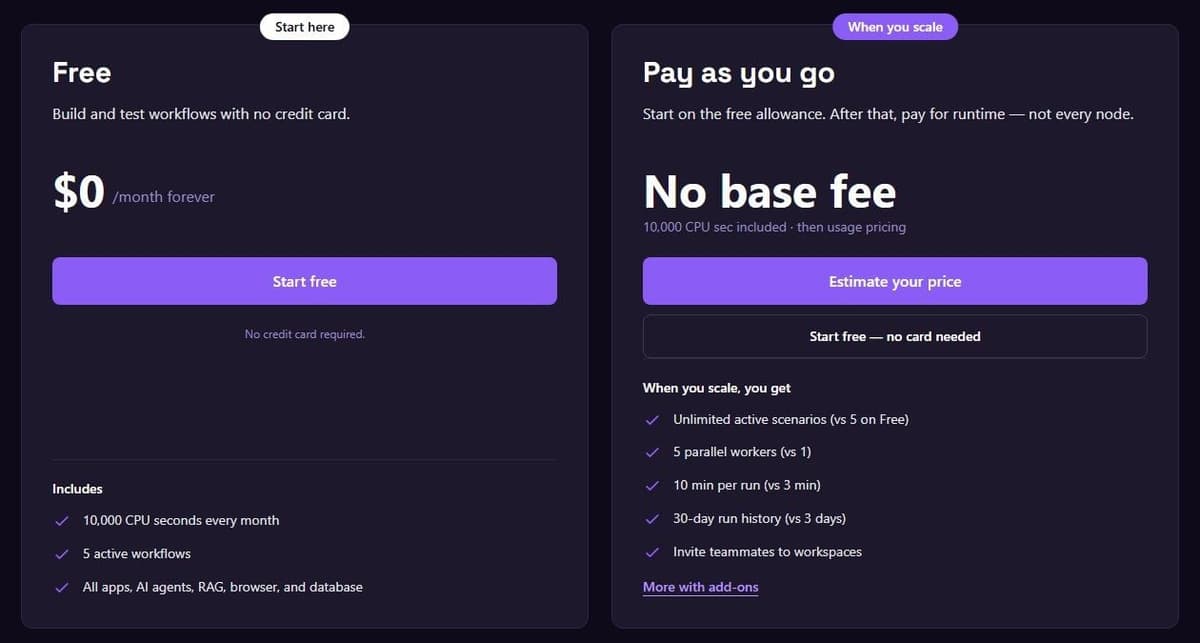
Latenode bills runtime in CPU seconds, not per operation, and the first 10,000 each month are free on both plans. Free costs $0 a month forever with no credit card: 5 active workflows, 1 execution worker, 3 minutes per run, 3 days of history, 10 connected authorizations and 16 MB files per run.
Pay as you go adds no base fee. It charges $0.00012 per CPU second from 10,001 to 100,000, $0.00011 from 100,001 to 200,000 and $0.00010 from 200,001 to 300,000. Each bracket bills only the runtime inside it. Nodes marked with a dollar icon use optional PnP tokens: one token is $1, charged by actual provider usage on top of runtime.
How embedded iPaaS platforms charge
Nango bills per connection: $0.29 once its monthly credits are used. One connection is one API key or access token. Other meters count customers. Paragon counts Connected Users, Pandium tenants at one per customer-integration pair, hotglue active tenants with a sync job in the last month, Merge production Linked Accounts at $65 each above ten.
Action meters come next: Tray.ai counts Tasks, Workato credits. Cyclr charges per connector, $100 a month for connectors active in the last 30 days, plus an agreed one-off fee, sized from Small to Large, when it builds one. Its API allowances run from 100,000 to 5,000,000 a month. Ampersand counts actions: reads, writes, subscriptions, searches and proxy calls.
A per-customer meter ties the bill to your customer list rather than to how hard the integrations work. In any quote, ask what one unit is, the overage rate, the minimum term, and which limits are hard caps.
Build, buy or embed: how to choose
Start with two numbers: how many integrations you must ship, and how many customers will connect them. The first drives connector coverage and effort, the second your bill on per-customer meters.
Building in-house means owning OAuth flows, token refresh, retries, rate limits, API changes and per-customer monitoring for the life of the feature. An auth and sync layer such as Nango takes credentials and syncs off your team and leaves product logic in your code. An embedded iPaaS takes the interface too, and renders inside your product under your brand.
Buying does not remove per-customer monitoring, so ask how a partial failure for one customer reaches you and how long the evidence lasts. Merge Launch keeps logs for 3 days as of September 2026, and Ampersand lists log retention as customizable on its Growth plan, so check the window you would actually get: a sync that quietly drops records can outlive its logs. Pick a retention window longer than your customers take to report missing data, or ask whether logs can flow into your own monitoring; hotglue's Pro plan, for one, lists observability integrations. One user on r/automation described the risk: "a partial write that succeeds on 8 of 10 records looks identical to full success until someone notices missing data three weeks later."
Before you sign, test what a demo hides. Ask what happens when one customer's token refresh fails, how rate limits hold up when hundreds of tenants sync at once, and whether one tenant's errors can stall another's. Ask who updates a connector when the third-party API changes: Tray.ai Embedded and Cyclr's Branded Embedded iPaaS say the vendor keeps connectors current, while on Nango the integration code is yours. Ask which screens you can rebrand or replace, since white-label options run from a styled portal to a headless SDK for your own UI. Then price the quote at the customer count you expect in a year or two, not today's.
For breadth across a category rather than depth in a few apps, a unified API is the shorter path. When each integration carries its own logic, per-app workflows win. Data residency narrows the field. Cyclr deploys a Self-Hosted Enterprise plan into your own AWS or Azure account, Nango and Paragon self-host on Enterprise, Ampersand Enterprise can run in Ampersand's cloud or in your own Google Cloud or AWS account, and Prismatic Enterprise private and GovCloud hosting.
Check who builds: Prismatic pairs code-first tools with low-code, hotglue expects Python, Cyclr leans low-code, while Pandium is code-first by design: your developers write the integration logic in their own language and Pandium runs the infrastructure. Then weigh budget certainty: Cyclr, Pandium, Merge and Nango publish a number, while Paragon, Prismatic, Alloy, hotglue, Ampersand, Tray.ai Embedded, Workato Embedded and Latenode's embedded offer quote. Latenode's per-CPU-second rate prices its workflow platform, not the embedded offer. A general workflow platform is enough when the automation runs beside your product, not inside your customer's account in your UI.
Integration now runs the other way too: your customers' AI agents calling your product, for example through an MCP server. A few vendors here mention MCP in their pricing: Prismatic's Scale plan lists AI-enabled development with MCP server support, and Tray.ai's Tasks meter covers MCP and agents along with integration. Neither line says what that MCP layer exposes, so ask in the demo whether outside agents can call your product through it or whether it only helps your team build integrations, and how those calls are metered. A user on r/mcp described customers who "churned to make their process automated with MCPs and go for competitors."
Which platforms overlap and which sit next to each other
Embedded iPaaS vendors mostly replace each other: Paragon, Prismatic, Cyclr, Pandium, Alloy, Tray Embedded and Workato Embedded all sell a marketplace, connectors and an execution engine inside your product, so you pick one.
The other categories stack. A unified API such as Merge sits next to an embedded iPaaS when you want one schema across a category instead of per-app work. An auth and sync layer such as Nango goes under a custom build: it holds credentials and syncs while your code keeps the logic. hotglue fits where the job is moving customer data rather than firing actions.
Ampersand is a fifth shape: a managed read-and-write sync layer between your product and your customers' SaaS apps, billed on the actions it runs, such as reads, writes and subscriptions, rather than on connecting customers. It overlaps an embedded iPaaS on connector and auth work but stops short of the UI, so teams run it instead of building their own sync layer, not instead of an in-product marketplace.
A workflow platform is another shape. Latenode runs internal and customer-facing automations beside the product and bills in CPU seconds with no per-operation fees. It also sells an embedded iPaaS with White Label documentation, so if the integration must live in your own UI, compare its embedded offer with the platforms above.