

Here's a pattern I keep seeing in support threads, onboarding calls, and the occasional frantic Slack message: someone has just bought a BPM tool. They've maybe built a few process diagrams. They're calling it "our BPM initiative." And when something breaks six months later, or nothing measurably improves, they open a ticket or ask a question that reveals the same underlying gap: they treated BPM as a project with an end date, not a cycle with a feedback loop.
The business process management lifecycle is not a one-time transformation. It's a closed-loop, strategy-led cycle that keeps running. Teams that don't understand this either stall after implementation or repeat the same inefficiencies under a new tool's branding. That's the central claim here, and it's falsifiable: you can disagree with it by pointing to teams that ran a one-time BPM initiative and never needed to revisit it. I haven't met those teams, but they could exist.
The part teams learn after the tool is already running
- The BPM lifecycle is a repeating cycle, not a deployment project with a done state.
- It starts with process discovery, not tooling selection - that order matters.
- Automating a process is not the same thing as managing it.
- The lifecycle applies to teams of five or five hundred.

What Business Process Management Actually Covers
Business process management is a discipline focused on repeatable, end-to-end processes that cross functional boundaries inside an organization. Not one-off projects. Not individual task lists. Whole business processes, from trigger to outcome, running on a cadence.
The distinction matters because people collapse these categories constantly. A project has a start date, a scope, and an end. A task is a single work item someone checks off. Business operations are different: they're the ongoing, repeatable patterns of work your organization runs to deliver value, handle customers, process orders, onboard employees, or anything else that happens more than once.
BPM covers those repeatable end-to-end processes: understanding what they are, designing how they should work, putting those designs into motion, watching what actually happens, and improving based on what you find. That loop is the whole discipline. Where it doesn't apply: project-specific work, individual task management, or anything that runs once and never repeats.
If your business processes are running whether you manage them or not, BPM is the decision to manage them intentionally.
What the BPM Lifecycle Is and Why It's a Cycle, Not a Project
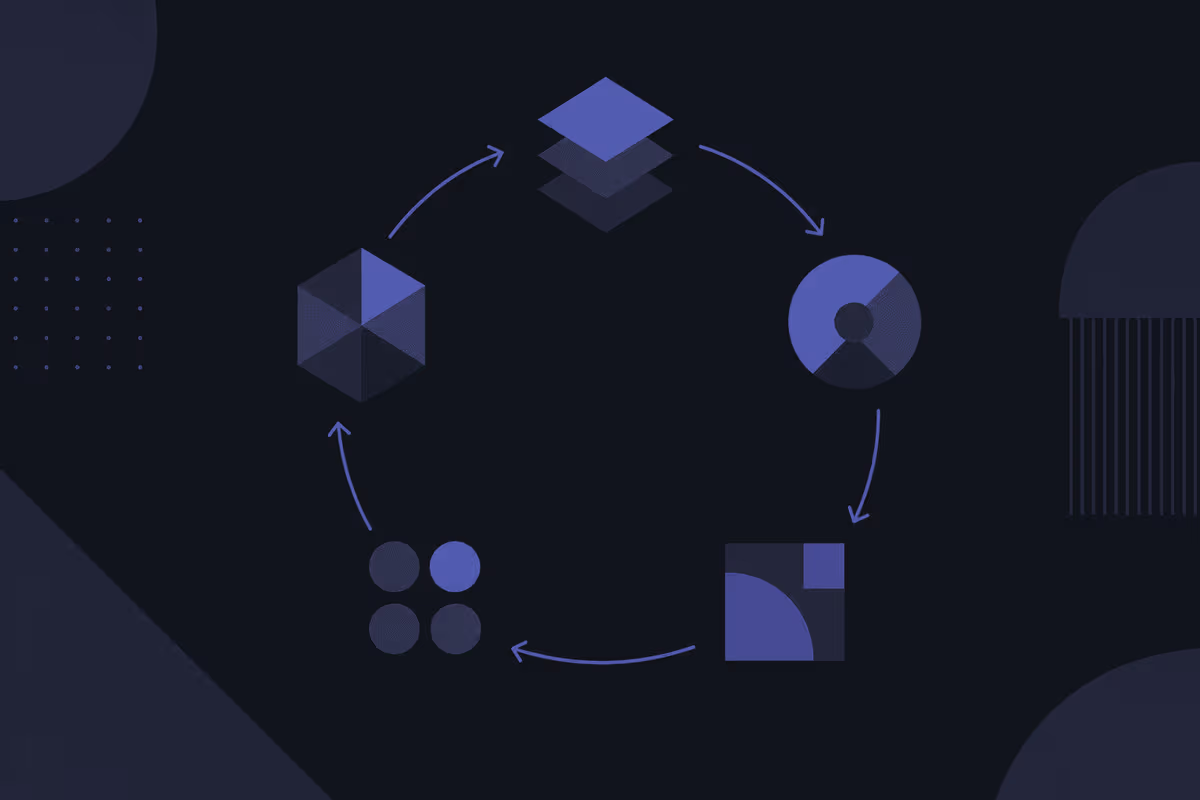
The BPM life cycle is a cyclical framework of phases used to design, execute, monitor, and continuously improve processes across an organization. The word "cyclical" is doing real work in that sentence. The stages of BPM don't run once and conclude. Each optimization loop feeds the next design phase, which updates the model, which changes execution, which generates new monitoring data.
The misconception that keeps showing up is that the BPM lifecycle provides a one-time transformation roadmap. You do the phases, you're done, you move on. This is how projects work. It's not how BPM works. An iterative process by definition doesn't have a terminal state, and treating the BPM lifecycle as a project with a completion date is precisely why so many initiatives produce a process documentation repository that nobody updates and a tool nobody maintains after the consultant leaves.
The business processes you improve in cycle one will need revisiting in cycle two, because the environment changes, the team changes, the strategy shifts. The lifecycle isn't a sign that something went wrong. It's the mechanism that keeps things right.
The Stages of Business Process Management, Phase by Phase
Most authoritative models describe five to six core BPM lifecycle stages. Terminology varies across frameworks, but the underlying pattern is consistent: discover, model, execute, monitor, optimize. Some modern frameworks add an explicit governance phase. Here's what each stage actually involves and where teams typically hit problems.
Process Discovery and Definition: Where the BPM Lifecycle Has to Start
The lifecycle begins before anyone opens a modeling tool or selects software. It begins with understanding what your business processes actually are - not what the org chart says they should be, but what people are actually doing to accomplish the work.
Process discovery involves mapping current-state workflows, interviewing the people who run them, and identifying where the process deviates from its intended path. Process mining and task mining tools can accelerate this by analyzing system logs to reconstruct actual process flows automatically. But even without software, the discipline is the same: observe first, design second.
This phase also connects BPM to business strategy. What are the business goals this process needs to support? What does success actually look like in measurable terms? Teams that skip discovery and jump straight to automation are automating assumptions, not processes. I've seen this specific pattern enough times to have a name for it internally: automating the fiction. The workflow runs perfectly and produces results nobody asked for.
Business strategy and business goals anchor discovery. Without that anchor, you're optimizing in a direction you haven't verified is correct.
Process Modeling: Turning What You Found Into Something You Can Test
Process modeling is the translation step. You take what discovery revealed and turn it into a structured process model - a representation precise enough that it can be tested, simulated, or handed to implementation without ambiguity.
In practice, what teams produce here is a process design document, a BPMN diagram (the Object Management Group maintains the notation standard most BPM tools use), or a workflow map that captures triggers, steps, decision points, business rules, exceptions, and the roles responsible for each. The exact format matters less than the rigor. A process model that's incomplete at this stage creates execution problems downstream - teams implement the parts that were specified and improvise the parts that weren't, and that improvisation becomes the new de facto process.
Skipping modeling to get to execution faster is roughly equivalent to skipping the blueprint to start construction. Things get built. Whether the right things get built is a different question.

Execution and Implementation: Where Most BPM Initiatives Hit Their First Wall
Execution is where the modeled process is deployed. That might mean building it in a BPM suite, configuring automation software, or establishing managed human workflows with defined handoffs and tools. This is the phase most teams associate with "doing BPM" - and it's also the source of the most common misconception in the space.
Deploying a tool does not mean you're doing BPM. Business process automation handles process execution, and robotic process automation can accelerate specific repetitive steps, but the execution phase is one stage in a six-stage cycle. A team that configures software, calls the project complete, and moves on hasn't implemented BPM. They've implemented software.
The new process that emerges from execution needs to be monitored before it can be trusted. What was designed is rarely identical to what runs in production. Implementation surfaces edge cases, missing rules, and human behaviors the model didn't account for. That's not a failure of the model. It's the reason the next phase exists.
Monitoring, Optimization, and Continuous Improvement: The Phase Teams Skip
Monitoring is where you find out whether the process you designed and deployed actually works. Track process performance against the metrics defined in discovery: cycle time, error rate, cost per execution, exception frequency. Without monitoring, you're flying without instruments.
The optimization phase closes the loop. When monitoring reveals a deviation, a bottleneck, or a performance gap, the team redesigns the relevant part of the process and runs the cycle again. This is continuous process improvement operating inside a structured lifecycle, not as a separate initiative. Continuous improvement in BPM isn't an attitude or a philosophy. It's a phase with inputs (monitoring data), a mechanism (root cause analysis and redesign), and outputs (an updated process model).
Research published in the International Journal of Lean Six Sigma found that a structured BPM lifecycle framework is linked to higher process performance and ongoing governance alignment - not just one-time efficiency gains. The discipline of the cycle produces compounding returns. Teams that monitor and optimize consistently tend to close the gap between designed performance and actual performance over time. Teams that stop at execution tend to see that gap widen.
Modern lifecycle extensions, from frameworks developed by organizations like Navvia and BPMInstitute.org, add explicit governance stages that sit alongside monitoring. Governance addresses who owns the process, who can change it, and how changes get approved. That ownership question is where most long-running BPM implementations eventually stall.
That is where the ticket usually starts.
Types of Business Process Management: Why the Same Lifecycle Looks Different Across Teams
The same lifecycle phases apply across all types of business process management, but the weight of each phase shifts depending on what kind of BPM a team is running. There are three main types of BPM, and getting them confused produces misaligned tooling choices and miscalibrated lifecycle investments.
Integration-centric BPM focuses on connecting systems and automating data flows across applications. The execution phase is heavy: building integrations, configuring triggers, managing payloads. Monitoring looks like watching for failed syncs, API errors, and field mapping mismatches. Teams running integration-centric BPM spend comparatively less time in governance because the process is largely system-mediated.
Human-centric BPM focuses on processes where people are the primary actors: approvals, escalations, reviews, handoffs between teams. The modeling phase matters more here, because the rules governing human decision-making need to be explicit. Monitoring looks different too: you're tracking task completion rates, assignment accuracy, and time spent in queue rather than API response codes.
Document-centric BPM revolves around the creation, review, routing, and approval of documents. A compliance team processing contracts, a legal team managing policy reviews, a finance function handling invoice approvals. This type of BPM spends the most lifecycle time in monitoring and governance. Document trails, audit requirements, and regulatory constraints mean the governance phase isn't optional - it's the point.
A compliance team running document-centric BPM will configure their lifecycle differently than an ops team automating data flows, even if both are using the same five-stage framework. The stages are the same. The implementation emphasis is different. Choosing tooling before identifying which type of BPM you're running is a very reliable way to buy the wrong tool.
Benefits of Business Process Management That Are Actually Tied to Lifecycle Discipline
The advantages of business process management are real, but they're tied to specific lifecycle phases doing specific work. Each benefit below has a corresponding lifecycle mechanism - and a failure mode that appears when teams skip that phase.
Cost reduction through discovery
Process discovery surfaces redundant steps, duplicate work, and manual effort running where a decision should be sitting. Without discovery, you don't know which costs are structural and which are incidental. Teams that skip discovery and jump to execution often automate the expensive thing instead of eliminating it.
Cycle-time improvement through modeling and execution
Modeling makes the bottlenecks visible before deployment. When execution runs a well-modeled process, cycle times drop because the handoffs are clean and the exceptions are handled. When execution runs an unmodeled process, cycle times drop initially and then creep back up as the edge cases accumulate.
Compliance readiness through monitoring and governance
Compliance functions need audit trails, version history, and documented ownership. Those requirements are met by monitoring and governance phases, not by buying compliance software. Business processes are continuously improved only when someone is actually watching them and recording what changed.
Greater business value through alignment with business objectives
Strategy alignment happens in discovery, when process goals are tied to business objectives explicitly. Teams that define BPM goals as "efficiency" without connecting to a specific business goal optimize processes in a direction the business hasn't confirmed it needs. Better business outcomes come from a BPM lifecycle grounded in strategy from phase one.
Sustained improvement of business processes through continuous optimization
One-time process improvement is a project. Repeated optimization cycles inside a BPM lifecycle is how organizations actually improve over time and optimize business processes durably. The difference is whether the loop closes. If monitoring data never feeds back into redesign, you've built a one-way pipeline, not a lifecycle.
🤔 Wait.
Most teams that report "implementing BPM" have deployed software and documented current-state processes. That covers execution and part of modeling. But if there's no monitoring cadence, no defined process owner, and no mechanism for feeding performance data back into redesign - is that a BPM lifecycle, or is that just BPM software sitting on top of an unmanaged process?
BPM vs. Project Management: A Distinction That Comes Up in Almost Every Support Thread
Business process management and project management solve different problems. Getting them confused produces real organizational dysfunction, so let me make this fast.
BPM manages ongoing, repeatable end-to-end processes that the organization runs continuously. Project management handles temporary, scope-bounded initiatives with a defined start and end. The BPM lifecycle has no natural end state. A project closes when deliverables are complete.
A few quick contrasts that actually hold up in practice:
- BPM: the same process runs 500 times a month. Project management: this initiative runs once.
- BPM: process owners maintain the system after launch. PM: the project team disbands after delivery.
- BPM: performance is tracked over time against consistent metrics. PM: success is measured against original scope and schedule.
Adjacent disciplines add more confusion. Customer relationship management, human resource management, and enterprise resource management all involve business processes - but they're functions that operate within processes, not frameworks for managing the processes themselves. BPM is the discipline that governs how those processes are designed and improved. The tools are different objects.
The confusion between BPM and project management usually appears when teams try to close a BPM initiative: "We finished the process redesign project." There's no finished. There's the next monitoring cycle.

What Successful BPM Implementation Usually Requires Before Anyone Touches a Tool
Successful BPM doesn't start with a purchasing decision. It starts with a set of preconditions that most teams either partially complete or skip entirely. Think of this as the pre-flight checklist for any BPM initiative.
Process discovery completed. Before tooling, before modeling, the current-state process needs to be documented and understood. What are the actual steps? Where does work pile up? Where does it break?
Strategic objectives defined. What business problem is this BPM work solving? If the answer is vague ("improve efficiency"), it's not defined enough. If it's specific ("reduce order processing time from 4 days to 24 hours for orders under $10,000"), you have something to measure against.
Process owners assigned. This is the one most teams skip. Someone needs to own each process: responsible for its performance, accountable when it breaks, authorized to redesign it. Without process owners, monitoring produces data nobody acts on and optimization cycles never start.
Governance structure decided. Who can change the process? What approval is needed to redeploy? How are exceptions escalated? This doesn't need to be elaborate for a small team, but it needs to exist. Modern lifecycle frameworks are explicit about governance as a distinct phase, not a bureaucratic overlay.
Change management plan in place. BPM initiatives change how people work. Change management strategies address the human side: communication, training, stakeholder alignment. The automation can be perfect and the adoption can still fail. Those are separate problems and require separate attention.
For automation and operations teams starting a BPM initiative on a platform like Latenode, doing this pre-work before building the first workflow means you're configuring execution against an understood process model rather than translating tribal knowledge into nodes and hoping it holds. It takes longer up front. It produces significantly fewer "why does this workflow do that?" tickets six months later.
📊 In practice:
Research published in the International Journal of Lean Six Sigma found that organizations applying a structured BPM lifecycle framework showed sustained governance alignment and ongoing process performance improvements - not just initial efficiency gains. The structure of the lifecycle itself, not the tooling, drives durability. That's not a vendor claim. That's the academic finding that sits underneath most serious BPM frameworks.