


Most teams that come to me burned by a bad automation project tell the same story. They mapped a process, picked a tool, built the workflow, and launched. Six months later, the automation is running perfectly and the wrong things are still happening. The root cause is almost always the same: they skipped the diagnostic step and went straight to the solution.
That diagnostic step has a name. Business process analysis.
What most teams learn too late
- BPA is a structured diagnostic method, not a documentation exercise-and skipping it means automating the broken version.
- A process map is one output of BPA, not the end goal; analysis of each step is where the actual value lives.
- BPA without a monitoring phase isn't finished-it's just a project with an optimistic end date.
- Process mining only returns useful findings when the underlying event log data is clean; bad data produces confident-looking wrong answers.
- BPA scales to SMBs and single-process pilots; it doesn't require a full organizational overhaul to deliver a measurable result.
What Business Process Analysis Actually Means
Business process analysis is a systematic method for examining and evaluating how work actually moves through an organization. The goal is to identify inefficiencies, bottlenecks, and improvement opportunities before deciding what to change.
The IBM-sourced definition is worth stating plainly: BPA uses evidence to understand business processes-interviews, direct observations, surveys, and existing documentation-not just a whiteboard session where people describe how they assume the work happens. That distinction matters more than it sounds. In my experience, the whiteboard version and the evidence-based version produce different maps roughly 70% of the time.
The importance of business process analysis is that it closes the gap between how a process is supposed to work and how it actually works. That gap, when left unmeasured, gets automated. Business process analysis provides the diagnostic foundation that prevents teams from scaling a broken process instead of fixing it.
BPA isn't a single technique. It's a structured approach that can include process mapping, root cause analysis, process mining, stakeholder interviews, and gap analysis-applied in sequence so that findings lead to real improvements rather than a slide deck that lives in a shared drive until the next reorganization.

Business Process Analysis vs. Business Process Management: Why the Distinction Matters
People use BPA and BPM interchangeably. They're not the same thing, and conflating them creates real problems when you're trying to explain to a stakeholder what you're actually doing.
Business process management is the broader discipline. According to IBM and the BPM Institute, BPM covers the full lifecycle of making business processes effective, efficient, and adaptable over time-including design, execution, monitoring, and optimization. It's an ongoing management system, not a one-time project.
BPA sits inside that system as the diagnostic phase. It's what you do when you need to understand the current state of a process before you can make informed decisions about what to change. BPM without BPA is just organizational activity. BPA without BPM is a diagnostic report that never connects to sustained business process improvement.
The practical implication: if someone asks "are we doing BPA or BPM," the honest answer is usually "right now, BPA-the diagnostic work that should precede the broader BPM investment." One of the areas of business process management where teams skip BPA most often is pre-automation planning. They jump from "we have a process" to "let's manage it better" without ever clearly documenting what the process actually does.
Business Process Analysis vs. Business Analysis: Where Teams Get Confused
A business analyst asked me about this last year during an onboarding session. Her team kept being handed "BPA work" that was actually requirements gathering for a new system, and she couldn't figure out why the scope kept expanding.
Business analysis is the broader discipline: identifying business needs, evaluating options, and defining requirements across systems, processes, and stakeholder gaps. Business process analysts do a specific subset of that-process-level diagnosis. They focus on how work flows, where it stalls, and why.
A business analyst might be identifying business needs across an entire department and recommending a new CRM. A business process analyst is mapping the lead qualification workflow inside that CRM and finding the step where records get stuck. Same job family. Very different scope. Teams that confuse them end up with process analysts redesigning software architecture, or analysts mapping workflows that need requirements work instead.
Core Business Processes Worth Analyzing First
Starting BPA with a list of every workflow in the organization is how BPA projects fail. You end up with enormous maps, contested findings, and no clear starting point for change.
The smarter question is: which specific process is causing a measurable problem right now?
Four categories tend to yield the highest return on BPA effort:
Operations bottlenecks where work visibly piles up at a consistent point-approval queues, handoffs between teams, or steps that require manual intervention before anything can move forward.
Compliance and audit gaps where a business operation has regulatory requirements but no documented, verifiable process flow to show an auditor. Healthcare pathway analysis is a good example: NHS England's quality improvement work treats structured process mapping as foundational for safe, evidence-based change in clinical pathways.
Pre-automation candidates where a team is about to invest in a workflow tool. This is the scenario I care about most. If you automate before BPA, you lock in the current process-including the broken parts. Business goals don't get met faster by running a flawed process at scale.
KPI divergence where a business function is underperforming against expected targets and the cause isn't obvious. BPA turns a vague "something is wrong" into a specific "this step takes 3 days when it should take 4 hours."
Analyzing a process in isolation, without following the end-to-end flow, is a reliable way to miss the actual problem. The bottleneck in step 4 is often caused by something in step 1 that nobody looked at.
How to Perform a Business Process Analysis: The Standard Steps
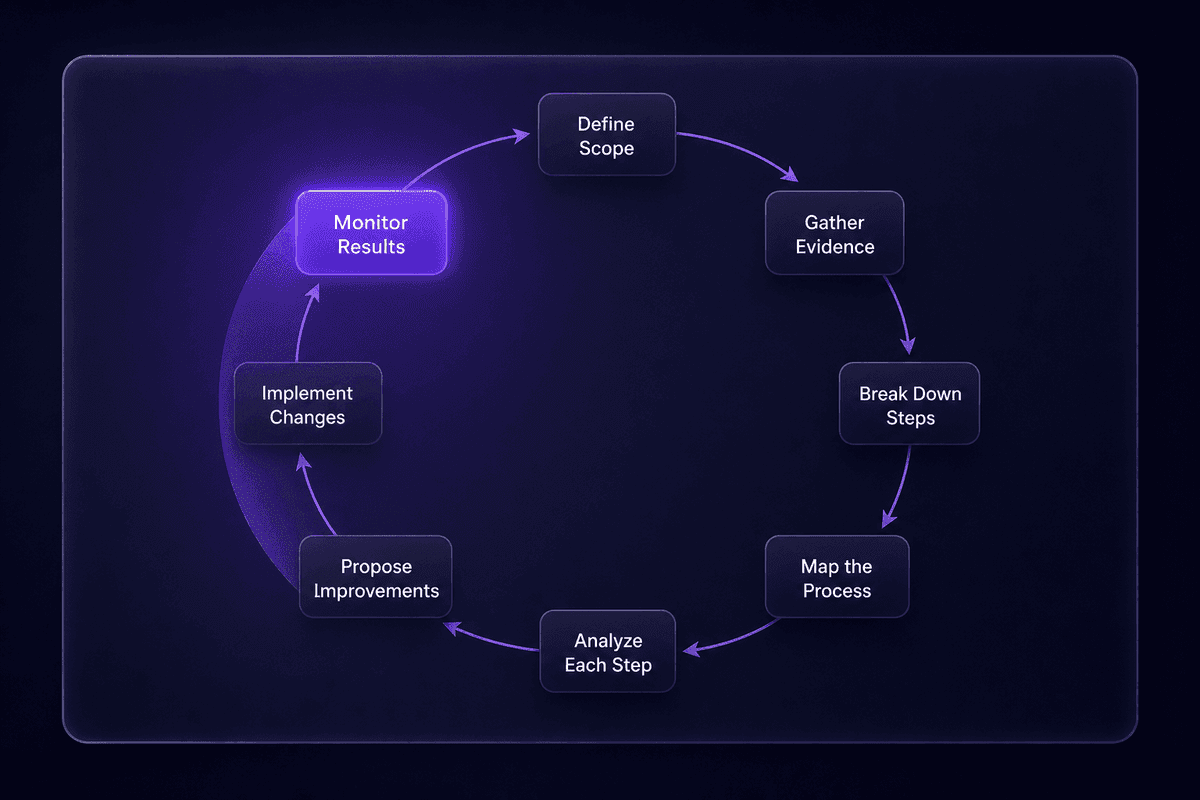
The IBM-sourced BPA sequence is eight steps. That sounds like a lot until you realize that most teams skip the last two-and those are the steps that determine whether anything actually changes.
Step 1: Define the process scope. Pick one process with clear start and end points. "Onboarding" is too broad. "The steps between a signed contract and a new user's first login" is a process. Scope before anything else.
Step 2: Gather information. This is where BPA earns its description as evidence-based. Interviews, direct observations, process walkthroughs, timing studies, and documentation review. Not just one of these.
Step 3: Break it down into individual steps. Map every discrete action in sequence, including the informal workarounds people have developed over time. Those workarounds are often the most revealing data you'll collect.
Step 4: Build the process map. Visualize what you've gathered. This is a tool, not the deliverable.
Step 5: Analyze each step. Where does work wait? Where does it get repeated? Where does quality vary? This is the diagnostic phase that most teams underinvest in.
Step 6: Propose improvements. Specific, measurable, connected to the findings from step 5.
Step 7: Implement changes. Coordinated, with clear ownership.
Step 8: Monitor results. This is the step that turns BPA from a project into a thorough business process analysis with a real feedback loop.
Stopping at step 7 is extremely common. It's also the reason so many improvement projects don't hold. The monitoring phase isn't optional-it's what closes the loop.
Gathering Information: Interviews, Observations, and Existing Documentation
This step stalls more BPA projects than any other. I keep seeing this pattern: teams schedule one stakeholder meeting, produce a process map from the notes, and call it research. Then they discover in step 5 that the map doesn't match what anyone actually does.
Business process analysis requires layering multiple evidence sources. Interviews reveal what people believe the process is. Observations reveal what people actually do. Documentation review reveals what the process was supposed to be. The gaps between those three are usually where the real problems live.
Document the current process using all three sources before building any map. Surveys help for larger teams where direct observation isn't practical-asking 30 people "where does this step slow down for you" surfaces patterns that a single stakeholder interview would miss entirely. Business needs often look different depending on who in the process you're asking.
Process Mapping as an Analysis Output, Not the End Goal
A process map is where a lot of teams stop. The map looks complete, the workshop participants nod, the PDF gets filed. Nothing changes.
Business process mapping produces a visual representation of how work flows-steps, decision points, handoffs, roles, timing. Business process modeling can add more formal notation (BPMN is common) and can include success and error rates at each node. Both are useful. Neither is the analysis.
The analysis happens when you examine each step on the clear process map and ask: does this step add value, or is it overhead? Where do errors occur here? How long does this step actually take versus how long it should take? What happens when this step fails?
Include process modeling as a foundation for that conversation, not as the conclusion. A map that ends the discussion is a map that wasn't used.
Root Cause Analysis Inside the Process Review
Describing a bottleneck is not diagnosing it. "This approval step takes too long" is an observation. "This approval step takes too long because the approver receives requests without the information they need to decide, so they have to request more information, which adds a 2-day loop" is a diagnosis.
Root cause analysis is the step that moves BPA from documentation to actual understanding of the current process flow. The basic technique is to keep asking why until you reach an actionable cause. Five iterations is usually enough-after that you're either at a fundamental constraint or a people issue that needs separate handling.
Gap analysis sits alongside root cause work: comparing the current process flow to the desired future state to quantify the distance. What specifically needs to change for the process to reach its target performance? That framing turns improvement planning from abstract to specific.
Here's where it connects to automation. An operations team at a 40-person SaaS company I know spent three weeks building a Latenode workflow to automate their customer onboarding handoff. The automation worked as designed and the same delay remained. The root cause-found during a belated BPA exercise-was that the sales team was closing contracts without a required field populated. No automation fixes an input problem. The BPA would have taken two days. The rebuild took two weeks.
That is where the ticket usually starts.
Business Process Analysis Methods and Techniques
BPA isn't one technique. It's a family of them, and picking the wrong one for the situation adds overhead without adding insight. Here's how to choose:
| Technique | Best for | Output |
|---|---|---|
| Process mapping / BPMN | documenting current state for any process | visual flow with steps, roles, and decision points |
| Value stream mapping | manufacturing or service delivery chains where waste elimination is the goal | end-to-end flow with time and value data at each step |
| SIPOC | scoping a process before detailed mapping | one-page summary: suppliers, inputs, process, outputs, customers |
| Root cause analysis | diagnosing why a specific failure or bottleneck exists | identified root cause and improvement hypothesis |
| Gap analysis | measuring distance between current and target process performance | structured comparison across defined dimensions |
| SWOT analysis | evaluating a process in its organizational context | four-quadrant assessment of strengths, weaknesses, opportunities, threats |
| Process mining | data-driven discovery and validation using system event logs | actual process map from real data, with variant analysis and performance metrics |
Business process analytics connects all of these: the discipline of applying data to understand how processes perform, not just how they're documented. The question for each BPA project is which combination of these techniques fits the available evidence and the specific improvement goal.

Process Mining: When You Have Event Log Data to Work With
Process mining is the most analytically rigorous BPA technique available when your systems log events reliably. The premise: information systems record timestamps and activities as work moves through them. Process mining extracts those event logs and uses them to reconstruct what the process actually did-every variant, every time a step was skipped, every case that took longer than the median.
IBM describes process mining as sitting at the intersection of business process management and data mining. It discovers, validates, and improves workflows from real operational data rather than from stakeholder recollection. Research published in Scientia Iranica supports this: event-log-based analysis that visualizes and measures real business processes leads to more targeted managerial interventions, improving cycle time and compliance adherence in practice.
Process analysis can help surface things that interviews never will-the 23% of cases that always go through an undocumented exception path, the three team members responsible for 80% of approval delays, the integration that fails silently every Tuesday.
The process mining software market was valued at approximately $3.66 billion in 2025 and is projected to reach $5.45 billion in 2026 and $58.18 billion by 2035, according to Fortune Business Insights-a compound annual growth rate of around 18.37%. That expansion reflects a genuine shift in how organizations think about BPA: from periodic diagnostic events toward continuous, data-driven monitoring.
💡 Worth knowing:
Process mining only returns useful findings if the underlying event log data is clean and representative. Teams running BPA for the first time often discover during this step that their data quality problem is bigger than their process problem. Missing timestamps, inconsistent case IDs, and gaps in logging aren't just inconveniences-they make the process map untrustworthy. Fix the logging before you trust the map.
Value Stream Mapping, SIPOC, and Other Effective Business Process Analysis Techniques
Value stream mapping comes from lean manufacturing but applies cleanly to any service or administrative process with a clear end-to-end flow. It maps each step with its time and value-add status, making waste visible in a way that standard flowcharts don't. Use it when analyzing business operation processes where cycle time reduction is the explicit goal. It adds overhead when the process is short, knowledge-intensive, or highly variable between cases.
SIPOC (Suppliers, Inputs, Process, Outputs, Customers) is the right tool before detailed mapping begins. A one-page SIPOC answers the scoping question: what are the actual boundaries of this process? Business process analysis may get misdirected when the scope isn't agreed on before the mapping workshop-teams spend 45 minutes arguing about whether the vendor review step is inside or outside the process. SIPOC prevents that.
SWOT analysis, when applied to a specific process rather than an organization, helps connect process findings to strategic context-particularly useful when the improvement decision involves significant resource commitment. It's not a substitute for data-driven analysis, but it's a useful framing for the "do we fix this or replace it" conversation.
When to Apply Business Process Analysis-and When It Is Overkill
BPA is worth doing in four situations:
Before automation investment. Always. Business strategy built on workflow automation that skips BPA is how organizations end up running a broken process faster. The business operation hasn't improved; it's just more consistent in how it fails.
After repeated bottlenecks. When the same delay, error, or complaint resurfaces after fixes, that's a signal the fix addressed a symptom. BPA finds the underlying cause.
During compliance reviews. Regulated industries-healthcare, finance, legal-often require demonstrable process control. BPA produces the documented, evidence-based process description that compliance reviews require.
When KPIs diverge from targets. If the overall business shows a gap between expected and actual performance in a specific area, BPA connects that gap to a process-level explanation.
BPA is overkill in three situations most teams don't talk about openly:
A small, stable, low-risk process with no measurable problem doesn't need formal analysis. If a 3-step internal review process has worked without incident for two years and nobody is asking for changes, that's not a BPA candidate-it's a functioning process.
High-urgency production incidents need a fix, not a methodology. BPA is a diagnostic tool for improving processes, not for restoring service at 2am. Handle the incident first.
Processes with no data or access. BPA may require more investment in evidence collection than the process is worth analyzing. A process that touches one person for 20 minutes a week is probably not worth three weeks of interviews and mapping.
The misconception worth naming: BPA does not require a full process overhaul. Business process analysis may surface one targeted fix-a single handoff, a duplicated approval, a missing field-that delivers a measurable result without touching anything else. Starting small and scoping tightly is a legitimate strategy, not a compromise.
Benefits of Business Process Analysis Beyond Efficiency Gains
The "BPA saves time" framing undersells what it actually does. And it accidentally reinforces the idea that BPA is only relevant when processes are slow-which is wrong.
Compliance and auditability improve when processes are documented with evidence rather than described from memory. An auditor asking "show me how this approval works" should receive a process map backed by documented observations, not a verbal explanation from whoever happens to be in the room. BPA produces that artifact.
Pre-automation quality assurance is the business value I find most underappreciated. Automating a process that hasn't been analyzed first is a real failure pattern. Teams that skip this step end up with what one ops lead described as a "high-quality machine doing the wrong thing." BPA ensures you automate the right steps.
KPI alignment becomes visible through BPA. What specific process steps are preventing the business from meeting its targets? That question, answered with evidence, connects operational work to business goals in a way that generic efficiency metrics don't.
The improvement loop is what IBM identifies as the monitor-and-iterate phase. Business processes don't stay optimized without continued measurement. BPA that ends at implementation is a project. BPA with ongoing monitoring is a capability. Within a business, the teams that sustain process improvements over time are almost always the ones that built measurement into the process change rather than bolting it on afterward.
📊 In practice:
Teams that automate without prior BPA frequently discover they've scaled their workarounds, not their processes. A 2026 analysis from Process Excellence Network found that 59% of organizations now prioritize continuous process monitoring over one-off analysis-a shift that reflects how many improvement projects stalled when measurement stopped at go-live. Changes in a process that aren't measured after implementation tend to drift back toward the original behavior within months.
The belief that BPA only makes sense for large enterprises or IT teams is one I've watched cost smaller organizations real money. A 15-person finance team running broken invoice approvals has exactly as much to gain from a 2-day BPA exercise as a 2,000-person organization has from a 6-month engagement. The methods scale down.
Business Process Analysis Tools Worth Knowing
No single tool does all of BPA. The category you need depends on where you are in the process. Here's a practical guide:
- Process mapping software
Produces visual workflow diagrams from templates or free-form drawing. Output is a current-state map suitable for stakeholder review and step-level analysis. Use when the team needs a shared visual of how work flows before any other analysis begins. Examples include Lucidchart, Miro, draw.io, and Microsoft Visio.
- Process mining platforms
Extract and visualize actual process behavior from system event logs-ERP, CRM, ticketing, EHR. Output includes real workflow maps with variant analysis, cycle time data, and compliance checks. Use when system data is available and the goal is evidence-based discovery rather than stakeholder reconstruction.
- BPA frameworks and structured methodologies
SIPOC templates, value stream mapping guides, BPMN notation tools, and root cause analysis frameworks (5 Whys, fishbone diagrams). Output is structured analysis artifacts. Use at any stage where analytical rigor needs to be visible-particularly for compliance or audit contexts.
- Workflow documentation and knowledge management tools
Confluence, Notion, or similar platforms that store the process documentation output of a BPA exercise. Output is a living process map that can be updated as the process changes. Critical for maintaining the monitoring phase over time. These become the business function's institutional memory.
- Process automation readiness support tools
Low-code automation platforms where BPA findings translate into workflow configurations. The process map and root cause findings become the blueprint for what to automate-and which steps to leave as human decision points. Latenode fits here: once BPA identifies which steps in a process are stable enough and repeatable enough to automate, a workflow can be configured from those findings directly. The per-execution pricing model is worth noting for recurring analysis loops-a 5-node workflow for periodic process monitoring runs as a single execution.
Who Should Lead Business Process Analysis Inside Your Organization
The honest answer: it depends on why you're doing it.
A process improvement lead or continuous improvement specialist is the natural owner when BPA is triggered by an efficiency or quality problem. They have the methodology background and usually the organizational relationships to get stakeholder time.
A business analyst owns BPA when the trigger is a system or technology decision. Business analysts bring requirements discipline and can connect process findings to system design decisions. BPA is a core competency for the role-business process analysis is part of the job description, not an add-on.
An operations manager often runs informal BPA without calling it that when KPIs drift or bottlenecks become visible. Formalizing that instinct with a structured approach-evidence gathering, step-level analysis, documented findings-usually produces better outcomes than the whiteboard-and-intuition version.
External consultants are appropriate when the process crosses organizational boundaries (customers, vendors, regulators) or when internal ownership creates political complications. The neutrality matters more than the methodology expertise in those cases.
The misconception worth correcting: BPA is not IT work, and business process analysis doesn't belong exclusively to engineering or technology teams. Process improvement work happens in operations, compliance, finance, customer success, and HR. The trigger is a measurable process problem, not a technical one. The question "who should own this" has a simple test: who is accountable for the business outcome that the process is supposed to deliver? That person should either lead BPA or be the primary sponsor of it.