


Here's a question I get more often than you'd think, usually from someone who's just sat through a vendor demo: "Is this BPaaS, or is it just SaaS with a different name?" The honest answer is that most of the time it's the second one, and the vendor knows it.
That confusion has a cost. Operations and IT leaders evaluating service models end up comparing things that aren't the same, negotiating contracts for outcomes that belong in a different procurement category, and building internal cases around a model they haven't actually defined. The decision stays stuck.
So let's define it properly. BPaaS is not cloud-hosted outsourcing with a new acronym, and it's not another tier of SaaS dressed up in process language. It delivers end-to-end business processes as a consumable service - complete, managed, and built on cloud infrastructure. Understanding that distinction is what makes the buying decision tractable. Everything else follows from it.
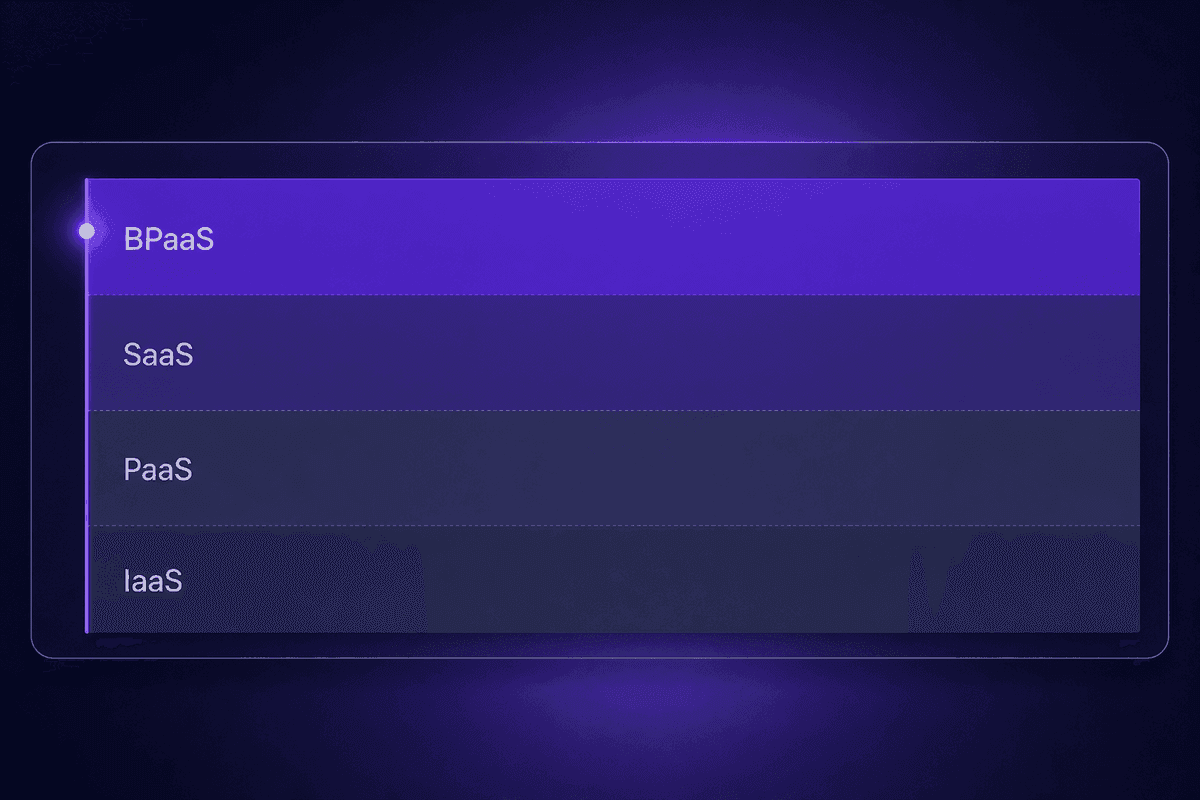
The distinction that changes the buying decision
- BPaaS delivers managed end-to-end processes, not software access - you consume outcomes, not tools.
- By Gartner's definition, BPaaS is cloud-delivered BPO built on multitenant infrastructure, which makes it structurally different from SaaS.
- The right signal for BPaaS fit: your process is high-volume, standardized, and currently consuming more maintenance capacity than it should.
What Business Process as a Service Actually Means
BPaaS, as Gartner defines it (via Pipefy's breakdown), is cloud-delivered business process outsourcing built on multitenant infrastructure. That last phrase matters more than it looks. Multitenant means the provider runs the same platform for many organizations simultaneously, which is what makes the economics work and what separates BPaaS structurally from traditional managed services.
The cleaner way to describe what BPaaS actually delivers: organizations consume complete business processes as a service, rather than applications. Virtusa puts it plainly - you're not buying access to software and then operating it yourself. You're buying a process outcome. The provider handles the infrastructure, the workflow logic, the automation, and in many cases the compliance scaffolding underneath it all.
Process data flows through these services rather than sitting in on-premise systems. That's a meaningful shift. Your HR records, your finance transactions, your claims data - these move through a cloud-based environment that the provider manages. Which is why questions about data segregation and audit trails come up so quickly when organizations evaluate BPaaS. They should.
The one thing that trips people up consistently: BPaaS providers do not just outsource tasks. They outsource the execution of a complete business process, end to end, through cloud infrastructure they own and operate. That's the actual definition of a BPaaS, and it's different enough from both SaaS and traditional business process outsourcing that the distinction deserves its own section.
How BPaaS Fits Into the Cloud Service Stack
If you've spent any time with cloud architecture documentation, you've seen IaaS, PaaS, and SaaS described as layers. BPaaS sits above all three. It's a fourth distinct layer, not a synonym for any of them.
The quick version: IaaS gives you infrastructure (servers, networking, storage). PaaS gives you a platform on which to build applications. SaaS gives you a finished application to use. BPaaS gives you a finished business process to consume. Each layer abstracts one more level of operational responsibility away from the buyer.
What makes BPaaS structurally different in the cloud computing stack is what Talsom describes as orchestration across multiple tools and systems. Payroll is a useful example. A SaaS payroll tool gives you software to run payroll. A BPaaS payroll offering runs payroll for you - pulling data from your HRIS, applying the right tax rules, generating payslips, pushing records to your accounting system, and handling compliance updates when regulations change. It crosses multiple cloud and on-premise applications. It owns the coordination layer. You see the output.
That's the distinction that matters for evaluation. SaaS provides a tool. BPaaS provides a managed workflow that often spans multiple tools, with the provider responsible for keeping it operational and current.
Where SaaS Stops and BPaaS Begins
The line between software as a service and business process as a service is the line between tool and execution. SaaS delivers software you operate. BPaaS delivers a workflow that runs on your behalf.
Here's where the confusion comes from in practice: a lot of teams build out a SaaS stack - CRM, HRIS, accounting software, project management - wire them together with some automation, and call the result their BPaaS setup. It isn't. They've built connected software. But the process ownership, the maintenance, the exception handling, the compliance tracking - all of that still lives in-house. The key difference is who manages the process end to end. In SaaS, you do. In BPaaS, the provider does.
That distinction has real consequences when you're evaluating vendors. SaaS solutions in a category you don't own can masquerade as BPaaS with the right pitch. Ask the vendor: who handles exceptions? Who updates the workflow when the regulation changes? If the answer is "your team," you're looking at SaaS, not BPaaS.
Why BPaaS Is Not the Same as Traditional BPO
Traditional outsourcing, in the BPO sense, runs on fixed contracts and primarily human labor. You hand a process to a provider, they staff people against it, you pay a fee. BPaaS operates differently: it's cloud-based, multitenant, and built for automation first. The provider's advantage comes from technology and scale, not headcount.
That difference changes the service model in ways that matter. BPaaS is modular - you can add or drop process scope without renegotiating a labor contract. It scales to transaction volume automatically rather than requiring the provider to hire. And when the underlying process logic needs to change, a BPaaS platform updates the workflow; a traditional BPO updates a procedure manual and retrains staff.
Cloud-based delivery is not cosmetic. It's the mechanism that makes BPaaS economically different from its predecessor.
What a BPaaS Solution Typically Includes
This is where a lot of buyers get surprised. A BPaaS solution doesn't look like a SaaS subscription with a managed services wrapper on top. It bundles components that most organizations would otherwise have to assemble and maintain separately.
According to NakaTech's analysis of BPaaS architecture, a mature BPaaS offering embeds automation, artificial intelligence, and advanced analytics as operating components of the service. These aren't optional add-ons the buyer enables - they're how the provider delivers the business process services at all. The process management layer sits on top of them.
In practice, that means a BPaaS solution typically includes:
- Workflow automation that executes the process steps without human intervention for standard cases
- AI-driven classification, extraction, or decision-making within the process (claims triage, invoice matching, candidate screening)
- Analytics dashboards that give the buyer visibility into process performance, exception rates, and SLA compliance
- Data integration across the buyer's existing systems, pulling from and pushing to their HRIS, ERP, CRM, or case management tools
- Compliance frameworks for regulated processes, updated by the provider as regulations change
- Human-in-the-loop handling for exceptions the automation can't resolve
The evaluation question this raises: when a vendor says "BPaaS," ask what percentage of process steps are automated versus handled by their staff. The answer tells you whether you're looking at an automation-forward service or a BPO with cloud branding.
Automation and AI as Core Operating Components
In a genuine BPaaS offering, automation and AI are not features the buyer switches on. They're the engine the provider built the service around. Process automation handles the volume. AI handles the variability - document parsing, language classification, anomaly detection, routing decisions in cases that don't fit a clean rule.
Robotic process automation often handles the structured workflow steps: moving records, validating fields, triggering downstream actions. Machine learning and broader artificial intelligence capabilities handle the less structured inputs: reading an unstructured claim attachment, classifying an invoice that doesn't follow the expected format, flagging a transaction that looks anomalous against historical patterns.
For buyers, this changes the evaluation checklist. You're not just asking what the platform can automate - you're asking what the provider has already automated inside the process you're buying. And you're asking where the humans still sit. Providers who automate 40% of a process and staff the other 60% are offering a different value proposition from providers who automate 85% and use humans for exceptions only.
That's not a theoretical distinction. It shows up directly in per-transaction cost and SLA performance.
Process Data Ownership and Visibility
Multitenant architecture is built into the Gartner definition of BPaaS, and it's the first thing that should prompt a data question. When your process data runs through a shared cloud platform, how is your data segregated from other customers' data? Who can access it? What does the audit trail look like?
These are not paranoid questions. They're standard vendor evaluation questions for any cloud-based service handling sensitive operational data. In healthcare, insurance, and finance contexts, the answers directly affect whether a BPaaS arrangement is permissible under the relevant compliance framework.
Ask specifically: where does process data reside, how long is it retained, and what access controls apply between tenants? A reputable BPaaS provider has documented answers to all three. A provider that can't answer them clearly is a third-party service risk, not just a procurement inconvenience.

Common Business Processes Organizations Run on BPaaS
Not every business process is a good candidate. The ones that work well share a few properties: high transaction volume, tolerance for standardization, and a cost structure that makes in-house operation harder to justify the larger you scale. Here's where BPaaS adoption is most concentrated across industries and organizations today:
- HR and payroll.
Human resources administration - onboarding workflows, benefits enrollment, payroll processing, offboarding - is one of the most common BPaaS deployments. High volume, repeatable logic, significant compliance exposure, and low competitive differentiation from doing it in-house. Organizations move these to BPaaS primarily to eliminate the maintenance overhead of running the underlying HR tech stack and to keep compliance current automatically.
- Finance and accounting.
Invoice processing, accounts payable, reconciliation, and financial close activities are strong BPaaS fits. These are high-volume, rule-driven, and expensive to staff at scale. BPaaS platforms apply automation and AI to capture data, match transactions, and flag exceptions, while giving finance teams an analytics view of outstanding liabilities without waiting for monthly reports.
- Procurement and supply chain management.
Purchase order management, supplier onboarding, contract compliance tracking - these processes cross multiple internal systems and external parties. BPaaS providers handle the orchestration, reducing the coordination overhead on internal procurement teams.
- Customer service and claims processing.
Claims intake, document classification, triage, and routing are a primary BPaaS use case in insurance and adjacent industries. An arXiv case study on AI-enhanced business process automation in insurance documents exactly this pattern: unstructured claim documents arrive, AI extracts and classifies the relevant fields, and a structured record moves downstream to adjudication. Manual handling becomes exception-handling only.
- Healthcare BPaaS: member enrollment and policy administration.
Healthcare organizations run some of the most compliance-heavy administrative tasks imaginable. Healthcare BPaaS platforms handle member enrollment, eligibility verification, prior authorization workflows, and policy administration - keeping the logic current as regulations update, without requiring the organization to staff and maintain that domain expertise internally.
- Regulated vertical workflows.
Beyond healthcare, policy administration, compliance reporting, and regulatory filing processes in financial services fit the BPaaS model well. The provider maintains the compliance logic; the buyer consumes the compliant output. Administrative tasks that once required specialized in-house teams become subscription line items instead.
BPaaS vs. SaaS vs. Traditional BPO: How to Tell Which Model You Are Actually Looking At
This is the comparison that usually gets run on a whiteboard at the wrong point in a procurement cycle - after someone has already committed to a vendor. Running it first saves a lot of rework. The three models look similar in pitch decks and differ significantly in who owns the work, how pricing scales, and what happens when something goes wrong.
| Dimension | BPaaS | SaaS | Traditional BPO |
|---|---|---|---|
| What is delivered | A managed end-to-end business process; buyer consumes outcomes | Software access; buyer operates the tool | A staffed service; provider's people execute the process |
| Who manages the process | The BPaaS provider | The buying organization | The BPO provider's staff |
| Infrastructure model | Cloud-based, multitenant, provider-owned | Cloud-based, provider-hosted, buyer-configured | Variable; may include on-premise or client-site operations |
| Pricing structure | Typically transaction-based or consumption-based; pay-as-you-go pricing common | Per-seat or per-module subscription | Fixed contract, often headcount-based; volume adjustments require renegotiation |
| Typical fit | High-volume, standardized processes with compliance or scale pressure | Teams that need a software tool and can staff operations around it | Processes requiring significant human judgment, or where technology investment is premature |
The column that matters most in practice is "who manages the process." Business process as a service and SaaS look identical in a cloud services model until you follow the ownership thread. SaaS provides the software; your team builds, maintains, and operates the process around it. BPaaS provides the process; you define the parameters and consume the output. That's a fundamental operating model difference, not a feature gap.

Service delivery accountability is the other telling signal. A SaaS vendor's SLA covers uptime. A BPaaS provider's SLA should cover process outcomes - error rates, cycle times, exception handling speed. If the vendor will only SLA on platform availability, you're looking at SaaS with process language.
📊 By the numbers:
According to Mordor Intelligence, the BPaaS market is projected to grow from USD 78.69 billion in 2025 to USD 154.29 billion by 2031, at an 11.88% CAGR - growth that tracks with broader AI- and cloud-driven automation investment. DataHorizzon Research puts the trajectory at more than double over a decade. Two different methodologies, directionally consistent. BPaaS is not experimental procurement. It's a digital transformation lever that mainstream ops functions are already pulling.
When a BPaaS Model Makes Sense - and When It Probably Does Not
The phrase "it depends" is overused in enterprise technology. But for BPaaS adoption, there are actual signals that tell you which side of the decision you're on. I'd rather give you those than another framework slide.
BPaaS works for processes that are standardized enough to run on someone else's platform, high-volume enough that automation economics matter, and compliance-heavy enough that keeping regulations current is a real cost. Back-office and HR processes hit all three. Claims processing in insurance hits all three. Finance operations at scale hit two out of three on a good day.
It doesn't work well when the process is genuinely proprietary - when the way you execute it is a competitive differentiator, and standardizing on a provider's platform would hand that advantage to every other customer on the same multitenant infrastructure. It also struggles when process data sovereignty requirements conflict with cloud-based multitenant architecture. If your data governance requires on-premise storage or prohibits third-party processing, BPaaS is structurally incompatible with that requirement, not a configuration problem.
CIOs using BPaaS as a digital transformation lever are typically making a capex-to-opex trade: getting off legacy systems that require capital investment and internal maintenance, moving to subscription-based services that reduce operational expenses and shift maintenance responsibility to the provider. That trade makes sense for standardized processes and looks risky for core differentiating ones. The decision isn't complicated once you've categorized the process correctly.
And BPaaS is not only relevant to large enterprises. That's a misconception I keep seeing come up in evaluation conversations. Strategic initiatives around BPaaS have historically been framed for enterprise buyers, but the actual adoption data tells a different story.
Back-Office and HR Processes That Standardize Well
HR, payroll, finance reconciliation, and procurement administration have one thing in common: almost every organization runs some version of the same process. The logic doesn't differentiate you. The outcome doesn't either. What matters is execution speed, accuracy, and compliance currency - which are exactly the things BPaaS providers optimize for.
Organizations that move these functions to BPaaS services typically do it to eliminate the upfront investment in building and maintaining the underlying systems, reduce the manual processes that slow cycle times, and gain compliance coverage they'd otherwise have to staff internally. A 50-person company running payroll on BPaaS gets the same human resources process quality as a 5,000-person company on the same platform, without building a finance and HR technology stack to support it.
The math on in-house system overhead can be surprising until you see it clearly: you're not just paying for the software. You're paying for the people who maintain it, update it when regulations change, handle exceptions when the software can't, and document the process when someone leaves. BPaaS bpaas services bundle all of that into the price.
Regulated Vertical Processes That Need Compliance Currency
Healthcare, insurance, and financial services organizations have a specific BPaaS problem that general back-office analysis misses. Regulations change. Not occasionally - continuously. A healthcare claims platform that was compliant in January may require workflow updates by March because a payer updated their submission requirements. An insurance policy administration system needs to reflect regulatory changes across multiple state jurisdictions, often on different timelines.

Maintaining compliance currency in-house requires domain expertise, regulatory monitoring, development resources, and testing cycles. That's expensive. BPaaS providers in these verticals build compliance maintenance into their operational model, because they're maintaining the same platform for many organizations simultaneously. The cost is shared; the update applies to every client at once.
This is where BPaaS often beats both SaaS and traditional BPO on total cost of compliance. SaaS gives you the software but leaves the compliance implementation to your team. Traditional BPO updates its procedures but at the pace its contract allows. A domain-specific BPaaS platform, built around claims processing, member enrollment, or policy administration, treats compliance currency as a core service feature, supported by genuine industry expertise. Cloud technology is the delivery mechanism. Regulatory staying-current is the actual value.
🤔 Think about this:
Most analyst coverage of BPaaS targets enterprise buyers. But midmarket firms are among the fastest-adopting segments - precisely because they lack the capital investment capacity to build and maintain enterprise-grade back-office systems in-house. A 200-person company can consume a scalable, compliance-ready HR or claims process that would cost millions to build from scratch. The organizations most likely to benefit from BPaaS are also the ones most likely to have self-disqualified before running the actual evaluation.
What to Check Before Choosing a BPaaS Provider
Most BPaaS evaluation lists are written by vendors. This one is written from the other side of the support queue, which means it's organized around the questions that reveal real problems rather than the ones that produce impressive demo answers.
- Process scope and ownership boundaries.
Risk: you buy a process and gradually discover 40% of it still requires your staff. Ask: what exactly does your team stop doing after go-live? Get the answer in the contract, not the pitch deck. If the vendor can't specify the handoff line, you're being sold BPaaS-adjacent SaaS.
- AI and automation depth.
Risk: AI is in the brochure but not in the workflow. Ask: what percentage of process steps are automated versus human-handled? Where does AI specifically apply, and where does your team still make decisions? A provider who can't walk through the automation coverage step by step probably hasn't built it.
- Process data handling and multitenant segregation.
Risk: your data commingled or accessible beyond contractual need. Ask: how is our data isolated in the multitenant architecture? What data security controls govern our records specifically? What's the breach notification commitment? For cloud-based solutions in regulated verticals, these answers need to be in the DPA before you sign anything.
- SLA and performance metrics.
Risk: SLA covers platform uptime, not business outcomes. Ask: what metrics are you held to? What are the remedies if you miss them? An SLA on process cycle time and exception resolution speed means something. An SLA on server availability is just standard cloud infrastructure.
- Compliance certifications for regulated verticals.
Risk: provider claims compliance but hasn't verified it for your specific regulatory environment. Ask: which certifications do you hold (SOC 2, HIPAA BAA, ISO 27001)? How do you accommodate regulatory changes in your jurisdiction? Who is accountable when a compliance gap appears?
- Integration with your existing systems.
Risk: the BPaaS platform assumes clean data inputs your systems don't produce. Ask: how do you integrate with our current ERP, HRIS, or CRM? What data transformation happens at the boundary? Who owns the integration layer when source systems change? (This is where things often break quietly, without a useful error message.)
- Pricing model transparency.
Risk: transaction-based pricing that looks efficient at current volume and breaks your budget at scale. Ask: what does pricing look like at 2x our current volume? At 5x? Is there a rate adjustment mechanism in the contract? The NextProcess observation about the blurred line between BPaaS and SaaS-priced BPA software is real - some providers automate processes and charge per seat anyway. The pricing model reveals which category you're actually in.
- Migration and exit provisions.
Risk: process data locked into provider infrastructure with no clear extraction path. Ask: how do we export our process data if we move to a different provider? What notice period and transition support do you provide? An organization that can't leave a BPaaS relationship cleanly is not a customer, it's a hostage.