


Here's the thing teams get wrong most often: they treat business process automation and business process management as two names for the same purchasing decision. So they buy a BPA tool and call it BPM, or they invest in a BPM platform and assume execution will figure itself out. Neither works. What's the difference between the two? Bigger than most people expect, and the gap between them is exactly where process improvement programs stall.
The part teams learn late
- BPM is a discipline, not software - confusing it with your tooling is where governance disappears.
- Automating without BPM foundation doesn't save time - it runs broken processes faster.
- BPA vs BPM isn't a choice between two options; it's a hierarchy where one sets direction and the other executes it.
What Business Process Management Actually Covers
Business process management is a management discipline, not a product category. The Gartner-sourced definition covers discovery, modeling, analysis, measurement, improvement, and optimization, all of it in support of business strategy. That's a governance cycle, not a software installation. BPM is ongoing, iterative, and organizational. It asks: what should these processes look like, and how do we know when they're healthy?
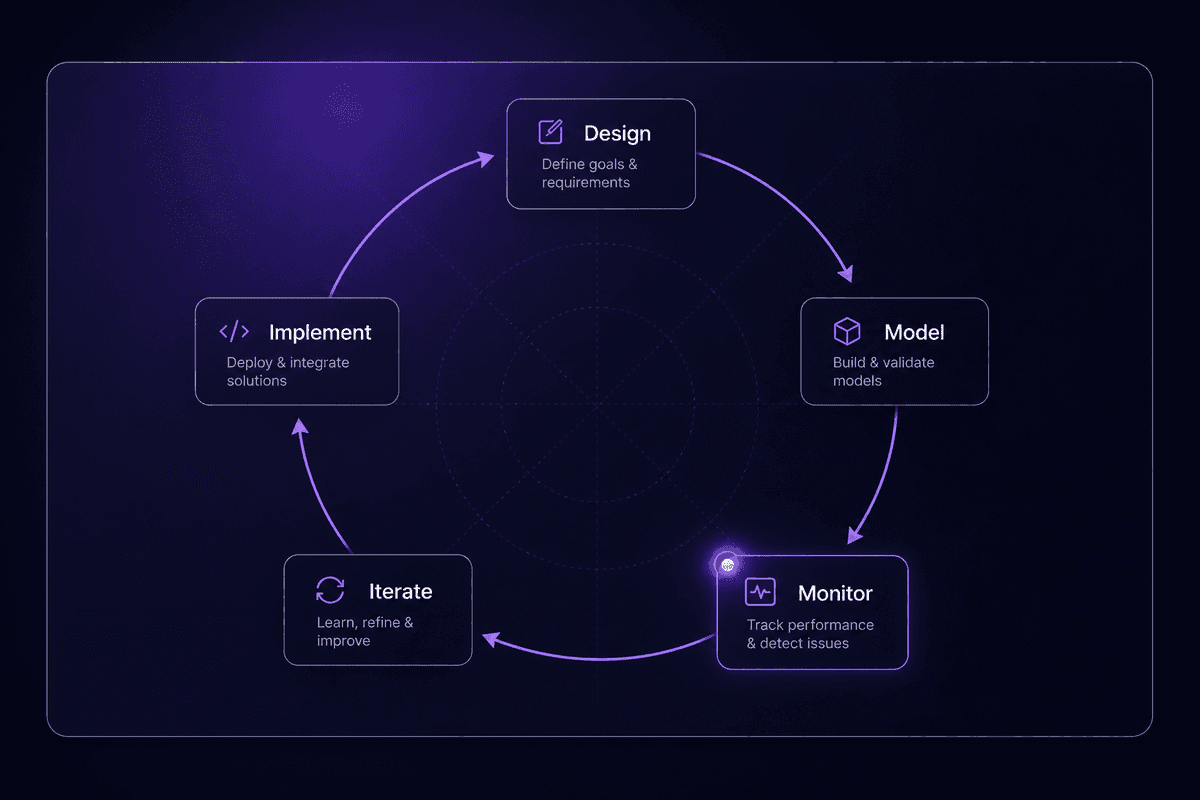
The lifecycle looks like this in practice: design, model, implement, monitor, iterate. Then repeat. BPM doesn't end when a process is documented. It ends when the process is consistently performing at target, which is usually never, because targets change. That's the point. Process modeling and process improvement aren't deliverables. They're habits.
The mistake I keep seeing - in support tickets, in onboarding calls, in conversations with ops leads who are six months into a platform rollout - is the assumption that BPM is synonymous with whatever software their team bought last quarter. It isn't. A BPM platform is one tool you might use inside a BPM discipline. Management processes, by definition, require someone to own them, measure them, and change them when they drift. The software can't do that part.
What Business Process Automation Actually Does
Business process automation is the technology-level execution layer. The Gartner-sourced definition, repeated by Bizagi, describes BPA as the automation of complex business processes beyond conventional data manipulation, using advanced technologies. That's a wider scope than most teams assume when they deploy their first workflow tool.
BPA stands for a holistic approach, not a single-tool purchase. According to Appian, modern BPA can combine RPA, workflow automation platforms, AI, and data management, all working together as part of one execution strategy. That matters because the misconception I run into most often is someone who deployed one automation tool and concluded they're "doing BPA." You might be. But if that tool handles a single step in one process, you've automated a task, not a business process.
The automation technologies involved in real BPA implementations range from rules-based workflow automation handling approval routing and data entry, to RPA bots that interface with legacy systems, to AI layers that handle classification and unstructured inputs. BPA is the architectural umbrella. Any single tool you buy is a component inside it.
Differences Between BPA and BPM: Strategy vs Tactics
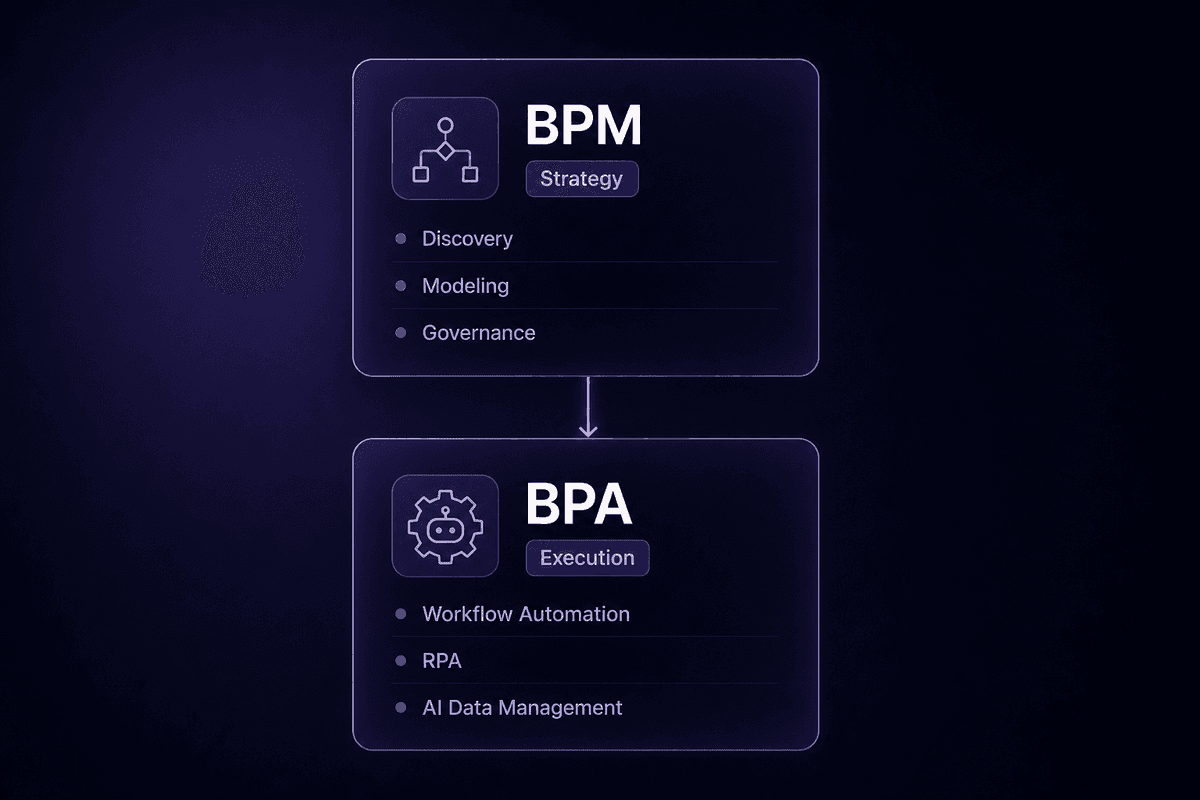
The ProcessMaker framing is useful here: BPM is strategy, BPA is tactics. SAP Signavio adds a hierarchy on top of that, where BPM governs the whole program and BPA executes within it. The table below maps the dimensions that actually matter for a team trying to figure out which conversation they're in.
| Dimension | BPM | BPA |
|---|---|---|
| Nature | Management discipline | Technology approach |
| Scope | End-to-end governance across the organization | Specific workflow or process execution |
| Primary question answered | How should this process work? | How do we execute it faster and with less manual effort? |
| Who owns it | Process excellence, operations leaders, process owners | IT, automation team, business and IT teams together |
| Output | Process model, governance policy, KPI baseline | Automated workflow, reduced manual effort, execution logs |
| Time horizon | Continuous improvement cycle | Project or implementation cycle |
| Automation strategy role | Defines which business processes should be improved and why | Implements the automation strategy at execution level |
The design column matters most in practice. BPM asks "should this process exist in its current form?" before BPA asks "how do we run it automatically?" Skipping the first question is where most automation programs produce measurable output that measures the wrong thing.
Why BPA and BPM Are Not Competing Disciplines
This is the false dichotomy I see most often in how teams frame their tooling decisions: they treat BPM and BPA as two competing options, pick one, and ignore the other. The result is predictable and comes in two flavors.
Flavor one: BPA without BPM. The team deploys automation tools, builds workflows, reports efficiency gains. Six months later, the workflows are running fast and producing wrong outputs because nobody governed the underlying process design. The automation is executing, but what it's executing was never validated as the right behavior. This is the case that shows up in support: the scenario is running, the dashboard is green, the business outcome is not what anyone expected.
Flavor two: BPM without BPA. The team produces thorough process documentation, maps every step, holds governance reviews. Nothing actually changes at execution speed because there's no automation layer to enforce the modeled behavior. The process maps live in a shared drive somewhere.
The SAP Signavio hierarchy makes the correct relationship explicit: BPM provides strategic direction, process analysis identifies improvement targets, and then BPA or other automation tools implement those improvements at scale. BPA and RPA both operate within the broader BPM program. They're not alternatives to it. A team that deploys RPA bots without a BPM framework has fast execution and no governance. The bots run. Nobody defined what "correct" looks like, so the bots run correctly in the wrong direction.
Improving business processes requires both layers. The discipline sets the business goals. The technology executes against them. Neither layer makes the other redundant, and the order of operations matters: governance first, automation second.
How BPM Sets the Conditions That Make Automation Worth Deploying
Automating a broken process doesn't fix it. It scales it. I've said this in enough onboarding calls that it's become reflexive, but it's the dependency logic that most teams skip. If the existing process has a flawed routing rule, an incorrect field mapping, or a bottleneck that isn't structural but behavioral, a BPA implementation will enforce that flaw at speed across every execution.
The BPM framework exists to answer the question automation can't answer on its own: what does "correct" look like? Without that baseline, automated processes run against phantom criteria. You get process performance metrics that measure execution volume rather than business outcomes. The bottleneck moves or hides. The dashboard looks healthy.
BPM sets the floor. It defines what the process should do, who owns each step, how exceptions are handled, and how performance is measured. BPA then executes against that defined floor. Teams that skip the floor don't save the time BPM takes. They spend it later, in incident reviews, trying to figure out why the automation produced faster results that nobody wanted.
Where Workflow Automation Fits Inside a BPM Framework
Workflow automation is one mechanism inside the BPA layer, which itself operates inside a BPM framework. This placement matters because workflow automation is often used as a synonym for BPA or, more confusingly, for BPM itself. It isn't either.
Workflow automation handles specific task sequences: routing an approval request, triggering a notification on a status change, moving data between two systems on a defined schedule. These are types of automation that solve execution problems within a defined process. Robotic process automation handles a different subset, typically the interface-level interactions with systems that lack APIs. Task automation solves individual step-level repetition. All of them are mechanisms that BPA can deploy once BPM has defined the target process structure. None of them replace the governance layer that tells you whether the process is correct in the first place.
Business Process Analysis: The Layer Most Teams Skip
Business process analysis is the diagnostic bridge between BPM strategy and BPA execution. It's the step where you examine what processes actually do, measure how they perform, and identify which of them are candidates for automation, redesign, or elimination. SAP Signavio frames this as a three-part hierarchy: BPM governs the program, process analysis identifies what needs to change, and automation implements the changes at scale.
The failure mode I see most consistently is teams jumping from "we need to automate" directly to tool selection, skipping the analysis step entirely. They know they have manual work. They buy an automation tool. They automate the manual work. Three months later, they have faster manual work, encoded in a workflow, owned by nobody, producing outputs nobody validated.
What process analysis actually answers before you build anything:
Which processes are actually candidates for automation
Automation candidates are processes that are high-volume, rules-based, stable, and well-defined. Performance analysis reveals which processes meet those criteria and which are too variable or too dependent on judgment calls to automate reliably.
What the process actually does vs. what people think it does
Process mining, when applied to system logs, often reveals that the process as documented and the process as executed are different things. Automating the documented version ignores how work actually flows.
Where the real bottlenecks are
Teams frequently identify automation opportunities based on where the work is most visible, not where the actual constraint lives. Analysis separates symptom from cause before execution tools get involved.
What the baseline is before automation runs
Without a pre-automation baseline, you cannot measure whether automation initiatives produced a real improvement or just moved the work. BPM needs that baseline. BPA needs it to prove ROI.
The teams most eager to choose the right automation tool are usually the ones skipping this layer fastest. They want to get to building. The cost shows up months later, in the form of workflows that run correctly and produce wrong results, because nobody asked whether the process was worth running correctly in the first place.
🤔 Wait.
The teams deploying BPA fastest are often the ones who spent the least time on process analysis. Which means the speed advantage of modern automation tools can accelerate the production of wrong outputs. Readiness for automation isn't about tool access. It's about knowing what "correct" looks like before you automate it.
Benefits of Business Process Automation When BPM Is Already in Place
The benefits of business process automation are real. But they're conditional. Each one requires a BPM precondition to materialize at the scale teams actually expect. Here's what the list looks like when it's honest:
Faster cycle times on well-defined processes
When BPM has documented a process clearly, with defined inputs, outputs, rules, and exception paths, BPA can execute that process without the delays introduced by manual handoffs and routing decisions. The speed gain is real. It requires the process to be defined well enough that automation can follow it without human interpretation at each step.
Reduced manual effort in rules-based back-office work
Shared services teams in HR, finance, and customer service doing approvals, case routing, and data entry are the classic BPA use case. The repetitive tasks in these functions are well-suited to automation precisely because they're rules-based, high-volume, and not judgment-intensive once BPM has defined what the rules are. Without that definition, "automating manual effort" means encoding whatever someone happened to do last Tuesday.
Higher throughput on onboarding and order-to-cash workflows
The onboarding and approval process categories respond well to BPA because they're sequential, involve multiple systems, and have clear completion criteria. BPM sets those criteria. BPA then enforces them at scale, with a consistent execution that doesn't depend on who's in the office.
Measurable ROI that digital transformation teams can demonstrate
The teams that can show a number after a BPA deployment are the ones that measured where they started. BPM provides that baseline. Without it, the ROI claim amounts to "we automated some things and it feels faster," which is not what a CFO needs to see to approve the next initiative. Automating business processes on top of a BPM foundation means you know what changed because you measured before and after.
Better business outcomes that compound over time
BPA running within BPM governance produces feedback loops: the monitoring data from automated processes flows back into the BPM cycle, which identifies the next improvement target, which BPA then executes. Overall business performance improves not because of a single automation deployment, but because the discipline keeps the execution layer aligned with current strategy. Streamline business operations once, and you've shipped a project. Build the cycle, and you've changed how the organization improves.
Who Uses BPM and BPA, and for Which Business Processes
The audience segments are different, and when they're not aligned inside the same organization, BPM and BPA end up running as separate programs that produce duplicate work and competing governance models.
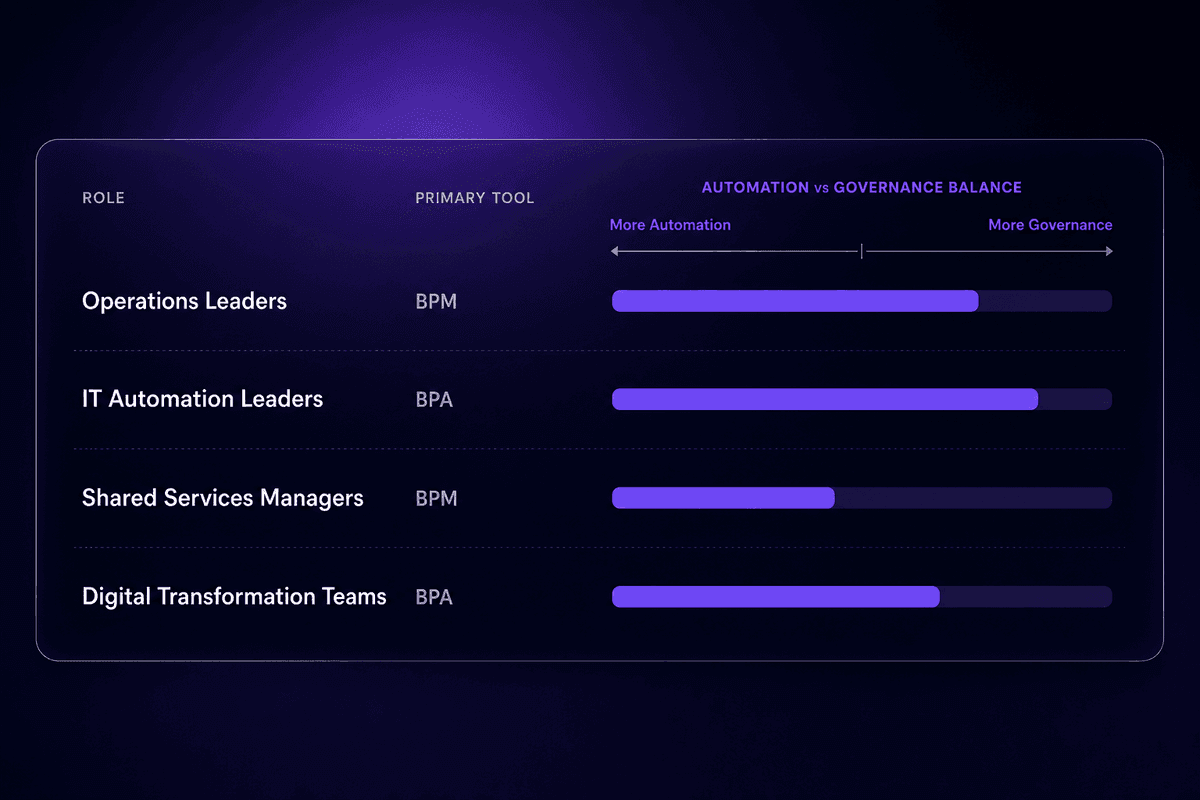
Operations and process excellence leaders use BPM to standardize cross-functional business processes, establish ownership, and maintain the governance that prevents process drift. Their scope is organizational: they're thinking about how work flows across the organization, not just inside one team.
CIOs and IT automation leaders are typically the ones deploying BPA for complex workflows, specifically where multiple systems, data sources, and execution paths need coordination. Their business process transformation agenda tends to be technically framed, which is why it sometimes runs without enough process governance from the operations side.
Shared services managers in HR, finance, and customer service use BPA within a BPM framework for the back-office use cases: employee onboarding, expense approval, customer relationship management updates, inventory management reconciliation. These are the functions where the volume is high enough that automation delivers clear value and the processes are stable enough that BPM governance holds.
Digital transformation teams use BPM to map the value chain and identify where automation investments should go, then use BPA to hit specific pain points inside that map. The risk here is when the transformation initiative and the BPA deployment happen in different budget cycles with different sponsors. I've seen this pattern produce a detailed BPM-mapped business process that nobody automated, sitting next to a BPA deployment that automated a process nobody governed. Same company. Different initiative owners. Zero collaboration between business and IT teams.
That last configuration doesn't usually produce a ticket. It produces a quarterly review where everyone reports positive numbers and the actual outcome of the combined initiative is unclear.
For a practical example of what alignment looks like in an automation platform: when Latenode is used as the BPA execution layer alongside an existing process governance structure, the workflow canvas becomes the visible record of how the process actually runs, not just how it was modeled. An ops manager at a 40-person SaaS company can connect their CRM, billing, and support systems using built-in OAuth integrations, encode branching rules directly in a JavaScript node, and route edge cases to a human review queue, all inside one flow. The BPM layer sets what the flow should do. The Latenode workflow executes it. When the process changes, the workflow gets updated in one place rather than across scattered scripts. That's the handoff working correctly: BPM sets direction, BPA uses software to automate the execution of it.
Intelligent Automation and BPM Tools: Where the Stack Is Heading
The convergence is real and already affecting purchasing decisions. BPM platforms are adding automation capabilities. BPA tools are adding process governance features. AI is showing up in both layers simultaneously. Harvard Business Review noted that process management is experiencing a renaissance specifically because organizations treating AI as a standalone experiment are getting worse outcomes than those embedding AI inside a governed process structure. The governance layer is what makes AI-enriched automation predictable rather than experimental.
For teams deciding whether to buy a BPM tool, a BPA tool, or a combined platform right now, the convergence means the category labels are becoming less reliable as selection criteria. A platform sold as BPA software may include process modeling features. A BPM suite may include automation capabilities that make BPA tools redundant for certain use cases. The right automation approach isn't identifiable from category names alone.
What hasn't converged: the strategic-vs-tactical distinction still holds. BPM tools, even with added automation capabilities, are oriented toward governance and modeling. BPA solutions and automation software, even with added governance features, are oriented toward execution and throughput. The intelligent automation direction is toward platforms that handle both layers, but the discipline of asking "should this process work this way before we automate it" isn't something any platform answers for you.
📊 In practice:
Appian describes modern BPA as a holistic approach combining RPA, BPM platforms, workflow automation, AI, and data management, not a single-tool purchase. Which means buying one "automation platform" and expecting it to resolve the strategy-vs-tactics gap is the wrong procurement assumption. The gap is organizational. No stack purchase closes it.