


Most organizations invest serious money in process improvement without a clear picture of where they actually stand. They purchase new software, hire consultants, redesign workflows, and then wonder why the improvements don't stick. The business process maturity model exists to answer the question that should have come first: how mature are your processes right now, before you change anything?
That said, here's the thing about BPMM most articles skip: a high maturity score is not the same as a well-running operation. The model measures. It does not fix.
The part teams learn late
- BPMM measures how well-defined and controlled processes are, not whether they actually work well.
- Five maturity levels describe real operational behavior, not just abstract labels.
- Higher maturity does not automatically produce better business outcomes - research backs this up.
- The model's biggest practical weakness: it tells you your score without always telling you what to change next.
- Useful for any organization with defined processes, not just large enterprises or IT departments.
What Is Business Process Maturity?
Process maturity is not about whether processes exist. Almost every organization has processes. The question is how well-defined, controlled, and improvable those processes actually are - and whether anyone could answer that question with evidence rather than gut feeling.
A mature process is documented, consistently followed, measured, and capable of being improved deliberately rather than reactively. An immature one exists mainly in people's heads, runs differently depending on who's doing it, and changes when something breaks rather than when data suggests a better approach.
The level of maturity in any given process reflects a spectrum of organizational capability. At one end, work happens ad hoc. At the other, improvement is continuous and data-driven. Most organizations sit somewhere in the middle, with significant variation - process maturity across different departments in the same company can differ by two or three levels simultaneously.
Bizzdesign's practitioner framing is useful here: a maturity model helps organizations measure current BPM maturity, identify strengths and weaknesses, and define a roadmap for what to fix next. The maturity of business processes isn't a fixed trait - it changes as organizations invest, neglect, or restructure. And individual processes within the same organization routinely sit at different levels. Your sales process might be well-documented and measured. Your onboarding process might be running entirely on tribal knowledge and good intentions.
Organizational maturity, in the process sense, is the sum of these levels - and the gaps between them.
What Is the Business Process Maturity Model (BPMM)?
The Business Process Maturity Model (BPMM) is a formal framework published by the Object Management Group in June 2008. It provides a structured approach for assessing and improving an organization's process capability, with particular emphasis on organizational readiness for technology deployment. That last part is worth holding onto - it shapes what the model is actually designed to do.
BPMM is a structured process model, not a process map. This distinction confuses a lot of people. A process map shows how a process flows: who does what, in what order, using which tools. BPMM doesn't do that. BPMM assesses how mature and controlled the process organization is. It answers a different question: not "how does this work?" but "how capable is this organization of making this work reliably, measuring it, and improving it?"
The framework operates as a diagnostic and improvement tool. It gives process teams a common language - a bpmm process maturity framework that allows cross-functional teams to talk about capability gaps without the conversation devolving into tool debates or territory disputes.
This is also the right place to name the most common misconception upfront: BPMM does not guarantee results. Using the framework tells you where you are. Getting to a higher level requires actual operational change. The model is the assessment mechanism. What you do with the assessment is a separate problem entirely.
Where BPMM Comes From and Why the OMG Published It
The Object Management Group published BPMM Version 1.0 in June 2008. The OMG is a nonprofit technology standards consortium - the same organization behind UML, BPMN, and other widely-used process and modeling standards. Its standards exist to create interoperability and shared language across industries.
The BPMM was developed to address a specific gap: organizations were deploying technology without understanding whether their processes were ready to support it. Software development projects fail not because the code is wrong but because the processes around the code are immature. Requirements change unpredictably, handoffs break down, quality varies by team, and nobody has a reliable mechanism for measuring or improving any of it.
Organizational readiness for technology deployment was the explicit design problem BPMM was built to solve. If your organization wants to understand why that three-year digital transformation keeps stalling, this origin story is relevant.
How BPMM Fits Into the Broader World of BPM
BPM maturity is one dimension of a larger business process management discipline. Business process management efforts cover strategy, governance, architecture, measurement, culture, and technology. BPMM is a diagnostic lens, not a complete BPM program.
Think of it this way: process management includes deciding which processes to own, how to govern them, how to document and analyze them, and how to continuously improve them. BPMM tells you how capable your organization currently is at doing all of that - consistently and measurably. It informs the BPM program. It doesn't define or replace it.
If your organization is running a process architecture initiative or a digital transformation program, BPMM gives you a starting benchmark. It answers "where are we now?" so the rest of the BPM work can answer "where are we going and how do we get there?" without those questions floating in abstraction.
The Five Levels of Process Maturity, and What Teams Actually Do at Each One
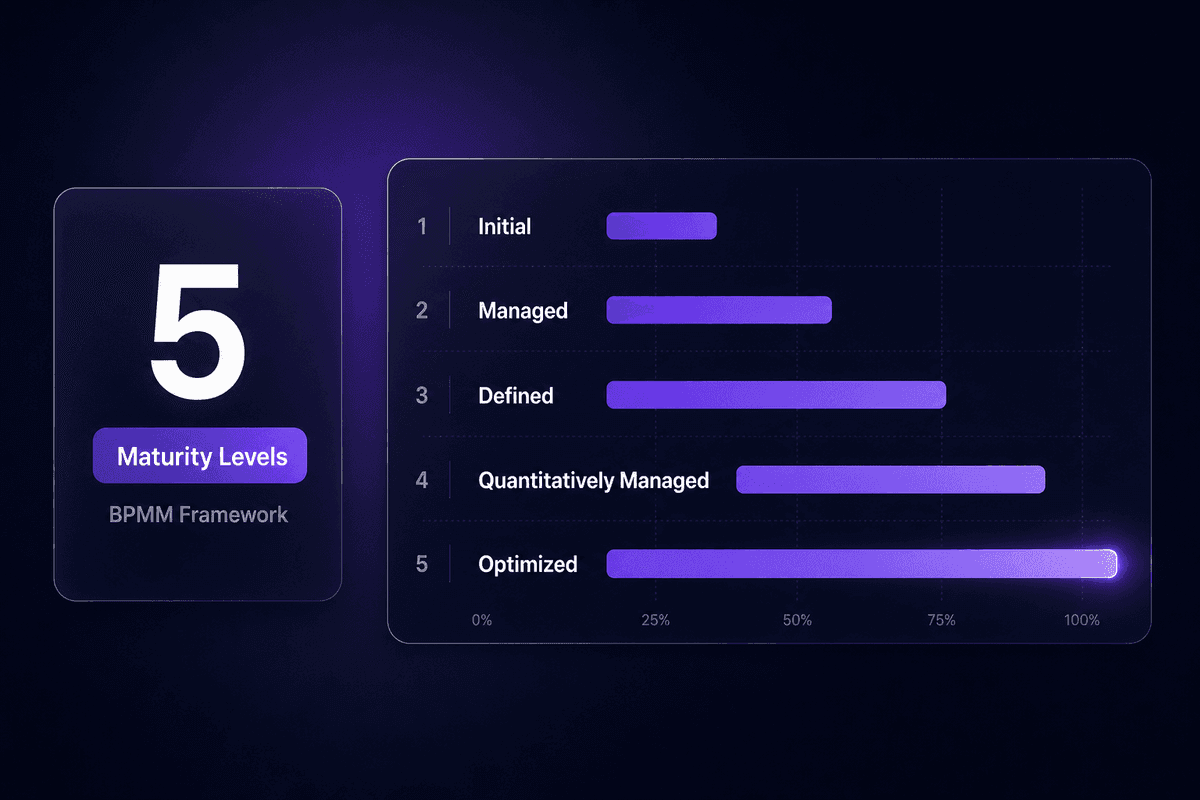
BPMM orders these stages as a progression of organizational capability. Each maturity level describes real, observable operational behavior - not just an abstract label. The 5 maturity levels share their structure with frameworks like CMMI, which is why the language looks familiar to anyone who's been in a software delivery context.
The level of process capability at each stage determines what kinds of improvement initiatives are even possible. You can't measure what you haven't defined. You can't optimize what you haven't measured. The sequence is intentional.
Level 1-2: Initial and Managed
Level 1 is where most teams start, even if they won't admit it. Processes exist, but inconsistent business activities are the norm. Work happens differently depending on who's doing it, what day it is, and what fires are currently burning. There's no consistent documentation. Results vary. When something goes wrong, the fix is reactive and person-specific rather than systemic.
The move to Level 2 - managed, sometimes called "repeatable" - is the first meaningful improvement. Teams begin to establish basic controls. Some processes become repeatable across similar situations, even if they're not formally documented or standardized. But the weaknesses in the business processes are still significant: repeatability depends on individuals rather than systems, and success is tied to specific people's knowledge rather than shared process standards.
That is where the ticket usually starts.
Level 3: Defined
Level 3 is the point where process documentation moves from optional to expected. Processes are formally defined, documented, and standardized across the organization. The organization has a process architecture, and individual contributors follow shared standards rather than improvising based on personal preference or memory.
Standardization at this level means a new hire can follow the same steps as a ten-year veteran. Process outputs become more consistent. The organization can make decisions about process improvement based on documented baselines rather than anecdotes.
Here's the honest observation: Level 3 is where most improvement efforts stall. The documentation exists. The training happened. But consistent across the organization is harder to achieve than it sounds. Exceptions proliferate, documentation drifts out of date, and the gap between the documented process and the actual process quietly widens. Organizations declare Level 3 and then stop investing, which turns a milestone into a ceiling.

Level 4-5: Quantitatively Managed and Optimized
Level 4 adds measurement. Not reporting - measurement. The distinction matters. At this level, organizations collect quantitative data on process performance, analyze it, and use it to make decisions about managing and adjusting processes. Processes and performance metrics are linked. Variation is tracked. When something drifts from expected performance, the data reveals it before it becomes a problem someone reports via email.
Level 5 is continuous improvement at scale. Achieving process maturity at this level means the organization doesn't just respond to problems - it proactively identifies and implements improvements based on ongoing data analysis and predictive signals. Waste gets eliminated, not just addressed. Process changes are managed systematically rather than episodically.
Very few organizations reach Level 5 in practice, and fewer sustain it. The ones that do tend to have automation doing significant heavy lifting in measurement and feedback. Manual data collection doesn't scale to this level of monitoring. This is where automation tools stop being a convenience and become a prerequisite for achieving process maturity at all.
What BPMM Is Actually Used For
The model has three practical roles that help organizations achieve structured improvement rather than just aspiration. Most explanations describe BPMM in the abstract. Here's what it actually does in practice.
First, it allows organizations to benchmark current process capability before committing to change. Before a technology deployment, a process redesign, or a major operational transformation, an organization needs a baseline. Without one, "we improved" is an unfalsifiable claim.
Second, it creates a shared language across functions. When finance, IT, operations, and leadership all interpret "our processes are mature" differently, improvement programs stall in definitional debates. BPMM gives those conversations a common reference point.
Third, it guides prioritization. Not all processes need to be at Level 5. Some processes run fine at Level 3. Understanding where each process sits, and where it needs to be relative to business goals, helps teams direct investment where it actually matters.
Benchmarking Process Capability Before a Transformation
This is where the original OMG design intent comes through most clearly. Organizations routinely deploy enterprise applications - CRM systems, ERP platforms, workflow automation infrastructure - without assessing whether their processes are ready to support those systems effectively. The result is predictable: the software gets implemented, the features go unused or get worked around, and eighteen months later someone commissions a review asking why the system isn't delivering value.
A business process maturity model assessment before a technology rollout changes the question from "what software should we buy?" to "what process capability do we need to run this software well?" Those are different questions with very different answers.
Using the model as a benchmark before committing to requirements for enterprise applications means the project scope reflects where the organization actually is, not where it wishes it were. Context from SimbirSoft's analysis of process maturity in information system design makes this practical point well: the maturity assessment results should feed directly into architecture decisions and implementation plans, not sit in a drawer while the technology project proceeds on its original trajectory.
Using the Maturity Model to Prioritize Process Improvement
The model provides a structured approach to process improvement by turning assessment into a prioritized action list. The mechanic is fairly direct: identify your current process areas, score them against the maturity levels, map where the gaps are between current state and needed state, then decide what to address first.
The approach to process improvement that actually works is gap-driven, not aspiration-driven. You're not trying to make every process a Level 5. You're trying to identify where weakness creates the most operational risk or constrains your most important business outcomes. A sales process that's a Level 2 when your revenue targets depend on consistent pipeline management is a different priority than a Level 2 internal IT request process.
That prioritization logic is how a maturity model provides real value as a guide to process improvement initiatives. It's also where I keep seeing teams get stuck: they complete the assessment, get their scores, and then don't know which gap to address first. The model identifies areas for improvement, but it doesn't weight them by business impact. That weighting step requires judgment the model can't provide.
One illustration from Latenode's Scenario S-03 in practice: a transformation manager facing a 40-item list of candidate processes can use a Latenode workflow to read process names and basic metrics from CRM, ticketing, or ERP data sources, then apply a transparent scoring formula weighted by volume, error rate, and customer impact. The model provides the maturity assessment layer; the automation handles the prioritization calculation and produces a ranked roadmap. The two tools serve different purposes and work better together than either does alone.
Why BPMM Has Real Limitations That Support Teams See Repeatedly
I'd rather address this directly than bury it. The academic research is fairly consistent on this point, and the practical experience matches.
A 2024 critical review in Information Systems Management analyzed how organizations apply business process maturity models and where they fall short. The finding is worth quoting clearly: many organizations use BPMM as a mechanism to capture and monitor changes in process orientation over time, which sounds right - but the review identifies real limitations in how useful that measurement turns out to be in practice.
And there's a deeper problem. A systematic literature review published in Information and Software Technology identified 61 distinct studies proposing generic business process maturity models. Sixty-one. That's not a sign of a mature, settled discipline. That's a sign of a fragmented field where no single model has proven dominant across different contexts. Different maturity frameworks make different assumptions, use different terminology, and produce scores that aren't comparable across organizations or even across assessments done at different time points.
For many organizations, process maturity is crucial precisely because it affects whether digital and AI investments pay off. Empirical research published in Knowledge and Process Management found a positive correlation between BPM maturity and successful digital transformation outcomes. That's meaningful. But correlation is not prescription, and maturity doesn't drop in automatically - teams have to combine the diagnostic with deliberate improvement work.
🤔 Think about this:
BPMM is supposed to guide improvement. But research identifies limited actionable properties in many maturity models - meaning teams score their processes at Level 2 or Level 3 and then face a blank page where the improvement plan should be. The assessment tells you the diagnosis. It rarely tells you the treatment.
A Maturity Score Is Not the Same as a Process Improvement Plan
This is the misconception I most want to resolve, because it's the one that turns a useful diagnostic tool into an expensive exercise with little follow-through.
Higher maturity on the model is associated with better performance in the research. But the model measures the presence of certain organizational characteristics - documentation, standardization, measurement, improvement mechanisms. It does not automatically produce those characteristics. Getting from Level 2 to Level 3 requires actual change in how people work, what gets documented, who owns what, and how performance gets tracked. The score reflects that change after it happens. It doesn't cause it.
The practical implication: use your maturity score to monitor progress over time, but anchor it to specific business objectives. "We're at Level 3" is not an improvement plan. "We're at Level 3, our target for six months is Level 4 in customer onboarding specifically, and here are the three process changes that will move us there" is closer to useful.
Process performance improvements come from the work of changing how things are done. BPMM tells you whether you've changed. It doesn't change anything on its own.
Why BPMM Feels Conceptual but Hard to Operationalize
The "limited actionable properties" finding from the ScienceDirect systematic review describes something that lots of process teams experience without having a name for it. You complete the assessment. You have scores. You present them to leadership. And then... the conversation stalls. What do you actually do with a Level 2 designation?
The problem is that maturity stages are defined by the presence or absence of certain process characteristics - documentation, standardization, measurement. But the model doesn't describe the specific steps to build those characteristics in your organization. It describes the destination, not the route. Teams who go through a BPMM assessment often need a separate improvement planning process to translate their scores into concrete action items.
Support process teams feel this acutely. The continuous improvement efforts that actually move maturity levels tend to combine the model's diagnostic structure with practical improvement at each stage - specific process changes, tool implementations, ownership assignments, and measurement mechanisms. The model can tell you that improvements at each stage require those things. It rarely tells you which ones to start with given your specific constraints.
That gap is real and it's worth going in with eyes open.
The Maturity Model Misconceptions That Keep Showing Up
Three misconceptions about the business process maturity model circulate persistently. Each one has a logical origin, which is why they're hard to kill.
- BPMM is just a detailed process map
This spreads because both tools involve process documentation, so they look related. The actual difference: a process map describes how a process flows. BPMM assesses how mature and controlled the organization's process capability is. One is descriptive. The other is evaluative. Confusing them leads teams to think they've done a maturity assessment when they've actually done a documentation exercise - useful, but not the same thing. APQC's process classification framework is a relevant cousin here; it's also not a maturity model.
- Higher maturity automatically guarantees better business outcomes
This spreads because the correlation in the research is real. BPM maturity and digital transformation success are positively linked. But correlation isn't causation, and maturity is a measure of organizational capability, not a performance guarantee. A Level 4 organization with the wrong strategy, wrong tools, or wrong people is still a Level 4 organization with problems. Maturity models, including BPMM and its relatives like CMM and Capability Maturity Model Integration (CMMI), diagnose capability. What you do with that capability determines outcomes.
- BPMM is only relevant for large enterprises or IT departments
This comes from BPMM's origin in the software development and technology deployment domain and from CMMI's roots in defense contracting. SMBs sometimes assume these models require large teams and formal governance structures to be useful. They don't. Any organization that runs repeatable processes - including ten-person teams - can use best practices from maturity frameworks to benchmark where they are and identify where the biggest gaps are. The rigor scales with need. The diagnostic logic applies regardless of size.
📊 In practice:
BPMM was published in June 2008, explicitly as a framework for assessing organizational readiness for technology deployment - not as a universal organizational excellence standard. The seven tenets of process management that inform it treat process capability as a specific operational condition, not a proxy for overall business health. Organizations that misread it as a general excellence benchmark tend to chase high scores rather than specific operational improvements.

How to Use a Process Maturity Model Without Wasting the Exercise
The most common way to waste a BPMM assessment is to treat it as a destination rather than a starting point. Teams invest weeks in data gathering, stakeholder interviews, and scoring. They produce a report. Leadership acknowledges the results. Nothing changes.
That pattern is avoidable if you design the assessment with its outputs in mind from the start.
Using BPMM well means treating the maturity process as diagnostic: you're gathering information to make decisions, not earning a score to report. The bpmm assessment should scope specifically to the processes that are most consequential to your current business objectives. Doing a comprehensive assessment of every process in a 200-person organization before you've identified which gaps are actually limiting performance is a significant investment with diffuse returns.
Building a culture of continuous improvement with BPMM requires involving the people who own and run the processes, not just the people who analyze them. A maturity score assigned by an external analyst or a distant transformation team has significantly lower adoption than one built with input from the people doing the work. The conversation that happens during the assessment is often as valuable as the score that comes out of it.
Automation becomes relevant here at higher maturity levels - specifically as a mechanism for achieving process maturity in the measurement and improvement phases. You can't manually track process performance at Level 4 scale. The data collection, analysis, and feedback loops that Level 4 and Level 5 require are practically dependent on automation infrastructure to be sustainable.
What a Realistic Process Maturity Assessment Looks Like
A practical BPMM-style assessment runs through four phases. None of them require a proprietary method.
Scoping. Identify which process areas you're assessing. Not everything - the processes most critical to the organization's current objectives, or the ones where performance gaps are already visible. Document the scope before gathering any data.
Data gathering. Interview process owners, analyze existing documentation, and observe actual process execution where possible. The gap between the documented process and the actual process is often the first finding. Use a structured template to collect consistent information across process areas.
Level assignment. Score each process area against the maturity level criteria. Be honest about where the evidence supports Level 2 rather than Level 3 - benchmark against observable reality, not aspiration. Different assessors will score the same process differently; calibration conversations between assessors reduce this variance.
Gap identification. Map the distance between current maturity levels and needed maturity levels for each process area, given your organization's business objectives. The output should be a gap list, not a score card. The gaps are what you act on.
At Latenode, we've seen the data-gathering phase collapse into an email chase more times than I can count - one analyst, dozens of stakeholders, responses trickling in over two weeks, in six different formats. Running the intake through a structured workflow that classifies free-text responses and consolidates results automatically cuts that phase from weeks to hours.
What to Do With the Score Once You Have It
"We're at Level 2" is information. It's not a plan.
Translating a maturity level into a prioritized action list requires connecting process gaps to business goals. Start by identifying which gaps, if closed, would most directly improve performance on the outcomes that matter. Process optimization for its own sake is a consulting bill, not a business improvement.
From there, the sequence matters. Continuous process improvement at higher maturity levels builds on foundations. You can't reliably measure a process that isn't consistently defined. Jumping straight to Level 4 measurement ambitions when you're operating at Level 2 produces dashboards that measure the wrong things consistently.
Process reengineering may be appropriate for some gaps - where the current process design is fundamentally wrong, not just inconsistently executed. Most gaps, though, are solved by incremental improvement: better documentation, clearer ownership, more consistent execution, and measurement mechanisms that surface problems before they escalate.
The question that helps achieve alignment after an assessment: "If we fixed this one gap, what specifically would get better?" If the answer is clear and valuable, that gap goes near the top of the list. If the answer is vague, the gap might be real but not yet worth the investment.