


Here's a pattern I keep seeing in support and onboarding: a team spends weeks mapping their processes, buys a BPM tool, builds the workflows, and then... nothing measurably changes. The documentation is thorough. The tooling works. But six months later, the same bottlenecks exist, the same rework happens, and the same questions get escalated to leadership.
The tool wasn't the problem. The alignment was.
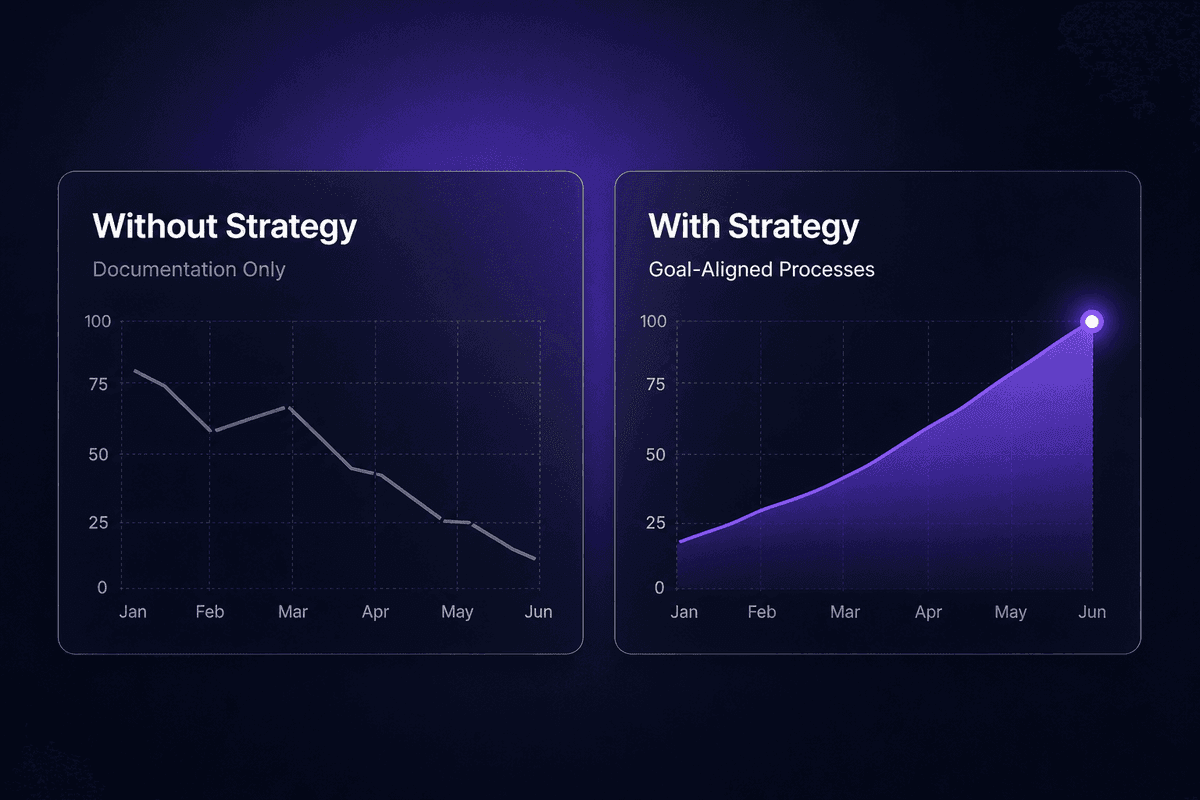
Most teams skip the step that actually connects what their processes do to what the business is trying to achieve. They treat process improvement as an operational task instead of a strategic one. The result is well-documented dysfunction. Faster dysfunction, if the automation is good.
Business process strategy is the bridge that prevents this. Without it, BPM becomes documentation theater: a lot of activity, a lot of diagrams, and organizational outcomes that stay exactly where they were.
The part teams learn late
- Business process strategy connects process design to corporate goals - not just workflow documentation.
- Misalignment with business goals is why most BPM initiatives fail to deliver measurable results.
- Automation chosen without strategic alignment accelerates broken processes, not fixed ones.
- Process strategy is a continuous cycle, not a delivery. Mapping once and moving on is the mistake.
What Business Process Strategy Actually Means
A business process strategy defines how an organization configures and manages its business processes to transform resources into outcomes that support its strategic position. That's the working definition, and it's more specific than it sounds.
Notice what it doesn't say. It doesn't say "documents workflows" or "maps current state." It says configures and manages processes to produce outcomes that support a competitive position. The directional word is "support its strategic position." That's the load-bearing phrase.
An organization's process strategy answers: which processes matter most to where we're trying to go? How should those processes be designed, resourced, and measured? When market conditions shift or the corporate strategy changes, which processes need to change with it?
This is organizational strategy made operational. It's the translation layer between "we want to lead in customer retention" and "here's how our renewal, support, and success processes need to be designed to make that happen." Without that translation, the business strategy stays in the slide deck and the business processes stay in production, running however someone set them up in 2019.
A solid process management strategy also assigns ownership. Someone has to be accountable for whether each process is actually contributing to the stated objective. Without that assignment, processes drift. New tools get bolted on. Steps accumulate. Nobody questions whether the whole thing is still pointing in the right direction.
Good process design is not about making existing steps more efficient. Sometimes the right answer is to stop doing a step entirely. Process strategy gives you the framework to make that call intentionally, rather than accidentally.
Why This Is Not the Same as Business Process Management
Business process management (BPM) is a discipline: a set of methods, tools, and practices for analyzing, designing, executing, monitoring, and improving processes over time. It's how you manage processes once you know what they should be doing.
Process strategy is different. It answers the prior question: what should these processes be doing, and why?
The confusion comes from the fact that most teams encounter BPM first. They buy a tool, learn the methodology, start mapping. All of that is legitimate. But it's all implementation. Process documentation, modeling, and execution are methods. They need a direction before they become useful.
A team can be excellent at BPM and still produce no strategic value if nobody has connected the work to a business objective. I've seen this: thorough maps, clean swimlanes, color-coded lifecycle stages. Beautiful documents that nobody uses to make decisions. The diagnosis is almost always the same: BPM was treated as the strategy instead of the discipline that serves one.
What a Process Strategy Actually Contains
A process management strategy has four components worth naming explicitly, because most teams only have one or two of them.
First: a corporate goal cascade. This is the explicit link between each core process and the business objective it serves. The bpm strategy provides this connection; if you remove it, you're left with a process architecture that has no stated purpose.
Second: a process architecture. A prioritized map of which processes are core to competitive positioning, which are necessary but standard, and which are candidates for outsourcing or elimination. Not everything needs equal attention. Strategy means choosing where to invest.
Third: process-level business objectives. Each core process should have a stated objective that traces back to a corporate goal. "Handle customer onboarding" is not an objective. "Reduce time-to-first-value for new accounts to support our retention target" is.
Fourth: process metrics at both business and operational levels. This is the measurement layer that tells you whether the process is actually contributing. Strategic KPIs measure business outcome (retention rate, cost per transaction). Process metrics measure execution health (average cycle time, error rate, step volume). Both are needed. Strategic metrics without process metrics won't tell you what to fix. Process metrics without strategic metrics won't tell you why it matters.
Good process design, at this level, is genuinely analytical work. It requires knowing both the corporate goals and the current process performance - and it requires someone willing to say when they don't align.
Why Business Process Alignment Is the Core Problem Teams Keep Skipping
When a BPM initiative fails to deliver results, the autopsy usually points at the tool, the methodology, or the change management execution. Rarely does anyone say: we never connected this work to what the business was actually trying to achieve.
But that's usually the answer.
Consider what happens in most mid-size organizations when a process improvement initiative gets launched. The business strategy team defines goals at the top. Operations or IT runs a parallel track to map and improve processes. The two tracks share a meeting occasionally. By the time either side finishes, the landscape has shifted and the connections are loose at best.
This is the structural problem: strategy and process decisions running in parallel without a shared coordination framework. Business units optimize locally. IT builds something technically correct that doesn't match what the business actually wants. Operations improves speed on a process that should have been eliminated. None of these teams are wrong, exactly. They just weren't aimed at the same target.
The cost is real. Wasted resources on process improvement initiatives that don't move strategic metrics. Fragmented workflows that create new integration problems instead of solving existing ones. And a slow accumulation of process debt: steps, approvals, and hand-offs that accumulate because no one has the authority to remove them.
What alignment looks like in practice is simpler than the problem suggests. Each core business process has a named owner, a stated objective, and a measurable KPI that traces back to a corporate goal. Someone reviews that KPI on a defined cadence and has the authority to redesign the process when the numbers drift. That's it. Most organizations don't have this.
The misalignment usually starts before anyone builds anything. An organization decides to improve strategy and process outcomes, but the conversations about what "improved" means happen in different rooms.
📊 In practice:
According to the Deloitte AI Institute's 2026 enterprise AI report, only 34% of organizations are using AI to fundamentally reinvent core processes - while 37% apply it at a surface level without changing underlying workflows. The gap between surface-level optimization and structural process redesign is exactly what business process strategy is meant to close. Incremental efficiency is not the same thing as strategic alignment.

The Business Process Management Lifecycle: Why Process Strategy Is a Cycle, Not a Delivery
BPM is taught as a lifecycle for good reason. There's no clean endpoint. The phases - typically discover, design, model, execute, monitor, and optimize - feed back into each other continuously. The end of one cycle is the start of the next.
The mistake I see most often isn't a failure to complete the cycle. It's the assumption that completing it once is sufficient. The process management lifecycle was never intended as a one-time project. It's a permanent operating mode.
When teams treat it as a project, here's what happens: they complete the discovery and design phases, implement the workflows, and move on. Three months later, something has shifted - a market condition, a product change, a team restructure - and the mapped process no longer reflects reality. The execution happens, the bpm monitors the activity, but nobody is comparing the results to the original strategic objective anymore. The cycle stopped before the optimization phase had a chance to return anything useful.
The process models created during design and modeling are not static documentation. They're living references. When process performance metrics drift, the model is where a team goes to understand why and what to change. An outdated model is nearly as bad as no model, because it gives false confidence about how the process actually works.
Within an organization committed to effective BPM, the optimization phase doesn't terminate - it generates the inputs for the next discovery cycle. What do the monitoring metrics show? Where did the actual process deviate from the modeled process? Which process improvement was implemented and what was its effect on the strategic KPI? Those questions drive the next iteration.
Process improvement, at this level, is not a sprint. It's a cadence. And it requires someone accountable for running it.
What Continuous Optimization Actually Requires in Practice
Continuous improvement sounds appealing until you ask who owns it. That's usually where the conversation stalls.
Effective process optimization requires three things that teams often don't have set up before they start. First: KPI data at the process level, meaning actual measurements of process performance that are up to date and visible to the right people. Not a report somebody produces quarterly. Something the process owner can see when they need to make a decision.
Second: feedback loops from process performance into strategy reviews. If the quarterly business review has no data from the process monitoring layer, the strategy team is making decisions without knowing whether the processes executing the strategy are working. That's a structural blindspot. The fix is straightforward: process performance metrics belong in the same review where strategic decisions get made.
Third: scheduled reassessment. Not reactive investigation triggered by a crisis, but a defined cadence - monthly, quarterly, whatever makes sense given the volatility of the process area - where someone sits down and asks whether this process is still performing at the level the strategy requires. Process optimization that only happens after something visibly breaks is not continuous. It's just responsive.
Each core process should have at least two metrics attached to it: one strategic (does this process contribute to the stated business goal?) and one operational (is the process running within expected parameters?). The operational metric catches execution problems early. The strategic metric keeps the work connected to the reason the process exists.
In terms of real signals to watch: look at cycle time trends, error and exception rates, step-level failure counts, average queue depth, and the ratio of automated to manual interventions over time. If manual interventions are increasing, something in the process design isn't holding up under current conditions.
Types of Business Process Management and Which One Your Strategy Needs
There are three primary types of BPM, and the mistake teams make isn't choosing the wrong one - it's defaulting to a type without checking whether it serves the strategy.
Integration-centric BPM
Designed for processes that are primarily about moving data between systems: ERPs, CRMs, databases, APIs. Best-fit context is high-volume, low-variation transactions where human judgment adds little value. The bpm in this mode is about workflow management across system boundaries, enforcing business rules around routing and transformation. The mistake: teams adopt integration-centric bpm solutions because they're technically tractable, then discover that the processes dominating their bottlenecks are human-dependent decisions that no amount of API wiring will fix. Data moved correctly between the wrong steps is still wrong.
Human-centric BPM
Designed for processes where people make the decisions: approvals, reviews, exceptions, judgment calls. Human-centric bpm tools prioritize task routing, visibility into who owns what, and escalation paths. Best fit when process performance depends more on human decision quality and speed than on automation coverage. The mistake: deploying human-centric bpm for a process that could and should be automated, essentially building expensive task management infrastructure around something that should never require a human step. This is where organizations confuse "the process involves people" with "the process requires human judgment." Those are different things.
Document-centric BPM
Designed for processes built around document creation, review, approval, and storage: contracts, compliance records, proposals, reports. Closely related to workflow management around structured content. Best fit in regulated industries or any context where the document itself is the artifact the process is managing. The mistake: treating document-centric BPM as distinct from the business process it serves. A contract review process still needs to connect to a business goal. Optimizing the routing of a document while the underlying approval criteria are disconnected from strategic risk tolerance produces faster bad decisions.
The underlying principle for all three: the type of BPM you choose should follow from what the process does and what kind of performance problem you're solving. Starting with the tool type and working backward to the strategy is how organizations end up with well-configured bpm solutions that don't move the metrics that matter.
How Process Automation Fits Into a Business Process Strategy
Process automation is an execution tool. That's not a limitation - it's a clarification about where it lives relative to strategy.
The confusion happens because automation projects are highly visible. They produce something tangible: a workflow, a connection, a time saving that's easy to measure. That visibility makes automation feel like strategy. It isn't. Automation that isn't directed by a process strategy is just faster execution of whatever the process already does, which means automating business processes without strategic alignment accelerates existing problems rather than addressing them.
An organization that automates a broken customer onboarding process will onboard customers incorrectly at higher volume and lower cost per error. A team that automates data entry from a source with bad field hygiene will populate downstream systems with bad data more efficiently than they ever could manually. The end-to-end process looks improved on activity metrics. The strategic outcome gets worse.
McKinsey's research on productivity gains from systematic work rethinking is specific about the sequence: eliminate, synchronize, streamline, and then automate. Automation is last. The work before it - removing unnecessary steps, aligning timing across process steps, reducing variation - determines whether automation delivers strategic value or strategic debt. Teams that skip to automation because it's the most technically interesting part of the sequence skip the part that decides whether the automation was worth building.
Business process automation belongs at the point in the strategy cycle where a process is stable, well-defined, and directly tied to a measurable strategic KPI. Until those conditions exist, automation adds complexity without adding value. If you're not sure whether the process is stable yet, it isn't. The question is cheap to ask.
Where Automating Business Processes Delivers Strategic Value
Process automation creates measurable strategic value under three conditions. The process is stable (its steps don't change based on who's running it or what day it is). It's well-defined (everyone agrees on what inputs trigger it, what outputs it produces, and what error handling looks like). And it's directly tied to a strategic KPI (someone can tell you which business objective gets better or worse based on whether this process runs correctly).
When those conditions exist, the McKinsey framing of eliminate, synchronize, streamline, and automate becomes a usable sequence. You've already done the work of removing the bad steps and aligning the timing before any code gets written. What's left is a lean, well-understood process that automation can run faster and more reliably than manual execution. Those are the conditions under which you optimize processes at scale and actually see the KPI move.
When I work with teams building automation for onboarding workflows, for example, the setup question I always ask first is: do you have a business outcome attached to this process? Not "is this faster," but "does it improve a specific metric you're already tracking?" If the answer is no, the automation may be useful operationally but it won't produce strategic business outcomes. It'll just reduce the hours someone spends on data entry.
For teams looking to operationalize this, a workflow that connects a specific process step - say, customer onboarding task completion - to a downstream business outcome metric can be built with relatively low-code tooling. In Latenode, a process task trigger can feed into a dashboard aggregation within a single execution, keeping the operational view and the strategic view synchronized without requiring custom development time every time the process changes. The per-execution pricing model means that a multi-step monitoring workflow counts as one execution rather than one per action, which matters when you're running this kind of visibility across several business process improvement initiatives simultaneously.

Who Actually Uses Business Process Strategy and What Each Role Gets Wrong
Different roles engage with business process strategy at different levels of the organization, and each one has a signature mistake. Naming them is useful because the mistake usually looks like a success right up until it isn't.
Executive and strategy teams own the corporate goal cascade. Their failure mode is treating process strategy as a one-time exercise. They approve the framework at the start of the fiscal year and expect the process owner layer to maintain alignment indefinitely without further input. When market conditions shift - and they do - the processes don't get updated because nobody re-engaged the strategic layer. The process management specialist on the ground is optimizing for objectives that were revised in a strategy meeting nobody told them about.
Operations and BPM teams own the lifecycle execution. Their failure mode is the opposite: they're deeply engaged with process performance and improvement but rarely in the room where strategic priorities get set. So they optimize within the existing process architecture, hitting the metrics they can see, without ever questioning whether the architecture still serves the strategy. Good at BPM. Disconnected from the goal cascade above it.
IT and digital transformation leads own the technical enablement layer. Their failure mode is scoping misalignment: they plan and deliver the process management system on a technology timeline that runs parallel to, rather than in service of, the business needs the process is meant to address. The system goes live. The business landscape has shifted. The tool is excellent. It solves a slightly different problem than the one the organization now has.
Business unit managers own the front-line process execution. Their failure mode is local optimization with change management friction. They'll redesign a process within their team's scope, improve local efficiency, and then discover that the change broke a handoff two steps downstream in another unit's process. No malice, no bad analysis - just insufficient visibility into the cross-unit dependencies that appear when you change something in the middle of a shared workflow. This is the one that lands as a support ticket, by the way.
The thread connecting all four is the absence of a shared coordination framework. Business strategy decisions, process decisions, and technology decisions are made by different people on different timelines, and nobody explicitly owns the alignment between them. Until that gap is addressed, each role will continue to do good work that doesn't fully compound with the others.
🤔 Wait.
If executive teams own the goal cascade, operations teams own the lifecycle, IT owns the technical layer, and business units own execution - who owns the alignment between all four? In most organizations, the honest answer is nobody. That's not a people problem. It's a structural one. A process inventory that no one is accountable for maintaining is a gap that usually shows up in a project postmortem, not a strategy review.
Wrapping Up: Where the Work Actually Starts
Most organizations already have BPM. Most of them have process documentation, tools, and people dedicated to improvement. What they often don't have is the connection between that work and where the business is actually trying to go.
Process mapping without a goal cascade produces archive material. Automation without alignment produces a faster version of the original problem. The process management lifecycle, run without strategic anchors, is a loop that generates documentation and doesn't generate outcomes.
The place to start is not a new tool or a new methodology. It's a simpler, less comfortable question: for each process that's absorbing significant time, money, or attention right now, what business objective does it serve, and how would you know if it was working?
If you can answer that for your three most critical processes, you have the beginning of a process strategy. The bpm success stories - the ones where process improvement initiatives actually move strategic metrics - all start there. The process mining, the workflow redesign, the automation build: all of it comes after.
Identify the process changes that connect to real business objectives. Run those through the lifecycle. Measure against the strategic KPI. And when the KPI shifts, go back to the beginning.
Not a project. A practice.