


Most teams have a contracting process. Someone sends a draft, someone redlines it, someone eventually signs it. But a process and a contract workflow are not the same thing. A process is what happens. A workflow is what's supposed to happen, with defined rules, clear handoffs, named owners, and stage boundaries that hold even when the person who set it up goes on vacation.
The gap between those two things is where most contracting problems actually live. And here's the claim worth arguing about: a contract management workflow is not a software feature. It's a structured, rules-based operating system for agreements. Without mapping it first, no tool will fix the underlying mess. You'll just have a faster version of the same chaos.
The part most teams learn after buying the software
- A contract workflow means defined rules, handoffs, and stage boundaries - not just a contracting routine someone developed by habit.
- The five core phases are negotiation and drafting, approval, execution, monitoring, and renewal or termination - and most teams have no governance over at least two of them.
- Automated contract management workflow tools only deliver their full value after the process is documented, not before.
- Only 31% of organizations follow a contracting playbook - which means ad-hoc is the industry default, not the exception.
What Is a Contract Management Workflow?

A contract workflow is a structured sequence of activities, approvals, and handoffs that governs an agreement from initial request through drafting, negotiation, approval, execution, and renewal or termination. The key word is "structured." It means the sequence is defined in advance, roles are assigned, and each contract contract workflow stage has a clear entry condition and exit condition.
This is not the same as a contract management process in the informal sense. An email chain where someone eventually gets a signature qualifies as a process. It does not qualify as a defined contract workflow. The difference is governance: who owns each stage, what happens when someone is unavailable, how long a stage is allowed to take, and what constitutes approval versus acknowledgment. Most teams learn this distinction only after they try to buy software that's supposed to automate their "process" and discover the software has nowhere to put half of what they actually do.
When you learn what contract management really means at the workflow level, you're learning to see the entire contract lifecycle as a system with rules - not a series of document exchanges held together by institutional memory and inbox searching.
The Key Stages of the Contract Workflow Process
Every stage of the contract workflow has a failure mode. The happy path - someone requests a contract, it gets drafted, reviewed, signed, monitored, and renewed - works fine until there's volume, deadline pressure, or staff turnover. What breaks at every stage of the contract is usually not dramatic. It's quiet. A draft sits in an inbox for nine days because the reviewer didn't know it was their turn. A renewal date slips because nobody owns the tracking. Understanding what breaks within the contract lifecycle is more useful than understanding what's supposed to happen.
Contract Creation and Negotiation: Where Drafting Delays Start
This is where the first major slowdown happens in almost every team I've seen deal with contract volume. Manual contract creation means someone is starting from a blank document or hunting through shared drives for the right contract template. They find three versions of the same template, none of which is dated, and pick the one that looks newest. The new contract is now built on a foundation nobody verified.
Negotiation layers on top of that. Without a standard contract template and approved fallback positions, every redline becomes a conversation about first principles. Legal ends up relitigating clauses they've already decided on a dozen times. The delay isn't negotiation - it's the absence of a documented starting position.
Approval and Review: The Stage Most Workflows Leave Unstructured
The approval and review stage is the one I'd bet is undefined at most organizations. There's no approval workflow, no routing rules, no named owners by contract type, and no SLA. A contract goes to "legal" - meaning whoever sees the email first - and then waits. The stage of the contract management process that should have the tightest governance usually has none at all.
What this looks like in practice: a contract requiring approval from finance, legal, and a department head sits in three separate inboxes with no sequencing. Finance reviews it and waits. Legal doesn't know finance already reviewed it. The department head approves it anyway, not knowing legal hasn't seen it yet. Nobody owns the bottleneck. The contract approval eventually happens, but the contract approval workflow that produced it will produce the same confusion next time.
Execution, Monitoring, and Renewal: The Stages Teams Usually Forget to Manage
Once a contract is signed, most teams consider it done. Filed, maybe indexed, definitely not actively monitored. This is where the back half of the lifecycle quietly falls apart.
Contract execution means more than getting a signature. It means confirming the right version was signed, by the right parties, with the right authority. Contract monitoring means someone has eyes on performance obligations, payment timelines, and SLA requirements - not someday, but on a schedule. And renewal tracking, when left to spreadsheets and calendar reminders, produces exactly the situation where a key contract auto-renews on unfavorable terms because nobody was watching the notice period. According to McKinsey, suboptimal terms and poor contract management can erode value equal to about 9% of annual revenues - and this back half of the lifecycle is where most of that erosion happens invisibly.
Missed renewal windows. Unmonitored SLA breaches. Obligations nobody remembers agreeing to. That's the real cost of treating execution as a done state rather than the beginning of active contract performance management.
Why Contract Management Breaks Down in Practice
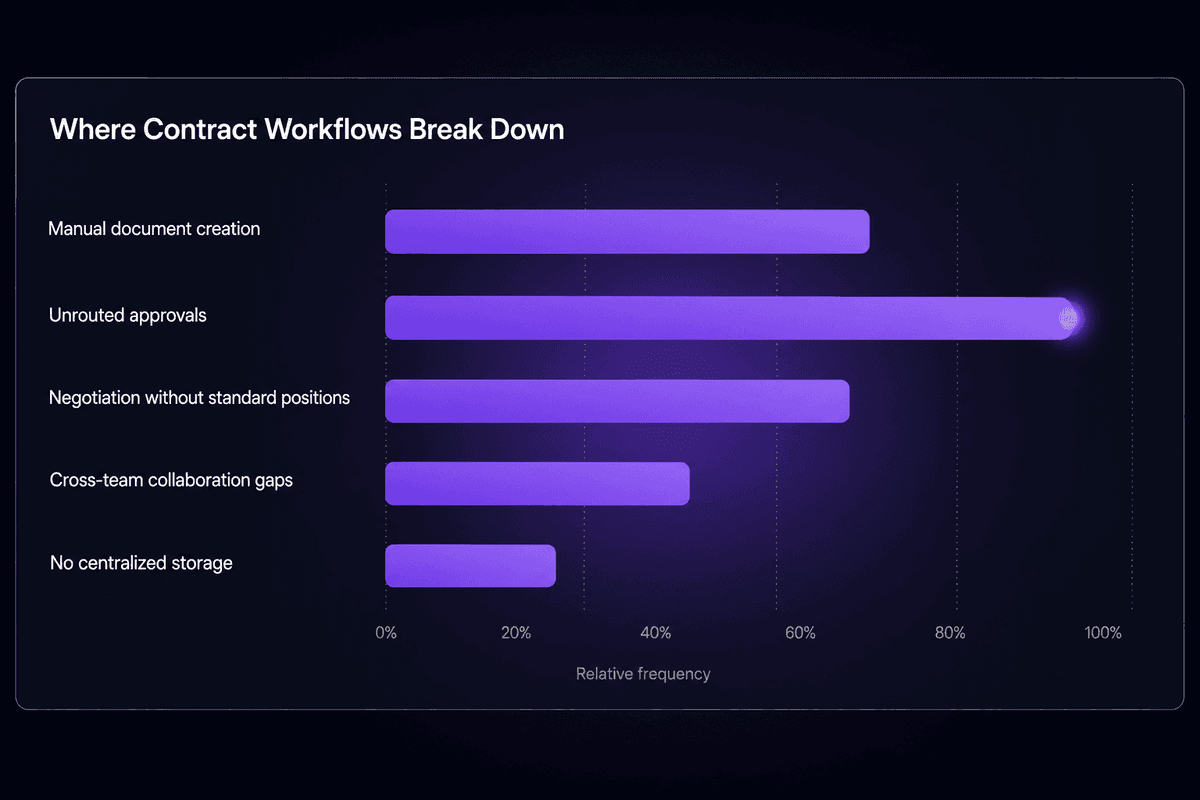
The breakdown isn't one thing. It's a set of specific failure modes that compound, and most of them are invisible until something goes wrong. Contract workflows must have defined owners at each stage to hold together under pressure - and most don't.
- Manual document creation with no version control
Someone creates a contract by copying last month's version, edits the wrong fields, and sends it. The recipient redlines against assumptions that are three iterations old. By the time legal reviews it, the document has five versions and nobody is sure which clauses are still live. Contract storage that's a shared drive subfolder labeled "contracts_FINAL_v3" is not a repository - it's a liability.
- Inefficient review and approval with no routing rules
Contract approval processes that rely on email forwarding and Slack pings have no SLA and no escalation path. A reviewer goes on leave, and the contract waits. Nobody owns the handoff. These contract workflows can help eliminate that ambiguity, but only if the routing logic exists somewhere before the tool does.
- Negotiation delays from inconsistent positions
When legal hasn't documented its fallback positions for standard clause types, every negotiation re-litigates the same ground. What streamlining contract workflows can genuinely fix here is speed - but only once the standard positions are written down.
- Poor collaboration across systems and teams
Finance, legal, procurement, and the business owner are working in different tools. Comments live in tracked changes in a Word doc, in an email thread, and in a Slack DM. Nobody has a single view of where the contract actually stands. Efficient workflow management requires a single handoff record, not four parallel communication channels.
- No centralized contract storage or obligation monitoring
An agreement that's stored in a personal folder, or in the inbox of the person who signed it, is effectively invisible to everyone else. Managing contract workflows helps only if the contracts themselves are findable and searchable.
📊 By the numbers:
Only 31% of organizations follow a contracting playbook, according to Agiloft's research. That means the bottlenecks above aren't edge cases - they're the default operating state for most contracting teams. Ad-hoc isn't a failure mode. It's the norm. And a robust contract management workflow is rarer than most workflow management conversations imply.
What Automated Contract Workflows Actually Fix - and What They Don't
Automation enforces the process. It doesn't replace the process, and it definitely doesn't create one. This is the distinction that almost every CLM software pitch glosses over and almost every disappointed implementation proves out.
What Automation Handles Well Once the Process Is Mapped
When the workflow is documented and the rules are clear, automation delivers real speed. Template-based contract creation means every new contract starts from an approved baseline - no more version hunting. Conditional approval routing means the right reviewers get notified in the right sequence automatically, which speeds up contract cycle times without anyone having to chase. E-signature sequencing ensures the right parties sign in the right order. Deadline and renewal alerts ensure nobody misses a notice window.
The Ironclad benchmark research is worth knowing here: organizations with fully automated workflows resolve 78% of legal requests within 72 hours, compared to 33% for teams running manual processes. That gap is real. But it's a gap that only opens when the process is already defined well enough to automate. The automation speeds up the contract; the process determines what the contract is doing.
When an operations team uses a platform like Latenode to automate contract approval routing, the workflow starts from an intake form or a CRM event - contract metadata flows into an automated sequence, a JavaScript node encodes the approval matrix by value and contract type, and AI models summarize key payment terms and termination rights for each approver before they open the document. A six-step approval workflow runs as a single execution, not six separate billable tasks. The result is faster approvals and a clear audit trail. But you have to know your approval matrix before you build that node. The tool can't infer it.
Where Teams Get Contract Workflow Automation Wrong from the Start
Two mistakes show up constantly. The first is the assumption that an email-and-spreadsheet routine qualifies as a defined workflow. It doesn't. When teams automate an undocumented process, they produce faster versions of the same wrong outcomes. The CLM tool is doing what it was asked to do. The problem is nobody wrote down what it should actually enforce.
The second mistake is trying to automate every contract type at once across the entire contract management process. The teams that succeed start with one high-volume, low-complexity type - NDAs are the standard starting point - prove the workflow, fix what breaks, and expand from there. The teams that fail try to roll out the complete end-to-end automation for every contract throughout the organization in the first sprint. What they get is a half-built CLM that nobody trusts for any contract type. Pick one. Make it work. Then go broader.
Who Actually Uses Contract Management Workflows and for What

Different teams own different parts of the workflow, and their pain concentrates in different stages. It's worth mapping this before deciding where to invest in process improvement, because "we need better contract management" usually means something different depending on who's saying it.
Legal teams care most about compliance and audit trails. Their version of contract workflow failure is a contract that was approved without the right legal review, or an obligation that ran unmonitored for six months. Contract compliance is their core concern - they need to know every agreement went through defined review steps, with documented outcomes at every stage. Contract managers in legal departments also carry the burden of tracking what was agreed to, not just that something was signed. When I look at the support patterns around CLM tools, legal tends to be the team that builds the most governance into the workflow - and the team most frustrated when other departments treat their review stage as optional.
Sales, procurement, and finance teams feel the approval stage most acutely. Their version of failure is a deal that should have closed in a week taking three because a contract approval sat unrouted. Every approval bottleneck is a delayed revenue event or a vendor relationship problem. Managing contract requests is where their workflow pain concentrates - specifically, the experience of submitting a contract and having no visibility into where it is or who's blocking it. The pattern I keep seeing: someone in procurement builds their own ad-hoc contract approval matrix in a spreadsheet because the official process has no routing logic and they got tired of waiting.
Operations and vendor management teams own the back half - execution through renewal. Their failure mode is a successful contract that becomes a liability because nobody was watching the obligations. Contract monitoring and renewal tracking are what they need, and they're usually doing it manually, in a spreadsheet, with a color-coded renewal date column that hasn't been updated since the last person who owned it left. A tool like Latenode can run AI extraction on contract PDFs using built-in RAG, pull key dates and values out automatically, push renewal metadata into CRM or task systems, and send timed alerts to the right owners - without anyone manually maintaining the spreadsheet. That's a workflow that runs without being watched. But the underlying logic - which dates matter, who gets which alerts, what action is required - still has to come from the team that knows the contracts.
How to Build an Effective Contract Management Workflow: Steps That Actually Hold
The guide to contract lifecycle management always starts with "map your current process." This sounds obvious. It is not. Most teams discover their current process is not a process so much as a collection of individual habits that happen to produce the same document at the end.
Map the Current Process Before Touching Any CLM Tool
Before you evaluate contract lifecycle management software, before you configure anything, before you build a single workflow in a CLM, document what actually happens today. Not what's supposed to happen - what does happen. Who initiates a contract request and how? Who reviews it, in what order, and based on what criteria? What does approval mean, and who has authority? Where do contracts live after they're signed?
The reason this step matters: CLM software that automates an unmapped process will automate the confusion. I've watched teams spend significant budget on contract management systems and then spend the next six months fighting the tool because it enforced steps that never existed in practice or skipped handoffs that everyone assumed were implied. If you can't describe the workflow in a swimlane diagram before you buy the software, the software will not help you draw it.
A quick pre-CLM checklist worth running through before any tool decision:
- Identify every contract type your team handles (NDAs, MSAs, SOWs, vendor agreements)
- Name the role responsible for initiating each type
- Document every review or approval required, in sequence
- Define what "approved" means - unanimous sign-off, majority, or designated authority
- Identify where contracts are stored after signing and who maintains that repository
- Map the renewal or termination steps, including notice periods
If any of those steps produce a blank or a "it depends," that's your process gap. Fix it before you buy contract lifecycle management software to automate it.
Start With One High-Impact Contract Type, Not the Entire Portfolio
The single most reliable predictor of a failed CLM rollout is scope overreach. Teams that try to automate every contract type across the entire portfolio in the first implementation rarely succeed, and when they fail, they often conclude the tool doesn't work rather than that the approach was wrong.
Start with NDAs. Or vendor onboarding agreements. Or whichever contract template your team produces at the highest volume with the most consistent structure. Build the workflow for that single type, test it under real volume, identify the edge cases that the initial design didn't account for, and fix them. Then add the next contract type.
This isn't conservatism - it's the difference between having average contract performance improve in month three versus having an expensive contract management software installation that nobody trusts by month six. Custom contract logic and non-standard contract language can be added once the baseline workflow is stable enough to absorb exceptions without breaking.
🤔 Wait.
If only 31% of organizations follow a contracting playbook, what does "full automation" actually mean for the other 69%? It means automating a process that isn't written down yet. Before committing to a broad implementation plan, the honest question is: do we have a documented contract process, or do we have a contracting habit we're about to encode in software?
Contract Management Workflow vs. Manual Contract Process: What the Gap Looks Like in Numbers

The performance gap between automated and manual contract processes isn't theoretical. The Ironclad research puts a number on it. The Deloitte CLM analysis adds a different and arguably worse finding: over 80% of organizations don't even measure whether their contracting is working. You can't improve something you're not tracking.
| Dimension | Manual Process | Automated Workflow |
|---|---|---|
| Legal request resolution within 72 hours | 33% | 78% |
| Organizations following a contracting playbook | ~31% | Defined workflow required to automate |
| Primary bottleneck type | Inbox routing, version confusion, missed escalations | Configuration setup, process gap |
| Governance reliability | Person-dependent, breaks on turnover | Rule-dependent, consistent across volume |
The table looks clean. The reality is messier. The 78% resolution rate under full automation assumes the workflow was mapped correctly before the CLM was configured. Teams that automate a broken process get faster versions of the same broken outcomes. And throughout the entire contract portfolio - across every stage, every type, every team - the gap between what the numbers promise and what the implementation delivers almost always traces back to the same root cause: the process wasn't documented before the software was purchased.