


Most executives I talk to treat data analytics as the reporting function that sits behind the real work of digital transformation. Someone builds a dashboard, the dashboard gets shared in a Monday review, and the assumption is that analytics has done its job.
That assumption is why roughly 70% of digital transformation programs don't fully deliver on what they promised.
Analytics isn't the dashboard layer. It's the decision infrastructure that determines whether a transformation program is steering toward something real or just spending money with good intentions. The two outcomes look identical for the first 18 months. They diverge badly after that.
What most transformation programs learn too late
- Analytics is the decision engine of transformation, not a reporting add-on.
- Only about 30% of digital transformations fully succeed - the difference is usually evidence-based decision-making, not better tools.
- Three value pathways drive the return: customer experience, operational efficiency, and decision quality.
- Buying analytics tools without a connected data strategy is the most common and most expensive gap.
What Data Analytics Actually Means in a Digital Transformation Context
Before this is useful, both terms need to mean something precise, not something vague enough to survive a boardroom.

Digital Transformation as a Business Strategy, Not a Tool Rollout
IBM defines digital transformation as the business's commitment to integrating technology across all organizational areas so it can enable continual, customer-driven innovation. That's not going paperless. It's not adding a digital channel alongside the old one. Digital transformation involves rethinking how the organization creates and delivers value, continuously, with technology embedded in that cycle rather than bolted onto the side of it. A digital transformation strategy is structural and ongoing. Teams that treat it as a project with an end date usually figure that out the hard way.
Data Analytics as the Practice of Turning Raw Data Into Decisions
Data analytics, as UTPB and Forbes frame it, is the specialized practice of collecting and assessing vast amounts of data to drive growth and competitive advantage. The word "specialized" matters. Analytics isn't passively accumulating data into a warehouse. It's actively working data - transforming raw inputs into actionable insights that inform what you do next. And it spans considerably more territory than reporting. The four types below explain what that territory actually looks like.
The Four Types of Data Analytics That Drive Transformation Decisions
The misconception I keep encountering is that data analytics equals dashboards and reporting. It doesn't. Dashboards cover one of four layers. The other three are where transformation decisions actually get made.
- Descriptive analytics
Answers: what happened? This is the historical data layer - revenue by channel last quarter, support ticket volume by week, churn rate by cohort. Data visualization lives here. It's the foundation, and it matters, but it's not where decisions get made. It's where you find out what you're deciding about.
- Diagnostic analytics
Answers: why did it happen? This is types of data analysis that go deeper than the summary number. Why did churn spike in March? What correlates with high conversion rates in one segment but not another? Without diagnostic work, organizations make decisions based on what happened rather than why - which is how the same problem recurs six months later.
- Predictive analytics
Answers: what is likely to happen next? This is where advanced analytics starts earning its budget - modeling customer behavior, forecasting demand, flagging accounts at risk before they close or churn. A transformation program without predictive capability is flying on yesterday's instruments.
- Prescriptive analytics
Answers: what should we do? This is the layer where analytics provide a recommended action, not just a forecast. Route this customer to this segment. Adjust that pricing threshold. Trigger this retention workflow when this score drops below this threshold. Most organizations are still building toward this layer.
The gap between "we have a dashboard" and "we use analytics to steer decisions" is usually the gap between descriptive and prescriptive. The first tells you the car's speed. The fourth helps you steer.
Where Data Analytics and Digital Transformation Intersect Across the Organization
Data plays differently depending on where in the organization you're standing. What a CFO needs from analytics is not what a process owner needs, and neither is what a CX team needs. Getting this wrong produces analytics that's technically correct and operationally useless.
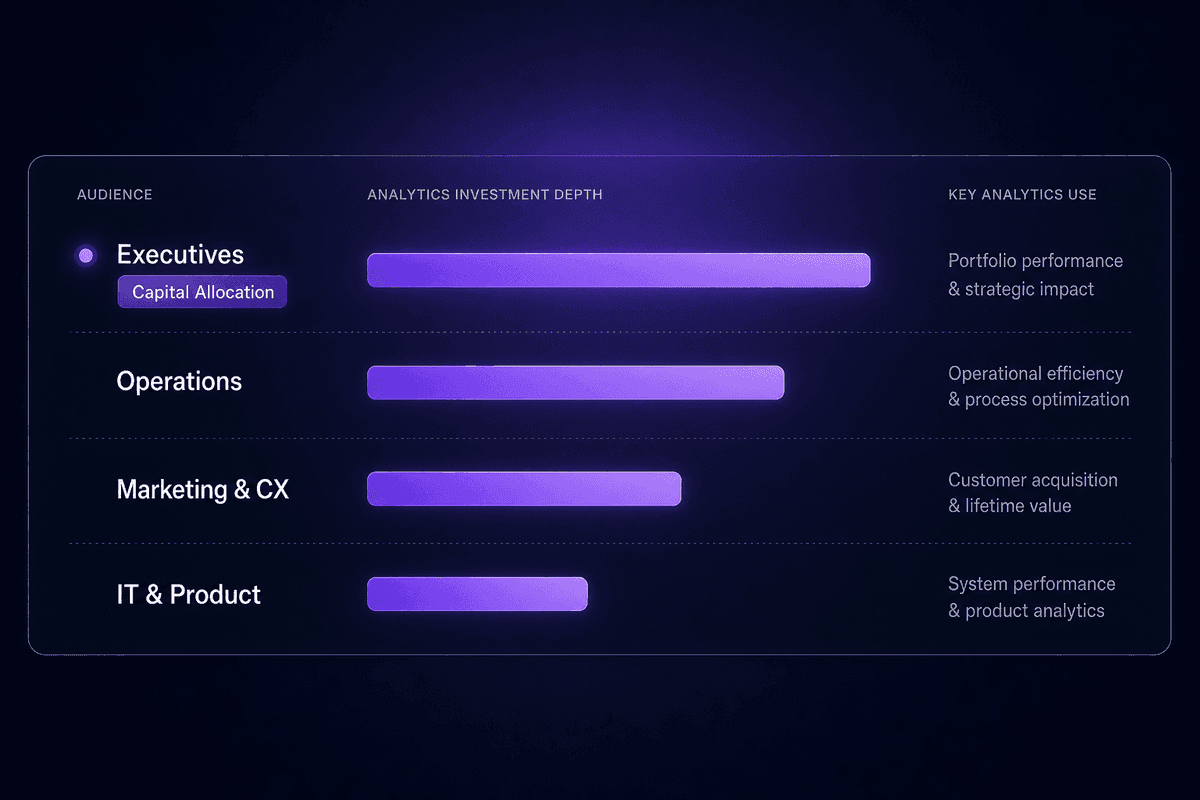
How Executives Use Analytics to Prioritize Transformation Initiatives
At the executive level, combining data from digital and offline sources into unified actionable insights is what makes capital allocation decisions evidence-based rather than politically weighted. Business leaders use analytics to answer questions like: which digital initiatives are generating measurable value against their investment case? Where is the program drifting from its revenue, cost, or customer satisfaction targets? The guidance from Acxiom's framing is useful here - integrating digital and offline data isn't optional if you want an accurate picture. A transformation program that only measures its digital channels is looking at half the picture and making whole-organization decisions from it. You can use data to achieve accurate prioritization or you can use gut instinct. The second option has a longer track record of generating expensive course corrections.
How Operations Teams Apply Analytics to Optimize Digital Processes
Process owners use analytics differently. Their question is: where are the bottlenecks, and what does fixing them actually cost? Effective data management requires identifying inefficiencies not just in theory but at the specific node in the process where throughput breaks down. The blocker that operations teams hit most often isn't a lack of data - it's that the data needed to diagnose a process problem lives in three different systems that don't share a common format. Data integration becomes a precondition. When systems don't connect, data silos form, and the workflow that looks clean on a process map has silent gaps in the middle. I've watched teams spend weeks streamlining a digital transformation process on paper without realizing their analytics were only capturing 60% of the actual transactions because two source systems didn't feed the same warehouse.
How Customer Data Shapes Experience and Retention Strategy
This is where the business impact of analytics becomes most visible to people outside the finance team. Marketing, sales, and CX teams use customer data from multiple data sources - behavioral signals, transaction history, support interactions, real-time data from digital touchpoints - to build a picture detailed enough to act on. Data helps personalize the next touchpoint, predict which customers are at risk before they signal it, and build retention strategies that address actual behavior rather than demographic assumptions. Mohamed Zaki's work at Cambridge on data-driven customer experience transformation makes the point that the shift from segment-based to individual-level analytics isn't a refinement of CX strategy - it's a structural change in what "knowing your customer" means. Most CX teams are somewhere in the middle of that shift.
Why Successful Digital Transformation Depends on Analytics, Not Just Tools
Here's the number that should make any executive uncomfortable: roughly 30% of digital transformation programs fully succeed. Bain, McKinsey, and BCG have each produced research pointing in the same direction - more than 90% of organizations struggle to realize their targeted transformation outcomes. The technology investment is real. The adoption happens. The results don't follow.
The pattern I keep seeing is organizations that treat technology adoption as the end state. They deploy the tools, measure adoption rates, and assume the transformation is on track because the dashboards are green. But adoption rates don't correlate with value realization. Transformation efforts stall when they hit a decision point and the organization reverts to assumptions instead of evidence, because the analytics infrastructure wasn't built to answer the actual question.
Successful transformation requires analytics at the center of the decision cycle, not at the edge of it. Leveraging data means having it available, accurate, and fast enough to actually change what a team does next. That's a higher bar than most transformation programs set for themselves.
📊 By the numbers:
McKinsey research finds that organizations with strong digital and AI capabilities generate two to six times higher shareholder returns than laggards. Advanced data analytics capabilities aren't a feature of transformation programs that succeed. They're one of the distinguishing variables between the 30% and the 70%.
The Analytics Strategy Gap Most Transformations Miss
Buying analytics tools is the easy part. The hard part is building the data strategy that makes those tools answer the right questions.
I've seen teams invest in enterprise analytics platforms and spend the first year using them to replicate the reports they were previously running in spreadsheets. The tool changed. The thinking didn't. What's missing is usually some combination of: a shared definition of which metrics actually measure transformation progress, data governance frameworks that determine who can trust which data source, data quality standards that make the numbers actually reliable, and the change management work that gets cross-functional teams to use analytics output rather than override it. Business analytics, in the narrow sense of measuring business performance, is one piece of this. Transformation requires that every major decision path runs through evidence, and that requires connection across the organization - not just a reporting function that produces a weekly summary.
Trust in the data is the variable that determines whether any of this works. And trust in the data is built by data governance, maintained by data quality processes, and destroyed the first time someone shows a number that turns out to be wrong.
Data Silos and Data Integration as the Most Common Execution Blockers
Data silos are where transformation analytics goes to die quietly. An organization can have excellent tools, a solid data strategy, and capable analysts - and still fail to steer its transformation program if the data that feeds those tools is fragmented across systems that don't share a common schema.
The structural problem is that enterprise organizations accumulate unstructured data, complex data from disparate sources, and high-quality data from some systems alongside low-quality data from others, all sitting in silos that developed organically over years. Building robust data pipelines across those silos is technically difficult and organizationally political. The technical work involves integration at the schema level, not just the API connection level. The organizational work involves convincing teams that sharing their data, including sensitive data, is worth the coordination cost.
The Acxiom framing - that analytics value comes from integrating digital and offline data into unified actionable insights - points directly at this problem. Unified only happens when the silo problem is solved. Actionable only happens after unified. Organizations that skip the integration work and go straight to analytics are building insights on incomplete inputs, and incomplete inputs produce confident wrong answers.
That is where the ticket usually starts.
Big Data, Digital Technologies, and the Analytics Infrastructure That Powers Scale
Digital transformation generates data at a scale that traditional analytics infrastructure wasn't designed to handle. Every customer interaction, every operational event, every digital touchpoint produces a record. Multiple that across thousands of concurrent users and the volume compounds fast. This is the world of data that big data analytics infrastructure was built for.
Statista reports that worldwide spending on digital transformation reached $1.85 trillion in 2022, growing more than 16% year over year. That number represents what organizations are spending on the digital technologies that generate this data explosion: cloud infrastructure, IoT sensors, digital channels, CRM systems, mobile platforms. And according to the same Statista research, over 90% of organizations worldwide have already adopted cloud technologies - meaning the data foundation exists and the focus has shifted to what you build on top of it.

The infrastructure question that matters is: what sits between raw data and a decision? Big data platforms provide the storage and processing capacity. Data mining identifies patterns in vast data volumes that wouldn't be visible to manual analysis. Data governance policies determine which data is trustworthy and who can use it. Quality processes catch the missing fields, duplicate records, and silently failing pipelines before they reach an analyst. Any one of these missing creates a gap.
The challenge I keep seeing in support interactions is teams that have adopted analytics infrastructure at scale without resolving the governance and quality layers underneath it. The big data platforms are running. The dashboards are populated. And the data they're showing is unreliable because nobody owns the pipeline that feeds them.
🤔 Wait.
By 2027, 75% of companies are expected to have adopted AI, cloud computing, and analytics infrastructure. But analytics adoption rates don't correlate with transformation success rates. Most companies adopting analytics tools still fall in the 70% that don't fully realize their transformation outcomes. Deploying infrastructure and using it to steer decisions are two different problems. Most programs solve the first one and call it done.
What the Future of Data Analytics Looks Like Inside a Transformation Program
The trajectory is toward real-time analytics and automated decision loops. Predictive models that identify what's likely to happen within hours or days, not weeks. Prescriptive systems that recommend a specific intervention rather than just flagging a trend. Real-time data flowing from digital channels into models that adjust operational decisions as conditions change.
AI and machine learning expand what's possible in this comprehensive data environment, but they require everything underneath them to work first - quality data, integrated pipelines, governed access, and a clear decision framework for what actions the models are meant to inform. In this world of data, the organizations that will move fastest aren't the ones with the most advanced models. They're the ones with the cleanest data feeding those models. The model is only as good as what it's reading.
How to Use Data Analytics to Accelerate Digital Transformation Without Stalling
Analytics can help organizations accelerate transformation or it can help organizations feel very busy while stalling. The difference comes down to whether the conditions for evidence-based decisions are actually in place. Here are the specific conditions worth checking before assuming your analytics approach will work.
- Alignment between analytics outputs and actual decisions
Data analytics can help only when the outputs reach the people making the decisions, in the right format, at the right time. The failure mode: a team builds strong analytics capability and uses it to answer questions nobody was asking. Check that your analytics workstreams are scoped against specific decision points in the transformation program, not general reporting requirements.
- Data ownership with named accountable people
Analytics need clear ownership at the data level, not just the dashboard level. The pattern I see repeatedly: everyone agrees on the importance of data, and nobody knows who to call when a pipeline breaks. Before applying digital analytics to a transformation program, define who owns each data source, who owns the pipeline, and who owns the metric definition. If those are three different answers, that's fine. But they should be three different named people.
- Integration that covers the whole process, not just the easy parts
Data analytics can provide an accurate picture of a transformation initiative only when the data covers the full process. Teams typically instrument the digital touchpoints well and the back-office integrations poorly. Include data to support the analysis of handoffs, not just the primary channels.
- Quality gates before data reaches analytics
The failure mode here is invisible: duplicate records, missing fields, pipelines that pass a null value silently. Analytics for digital transformation certificate programs cover data governance in theory. In practice, you need running quality checks on every source feed before it reaches the warehouse. As a practical starting point, flag any source pipeline that fails to deliver expected record volumes within two hours of its scheduled run.
- Analytics reviewed on decision cycles, not reporting cycles
Data analytics allows real adjustments only when it's reviewed when decisions happen, not when reports are due. Analyze data against transformation milestones, not calendar months. A dashboard reviewed monthly is a history lesson. Reviewed weekly against active decisions, it steers.
- A skilled interpreter between data and decision-makers
A data analyst who can translate findings into decision language isn't optional. Analytics services produce numbers. The value comes from someone who understands what those numbers mean for the specific transformation decisions being made. Digital transformation and uncovering the actual performance gap in a program requires someone who can read the data and say "this means we need to change the prioritization," not just "this is what the trend shows."
- Analytics applied to data usage, not just performance metrics
How people are actually using the digital tools and processes you've deployed - adoption patterns, drop-off points, workflow abandonment - is some of the most actionable analytics available. Most programs measure outcomes. The programs that steer well also measure adoption behavior while applying digital changes, because that's where you find out whether the transformation is actually taking hold.