


You bought the software. You ran the training sessions. You sent the announcement email with the enthusiastic subject line. Three months later, half the team is still using the old spreadsheet.
This is the pattern I keep seeing - not just in enterprise rollouts but in 20-person SaaS companies, ops teams, HR departments, and customer success functions that spent real budget on tools they genuinely needed. The software works. The adoption doesn't. And the gap between those two things has a name: a missing digital adoption strategy.
The central claim here is uncomfortable but falsifiable: a strong digital adoption strategy is not a training event or a deployment checklist. It's a cross-functional discipline spanning people, process, and product alignment. Teams that treat it as the former consistently fail to get measurable outcomes from the latter. The ones who treat it as the latter start to see their technology investments actually change how work gets done.
The expensive part is ownership
- Digital adoption strategies fail when they stop at deployment - the real work is embedding new behavior into existing workflows.
- Training is one input. Effective digital adoption also requires governance, measurement, and change management that predates the rollout.
- Usage volume is not adoption. Task completion, feature depth, and support ticket reduction are closer to the real signal.
- Digital adoption is essential for both internal teams and external customers - the success metrics differ, but the failure modes look similar.
What Digital Adoption Means - Beyond Deploying the Tool
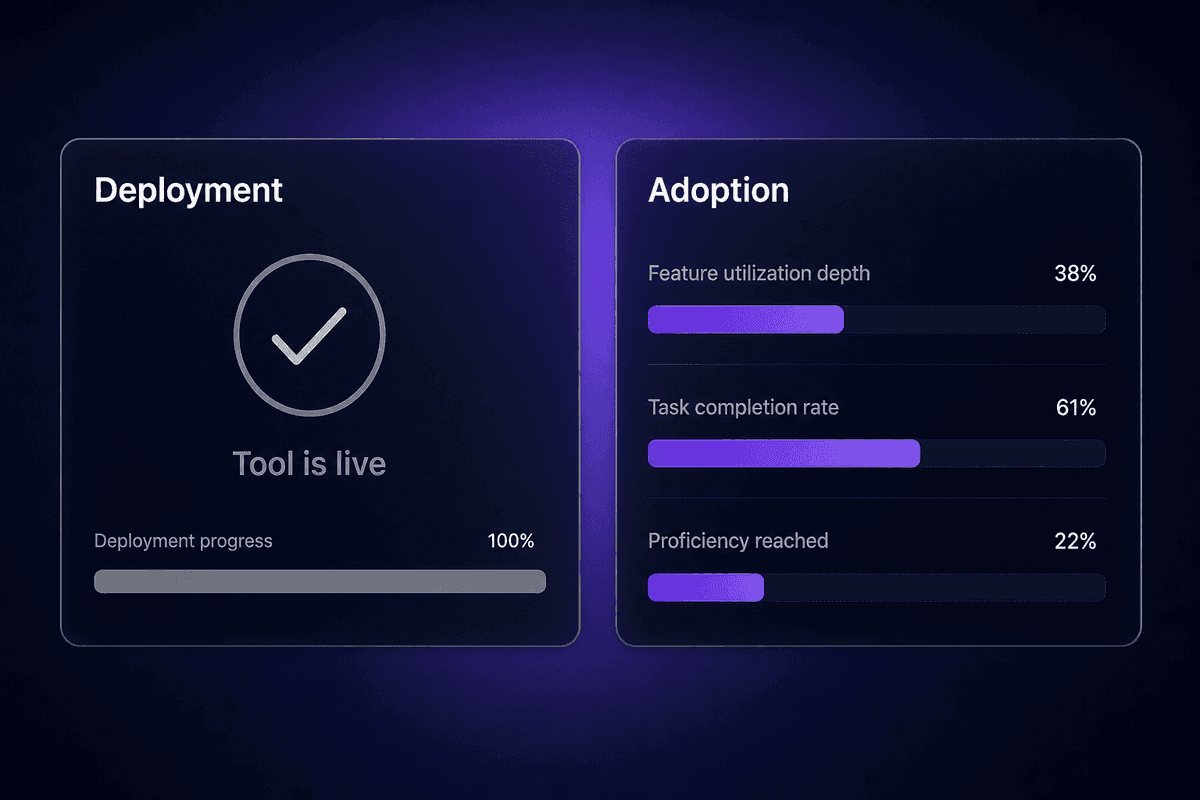
Let's be specific about what digital adoption is the process of achieving - because the definition matters more than it sounds.
Digital adoption is not access. It's not awareness. It's not completing the onboarding checklist. True digital adoption means embedded, proficient usage that changes how work actually gets done, day to day, without requiring someone to consult a help article or ask a colleague how to do the thing they've technically been trained on twice.
Nexthink frames it well: adoption means using the right features in the right context with minimal friction. That's the bar. Not login frequency. Not license utilization. Whether the tool is doing the job it was bought to do, inside the actual workflow of the person using it.
Digital adoption comes when three things align: the user knows what to do, the workflow makes it the path of least resistance, and the surrounding process was redesigned to stop rewarding the old way. When any one of those is missing, you get partial adoption - the most expensive kind, because it looks fine in the dashboard until someone checks the actual outputs.
Digital adoption bridges the gap between what a tool is capable of and what a team is actually extracting from it. Learn what digital adoption really requires and you'll stop measuring it by seat count. The software is live. That's a starting condition, not a finish line.
Why a Digital Adoption Strategy Matters for Driving Digital Transformation
Here's the version of this that senior leaders don't love to hear: the thing stalling your digital transformation strategy is probably not the tools. It's the absence of a plan for how people, processes, and governance will actually absorb those tools into real work.
Without a strategy, the pattern is predictable. You buy software. You deploy it. Utilization is low. You run more training. Utilization stays low. Someone in leadership asks why the ROI isn't showing up. The answer is that the ROI from technology only materializes when the technology changes behavior, and behavior change requires more than access and instructions.
The business stakes here are large enough to be uncomfortable. Global digital transformation spend is forecast to reach nearly $4 trillion by 2027, according to IDC and WalkMe research. Most organizations fail to translate that investment into measurable impact. The gap isn't a software gap. It's an adoption and orchestration gap.
Digital adoption is essential for connecting that spend to outcomes. Harvard Business School researchers studying AI ROI found that companies consistently fail to realize bottom-line impact from technology investments when they skip workflow redesign, ignore employee resistance, and fail to manage the power shifts that new tools create. That's not a finding about software quality. It's a finding about adoption strategy.
In the digital world we're actually operating in - where tools change fast, AI capabilities arrive faster, and teams are already dealing with change fatigue - the organizations that build deliberate adoption strategies are the ones that turn transformation budgets into transformation outcomes. The ones that don't are the ones still running the same report in Excel while the new platform sits at 12% utilization.
The Business Outcomes That Make Digital Adoption a Growth Lever
Reduced churn. Increased expansion revenue. Operational efficiency that shows up in actual productivity numbers rather than just in a slide deck. These are the measurable stakes that customer success and operations leaders call business outcomes worth fighting for.
Gainsight's research on customer success consistently links higher feature adoption to customer lifetime value. When customers use software to its fullest potential, they renew, they expand, they refer. When they don't, they churn - often without filing a single complaint first.
On the internal side, Prosci's data on change management connects adoption programs anchored to specific business KPIs to measurably better outcomes than programs that run without that anchor. Business success in a technology rollout is not a soft result. It shows up in support ticket volume, time-to-proficiency, and whether the ops team is running on the new system or working around it. These outcomes are the reason driving digital transformation at scale requires adoption as a discipline, not as an afterthought.
Why Enterprise Digital Programs Stall After the First Rollout
The pattern is consistent enough that I'd call it a law. Enterprise digital transformation initiatives pass deployment successfully and then stall. The system is live. The licenses are assigned. The training happened. And three months later, sustained usage is nowhere near the projections.
Ineffective digital adoption in enterprise programs almost always comes down to the same three gaps: no change management scaffolding around the rollout, no workflow redesign to make the new tool the path of least resistance, and no governance to sustain adoption after the launch announcement fades. Poor adoption isn't a user problem. It's a design problem.
The misconception that training alone guarantees adoption is what fills enterprise support queues. Digital transformation initiatives that treat onboarding as a one-time event and then measure nothing for 90 days are doing exactly what Gartner's change fatigue research predicts they'll do: overwhelming users with change, getting low adoption, and wondering why.
The Core Components of a Digital Adoption Strategy

A digital adoption plan is not an IT deployment plan with a training module attached. The structural elements are different, and each one breaks in a recognizable way when it's missing. Understanding the digital adoption process means understanding which component failure produces which downstream symptom.
The components that distinguish a real adoption strategy from a project checklist draw on what practitioners and researchers like those publishing through Aptly and LinkedIn's learning community describe as the structural pillars of enterprise adoption programs. Not all nine pillars apply to every rollout, but the ones below are the ones that, when absent, show up in support tickets.
In the digital age of fast-moving tool stacks, implementing digital adoption strategies without these components in place produces a specific kind of failure: usage that looks fine for 30 days and then quietly collapses.
| Component | What breaks when it's missing |
|---|---|
| People alignment | Resistance, workarounds, shadow processes |
| Process redesign | New tool used to do the old process, wasting its capabilities |
| Product configuration | Features that exist but nobody uses |
| Change management | Adoption spike at launch, cliff at 60 days |
| Governance | No owner, no accountability, no iteration |
| Measurement | No signal that anything is wrong until churn or attrition |
Each row in that table is a real failure mode. I've seen all of them. What's useful is that each one also has an early signal, which means you can catch most of them before they become expensive if you've built the measurement layer from the start.
Aligning Digital Adoption Programs to Measurable Business KPIs
Prosci's research makes the connection explicit: adoption metrics that aren't tied to business KPIs don't drive behavior change in the organization. They drive reporting behavior. Someone pulls the utilization numbers, the numbers look acceptable, leadership declares success, and the actual business outcome - reduced support tickets, faster time-to-value, lower churn - never materializes because nobody was measuring it.
Goals for digital adoption need to be defined in terms of business operations before the rollout begins, not after. The difference between a program that works and one that doesn't is usually whether someone asked, before launch: what will be measurably different in 90 days if this succeeds?
To align digital adoption programs to real outcomes, define the KPI first, then choose the adoption metric that leads it:
Support ticket reduction
The leading metric is self-service task completion rate. If users can complete key workflows without helpdesk contact, ticket volume drops downstream.
Time-to-proficiency
The leading metric is onboarding milestone completion within the first two weeks. Teams that hit those milestones reach proficiency faster.
Feature utilization tied to retention
The leading metric is depth of feature engagement, not login count. A user who logs in daily but accesses only one feature is a churn risk.
Change Management and Why Clear Digital Adoption Goals Come First
Change management strategies that arrive after a tool has been deployed are cleanup operations. They're the expensive version of something that would have been cheap if it had happened six weeks earlier.
Digital transformation goals must be stated before adoption campaigns or training sequences are designed. Not as an aspiration - as a specific, testable outcome. "We will reduce the average time to complete a contract request from 4 days to 1 day within 90 days of launch" is a goal. "We want people to use the new platform" is a prayer.
Change management is the mechanism that connects the goal to the behavior. It answers: who needs to work differently, what makes that difference easier, and what organizational friction will push back against it. Skipping this step and going straight to training is how organizations end up running their third training cohort on a tool that's been live for eight months.
Governance, Roles, and Who Actually Owns the Adoption Outcome
The most common single failure mode I see in adoption programs is the ownership gap. The tool shipped. The project closed. And nobody has explicit accountability for whether people are actually using it six months later.
Adoption efforts without an assigned owner drift. Adoption initiatives that span IT, HR, L&D, and CS without a clear RACI degenerate into everyone assuming someone else is watching the metrics. The "tool is live but no one uses it" complaint that lands in support queues is almost always an ownership problem wearing a technical costume.
A governance layer assigns the adoption outcome to a specific person or function, with a cadence for reviewing the metrics, a process for escalating declining usage, and a mechanism for iterating on the adoption approach when the data shows it isn't working. Organizations that get this right treat the organization's digital tool stack as a living system with maintenance requirements, not as a deployment that's done once the project closes.
Digital Adoption Use Cases Across Employee and Customer Journeys
The digital adoption journey looks different depending on whether you're running an enterprise ERP rollout, onboarding new SaaS customers, or trying to keep employees from reverting to email after a system migration. The failure modes are similar. The interventions differ. Here are the four practitioner contexts where adoption strategy does real work.
CIOs and CDOs running ERP or CRM rollouts are dealing with the highest-stakes version of this problem. New technologies at this scale - Salesforce, SAP, Workday - require not just training but process redesign, data migration, and a change management program that runs in parallel with the technical deployment. The rollout succeeds. Adoption often doesn't, because digital initiatives in this context get measured by go-live date, not by whether the finance team stopped using the old reports six weeks after launch.
HR and L&D teams managing internal onboarding are dealing with a volume problem dressed as a learning problem. When 50 new employees join in a quarter and each of them needs to reach proficiency in five different internal systems, you cannot solve that with instructor-led training. The answer is guided workflows, contextual help, and adoption measurement that tells you where people are dropping off before the help desk ticket arrives.
Marketing teams migrating customers to digital channels face adoption resistance from a different direction: customers who are comfortable with the old way and have no intrinsic motivation to change. Strategy here requires incentive design, graduated channel migration, and measurement that distinguishes customers who adopted the new channel from those who were pushed to it and are looking for a way back.
Employee Onboarding and Reducing Internal Support Ticket Volume
Employee adoption of complex internal systems - HRIS, ERP, contract platforms - fails in a recognizable pattern. The user experience at launch is confusing enough that employees either skip key steps, complete tasks incorrectly, or revert to the process they already know. The result is a support ticket, usually filed within the first two weeks.
Reducing that ticket volume is the measurable business case for a dedicated employee onboarding adoption strategy. Guided workflow overlays, contextual in-app help, and structured onboarding milestones can cut the support load significantly - not by making users smarter, but by making the right action the obvious one. When a new hire at a 200-person company doesn't know where to click to request PTO, that's a workflow design problem, not a training volume problem.
New tools require adoption infrastructure, not just documentation. The user experience of the first two weeks determines whether an employee reaches proficiency or builds a workaround. Workarounds are sticky.
Customer Digital Adoption and the Direct Link to Churn Reduction
Customer adoption rates are where product, customer success, and revenue intersect in the most visible way. When a customer activation doesn't convert to feature adoption, the churn signal is already forming - often before the CSM has noticed anything is wrong. Driving adoption through deliberate strategy, rather than hoping customers explore the product, is what separates customer success organizations that expand accounts from those that spend their time defending existing ARR.
The Gainsight research is unambiguous: adoption increases when customers experience the product's core value in the first sessions. Adoption by offering guided onboarding sequences, proactive feature discovery nudges, and milestone-based check-ins creates a digital experience that moves customers toward that first value moment rather than leaving them to find it alone.
The practical workflow looks like this: a new customer activation fires in the CRM, triggering a personalized onboarding sequence based on their industry and role, with escalation logic that routes disengaged accounts to a human CSM before the 14-day mark. In Latenode, that workflow connects the CRM to the communication layer via one of 5,500+ integrations with automatic OAuth, routes profile data through an AI model for personalized sequence drafting, and applies custom JavaScript logic to handle escalation thresholds - all as a single execution rather than a chain of separately billed tasks. The CSM stops chasing logins and starts managing relationships. Small process change. Measurable adoption signal.
Benefits of Digital Adoption Done Right - and the Challenges That Undermine It
Two sides of the same reality. The benefits are documented and achievable. The challenges are the reason most programs don't reach them.
What you actually get when digital adoption ensures the strategy is working:
- ROI realization that shows up in financial terms
When users reach proficiency and use the tool for its intended purpose, the productivity gains and cost reductions that justified the purchase appear in actual output, not just in projection slides. Successful digital adoption requires that this be measured before and after - not assumed.
- Churn reduction tied to feature depth
Customers who reach the core value of a SaaS product renew at higher rates. Digital adoption ensures the path to that value is clear enough that customers find it without needing to call support. Better adoption at 60 days post-activation is one of the clearest leading indicators for 12-month retention.
- Support ticket deflection from internal users
A well-designed adoption strategy reduces the volume of "how do I do X" tickets by making X obvious inside the workflow. New digital tools without adoption infrastructure generate predictable support load. With it, that load drops.
- Employee satisfaction that doesn't tank after implementation
Comfortable with digital tools doesn't mean technically sophisticated. It means confident. Employees who get guided, contextual support during a system transition report higher satisfaction and lower resistance two months out than those who received a training session and a PDF.
The challenges that most digital adoption programs underestimate:
- Resistance to change compounds faster than expected
Gartner's research on change fatigue found that workers' capacity to absorb change has dropped to roughly 50% of pre-pandemic levels. Relatively minor day-to-day changes now create 2.5x more fatigue than large structural ones. This means even a well-designed rollout can encounter resistance that looks disproportionate to the scale of the change.
- Inadequate training that covers features, not workflows
The dominant failure mode here is training that teaches users what buttons do, not how to accomplish the task they're trying to complete. Those are different lessons. Only one of them reduces support tickets.
- Lack of executive sponsorship that everyone knows is missing but nobody says
McKinsey's 2026 organizational readiness report found that only 14% of organizations report consistent leadership sponsorship for adoption programs. The other 86% have a championing problem that no amount of training will fix. Overcome digital adoption challenges by solving the sponsorship gap first.
- No measurement infrastructure, so failure is invisible
Digital adoption is a vital indicator of program health. Without baseline data and ongoing metrics, a program can be failing quietly for months. The signal appears eventually - in churn numbers, in low utilization warnings from the vendor, in the attrition of the employee who finally gave up.
- Ownership distributed to nobody
When adoption is everyone's responsibility, it's nobody's. This is the challenge that fills Monday morning queues.
📊 By the numbers:
Global digital transformation spend is forecast to reach nearly $4 trillion by 2027. The gap between that investment and realized impact is not a software problem - it's an adoption and orchestration problem. Digital transformation efforts at that scale don't fail because the tools don't work. They fail because the strategy for changing behavior at scale doesn't exist.
How to Measure Success in a Digital Adoption Strategy
Usage volume is not adoption. This is the mistake that produces misleading dashboards and premature success announcements. Digital adoption success requires connecting specific metrics to the business KPIs that were defined before the rollout.
Prosci's research on adaptive adoption programs confirms what most experienced practitioners already know: organizations that anchor their adoption metrics to measurable business outcomes see significantly greater impact than those tracking adoption as a standalone indicator. Effective adoption measurement answers the question "did behavior change in a way that produced a business result" - not "did people log in."
The practical metrics that close this gap:
- Feature utilization rate - not just which features exist, but which workflows are being completed using them
- Time-to-proficiency - measured in days from first access to first successful completion of a key task without assistance
- Support ticket deflection rate - tracked week-on-week post-rollout, compared to a pre-rollout baseline
- Task completion rate - the percentage of users completing a defined workflow end-to-end, not just starting it
- NPS delta at 60 and 90 days post-rollout - specifically for the tools affected, not general satisfaction
Having digital adoption strategies in place means having these metrics instrumented before go-live, not assembled retroactively when someone asks why the numbers aren't moving.
Leading vs. Lagging Indicators of Adoption Progress
Technology adoption programs that measure only lagging indicators catch adoption failures too late to fix them. Churn, productivity gains, and ROI realization are the results of adoption. They arrive months after the adoption decisions were made. By the time a lagging indicator turns red, the intervention window has usually closed.
Leading indicators are where the real signal lives. Workflow completion rates in the first two weeks tell you whether adoption might succeed or fail long before churn data does. In-app engagement depth - not just sessions but which features are being accessed in sequence - shows whether users are building the habits the tool requires. Onboarding milestone completion by day 14 is one of the most reliable predictors of 90-day retention I've seen in both internal and customer adoption contexts.
Adoption becomes a controllable variable when you're measuring leading indicators. It becomes an uncontrollable one when you're only watching the lagging outputs. The teams that build leading indicator dashboards are the ones who catch a struggling cohort and intervene. The ones who don't are the ones who are surprised by the quarterly churn number.
What Makes Digital Adoption Metrics Unreliable Without Baseline Data
Here's the trap that's embarrassingly common: an organization launches a tool, measures post-rollout utilization, sees 65% adoption, and declares success. Nobody asks: 65% compared to what?
Without a pre-rollout baseline capturing task completion rates, support ticket volume, and feature utilization in the old system, the post-rollout number means nothing. Digital adoption streamlines measurement only when there's a clear before-and-after comparison. A 65% utilization rate after a rollout could represent remarkable progress from 10%, or a disappointing plateau from 80% in the previous system. The success of digital programs depends entirely on having established that starting point.
Collect baseline data before you schedule the launch announcement.
Choosing or Building a Digital Adoption Platform - What to Verify First

A digital adoption platform earns trust by doing specific things that a training system doesn't: in-workflow guidance that appears at the moment of confusion, behavioral analytics that surface where users drop off, integration with existing systems so the platform sees what's actually happening, and the ability to detect adoption gaps rather than just deliver tutorials passively.
The framing from WalkMe and Nexthink is correct: a digital adoption platform is an adoption solution, not a training replacement. Digital tools can provide guidance, but only when they're instrumented to understand workflow behavior, not just content delivery. The selection mistake I see most often is choosing a platform before defining what specific adoption failure you're trying to solve.
Integrating digital technologies into an adoption program requires knowing what broke first. If the problem is that users never discover a key feature, you need behavioral analytics and proactive nudges. If the problem is that users know what to do but the workflow makes it hard, you need contextual in-app overlays. If the problem is that nobody knows adoption is failing, you need a measurement layer that's integrated with your business KPIs. Integrating and using digital tools that solve the wrong problem does not solve the right one.
A quick pre-selection checklist:
- Have you defined the specific adoption failure mode you're solving? (feature discovery, task completion, proficiency speed, something else)
- Can the platform surface where users drop off in a specific workflow, not just overall sessions?
- Does it integrate with your existing CRM, HRIS, or product analytics layer, or does it sit separately?
- Who will maintain it after implementation - and does that person have the access and skills to act on what the data shows?
- Can you measure the leading indicators you defined earlier (task completion, onboarding milestone, feature depth) through this platform?
🤔 The uncomfortable question:
Most teams evaluate a digital adoption platform on feature count - walkthroughs, tooltips, analytics dashboards, integrations listed. Almost none evaluate it on whether it closes the specific adoption gap they've already diagnosed. If you haven't diagnosed your adoption failure mode before you started the vendor evaluation, you're shopping for a solution to a problem you haven't defined. Complex digital programs fail here before the platform is even selected.