


Here's a pattern I keep seeing in support conversations and community threads: a company spends eight months rolling out a new HR platform, a new IT ticketing system, and a new collaboration suite. The project closes on time. The deployment dashboard turns green. Six months later, someone senior asks why productivity hasn't moved, why turnover is still high, and why employees keep complaining that work feels more complicated than it did before.
The tools worked. The transformation didn't.
That gap has a name. It's called the digital employee experience - and most organizations either measure it wrong, own it in the wrong department, or skip it entirely while wondering why their transformation spend isn't showing up in outcomes. According to the TEKsystems State of Digital Transformation 2026, only 16% of organizations cite improving employee experience as a primary goal of digital transformation. The other 84% are presumably hoping it improves on its own.
It doesn't.
The part transformation roadmaps skip
- DEX is how employees perceive every digital interaction at work - not an IT headcount metric.
- More tools don't automatically mean better DEX; usability and integration quality are independent variables.
- Companies with strong employee experience achieve roughly 2.4x higher revenue growth than those without it.
- SLAs measure uptime; XLAs measure whether employees are actually better off.
What Digital Employee Experience Actually Means
Digital employee experience is how employees perceive, feel, and function within every digital interaction their work demands: the HRIS they use to request time off, the ticketing system that does or doesn't resolve their IT issues in time, the onboarding portal that guided them through week one, the collaboration tools their team actually uses versus the ones IT provisioned but nobody touches.
It's perception-based, not system-based. Two companies can run identical software stacks and produce completely different digital employee experiences depending on how those tools are configured, integrated, and supported.
Brightmine's 2026 practical guide defines it as a critical pillar of HR strategy - not an IT concern - treating digital experience as core to workforce planning rather than an adjunct IT function. ServiceNow frames it similarly: DEX covers the full range of an employee's interactions with digital tools, processes, and support structures. It's not a software audit. It's a perception score.
The first misconception worth clearing: DEX is not just about devices and applications. That framing is how it ends up owned entirely by the helpdesk. But if the HR portal is confusing, that's a DEX problem. If the onboarding documentation lives in three disconnected systems, that's a DEX problem. If employees in different regions use different tools to do the same job and the digital experience is inconsistent, that's also a DEX problem. The digital experience of employees spans IT, HR, operations, and culture. Assigning it to one function is part of why it underperforms.

DEX vs. Employee Experience: Where the Digital Layer Starts
General employee experience covers the full spectrum: culture, management quality, physical environment, compensation structures, career development, and yes, digital tools. DEX is the digital layer inside that broader picture. It's specifically about the quality of digital interactions - whether the tools work, whether they're usable, whether they help employees get things done without friction eating into their day.
AIHR frames DEX as how effectively people interact with workplace digital tools to be engaged, proficient, and productive. That framing matters because it applies to office workers, remote workers, and frontline employees equally. A warehouse worker logging shift data on a slow tablet has a digital employee experience. A remote analyst waiting for a 40-second dashboard to load has a digital employee experience. The overall employee experience they have at work is shaped, significantly, by whether those digital interactions help or hinder. When companies say DEX "only matters for remote workers," they're usually describing a gap in their own measurement, not a feature of reality.
Why DEX Is a Cross-Functional Problem, Not an IT Ticket
The support queue has a predictable shape when DEX ownership is unclear. IT gets tickets about slow systems. HR gets complaints about the onboarding portal. Operations gets feedback that tools don't connect properly. Nobody is looking at the full picture because nobody owns the full picture.
The Ivanti 2025 DEX Report found something worth sitting with: most organizations do not adequately prioritize digital employee experience even when actively investing in new tools. They're buying software, not improving experience. The gap between IT leader perception and employee frustration with those same tools was significant. Leaders thought the experience was better than it was. Employees were dealing with the friction daily.
That gap exists because DEX isn't owned as a cross-functional outcome. It's treated as an IT responsibility in the work environment, addressed ticket by ticket, without anyone aggregating signal across HR, IT, and operations to ask: what is the actual state of our employees' digital experience, and who is responsible for improving it? The importance of employee experience as a business outcome demands a better answer than "open a ticket."
The Core Components of Digital Employee Experience
DEX isn't one thing. It's a stack of interconnected layers, and the failure mode in most organizations isn't that any single layer is broken - it's that the layers don't connect well enough to produce a coherent experience. The Brightmine and AIHR frameworks both land on roughly the same set of components: tools and technologies, workflows and processes, communication and collaboration infrastructure, digital onboarding, IT support quality, and the usability and integration quality that connects all of them. Employee sentiment runs through all of it, because DEX is ultimately measured in how employees feel about doing digital work - not in system uptime metrics.
The misconception that having many modern tools automatically produces strong DEX is one of the most expensive assumptions in digital transformation. A company can have excellent individual products in a fragmented digital environment and still produce a frustrating experience. If the HR platform doesn't handoff to the IT provisioning system, a new hire's first week is a manual maze. If collaboration tools aren't integrated with project management, people build their own shadow systems. The total experience of employees working across these digital platforms is worse than the sum of its parts when integration quality is low.
Tools and Technologies: What the Stack Looks Like From the Employee Side
From an employee's perspective, the tools and technologies layer isn't experienced as a vendor lineup. It's experienced as: how long did it take for that to load, why does this system not know that I already entered this information somewhere else, and why am I opening a sixth tab to do one task.
The digital landscape most employees navigate daily - collaboration tools, HR systems, IT portals, project management platforms, communication channels - is often assembled by different teams over different years with different integration assumptions. What looks like a modern workplace technology stack from an IT roadmap looks like fragmented noise from a desk chair. A digital tool that does its own job well but doesn't talk to adjacent systems creates the same daily friction as a broken one. Proactive IT problem-solving and automation help, but only if they're applied to the connections between management tools as much as to the tools themselves. The employee doesn't see your architecture diagram. They see how long it takes to do their job.
Digital Friction: Where the Experience Actually Breaks Down
Digital friction is the specific mechanism that turns a good tool investment into a bad employee experience. Slow systems. Broken integrations between platforms. Redundant tool-switching to complete a single task. Support that is reactive rather than proactive. These aren't edge cases - they're the normal operating conditions in organizations that measure deployment success without measuring post-deployment experience.
1E's research on proactive IT monitoring identifies the failure pattern clearly: issues that reach employees as conscious frustrations have usually been detectable in system signals long before anyone noticed. A degraded end-user experience often starts as a small latency anomaly or an authentication error that nobody flagged. Self-service tools help reduce friction on the resolution side, but the better digital solutions are the ones that resolve issues before they affect users at all. That requires monitoring and proactive response infrastructure, not just a better ticketing portal. Most organizations have built the portal. Fewer have built the monitoring logic that makes the portal less necessary.
That's where the ticket usually starts.
Why Prioritizing Digital Employee Experience Is Not Optional Anymore
The business case for DEX has moved past "it would be nice if employees liked their tools." The numbers are specific enough to bring to a budget conversation.
72% of employees consider the digital workplace extremely important to their day-to-day work, according to Gartner and Liferay research. 74% of organizations plan to increase investment in employee experience technologies. These are adoption signals, not satisfaction scores. They tell you that employees are already making judgments about their employers based on digital experience quality, and that the organizations competing for talent are investing accordingly.
The employee engagement and employee retention connection is direct: when digital friction is high, the daily cost of work goes up. Not the cost to the company in software spend - the cost to the employee in cognitive load, time lost to broken processes, and the low-grade frustration that compounds over months. That's what shows up in exit interview data and in the gap between reported productivity and actual output. The impact of digital transformation on these metrics isn't about which software was deployed. It's about whether the experience of doing work improved.
The Ivanti finding is the one I'd put in front of a CFO: transformation spend routinely fails to reach its value because the experience layer is skipped. The project closes green. The ROI doesn't appear. The experience layer is usually why. Organizations that treat overall employee satisfaction as a business outcome rather than an HR metric close that gap faster. Business outcomes like revenue growth, customer experience quality, and retention rates are all downstream of whether employees can do their work without fighting their tools every day.
📊 By the numbers:
Companies with strong employee experience achieve roughly 2.4x higher revenue growth than those without it, according to Kincentric research. That shifts the DEX conversation from IT satisfaction metric to growth lever - which is a completely different budget discussion.

Where Digital Transformation Gets DEX Wrong
Digital transformation programs are very good at measuring what they deployed. They are much less good at measuring whether anything improved.
Most transformation initiatives track tool rollout milestones, system uptime, and SLA compliance. Those are deployment metrics. They answer "did we ship the thing?" They don't answer "are employees doing their jobs better than they were before?" Those are different questions, and answering only the first one is how a program closes on time and on budget while the actual experience of working at that company gets worse.
Tool Rollout vs. Digital Experience: Why Deployment Metrics Lie
The dashboard said the deployment was complete. 94% of employees had logged into the new platform at least once. The IT team declared success. Six months later, a survey found that 61% of those employees had found workarounds to avoid the platform for their core tasks, because it was slower and less integrated than the combination of tools they'd been using before.
I keep seeing this pattern. The Ivanti research confirms it's systemic: organizations that invest in new tools to embrace digital transformation frequently do so without building measurement infrastructure that tracks employees' digital experience after the rollout. The SLA for uptime was met. Whether the digital transformation efforts actually improved how employees work wasn't tracked. Impact on employees shows up in productivity data, attrition trends, and support ticket volume - none of which appear in the deployment dashboard. SLAs tell you the system ran. They don't tell you it worked.
Experience Level Agreements: The Measurement Shift Most Teams Skip
Top Employers Institute and Gable research identifies Experience Level Agreements (XLAs) as the more honest measurement frame for transformation programs. Where a Service Level Agreement says "the system was available 99.7% of the time," an XLA says "did the experience of using that system help employees complete their work effectively?"
XLAs measure digital employee experience outcomes rather than technical compliance. They pull together employee feedback, employee surveys, employee net promoter scores, and behavioral signals like tool adoption rates, time-to-task, and support ticket frequency. To measure digital employee experience properly, you need to know not just that the system ran, but whether it helped. The shift from SLA to XLA thinking is the practical mechanism that moves transformation leaders from IT compliance thinking to outcome thinking. Most teams skip it because SLA metrics are already instrumented and XLA metrics require building something new. That's exactly the reason the experience layer keeps being the thing that transformation programs don't improve.
AI Adoption and the Growing DEX Gap in the Workforce
There's a specific version of the DEX problem emerging right now that I'd flag to anyone building a transformation roadmap for the next two years: the AI adoption gap.
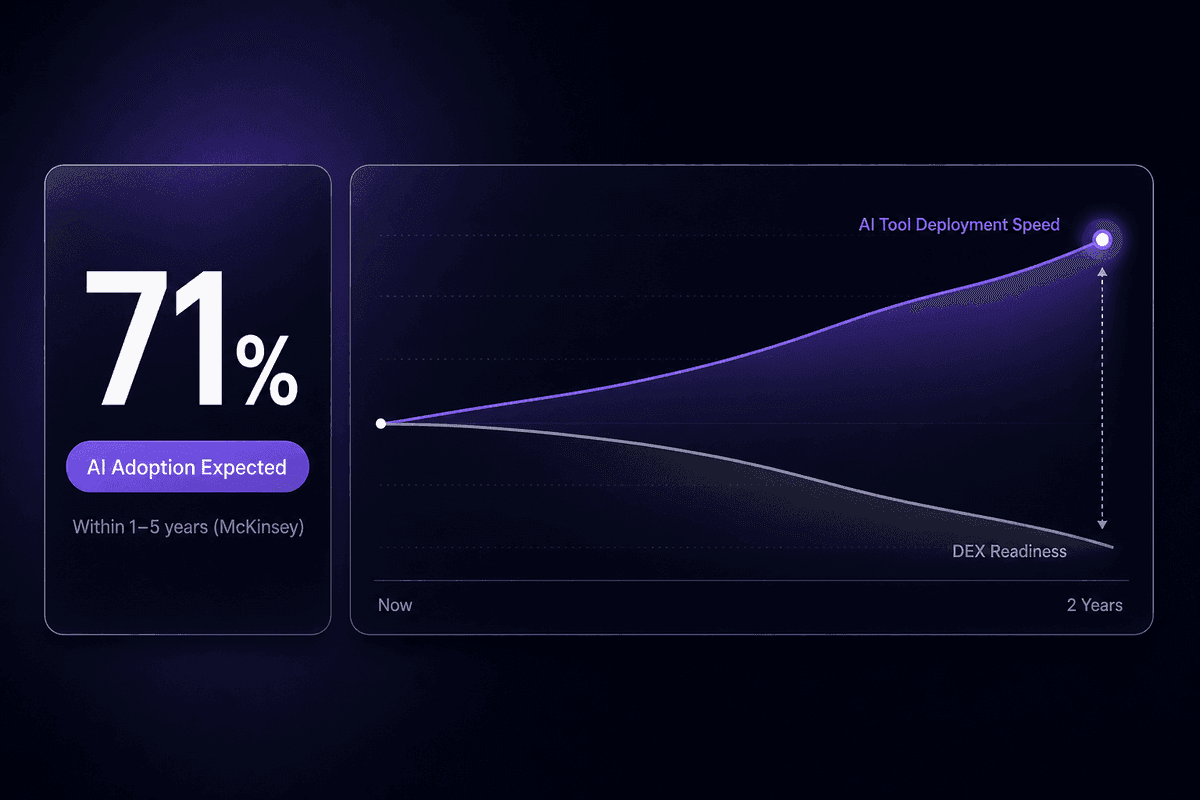
McKinsey research found that 34% of employees expect to use generative AI for more than 30% of their work tasks within one year. Another 37% expect to reach that threshold within one to five years. That's a large share of the workforce expecting AI tools to become central to how they work in the digital age. The problem: only a small minority report feeling fully supported in that transition. The tools are being deployed. The experience infrastructure to support adoption is not being built at the same pace.
This is a DEX problem, not a training problem. When AI tools enter the digital stack without adequate integration into the broader digital workplace, they become another source of friction rather than relief. Employees who can't get clear answers about how to use a new AI tool, whose team workflows haven't been redesigned around it, and who lack self-service support infrastructure for AI-specific questions are experiencing a wider digital experience gap, not a narrower one. The digital work that AI is supposed to simplify becomes more complicated when the DEX layer hasn't kept pace.
The risk is that organizations measure AI adoption by deployment counts - how many employees have access to the tool - while the actual adoption rate, the percentage who use it confidently for real tasks, lags badly. That gap shows up in productivity metrics six to twelve months after rollout. By then, the DEX budget for the AI program has usually been spent.
🤔 Wait.
The organizations accelerating AI tool deployment the fastest may be widening their DEX gap, not closing it. Rollout speed and experience readiness are two different timelines, and right now most roadmaps are optimizing for the first one. If your AI investment plan doesn't include XLA targets for AI adoption quality, you're measuring the wrong thing.
Building a Digital Employee Experience Strategy That Connects to Outcomes
A strong digital employee experience strategy starts from a specific decision: are you designing around tools or around journeys? Most programs start from tools. The ones that produce durable outcomes start from employee needs and map backward to the technology.
Here are the structural moves that separate effective digital employee experience management from tool procurement with better branding:
Start from journey mapping, not tool evaluation
Map the digital touchpoints an employee actually encounters - from first day to daily work to offboarding - before deciding what to buy or build. The recurring mistake is buying a "digital workspace" platform and then asking employees to change how they work to fit it. The failure mode: tools that are technically excellent but solve problems employees don't have, while leaving the ones they do have untouched. Improve the digital employee experience by understanding where it breaks before choosing the intervention.
Establish cross-functional ownership with a named accountable team
DEX without a cross-functional owner degrades into an IT helpdesk metric and an HR engagement survey, running separately, measuring different things, owned by different people who rarely compare notes. Assign DEX ownership jointly to IT and HR with a shared dashboard and shared KPIs. A strong digital employee experience strategy requires that employee needs are represented in both technology decisions and people strategy simultaneously.
Replace SLA-only metrics with XLAs before the next deployment
If your transformation program measures tool rollout and uptime but not employee outcome metrics, you're flying blind post-deployment. Building XLAs into the measurement framework of the next initiative - before it ships, not after it disappoints - is the single highest-leverage structural change available. Effective digital employee experience is measured in whether work got easier, not whether systems stayed up.
Design for proactive rather than reactive IT support
Reactive support is what you have when the ticket arrives. Proactive support is built from real-time monitoring signals, pattern detection, and automated resolution of common issues before employees notice them. The difference in perception is significant: employees who never have to submit an IT ticket because the problem was already fixed rate their digital experience dramatically higher. Enhance the digital employee experience by reducing the number of moments where employees have to stop work to seek help.
Include AI adoption readiness explicitly in the DEX program
Given the McKinsey data on how quickly AI is expected to become central to digital work, any DEX program that doesn't have a dedicated AI adoption readiness component is already behind. This means not just access to AI tools, but support infrastructure, updated workflows, and XLA targets that track whether AI tools are actually improving employee productivity or just sitting unused. Digital employee experience management in the AI era requires measuring the experience of using AI, not just having access to it.
Measure across frontline and remote roles, not just office workers
DEX programs that survey only desk workers are missing the part of the workforce where digital friction has the most direct operational impact. Frontline employees using digital tools for shift management, safety reporting, or customer service interactions have a DEX, and it often lags office worker experience significantly. A positive digital employee experience across the full workforce means instrument coverage that reaches every role type, not just the ones with a desk and a dual monitor.
What a Great Digital Employee Experience Looks Like in Practice
Not a vision statement. What you'd actually observe.
You'd see IT issues flagged and resolved before tickets are opened, because real-time monitoring is catching degraded performance signals proactively. The user experience of "everything just works today" is the output of monitoring infrastructure running in the background, not luck. You'd see a consistent experience across the workforce whether the employee is in an office in Warsaw, working remotely from home, or on a shop floor checking a tablet between tasks. AIHR's framework specifically notes that engaged, proficient, and productive digital work requires that consistency - not just for remote workers, not just for knowledge workers, but across all worker types.
You'd see XLA targets being tracked in the same dashboard as SLAs, with clear owners for improving them. You'd see a named support structure for AI tool adoption, not just access provisioning. And you'd see cross-functional DEX ownership that means when the HR portal has a usability problem, the IT team is in the same room as the HR team when it's being diagnosed.
A successful digital employee experience is operational, not aspirational. It improves employee engagement because working digitally is reliable. It improves employee productivity because friction has been measured and addressed, not just acknowledged. It produces a positive employee experience not because anyone declared it a priority, but because the structural conditions for it were actually built.
One practical illustration: the classic onboarding friction pattern, where a new hire's first week involves IT provisioning, HR paperwork, and training coordination running through separate systems with manual handoffs between them, is solvable with workflow automation. In Latenode, automating onboarding means a new hire record triggers a workflow that orchestrates account provisioning, document routing, and training path assignment across HRIS, identity management, and collaboration platforms simultaneously - using a JavaScript node to apply role-specific logic (different setup paths for contractors versus full-time hires) and built-in RAG to answer routine onboarding questions from uploaded policy documents, without adding separate tools or subscriptions. The HR team stops being a manual relay station. The new hire stops waiting. That's what a great digital experience looks like operationally, not as a value statement but as an architectural outcome. Enhancing employee satisfaction through better workplace tools is the tangible result, but it requires the automation plumbing to be deliberate, not accidental.