


Most organisations approach digital readiness as a procurement question. They ask: do we have the right tools? Do we have the budget? Is the IT department on board? Then they wonder why transformation programs stall six months in, when the technology is already installed and the dashboards are showing green.
The tools were never the bottleneck.
Digital readiness is the actual precondition for transformation - and it includes skills, trust, governance, and organisational capability alongside technology. Not instead of it. Alongside it. Miss any one of those dimensions and the technology sits there doing nothing useful, like expensive furniture nobody knows how to use.
What usually breaks first
- Digital readiness measures capability across skills, trust, infrastructure, and governance - not just tool access.
- Pew Research identifies three dimensions: skills, trust, and actual use - all three have to be present.
- Readiness is the precondition for digital transformation, not a synonym for it.
- Organisations can score adequately on infrastructure and still fail transformation if culture and trust are unassessed.
- Assessments work at both national scale (UNDP's 50-country DRA) and SME level - because the gaps look surprisingly similar.
What Digital Readiness Actually Means
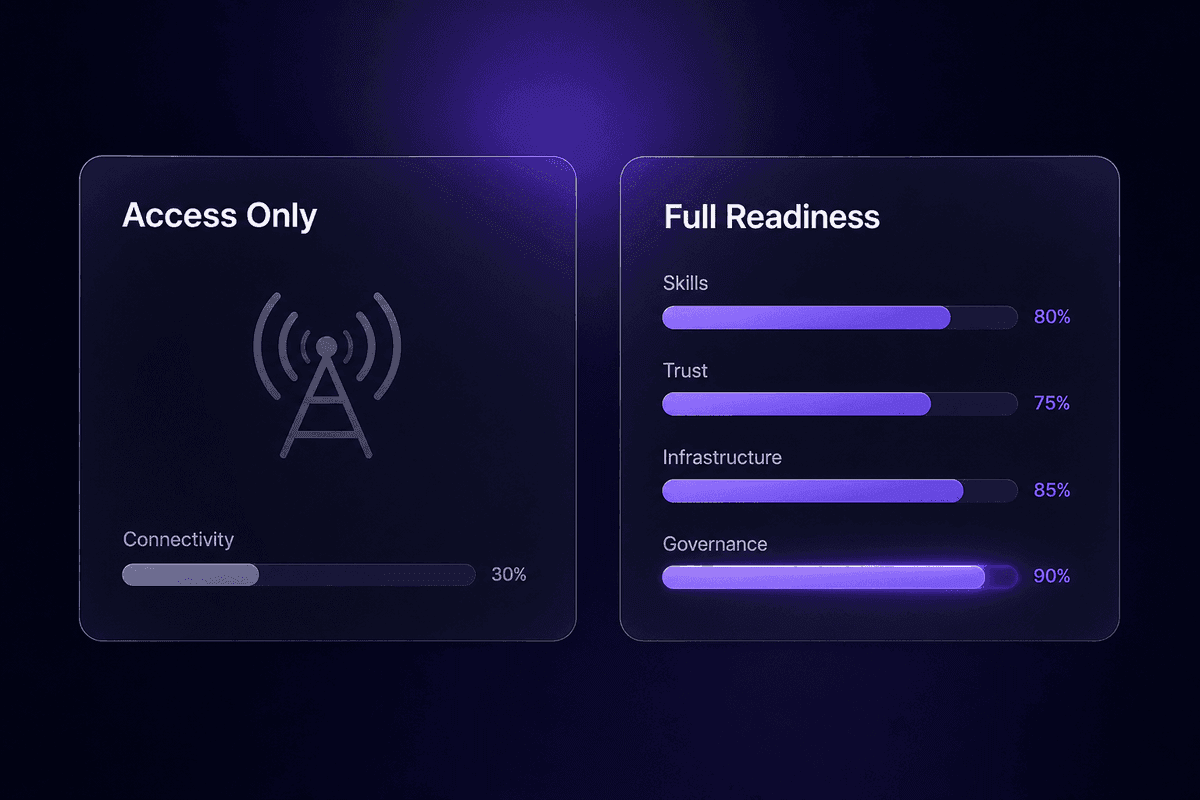
Digital readiness is an organisation's or nation's demonstrated capacity to participate effectively in digital environments - not just to access them. The distinction matters more than it sounds.
Granicus frames it as the intersection of infrastructure and capability: having the systems in place and knowing how to use them for real outcomes. That framing excludes organisations that own the technology but lack the processes, skills, or governance to act on it. Which, in practice, is a lot of organisations.
Pew Research Center sharpens the definition further. Their model identifies three measurable elements: digital skills (the ability to use connected technology effectively), trust (confidence that technology is reliable, safe, and accurately understood), and actual use (the observable behavior of applying digital tools to real tasks). Readiness requires all three. An organisation where 80% of staff have device access but can't evaluate whether a data source is credible is not digitally ready. It is digitally exposed.
That's the definition with measurable edges. Not "going digital." Not "having a digital ecosystem." Not a vague aspiration to adapt to the digital landscape. It's a specific capacity state - one you can assess, benchmark, and build a gap roadmap from.
The Key Components of Digital Readiness
The UNDP's Digital Readiness Assessment framework carves the concept into five distinct areas: people, connectivity, government, regulation, and economy. Pew adds skills, trust, and use as the individual-level dimensions of that broader picture. Together, they describe something more like a system than a checklist. None of the dimensions operates independently. Weak governance undermines strong infrastructure. High connectivity without skills produces frustrated users, not capable ones. Trust-or the absence of it-runs underneath everything.
Here is what each dimension actually involves in practice.
Skills and Digital Adoption Capacity
Digital skills are the most commonly cited readiness barrier, and the one most organisations think they understand better than they do. Having access to a tool is not the same as being able to use it effectively, evaluate its outputs critically, or adapt when it changes.
Pew's research gives this some texture: 54% of adults reported feeling confident with their devices and online tools. That sounds reassuring until you consider what it leaves out. The 4% who reported no confidence at all weren't evenly distributed - they clustered in older demographics, lower-income populations, and less-connected regions. Digital readiness is unevenly distributed, and any assessment that uses an average to describe skill levels is hiding the gaps that actually matter. The new technologies introduced into an organisation tend to land hardest on the people with the least skill runway to absorb them. That is where adoption failures start.
Trust, Cybersecurity Confidence, and Data-Driven Culture
Trust is less visible than skills, which makes it easier to overlook in a readiness assessment. But it operates as a ceiling on everything else: an organisation where staff don't trust data-driven reports won't automate decisions based on them, regardless of how good the data analytics infrastructure looks on paper.
Pew found that 22% of adults said it was difficult to judge whether online information was trustworthy. That number has clear implications for digital culture inside organisations: if nearly a quarter of people can't evaluate information reliability, data protection governance becomes load-bearing in a way most businesses don't anticipate. The safeguard question isn't just "are our systems secure?" It's "do our people trust the outputs enough to act on them?" Those are different problems with different fixes.
Infrastructure, Connectivity, and Organisation-Level Capability
This is the dimension most often assumed to be sufficient when it isn't. The UNDP's model specifically separates connectivity and economy as distinct readiness pillars - not subsets of IT. An organisation's digital infrastructure is not just servers and software. It includes network reliability, scalable integration capacity, the economic conditions that allow investment in new tools, and the operational capability to run IoT-connected systems or digital workflows without creating new technical debt faster than the old kind gets paid off.
The UNDP's assessment in Malawi - covering infrastructure, skills, and institutional capacity across a national context - found that these components interact in ways that single-dimension audits miss entirely. A ministry with strong connectivity but weak data management governance can still deliver poor digital services. The same pattern appears in private-sector organisations, just with different labels on the failure modes.
Digital Readiness vs. Digital Transformation, Digitization, and Digitalization
These four terms get collapsed into each other constantly in strategy decks and vendor conversations. They describe genuinely different states. Conflating them produces plans that skip the preparation stages and wonder why the transformation didn't land.
| Term | What it describes | Where readiness fits | Common confusion |
|---|---|---|---|
| Digitization | Converting analog content or processes to digital format | Readiness enables digitization to be useful, not just captured | Treating digitization as transformation; scanning paper records without changing workflows |
| Digitalization | Using digital data and tools to change how a process works | Requires a readiness baseline in skills and infrastructure | Assuming digitalization is automatic after digitization |
| Digital transformation | Systemic change in how an organisation creates value, using digital capabilities throughout | Readiness is the precondition; transformation is the outcome | Treating tool deployment as transformation; skipping the capability-building stage |
| Digital readiness | The capacity state that makes transformation feasible - skills, trust, governance, infrastructure | Readiness precedes all the others | Treating readiness as a synonym for maturity or as the end goal rather than the starting condition |
Digital maturity describes how advanced an organisation's capabilities have become over time. Digital readiness describes whether the conditions exist to start building those capabilities now. Readiness comes first. Digital workflows and sustainable transformation follow, but only if the readiness foundation - people, governance, connectivity, trust - is actually in place.
The misconception that causes the most expensive problems: treating the deployment of new technologies as evidence of readiness, rather than evidence that readiness is about to be tested.
How a Digital Readiness Assessment Works in Practice
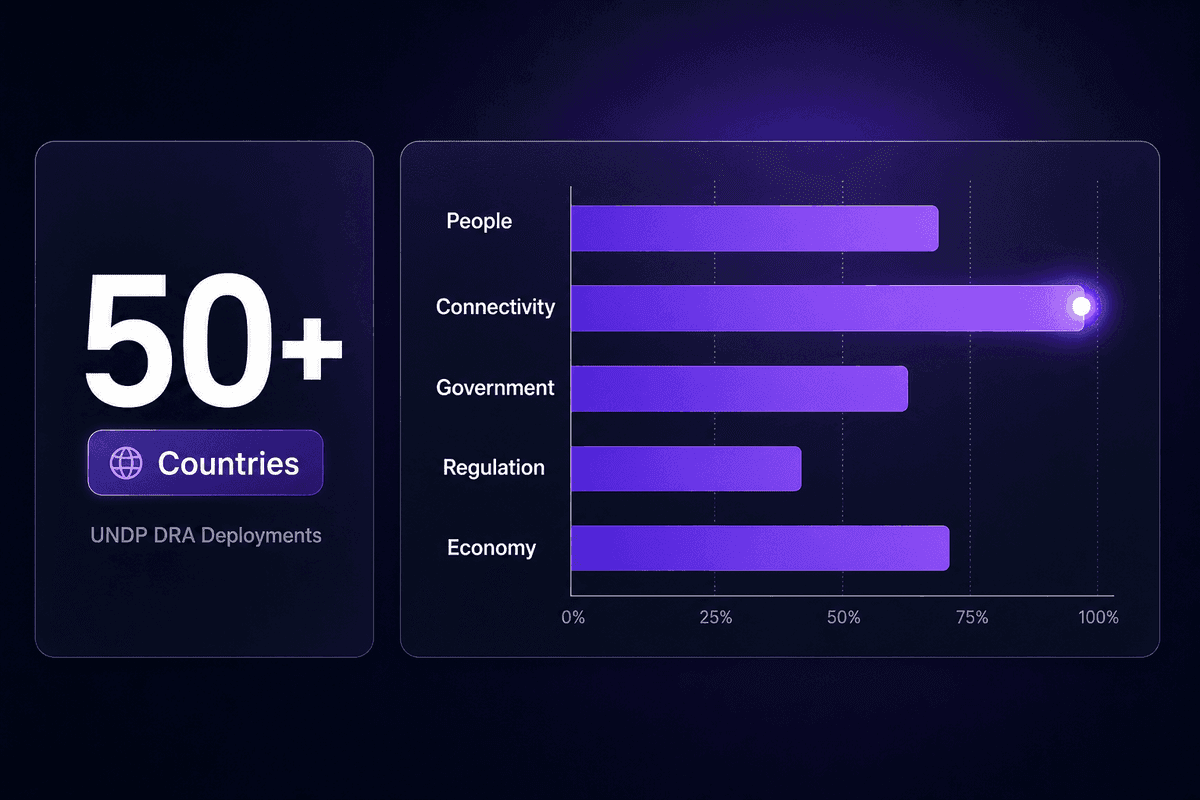
A digital readiness assessment is a structured diagnostic that maps an organisation's current state against what a planned digital initiative actually requires. It produces a gap analysis, not a report card. The output is a baseline and a roadmap, not a score that unlocks the next stage of a vendor sales process.
The UNDP Digital Readiness Assessment has been deployed across more than 50 countries as a tool for identifying priority areas in national digital strategy. WalkMe applies similar logic at the enterprise level, framing readiness assessments as the mechanism for identifying where the biggest gaps are before committing to a transformation program. Both approaches share the same underlying logic: before you choose the digital roadmap, verify that your organisation can follow it.
What Organisations Use Readiness Assessments to Benchmark
An assessment examines process, culture, technology, and people in combination - not separately. The output becomes a benchmark for gap prioritisation across all four dimensions simultaneously, which matters because organisations that underfund one area (usually culture or governance) while investing heavily in another (usually technology) tend to produce expensive pilots that don't scale.
WalkMe describes readiness assessments as a benchmarking tool for aligning digital initiatives with strategic objectives before resource commitment. The practical implication: if your assessment can't tell you which capability gap will kill your most important initiative first, it is not finished.
How Governments Use the Digital Readiness Assessment as a Policy Roadmap
At the national scale, the UNDP DRA functions as a diagnostic for public-sector digital strategy. The framework covers all five UNDP pillars - people, connectivity, government, regulation, economy - which means the assessment maps public services capability and governance frameworks alongside infrastructure and skills. For countries like Malawi, the DRA output shaped a structured roadmap that prioritised which public service digitisation projects to pursue first and where institutional capacity needed to be built before technology investment would produce returns.
📊 By the numbers:
Pew Research found that 74% of adults identified as personal learners, and 38% had used the internet for personal learning in the past year. This is observable behavior - not self-reported confidence. When assessing genuine digital readiness inside an organisation, that distinction matters: a survey that only captures whether staff feel digitally capable will overstate readiness, because perceived confidence and actual use are measurably different things.
What Digital Readiness Is Not: Three Misconceptions Worth Clearing Up
These three misconceptions appear in almost every readiness conversation I've seen. Each one looks like a reasonable assumption right up until it causes a problem.
- Readiness is not just having the latest technology
The false belief here is that investment in advanced technologies - newer platforms, emerging technologies, more integrations - constitutes readiness in itself. Where it breaks down: an organisation can deploy an AI-powered analytics platform across every department and still have a readiness score near zero if staff don't trust the outputs, can't interpret the results, or have no governance process for acting on them. The technology is inert without the capability. Digital readiness includes both the tools and the human and organisational capacity to use them toward defined digital goals.
- Readiness is not the same as digital access
Connectivity and device access are necessary conditions, not sufficient ones. This is the Pew finding made concrete: 54% of adults felt confident using their digital tools, but confidence varied dramatically by age, income, and context. Best practices in digital readiness treat access as one input among several, not a proxy for the full readiness state. An organisation where everyone has a laptop and a login but where data literacy is low and digital culture is underdeveloped has access. It does not have readiness.
- Readiness is not only an IT department issue
This is the one that produces the most expensive misalignment. IT owns infrastructure. Readiness spans roles and responsibilities across people, culture, leadership, and governance. The UNDP Digital Readiness Toolkit for National Human Rights Institutions makes this explicit: readiness assessments must cover governance and data management alongside infrastructure, because those dimensions sit outside IT's remit but directly determine whether digital tools deliver value. Inside a private organisation, the same logic applies. If the readiness assessment is happening entirely inside the IT function, it is assessing one dimension and calling it the whole picture.
🤔 Think about this:
An organisation can achieve an adequate readiness score on infrastructure and connectivity - and still fail transformation because trust and organisational culture were never assessed. If your readiness map doesn't include trust and governance, what are you actually measuring? Probably the budget spent, not the capacity built.
How to Assess Your Organisational Digital Readiness Before Choosing a Framework
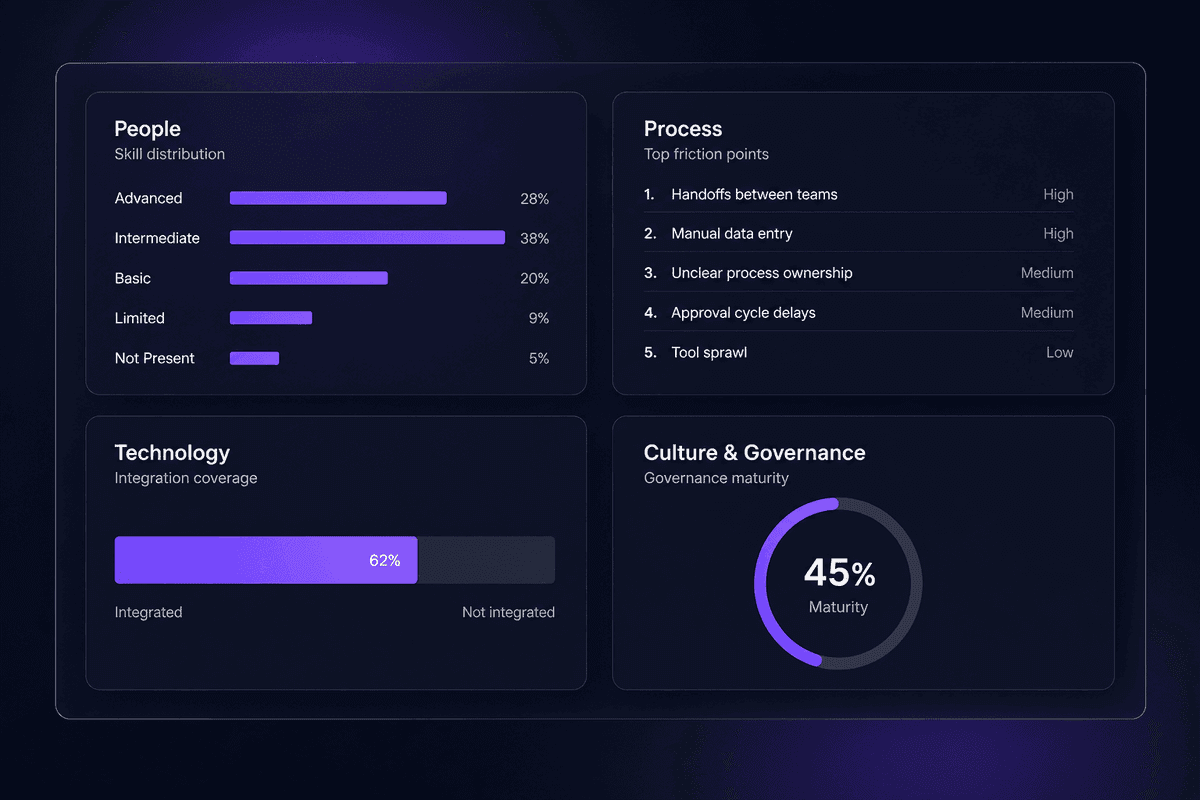
Before selecting a methodology or committing to a transformation program, do a quick internal scan across four areas: people, process, technology, and culture. Not simultaneously, and not through a committee. Someone needs to walk through each one with honest eyes and a willingness to write down what they actually find.
I keep seeing the same pattern in SME readiness conversations. The organisation knows it needs to do something. They have a list of processes that need fixing. They have opinions about which digital tools to buy. What they don't have is a baseline: a clear picture of where friction actually lives, who owns each process, and whether the people involved have the skills and trust to use a new solution without building a support problem into the first week.
Here is a starting structure for the self-assessment:
| Area | What to assess | Output |
|---|---|---|
| People | Digital skill distribution, training gaps, confidence by role | Map of where capability is uneven |
| Process | Manual handoffs, data silos, processes with no digital solution | Prioritised list of friction points |
| Technology | Current tools, integration gaps, platform coverage | Inventory with ownership notes |
| Culture and governance | Trust in data outputs, decision-making patterns, who owns automation | Gap map for cultural and governance readiness |
The output of this assessment should be a gap map or a digital roadmap draft - a document that shows you what has to change before a specific initiative can succeed. Not a readiness score to satisfy a stakeholder presentation. A working document that your research team and project owners can actually use to sequence the digital journey.
Feasibility check comes before tool or framework selection. An organisation that chooses an automation platform before understanding which processes to automate will discover, somewhere around the third month, that they have automated the wrong things. The OECD found that among SMEs, lack of digital readiness - specifically insufficient awareness and fragmented data - is one of the main barriers to AI adoption. The digital solutions exist. The readiness to use them productively often does not. Build the readiness map first. Remain competitive by knowing what you're improving before improving it.
Once the gap map exists, the tool choice becomes much less speculative. An SME ops lead who has mapped three high-friction processes and knows which SaaS tools are already in use can wire those processes together in Latenode using existing integrations without needing an engineering team - but the value of the platform starts with the clarity from the assessment, not the platform itself.