


Most executives who say they're leading a digital transformation are doing something else entirely. They're sponsoring technology purchases, attending kickoff meetings, and signing off on roadmaps that look convincing in a slide deck. What they're not doing is the specific, measurable, research-defined work that actually constitutes digital transformation leadership.
That gap is expensive. PwC's 2026 Digital Trends in Operations Survey - drawing from 767 US-based operations and supply chain leaders across organizations with at least $100 million in revenue - found that 89% of those leaders say their technology investments have not fully delivered expected results. That's not a technology problem. That's a leadership problem wearing a technology costume.
This article is about what digital transformation leadership actually is, what it requires, and why conflating it with generic digital leadership or standard change management is the single most common reason transformation programs stall.
The part teams learn late
- Digital transformation leadership is a distinct discipline, not a synonym for "being tech-savvy at the executive level."
- It has two dimensions - strategic vision and operational guidance - and collapsing them into one produces execution gaps.
- The biggest misconception: it's mainly about technology choice. It isn't.
- The core skill triad is technical fluency, human-centered leadership, and strategic vision - in that priority order.
- Most transformations stall not from bad technology but from the absence of operational-level leadership below the vision-setting layer.
What Digital Transformation Leadership Actually Means
Here's the definition that most people skip over because it doesn't fit on a slide: digital transformation leadership is a process of social influence through which leaders guide organizational change that is triggered and shaped by the diffusion of digital technologies. It aligns strategy, legitimacy, and operational capacity toward value creation. That definition comes from research published in Government Information Quarterly on digital transformation leadership from a public value-centered perspective.
Read that again slowly. "Social influence." "Organizational change." "Triggered and shaped by digital technologies." The technology is the trigger. The leadership is the process. Those are not the same thing, and treating them as interchangeable is where most transformation programs start going wrong.
This is not a definition of someone who knows how to use a dashboard or approve a cloud migration. It is a definition of someone who actively guides human behavior and organizational structure through a period of significant disruption - where the disruption happens to be driven by technology. The distinction matters because the skills, behaviors, and failure modes are completely different depending on which one you think you're doing.
Digital transformation leadership is not: being enthusiastic about technology. It is not having a CDO title. It is not running an agile team or managing a digital product. And it is specifically not a synonym for change management, though change management is one of its tools.
If you're the person responsible for a transformation program and you've primarily been optimizing for tool selection and implementation timelines, you've been solving the wrong problem. The tools are the easy part. The organizational change is the hard part. Digital transformation leadership is the discipline that handles the hard part.
Why Researchers Draw a Hard Line Between Digital Leadership and Digital Transformation Leadership
Digital leadership and digital transformation leadership sound the same. In most strategy decks they're used interchangeably. But digital change literature draws a hard boundary between them, and once you understand the boundary, you'll start seeing the practical consequences everywhere.
Digital leadership is a broad operational concept. It covers how leaders use digital tools, manage digital teams, and maintain digital capabilities in an ongoing enterprise. A VP of Engineering who builds high-functioning product teams is exercising digital leadership. So is a CMO who has built a sophisticated marketing data stack. Both are real skills. Neither is digital transformation leadership.
Digital transformation leadership is the narrower subset focused specifically on guiding transformation initiatives - those value-laden, identity-shifting changes where the organization has to become something structurally different from what it was. The word "transformation" is doing real work here. This isn't optimization. It's a discontinuous shift in how the organization creates value.
When digital leaders are mistakenly put in charge of transformation programs without this distinction being made explicit, the predictable result is an organization that successfully improves its digital operations without ever actually transforming. The tools get better. The underlying business model, processes, and value propositions stay the same. The initiative gets labeled a success. The strategic opportunity gets missed.
That's not a hypothetical failure mode. I keep seeing it surface as a pattern whenever transformation programs get stuck not at the execution level, but at the "what are we actually trying to become" level.
The Strategic and Operational Dimensions Most Leaders Collapse Into One
Researchers identify two distinct dimensions of digital transformation leadership, and the gap between them is where most programs fall apart.
The strategic dimension covers defining a digital vision, building collaboration across organizational boundaries, and considering the full range of stakeholder needs - not just the immediate business unit. This is the layer most executives believe they're handling when they approve a digital transformation strategy and present it to the board.
The operational dimension is different. It covers guiding employees through daily behavioral change, reshaping processes, and managing outputs through the transition period. This layer requires someone who is present in the organization below the vision-setting level - someone who can notice when a middle manager is quietly routing around the new process, or when a team has theoretically adopted a new tool but hasn't changed how they make decisions with it.
Here's what happens when you collapse both into one: strategy without operational guidance produces detailed roadmaps that nobody follows because the organization never received the behavioral scaffolding to change. Operational focus without strategic alignment produces something arguably worse: tool sprawl, with individual teams improving their own processes, but the totality of those improvements drifting away from any coherent value creation goal.
Organizational transformation requires both dimensions to be active simultaneously. One strong vision-setting leader cannot substitute for the absence of operational-level transformation guidance. And a highly effective operational change manager cannot substitute for a clear strategic direction about what the organization is transforming into. This is why transformation requires putting both dimensions in the org chart explicitly, not hoping one person will cover both.
The Role of Leadership in Digital Transformation - Beyond Sponsorship
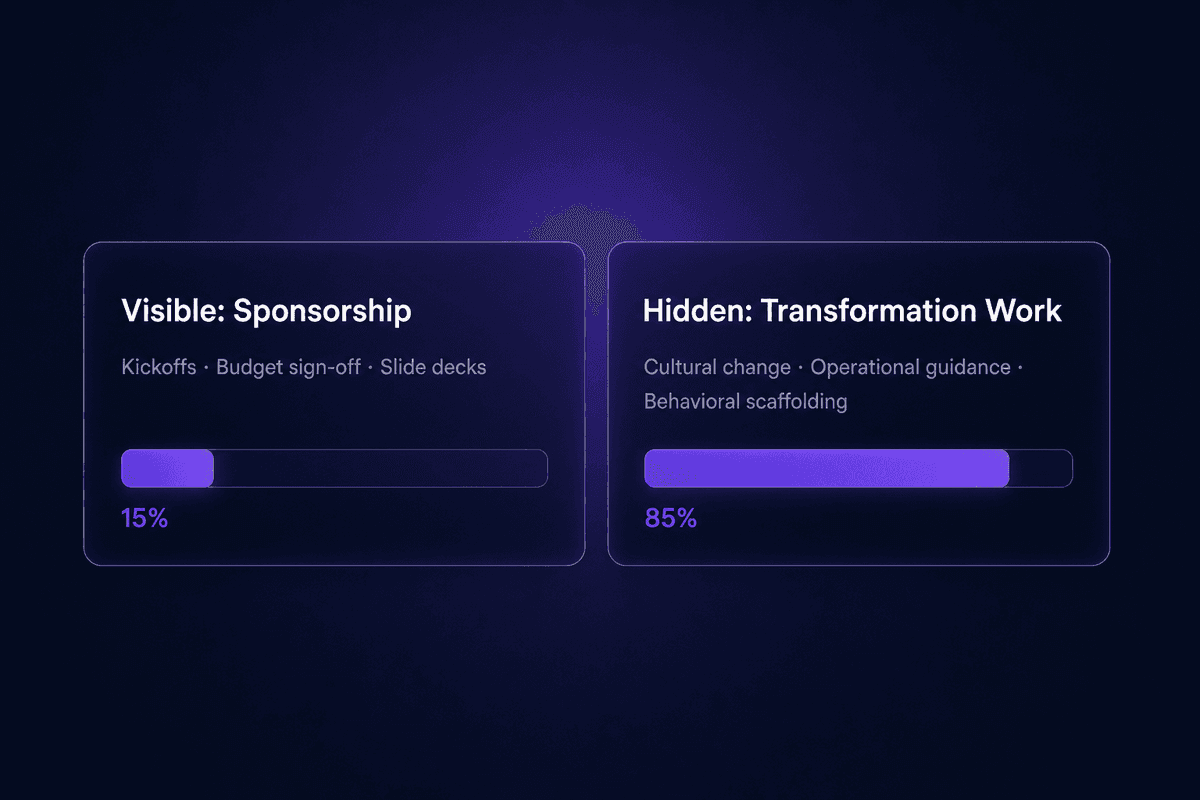
Executive sponsorship is how most organizations frame the leadership in digital transformation. The senior leader blesses the initiative, appears at the kickoff, and is listed on the program charter. Then they get busy with other things. This is not transformation leadership. This is adjacency to transformation leadership, which is a completely different thing.
The actual role is daily, operational, and often uncomfortable. It involves three specific responsibilities that don't fit neatly into a sponsorship model.
The critical role of a transformation leader is to hold the strategic and cultural threads simultaneously while the organization experiences the friction of change. That means being present when the process breaks down, when teams resist, and when the technology choices start drifting from the original strategic intent. It means making decisions in ambiguity, repeatedly, without waiting for complete information.
And it means owning the culture - not by announcing a culture change, but by making decisions that are visibly consistent with the transformation goals, even when that's inconvenient. Every time a transformation leader makes an expedient decision that contradicts the stated direction, the organization notices. That's the culture signal that counts, not the all-hands message.
Aligning Business Strategy With Digital Technologies Without Losing Either
Here's the failure mode I see most often: organizations align their technology investments to a digital transformation strategy, and then slowly, almost imperceptibly, the technology choices start leading the strategy instead of following it. A new AI platform becomes available. The CTO is excited. A pilot gets approved. And suddenly the transformation program is shaped by the capabilities of a tool the organization acquired six months after the strategy was written.
That's modernized infrastructure serving yesterday's business model. Which, to be clear, has a cost measured in years and millions.
The responsibility of digital transformation leaders to align business strategy with digital transformation initiatives is not a one-time act. It's an ongoing arbitration function. The question "does this technology decision actually serve the strategic direction, or have we started serving the technology?" needs to be asked explicitly, regularly, and by someone with enough authority to stop a project that isn't serving strategy anymore. According to PwC's research, 89% of operations leaders say their technology investments haven't delivered expected results - and that number suggests the arbitration function is either absent or overruled in most organizations.
Technology investments should be permanently anchored to business outcomes, not the other way around. That sounds obvious. It stops being obvious at the third or fourth executive who's excited about a new capability.
Leading a Culture of Innovation Instead of Mandating Tool Adoption
There's a version of digital transformation that looks like this: a new tool gets selected, a rollout plan gets built, training gets scheduled, compliance gets measured. Three months later, the tool shows 80% adoption in the reporting dashboard. Six months later, the team is using the tool to do the same things they were doing before, just in a different interface.
That's tool adoption. It is not a culture of continuous improvement.
The difference is structural. Mandating digital tools changes the surface of how work happens. Building a culture of innovation changes what questions people are allowed to ask, what experiments are permitted to fail, and whether failure produces learning or consequences.
An actual culture of organizational culture change around innovation requires specific leadership behaviors: publicly rewarding people who identify process problems, not just people who hit targets; treating failed experiments as useful data, not as performance issues; and creating explicit permission structures for teams to challenge existing processes rather than optimize around them. Those behaviors are harder than selecting a tool. They're also what the tool can't do for you.
When transformation leaders default to tool mandates, they're usually optimizing for something that shows up in a slide - adoption rate, active users, licenses deployed. The continuous improvement behaviors they actually need don't show up in those metrics at all.
💡 Worth knowing:
The organizations that move fastest on digital transformation tend to have leaders who deliberately slow down tool rollout decisions and accelerate cultural permission to experiment. Speed in transformation isn't about how fast you deploy technology. It's about how quickly the organization develops the capacity to learn from what the technology reveals.

Digital Transformation Leadership Skills That Actually Differentiate Leaders
Two research frameworks - one from Forbes identifying seven critical skills, one from IE University defining a core triad - converge on the same point: the differentiating skills are not purely technical. They're the intersection of technical fluency, human understanding, and strategic judgment. Here's what each skill enables and what its absence costs.
AI and data literacy
This is the ability to understand what AI systems and data pipelines can and cannot do - not at an engineering level, but at a strategic decision-making level. It enables leaders to evaluate AI investments realistically rather than being sold on capability demonstrations that don't survive contact with real organizational data. Without it, transformation programs invest heavily in AI use cases before the underlying data infrastructure can support them. PwC's survey found that 87% of operations leaders report poor data quality has impacted their ability to achieve value from digital initiatives - which is largely a leadership literacy failure, not a technical one.
Data-driven decision-making
Distinct from data literacy, this is the behavioral discipline of actually using data to make decisions rather than using data to support decisions already made. The failure mode when this skill is absent is visible in nearly every transformation program: dashboards exist, reports get produced, and the executive team continues making strategic calls based on intuition and prior experience. The data layer becomes expensive decoration. Data analytics infrastructure without the leadership behavior to use it is exactly that.
Change management as a practiced capability
Every transformation leader needs fluency in change management - not as a theoretical framework, but as something they've actually used to navigate organizational resistance, manage loss, and sequence communication decisions. The failure mode without it is predictable: technically solid initiatives that generate sustained human resistance because nobody managed the transition experience of the people inside it. Change management as a skill is not the same as having a change management team. The leader needs to be able to apply it personally.
Agile decision-making and execution fluency
This isn't about knowing Scrum ceremonies. It's the ability to run transformation programs as iterative delivery rather than waterfall commitments, and to make rapid decisions with partial information rather than waiting for certainty. The failure mode is the multi-year transformation roadmap built in year one that becomes a liability by year two because the market, technology, and organizational context have all shifted. Agile fluency produces the ability to update direction without organizational trauma.
Technical fluency - enough to ask the right questions
Digital transformation leaders need enough technical understanding to evaluate claims, challenge assumptions, and understand trade-offs. The specific domains that matter in the current environment: data architecture, AI capabilities and limitations, cloud infrastructure concepts, and cybersecurity risk. This is not engineering expertise. It's the level that allows a leader to ask "why can't we do this incrementally" and understand the answer. Without it, leaders become dependent on technical teams to define the solution space, which gradually cedes strategic direction to implementation preference.
Influence without authority
Most transformation happens across organizational boundaries - between IT and operations, between finance and product, between business units with different incentive structures. A leader who can only direct people in their formal reporting structure will hit the limit of their influence at the edge of their org chart. The skill of building alignment across functions, earning credibility with stakeholders who don't report to you, and creating shared ownership of outcomes is what separates leaders who can orchestrate transformation from those who can only execute within their silo. Without it, cross-functional initiatives stall at the handoff points.
Digital literacy and the ability to empower others
This is the skill that multiplies the others. A transformation leader who builds digital skills throughout the organization - who creates the capacity for teams to learn, experiment, and develop their own fluency - creates compounding returns. The failure mode is building digital capability that lives only in a specialist team: a transformation office, a data science group, a center of excellence that never transfers what it knows to the broader organization. The ability to empower teams to develop their own capability is not a nice-to-have. Without it, the organization becomes dependent on a small group of specialists for every digital decision, which is not scalable and is not transformation.
What a Digital Vision Looks Like When It Is Doing Its Job
Most digital visions I've seen are written for the wrong audience. They appear in investor decks, annual reports, and press releases. They describe an aspirational future state in language vague enough to be universally agreeable and specific enough to be photographed next to the CEO. And they do almost nothing to help the 300 people inside the organization decide what to prioritize on Tuesday.
A digital vision that is doing its actual job looks different. It is a clear vision - a credible directional claim - that shapes internal prioritization and earns organizational trust by being specific enough to generate real trade-offs. When the vision is specific, people can use it to say no to things. That's the test.
Setting a clear direction as a working artifact means specifying three things: where digital technologies will create value for the organization (not generically, but in terms of specific processes or customer interactions), how the organization will get from its current state to that value creation (the operating model implications, not the tool list), and what success looks like in measurable terms within a defined time horizon.
A vision built on those three components functions as a roadmap for prioritization decisions across the organization. When a team asks "should we invest six weeks in automating this process," they can answer that question by reference to the vision rather than by escalating it to the transformation office. That's organizational leverage. That's a vision doing its job.
A digital strategy document that can't be used to make a prioritization decision is a communications artifact, not a strategic tool. The difference matters because organizations routinely invest heavily in producing the strategy and then wonder why the execution doesn't follow.
How Agile Execution Connects Vision to Measurable Progress
The gap between a compelling digital vision and actual organizational progress is almost always an execution model problem. The instinct in most enterprises is to build a transformation program the way they build capital projects: define scope, estimate timeline, allocate budget, report quarterly on milestones. This produces three-year transformation roadmaps that are already partially wrong by the time they're approved.
Agile methods address this differently. Cross-functional teams organized around specific outcomes - not functional silos organized around inputs - can deliver measurable progress in six to ten-week increments, validate assumptions against real organizational and market data, and adjust direction without the sunk-cost dynamics that make waterfall programs so brittle.
OKR-style frameworks translate the vision into iterative delivery by requiring teams to define measurable outcomes at each planning cycle, not just activities. The question shifts from "did we complete the implementation" to "did the implementation move the metric we said it would?" That's a different accountability structure, and it's one that digital transformation efforts benefit from directly. When transformation projects run on an agile model, the vision stays connected to delivery through regular checkpoint cycles rather than through a planning document that was last updated in Q1.
The practical implication: build your transformation program across the organization around six-week delivery cycles with explicit outcome metrics at each cycle. The roadmap becomes the accumulation of those cycles, not the input to them.

Three Misconceptions About Digital Transformation Leadership That Show Up in Every Support Queue
I'm going to address these directly because they're the source of most program failures I see, and they tend to be politely avoided in formal transformation frameworks. They're not subtle. They're just inconvenient to say out loud.
Misconception One: It Is Mainly About Technology Choice and Implementation
This one is the most persistent. Organizations in the digital age consistently frame transformation programs around technology decisions: which ERP, which AI platform, which data architecture, which cloud strategy. The technology choices matter. But framing the program primarily around them produces a specific failure pattern: technically successful implementations that don't change how the organization creates value.
The digital initiatives that actually transform organizations are built around behavioral and process change, with technology as the enabling infrastructure. When technology selection leads the program, teams spend their energy optimizing for implementation rather than for the strategic outcome the technology was supposed to serve. Three years later, the successful transformation is declared at the technology layer while the business model, competitive position, and value creation logic remain substantially unchanged.
The new technologies are live. The transformation didn't happen. This is more common than anyone in the industry admits publicly.
Misconception Two: Leaders Must Be Deep Technical Experts
This one creates a specific hiring mistake that I want to name clearly: putting deep technologists in transformation leadership roles because the organization assumes that's what effective transformation leadership requires.
Chief digital officers and other digital transformation leaders in the digital era need strategic, change, and communication skills plus enough technical fluency to make informed decisions - not to build or architect systems. The Forbes framework is explicit on this. A CDO who spends 70% of their time on technical architecture decisions is probably not spending enough time on the strategic alignment, stakeholder communication, and cultural change work that actually drives transformation outcomes.
Hiring deep technologists for transformation leadership roles also produces a specific cultural problem: technical solutions get proposed for organizational problems. When the dominant lens is technical, the tendency is to reach for technical tools to solve what is fundamentally a human coordination and behavior change challenge. Technology integration expertise is valuable. Digital capabilities in a leader matter. Neither substitutes for the ability to navigate organizational dynamics at scale.
Misconception Three: It Is a Generic Form of Digital Leadership
This is the conceptual conflation I opened with, and it's worth naming as a misconception directly: treating digital transformation leadership as simply an intensified version of digital leadership creates organizations that optimize for digital operations instead of steering actual transformation.
The distinction is not semantic. Digital leadership maintains and improves existing digital capabilities. Transformation leadership changes the underlying value creation logic of the organization. The skills overlap, but the mandate, the timeline, and the failure modes are different enough that treating them as the same role produces predictable gaps - particularly at the operational level where transformation guidance is most needed and least likely to be provided by a leader whose primary orientation is toward operational excellence.
That's where the transformation usually stalls. Not at the vision level. At the gap between the vision and the day-to-day behavior of the organization below it.
This is where transformation really gets stuck.
Where Digital Transformation Leadership Gets Applied - And Who Uses It
The discipline looks different depending on the context it's being applied to, and conflating these contexts produces bad advice. Here are the three main application scenarios from the research, grounded in what the leader is actually navigating rather than just the industry or sector.
Large Enterprises and Public-Sector Organizations
In large enterprises and public-sector organizations, digital transformation leadership is primarily about steering complex, multi-year change programs where the organizational context is deeply layered - legacy systems, entrenched processes, multiple stakeholder groups with conflicting interests, and procurement structures that weren't designed for iterative delivery.
The leadership challenge here is maintaining strategic coherence across a program that will outlast multiple planning cycles, multiple budget approvals, and in some cases multiple changes in senior leadership. The failure mode is program drift: what started as a meaningful transformation gradually becomes a technology modernization project because the original strategic intent lost its advocate. Business transformation at this scale requires explicit continuity mechanisms - governance structures, program charters, OKR frameworks - that preserve the transformation direction when individual leaders move on.
Only 17% of manufacturing executives believe their company's operational leadership is ready to lead digital transformation over the next five years, according to the Manufacturing Leadership Council's Future of Digital Leadership survey. That's a striking number in a sector where transformation is a stated strategic priority - and it's almost certainly being replicated in other legacy-heavy sectors.
Mid-Market and High-Growth Firms
In mid-market and high-growth firms, the transformation leadership challenge is different. These organizations are typically modernizing operations and building data- and AI-enabled business models simultaneously - sometimes without a dedicated transformation function, sometimes with a single leader responsible for both strategic direction and implementation oversight.
The failure mode here is different from large enterprises: it's less about program drift and more about pilot purgatory. Executing a proof of concept is relatively fast. Moving from a successful PoC to an organization-wide behavioral change is the hard part. Leaders at this scale need the ability to translate strategic intent into operational change without the organizational scaffolding that larger enterprises have - and often without the budget or timeline to build it. PwC's finding that 83% of operations leaders believe AI agents will accelerate the breakdown of traditional functional silos, yet only 27% report that AI strategy is fully embedded across business units, maps directly onto this challenge.
For a transformation lead at a growing firm trying to orchestrate data flows across IT, operations, and finance without a large technical team, the practical question is: how do you move from pilot to production without an engineering department? This is exactly where low-code workflow orchestration becomes a legitimate leadership tool rather than just a developer convenience. A platform like Latenode, with 5,500+ integrations with automatic OAuth and per-execution pricing (a multi-step workflow that pulls data from ERP, calls AI models, applies custom logic, and updates dashboards counts as one execution rather than separate billable tasks), lets a transformation lead build KPI-linked reporting directly from operational systems without requiring a full engineering engagement. Not because it's easier, but because it keeps the initiative under the transformation lead's ownership rather than in the engineering backlog.
CIOs, CDOs, and Cross-Functional Transformation Leads
For CIOs, CDOs, and cross-functional transformation leads, the leadership context is orchestration across organizational functions that don't naturally align. IT, operations, finance, and front-line teams each have their own priorities, their own success metrics, and their own tolerance for disruption.
What orchestrating collaboration actually looks like at this level, concretely: it's not an org chart change. It's shared OKRs with explicit owners across functions, joint sprint reviews where IT and business teams look at the same metrics together, and cross-functional data dashboards that define shared truth before strategic decisions get made. The coordination mechanism is the artifact. Without it, "cross-functional collaboration" is a value statement, not a practice.
📊 In practice:
When a PwC survey finds 87% of operations leaders say poor data quality has undermined their digital initiatives, the underlying issue is almost always cross-functional: different systems, different field definitions, different ownership. That's not a data quality problem. It's a coordination failure that expresses itself in the data layer.
Finding digital solutions that serve cross-functional coordination requires someone who can ask the right questions across all four layers simultaneously - and who can hold the technology accountable to the organizational goal rather than the other way around.