


Most organizations know they are behind. They just do not know how far behind, or in which direction.
The honest version of what happens: a leadership team spends a strategy offsite agreeing that digital transformation is a priority. They allocate budget. They deploy tools. Someone builds a dashboard. Eighteen months later, the transformation office produces a slide deck showing initiatives in flight, and the CFO asks whether any of this is actually moving the needle. Nobody has a clean answer.
That is the problem a digital transformation maturity model is built to solve. Not with a score you get once and file away. With a structured way to see where you are, where you are not, and what the gap between them actually costs you.
According to McKinsey, an estimated 90% of organizations are now undergoing some form of digital transformation. Ninety percent. Which means almost everyone is in motion. The question the maturity model answers is whether that motion is progress or just activity dressed up as progress. Those are not the same thing, and the difference shows up in revenue.
Most teams learn this the expensive way
- A maturity model replaces guesswork with a staged roadmap across strategy, culture, technology, and operations.
- Digital transformation isn't an IT project - skipping the culture and governance dimensions is where most programs stall.
- A maturity model is a framework for continuous measurement, not a one-time audit score you collect and forget.
What a Digital Transformation Maturity Model Actually Is
A digital transformation maturity model is a structured framework that describes how organizations progress from ad hoc, reactive technology use toward optimized, data-driven operations. That is the definition. But the definition undersells what makes it useful.
The model does two things simultaneously. It is descriptive: it tells you where you currently stand across the dimensions that matter. And it is prescriptive: it tells you what the next stage looks like and what capability gaps you need to close to get there. Most strategy tools do one or the other. A digital maturity model does both, which is why it keeps showing up as the instrument leaders reach for when transformation programs lose direction.
Without it, you get misaligned investment. Marketing wants a new CRM. IT wants to migrate the data warehouse. Finance wants predictive reporting. No one has agreed on what "digitally mature" means for this organization, so every team optimizes for their own definition. The roadmap does not stall because people disagree. It stalls because they are all working from different maps.
A digital maturity model helps by creating a shared vocabulary. When the CIO and the CMO use the same framework to describe current state and target state, the conversation shifts from "whose priority is this" to "what sequences the investment most usefully." That shared vocabulary function is, genuinely, the underrated part. Not the framework diagram. The conversation it makes possible.
The maturity model is also a structured framework that tracks movement over time, not just a snapshot. That continuity is what prevents transformation from becoming a one-time initiative that generates a PDF, gets celebrated at a town hall, and then slowly disappears from the quarterly agenda. The model stays on the agenda because it has measurable stages. Progress becomes visible. Stagnation becomes visible too, which is sometimes more useful.
The Dimensions Every Solid Digital Maturity Framework Covers
Here is the misconception I see most often, and I have seen it often enough to stop being surprised by it: teams equate digital transformation with deploying tools. New CRM, check. Cloud migration, check. Automation platform, check. Maturity achieved.
Every serious framework disagrees with that framing, and they do not disagree quietly.
Deloitte's five-dimension model covers customer, strategy, technology, operations, and organization and culture. The academic research on prescriptive digital transformation maturity models consistently identifies core dimensions as strategy, organization, digital infrastructure, business processes, and management. The OECD's approach anchors on data, technology, processes, and organization as the building blocks. None of these frameworks let you score technology and call it done. Culture appears in all of them. Governance appears in most. Strategy appears everywhere.
The EU's Digital Maturity Assessment, developed under the Digital Europe Programme, formalizes this across six dimensions - digital business strategy, digital readiness, human-centric digitalization, data management, automation and AI, and green digitalization. The European Commission has made this multi-dimensional assessment a gateway to funding for SMEs. That is not an accident. It reflects a consensus that technology deployment alone is not transformation.
What the frameworks consistently undersell, in my experience, is governance and the external industry environment. A manufacturing sector study flagged this specifically: sector-specific pressures and regulatory context belong inside the model, not outside it. Your organization does not transform in a vacuum. The environment it operates in is part of the maturity picture, and organizations that ignore it build roadmaps that look right on paper and run into walls in practice.
Digital capabilities span all of these dimensions together. Scoring technology while leaving strategy and culture unscored is like checking whether a car has an engine and declaring it road-ready. The engine matters. So does the driver, the road, and whether anyone agreed on a destination.
Strategy, Culture, and the Dimensions Teams Usually Skip
The support pattern I see most often is not a tool problem. It is a governance problem wearing a tool problem's costume.
A team runs a digital transformation assessment. They score their technology stack, their data infrastructure, their automation coverage. Those scores look reasonable. Then you ask who owns the digital transformation strategy at the executive level, and the room gets quiet. Or someone names a person who owns it in name but does not have cross-functional decision authority. Or the honest answer is IT, by default, because no one else stepped up.
Deloitte's organization and culture dimension exists because this pattern is not unusual. It is the norm. Coherent digital strategies require explicit leadership ownership, not implied ownership. Digital transformation strategy that lives inside the IT function, without an executive sponsor who can move budget and challenge business unit priorities, tends to stay inside the IT function. The approach to digital transformation that actually moves organizations up the maturity curve is cross-functional by design, not by aspiration.
Culture is the dimension that cannot be bought with a platform subscription. That is also why it gets skipped.
Data, Technology, and Operations as Maturity Signals
The measurable dimensions are useful precisely because they can be scored without a workshop. You either have a data governance policy or you do not. Your processes either have documented owners or they do not. Digital technologies are either integrated across functions or siloed by department. These are not binary checkboxes, but they are observable signals.
The OECD model is useful here because it treats data, technology, processes, and organization as building blocks that interact, not independent scores. A high technology score with a low data management score produces automation that runs on bad data. A high process score with a low technology score produces efficient manual workflows that scale badly. The interaction between dimensions is where new digital technologies either compound in value or cancel each other out.
Digital capabilities across these dimensions tell you something specific: where the next investment will have leverage and where it will hit a ceiling. That sequencing logic is what turns a maturity assessment from a diagnosis into a roadmap. Digital processes that are measured and monitored reveal their own gaps. That is the whole mechanism.
The Five Maturity Levels Most Frameworks Converge On
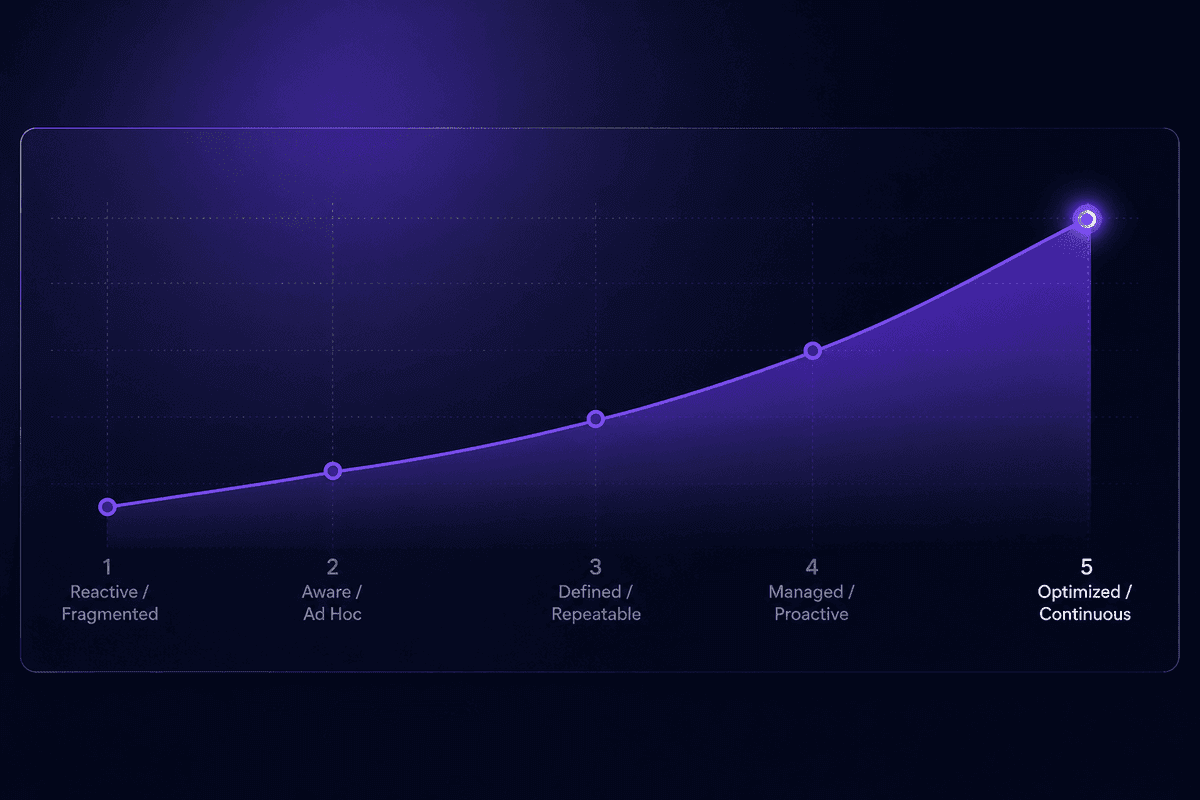
Ask Gartner, MIT CISR, and McKinsey to draw the maturity arc independently and you get roughly the same shape. Different labels. Same underlying structure. Five levels, from reactive and fragmented through progressively more deliberate stages to continuously optimizing. The convergence across major analyst frameworks is itself meaningful - it suggests the arc reflects something real about how organizations actually develop digital capability, not just how analysts prefer to model it.
The broad arc works like this: early stages are characterized by ad hoc, project-by-project technology adoption with no shared strategy and significant process variation between teams. Middle stages bring standardization, some cross-functional alignment, and more consistent tooling, but measurement is still weak and decision-making relies more on institutional habit than data. Advanced stages show automated, continuously learning operations with cross-functional orchestration and KPIs that actually drive decisions.
What the framework labels do not capture is how long organizations spend at each stage. Most teams assume they are further along the arc than they are. The assessment usually corrects that assumption, which is uncomfortable in the short term and useful in the medium term.
Level 1-2: When Digital Efforts Are Still Fragmented
At the lower end of the maturity arc, digital transformation initiatives exist, but they exist as isolated projects. A team adopts a new CRM. Another team launches a customer portal. A third team runs an automation pilot. None of these connect to a shared roadmap, and none of them were sequenced to compound on each other.
The awareness of digital change is present. The organizational muscle to act coherently on it is not.
According to Prosci's research on digital transformation maturity, 64% of organizations remain in early maturity stages. That number lands differently once you have run a few assessments. Organizations at level 1 or 2 almost always describe themselves as "in the middle of our transformation." They are not wrong. They are just further from the middle than they think.
Digital initiatives at these stages are often funded as capital projects, not capabilities. They get built, shipped, and handed to operations. The follow-on investment to measure, iterate, and improve rarely materializes because the project is "done." That mental model - transformation as a project rather than a capability - is the single most reliable marker of early maturity.
Level 3: Standardized but Not Yet Measured
Level 3 is where most organizations that have "done digital transformation" actually sit. Processes are more consistent. Cross-functional teams have adopted shared platforms. There is a recognizable digital stack. Someone can describe the strategy without looking at their notes.
But the KPIs are soft. Digital transformation progress is measured in outputs - tools deployed, processes automated, initiatives completed - rather than outcomes. Data-driven decision-making is aspirational. Leadership reviews dashboards but still makes decisions the way they made them before the dashboards existed.
Progress along the digital maturity curve stalls here more than anywhere else, because level 3 feels like success. The chaos is gone. The platform is stable. The organization has made real progress along the digital maturity curve and has the internal presentations to prove it. What is harder to see from inside level 3 is the gap between standardized and optimized. That gap is where the financial returns actually live, which is the finding McKinsey's research on operating model maturity makes clear: companies with mature digital and AI operating models significantly outperform peers on revenue growth and total shareholder return. Support progress along the digital maturity curve usually requires moving through this stage, not stopping here.
Levels 4-5: Optimized, Data-Driven, and Continuously Improving
At higher levels of digital maturity, automation is not a project. It is the operating model. Decisions are made from data. Cross-functional teams share not just platforms but feedback loops. When a customer experience breaks, the signal reaches operations and technology simultaneously, and the fix does not wait for a quarterly review.
Level 5 is continuous optimization: the organization monitors its own digital capabilities, identifies gaps before they surface as incidents, and adjusts its roadmap in real time rather than in annual planning cycles. Advanced digital capability at this level is less about any specific tool and more about the organizational habit of measuring, learning, and adapting.
The honest note: Prosci's data shows only 4% of organizations report a fully automated and digitized workplace. Level 5 is real. It is also rare. Higher level of digital maturity is achievable, but the path to it runs through level 3 honestly faced and level 4 deliberately built, not through aspirational roadmaps that skip the measurement step.
📊 By the numbers:
Only 4% of organizations report a fully automated and digitized workplace, while 64% remain in early maturity stages. Before reading the next section on assessment mechanics, consider where your organization actually sits - not where the last strategy presentation said it was. The gap between those two answers is the current level of digital maturity worth measuring.
How Digital Transformation Maturity Assessment Actually Works
Knowing the five-level arc is the easy part. Running an assessment that people actually trust and use afterward is where the mechanics matter.
The digital transformation maturity assessment process is not a single event. This point gets repeated in every framework, and teams still treat it as one. They run the workshops, collect the survey data, produce the report, and file it. Eighteen months later, someone pulls it out for the next strategy cycle and discovers the world has moved on. That is not an assessment failure. That is a process design failure. The maturity model evaluates capability at a point in time; the operational discipline to run it continuously is what turns it from a snapshot into a navigation instrument.
The assessment itself has three phases that need to work together: scoring current state across dimensions, identifying the gap between current and target state, and translating that gap into a sequenced investment roadmap. The third phase is where most assessments die. The score is interesting. The roadmap that follows it is useful. Getting from one to the other requires a structured hand-off process that most teams do not design in advance.
Mapping Current State Across Dimensions
Current digital capabilities are almost always underestimated when teams give overall impressions and overestimated when they score dimensions separately. That is not an observation from one assessment. It is a pattern.
When someone asks a leadership team "how digitally mature are you," the answer tends to cluster around level 3. When you ask that same team to score strategy and governance separately from data and analytics, and separately from technology architecture, and separately from talent and culture, and separately from customer experience, the scores spread out. Some dimensions score higher than expected. Some score lower. The discussion about why the scores diverge is where the useful work begins.
The EU's Digital Maturity Assessment tool does this through a structured online questionnaire across its six dimensions. A digital maturity model to assess current state properly needs to measure digital maturity across each dimension independently, not as a composite. Digital skills get evaluated separately from data governance, which gets evaluated separately from process automation coverage. That separation is not bureaucratic overhead. It is the mechanism that reveals where investment will have leverage.
A practical starting checklist for a current-state scoring session:
- Separate scores for strategy and governance, data and analytics, technology architecture, talent and culture, and customer experience
- Scores collected from multiple functions, not just IT and digital teams
- Evidence requested for each score: not "how do you rate this" but "what do you have that demonstrates this level"
- Gaps between self-scored levels and evidence-supported levels flagged explicitly
- Maturity is measured against the next stage, not against an ideal endpoint
That last point matters. Scoring against the ideal creates demoralization. Scoring against the next stage creates a tractable to-do list.
Turning the Assessment into a Roadmap That Gets Used
The assessment output by itself does not move anything. The roadmap it generates does, but only if the roadmap is sequenced by leverage rather than by enthusiasm. And only if the executives in the room own pieces of it.
The main use case for a maturity assessment, in practice, is not diagnosis. It is executive alignment around investment priorities. When the CIO and the CFO have scored the same dimensions independently and their scores diverge, that divergence becomes the conversation. It is harder to argue about budget allocation when both parties are looking at the same framework and can point to specific dimension gaps.
The digital transformation journey is not a single path. It is a series of deliberate stage-to-stage moves, each with its own investment logic. A digital transformation roadmap built from maturity assessment output shows which capability gaps to close first, in what sequence, and with what success criteria. Without that sequencing, transformation budgets get allocated to whatever surface looks broken rather than whatever gap is load-bearing.
The misconception that assessment produces a static score is worth naming directly. The score is the starting point. The roadmap is the product. And the roadmap needs to be reassessed when conditions change, which is always, which is why continuous measurement is the approach to transformation that actually sustains progress rather than just initiating it.
On the tooling side: one of the pain points I keep seeing is that assessment outputs end up as PDFs in inboxes, not as living data. A digital transformation lead at a mid-sized services company told me something along these lines last year - the assessment happened, the report landed, and three weeks of manual spreadsheet reconciliation followed before anyone could agree on which gaps to prioritize. In Latenode's scenario builder, you can connect survey outputs, SaaS usage metrics, and past assessment data into a single workflow that runs AI summarization across all of it - no separate vector database, because the built-in RAG handles the document ingestion. The executive summary lands in email and Slack the same day the assessment closes, not three weeks later. The gap between "assessment complete" and "roadmap agreed" shrinks from weeks to hours. That matters for actually using the output.

Who Uses These Models and for Which Decisions
A digital transformation maturity model is not a single-audience tool. Different roles use the same framework to answer different questions. Here is how that breaks down in practice.
- Executives and boards seeking baseline alignment.
The primary risk here is misaligned investment across functions - marketing, IT, and operations all pursuing "digital transformation" with incompatible definitions. The maturity model gives the board a shared language. Organization's digital transformation priorities become discussable rather than territorial. Without a baseline, the agenda item at every leadership meeting is which team's initiative gets this quarter's budget, which is the wrong conversation.
- CIOs and CDOs prioritizing technology investment.
The decision is sequencing: which capability gap, closed first, creates leverage for subsequent investments? A digital transformation strategy that builds data infrastructure before automation, or governance before analytics, or customer experience tooling before the organizational data literacy to use it, underperforms. Digital strategies built from maturity assessment output have a sequencing logic that pure technology roadmaps lack.
- Sector bodies and regulators benchmarking organizations against each other.
The OECD uses maturity models to benchmark public sector digital transformation across national tax administrations, adapting the core dimensions to the specific regulatory and operational context of government agencies. The ScienceDirect research on prescriptive maturity models includes manufacturing sector examples where industry associations use tailored models to help companies assess their readiness for Industry 4.0 adoption. Drive digital transformation at a sector level requires comparable scores, not just internally consistent ones.
- Transformation offices designing phased programs and KPIs.
An organization's digital maturity assessment output is the raw material for the initiative roadmap, success metrics, and stage-gate criteria. Without it, transformation offices are managing initiatives against a finish line nobody has formally agreed on. Digital transformation initiatives designed from assessment output have built-in success criteria because each initiative closes a specific dimension gap at a specific level.
- SMB owners and small operations teams evaluating readiness.
Digital transformation initiatives at smaller organizations often stall because the leadership team cannot agree on what "transformation" means for a company their size. The framework scales to organizational size because it focuses on capability dimensions rather than headcount or budget. A 15-person company and a 1,500-person company both have a customer experience dimension and a data governance dimension. The evidence for each just looks different at different scales.
Three Misconceptions That Derail Digital Maturity Programs
I have watched digital maturity programs stall in consistent patterns. Not random patterns. The same three, repeatedly, in different organizations at different stages. The digital transformation requires a functioning maturity program to avoid all three, and most teams walk into at least one of them without realizing it.
Treating Technology Deployment as the Only Maturity Signal
The most common gap I see: an organization scores its technology stack at a level 4, then scores culture and governance and discovers both are at level 2. The automatic assumption is that technology is the real measure and the other dimensions are softer, less tractable, harder to move. The Deloitte framework explicitly places organization and culture as a core dimension alongside technology, not below it. TM Forum's digital maturity model covers similar ground for the telecoms sector. The point is the same: digital experiences do not improve when technology improves while culture and governance stay fragmented.
Using digital tools is not the same as being digitally mature. A distributed team using five different platforms without a shared data governance policy is lower maturity than a team using two platforms with documented owners and clear measurement criteria. Technology is a dimension. It is not the dimension.
Running a One-Time Assessment Instead of Measuring Digital Maturity Continuously
Maturity is a moving target. The industry environment shifts. New tools get adopted. Teams change. A strategic partnership changes which integrations matter. A regulatory change moves the governance requirements. An acquisition adds a whole new set of processes and cultures to the maturity picture.
A single assessment becomes stale faster than most organizations expect. The practical standard, from the practitioners I have seen do this well, is reassessment at minimum annually, with lighter continuous measurement in between. Continuous measurement does not mean running full workshops every quarter. It means tracking the specific indicators - automation coverage, data quality metrics, alignment scores from cross-functional teams - that tell you whether the work between assessments is moving the needle.
A digital maturity model offers a practical approach to this when it is designed for reuse. A maturity model offers a practical approach only if the scoring criteria stay consistent enough across cycles to show genuine movement rather than methodology drift. Model offers a practical approach to measuring digital maturity continuously means building the measurement into the operating rhythm, not treating it as a separate project.
The teams that measure their digital maturity have to fight a specific organizational tendency: the belief that the last score is still accurate. It almost never is.
Letting IT Own What Should Be a Cross-Functional Digital Transformation
Successful digital transformation requires executive sponsorship and cross-functional participation. Full stop. When IT owns the program end-to-end, without a business sponsor who can challenge and align sales, marketing, operations, and finance on shared goals, the program narrows to what IT can directly control: infrastructure, tools, and data pipelines.
That scope is genuinely important. It is not the whole thing.
Business transformation means changing how the organization makes decisions, serves customers, and operates processes, not just changing which software runs underneath those activities. When transformation is treated as an IT project, the governance dimensions never get scored honestly, the culture changes never get owned, and the executive alignment that maturity models are designed to create never materializes. Digital transformation success at the program level requires a cross-functional accountability structure that the IT team alone cannot create.
That is where the ticket usually starts.
🤔 Think about this:
If digital maturity genuinely requires strategy, culture, governance, and technology assessed together, why do most organizations only produce a technology score when asked about their digital maturity? The answer usually reveals which dimension nobody in the room wants to own. That answer is frequently more useful than the score itself. Digital execution requires all four - not the one that is easiest to measure.