

Most organizations think they have end-to-end processes. What they actually have is a collection of departmental workflows, each one reasonably well-designed, each one stopping at the team boundary, and each one completely indifferent to what happens next.
That gap, the space between where one team's workflow ends and another team's workflow begins, is where revenue leaks, customers wait, and automation projects quietly fail. The process looks fine inside each department. The handoff is nobody's job.
This is not a beginner mistake. According to APQC research tracked by the Process Excellence Network, defining and mapping end-to-end processes has ranked as the number-one process management challenge for multiple years in a row. Organizations with decades of operational experience still struggle to see the full picture. The silo view is persistent because it's comfortable, not because it's accurate.
What follows is a working definition of what an end-to-end business process actually is, why it differs from what most teams mean when they say "process," and why getting this distinction right matters before you automate anything at all.
The expensive part comes after the build
- A departmental workflow ends at your team's boundary; an end-to-end process doesn't.
- No single owner across the full span means the handoff problem survives every redesign.
- Automating fragmented workflows at speed scales the fragmentation, not the fix.
- Cycle times genuinely compress when redesign comes before automation, not after.
What an End-to-End Business Process Actually Is
An end-to-end business process is a cross-functional sequence of steps that begins with a specific trigger and ends only when a defined outcome has been delivered, usually to a customer, internal or external. Every handoff between teams, systems, or roles is part of that single continuous flow, not a separate process belonging to a separate owner.
APQC describes these as value-chain processes that cut across organizational functions. Tallyfy defines the scope boundary precisely: the process starts to finish, from initial event to final result, with every intermediate step accounted for. The phrase "understanding end-to-end" is not metaphorical. It means tracing the full process from trigger to outcome without stopping at a departmental edge.
A sales team closing a deal is not an end-to-end process. It is one part of the process. The full process begins when a customer expresses intent and ends when payment clears and the product or service is delivered. Everything between those two points, across every function that touches it, is the e2e process.
The distinction sounds obvious. The operational reality is that most organizations have never actually mapped it that way.
How End-to-End Processes Differ From Departmental Workflows
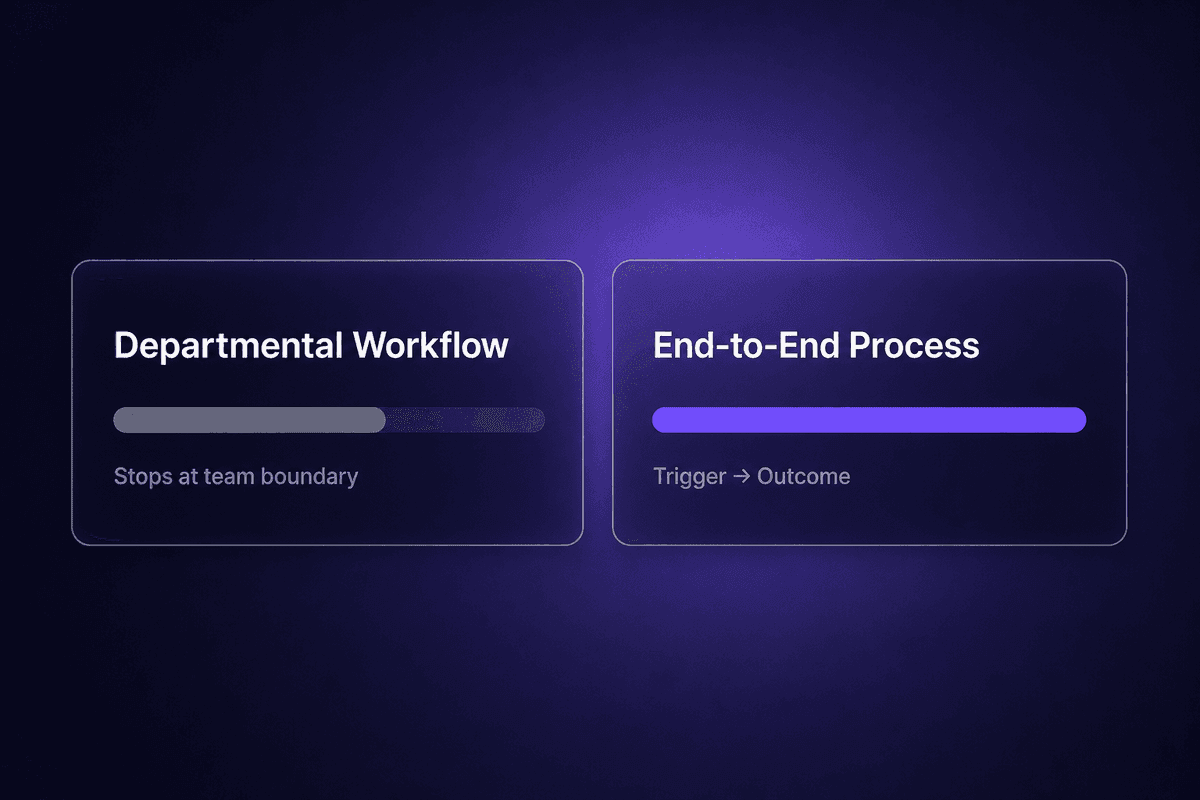
A departmental workflow describes what one team does. An end-to-end process describes what the organization delivers. Those are not the same thing, and treating them as equivalent is the root cause of most broken handoffs.
Take order-to-cash, one of the most common E2E processes in any business that sells something. Sales owns the opportunity and closes the deal. Finance owns the invoice and the payment. Operations or fulfillment owns the delivery. Each group has its own workflow, its own tools, its own metrics, and its own definition of "done." Sales is done when the contract is signed. Finance is done when the invoice is sent. Operations is done when the product ships.
The customer is done when they have what they paid for and the invoice reflects what they agreed to. That endpoint belongs to no individual department.
This is how disconnected processes develop inside organizations that believe they are well-run. Different departments each manage their own slice competently. The cross-functional process that connects those slices has no owner, no map, and no metric that spans the full scope. The result is a series of local efficiencies that add up to a frustrating customer experience, or worse, a revenue recognition delay nobody can fully explain.
The APQC finding that E2E process definition has topped the challenge list for years is telling. This is not a problem beginner organizations face before they mature. It is a systemic confusion that persists because organizational structure actively reinforces it. Cross-functional processes are invisible inside a structure built around functional departments.
Where the Workflow Stops and the E2E Process Keeps Going
Here is where the scope boundary becomes concrete. A sales team's existing process typically ends at "won." The deal is closed, the CRM is updated, the commission is logged. From the sales team's view, the work is done.
The end to end process has barely started. The order still needs to be entered. Inventory or capacity needs to be allocated. Fulfillment picks it up, often from a separate system. Finance generates an invoice, sometimes from yet another system. The customer receives the product. The payment posts. Reconciliation runs.
That entire sequence is part of the process. The sales workflow is a fragment of it. The question to ask about your own situation is this: where exactly does your team's workflow hand off to another team? What happens in that moment? Who owns that moment? If the answer is "it kind of just goes over to them," that is where the process breaks in production.
E2E Business Process Examples Worth Recognizing
These are the primary business processes that procure, produce, sell, and drive revenue. Each one is a revenue-critical flow, not just an operational procedure. Recognizing them as processes in action with defined starts and finish lines is the first step toward managing them properly.
Order-to-Cash
Trigger: a customer places an order. Finish line: payment received and reconciled. Cuts across sales, operations or fulfillment, and finance. This is the end-to-end process most often described as "working fine" inside three departments simultaneously while customers complain about billing errors.
Procure-to-Pay
Trigger: a procurement request is approved. Finish line: the supplier invoice is paid and the purchase is recorded. Crosses procurement, finance, and the requesting business unit. Often fragmented across three systems that were never designed to talk to each other.
Source-to-Pay
Trigger: a business need identified, requiring a new supplier relationship. Finish line: the supplier is onboarded, contracted, and first payment issued. Spans procurement, legal, finance, and sometimes IT for system access. The supplier onboarding portion alone involves enough handoffs to generate a week of email threads.
Concept-to-Market
Trigger: a product idea or strategic initiative. Finish line: the product is live and generating revenue. Involves product, engineering, marketing, sales, and customer success. The process that most often gets described as "collaborative" and least often has a single accountable owner.
Customer Onboarding
Trigger: a new customer signs a contract or creates an account. Finish line: the customer has successfully completed their first meaningful action and is retained. The customer journey crosses sales, implementation or success, product, and support. Business operations in this process often look smooth from the inside and chaotic from the customer's view simultaneously. Deliver a product, issue credentials, complete training, activate features - all of this is one process, not four.
Mapping Processes End-to-End: What Gets Skipped and Why It Breaks Things
Process mapping is often where E2E thinking fails in practice, not in theory. Organizations do map their processes. The problem is what they map.
Most process mapping efforts produce flowcharts that show what happens inside a single function. The diagram is accurate for that team. It becomes wrong the moment the work crosses to a different team, because that crossing is where the map ends and reality doesn't.
End-to-end process maps require a different scope definition from the start. The mapping exercise begins at the trigger, follows every step across every function, and ends only at the final outcome. Not at the edge of the department that initiated the mapping project.
Why Most Process Maps Miss the Handoffs
The structural reason is straightforward. When a process improvement team starts mapping, they typically involve the people in the room. Those people are from one department. The map reflects their experience. The parts of the process they do not see, the downstream systems, the upstream dependencies, the parallel actions happening in other teams, are invisible from that room and therefore invisible in the map.
The result is an accurate flowchart of one team's experience that misrepresents the full process flow. It shows no bottleneck where the real bottleneck sits, which is usually at the handoff point between teams. It shows no delay between the end of one team's step and the start of the next team's step. Those delays are where cycle time actually lives.
A correct End-to-end process map uses flowcharts or swimlane diagrams that allocate a lane to each function involved. Every step in every lane is mapped. Every handoff from one lane to another is explicitly shown as a transition, not implied, not assumed. The trigger is in lane one. The outcome is at the end of whichever lane owns the final step. Everything between those two points, across every lane, is in scope.
The swimlane approach also makes the bottleneck visible in a way that single-department diagrams cannot. When you visualize the handoff between sales and operations, you can see when the hand-off is manual, when it requires re-entry of data, when it depends on a person checking an inbox. Those are the points worth fixing first.
Mapping correctly is not a documentation exercise. The output is a diagnostic tool. A map that does not surface at least one gap you didn't know existed before you started is probably not covering the full process.
Stakeholder Involvement in E2E Process Mapping
Every function that touches the process must have a stakeholder in the room when it gets mapped. Not represented by someone who has adjacent knowledge of that function. Actually represented by someone who works in it and can describe what happens, what the exceptions are, and where the decision points live.
KPMG's research on process organization consistently identifies territorial barriers as the primary reason E2E mapping efforts produce incomplete maps. Teams are protective of their process documentation. They show what makes them look efficient. They minimize the steps that look messy or the handoffs that are informal. The result is a process map that reflects the intended design, not the operational reality.
The stakeholder group for a typical E2E mapping exercise should include the process initiator, each downstream function owner, the IT or systems owner for every platform involved, and whoever is accountable for the final customer outcome. Roles and responsibilities need to be visible in the map itself, not just in the meeting notes. And the decision points, those moments where a human choice determines which path the work takes, need to be named explicitly, because they are usually where the process becomes fragile under volume.
That is where the ticket usually starts.
End-to-End Process Ownership: The Governance Layer Most Teams Skip
Design the process correctly and it will still break without ownership structure behind it. This is the governance layer most teams skip, usually because it requires organizational authority rather than just technical effort.
End-to-end process management requires a single person who is accountable, in writing, for the design, data, technology, and service delivery across the entire process. Not a committee. Not a shared responsibility description that ends up meaning no responsibility. One person with the authority to make decisions that affect multiple departments.
KPMG's framework for process organization calls this role the global process owner. The accountability spans everything: how the process is designed, what data it runs on, what systems support it, and whether the end outcome meets the service standard. When something breaks at the handoff between sales and finance, the global process owner for order-to-cash is the person who owns that problem across the entire process, not the person whose team was holding it last.
Shared Services and Global Business Services adoption patterns show how this plays out at scale. Organizations that successfully consolidated cross-functional processes did so in part because they built ownership structures that matched the process scope, not the org chart. The process owner role predated the technology redesign in most successful programs. The governance came first. The automation followed.
For smaller organizations, the role may not carry a formal title, but the function still needs to exist. Someone has to own the full scope. Without it, every redesign effort will be undone by the next team boundary conflict, and every automation investment will amplify the fragmentation it was supposed to solve. Change management in E2E process programs is difficult precisely because it asks organizational goals and individual department metrics to stop contradicting each other. That is not a technical problem.
📊 In practice:
True end-to-end ownership means one person is accountable when the invoice is wrong after the deal is closed, when the onboarding stalls between IT and HR, and when the procurement request sits for nine days at a handoff nobody monitors. Not each function owning its slice. One person owning the full span, including the gaps between slices.
Why Automating an E2E Business Process Is Not the Same as Redesigning One
This is the mistake I see go wrong most often. A team decides to automate. They map their current workflow, add automation at the repetitive steps, and ship it. The automation works. The inefficiency remains.
Automation does not redesign a process. It accelerates whatever process exists. If that process has broken handoffs, manual re-entry points, redundant approvals, and unclear ownership, the automation will execute all of those things faster. The e2e process is still fragmented. Now it's fragmented at higher speed.
Deloitte's 2026 State of AI in the Enterprise survey found that 30% of organizations are now redesigning key business processes around AI, rather than layering AI onto existing ones. That 30% is doing the harder thing. The other 70% is automating their workarounds, not their processes.
McKinsey's research on digitization shows that compressing cycle times from days to minutes is achievable when entire E2E processes are redesigned as part of the automation effort, and when that effort is supported by cross-functional teams with proper process design authority. The compression does not happen when automation is bolted onto fragmented departmental workflows. The speed improves at the step level. The handoff delay, which is where cycle time actually lives, remains.
The question to ask before automating any workflow: does this workflow represent the full e2e process from trigger to outcome, or is it one department's fragment of a larger sequence? If it is a fragment, the automation will be correct inside that fragment and blind to everything outside it.
In Latenode, building a workflow that spans the full sequence of actions from trigger to desired outcome is structurally straightforward. The scenario starts when a record is created in the HR system, moves through document processing, system provisioning, and notifications, and ends with a confirmed outcome, all in one flow. The point is not the tool. The point is that automating the onboarding only inside the HR team's steps, while IT provisioning and finance setup remain manual handoffs, does not streamline the onboarding. It speeds up one fragment and leaves the bottleneck untouched. I've watched this happen more than once. The scenario runs green. The new hire is still waiting on day three.
Good news: the automation worked. Bad news: it worked on the wrong scope.
What Characterizes a Well-Designed E2E Process
Use this list as a diagnostic, not a description. If your current process can't pass each check, you know where to start.
Cross-functional integration is present, not assumed
Every function that touches the e2e process is formally connected, not coordinating over email. If handoffs rely on informal communication, the integration is missing regardless of what the process map shows.
Transparency exists across the full span
Visibility and control are not departmental. Any authorized person can see where the process currently is, not just where it is inside their team. If this isn't true, you have local dashboards, not process transparency.
Operational efficiency is measured end-to-end, not per-department
A department reporting strong throughput metrics while cycle time for the full process is long is a sign of misaligned performance measurement, not strong operations.
KPIs are tied to the final customer outcome
Best practices in E2E business process design treat customer experience metrics, not internal activity metrics, as the primary process performance signals. If the only measurable outcome is a departmental one, the E2E process isn't being measured.
Cost savings are cross-functional
Genuine business process efficiency shows up in total cycle time and total cost, not in one team's budget. Optimizations that reduce cost in one department by shifting work to another are not process improvements.
Quality and consistency hold at the handoff points
Rework, re-entry, exceptions, and escalations tend to cluster at handoffs. A well-designed E2E process has explicit quality controls at each transition, not just inside each team's steps.
🤔 Think about this:
Most organizations can recite these characteristics without hesitation. The question is who actually tracks them across the full trigger-to-outcome span. Not departmental KPIs. End-to-end ones. If the answer is "nobody has a single view of all of them," the governance problem from the earlier section is already visible here.