


Most HR leaders I talk to have already bought the platform. They've migrated the spreadsheets, launched the portal, maybe even run a kickoff with IT. And then, six months later, they're frustrated that nothing has really changed. The reports still take forever. The managers still email HR directly for everything. The onboarding process is still a checklist someone has to chase.
That's not a technology problem. That's a definition problem. They thought transformation meant installing something. It doesn't. HR digital transformation is a strategic and continuous shift in how HR operates - not a one-time technology upgrade - and teams that treat it as the latter consistently fail to see the outcomes they expected.
That's the central claim of this guide. Let me show you why it holds up, and more importantly, what to do about it.
The part teams learn late
- Installing an HRIS is digitization. Transformation means reimagining how HR creates value, not just where it stores data.
- Digital HR is continuous and iterative - there is no finish line, only the next process that needs rethinking.
- The biggest shift is HR moving from administrative overhead to a data-driven strategic function.
- AI, people analytics, and cloud platforms are the technology levers - but change management determines whether any of it actually sticks.

What HR Digital Transformation Actually Means
Here's the definition that actually holds: HR digital transformation is the integration of digital technologies into how human resources operates - not just the tools it uses, but the processes it runs, the decisions it makes, and the value it creates for the business. It's about rethinking how HR creates value, from the ground up.
Traditional HR was built around compliance, record-keeping, and policy administration. Most of the work was transactional: process the form, update the system, send the email, file the document. Digital transformation doesn't just move those tasks to new software. It asks whether those tasks need to exist in their current form at all - and then redesigns the work around what people and the business actually need.
IBM's framing on this is worth holding: genuine transformation means shifting from manual, paper-based processes to data-driven, automated, and employee-centric experiences. The operative word is "shifting." That implies a direction of travel, not a one-time event.
What that looks like in practice: an HR function that used to spend most of its time processing requests now spends most of its time analyzing patterns, advising managers, and designing the systems that handle routine requests automatically. The operating model changes. The relationship between HR and the rest of the business changes. The skills HR needs change. None of that happens just because you bought a new system.
This is also why transformation is harder to define than digitization. Digitization has a clear finish line: you've moved the thing from paper to digital. Transformation doesn't. You're continuously improving, continuously adapting, continuously asking whether the current state of your HR function is good enough for what the business needs next.
HR Digitization vs. HR Digital Transformation: Where the Confusion Starts
I keep seeing this distinction get collapsed in ways that cause real problems downstream. A company uploads their onboarding documents to a shared drive and calls it transformation. An HR team switches from paper timesheets to an online form and tells the board they've modernized. The dashboard looks different. The underlying work hasn't changed.
That's digitization. Converting existing manual HR processes into digital format. Same steps, same logic, same bottlenecks - just with fewer physical papers involved.
Transformation is categorically different. It involves questioning whether the current HR systems and manual HR processes are even the right processes to begin with. It means redesigning workflows so that routine work happens automatically, exceptions surface to the right person, and HR professionals spend their time on work that actually requires human judgment. The current HR systems may need to be replaced entirely, not just replicated in a new tool.
The clearest symptom of this confusion: teams that install a new platform and then configure it to mirror exactly what they were doing in the old one. They've changed the technology layer without changing the process layer. Digital processes that replicate broken manual logic are still broken - just faster.
Here's a simple test. Ask your team: what decisions does HR make differently now compared to two years ago? What processes no longer require HR involvement? Who has visibility into workforce data they didn't have before? If the answers are thin, you have digitization, not transformation. And the HR digital transformation changes that actually matter are still ahead of you.
The distinction matters because the two require fundamentally different investments. Digitization is mostly a technology project. Transformation is mostly a change management project that happens to involve technology. Confusing them means you'll underfund the part that actually determines success.
Why HR Digital Transformation Matters for the Business, Not Just HR
The business case for this isn't an HR argument. It's an executive one.
According to the World Economic Forum's Future of Jobs Report 2025, 86% of employers cite AI and information processing as transformative forces for their business by 2030. That expectation - set at the C-suite level - creates direct pressure on HR to modernize how it manages talent, plans workforce capacity, and develops people who can operate in that environment. A traditional HR function that processes forms manually and runs annual reviews isn't positioned to support that kind of business transformation.
The same WEF research on workforce trends identifies skill gaps as the primary barrier to business transformation - cited by 63% of employers. HR is the function responsible for closing that gap, which means digital transformation in HR isn't a back-office efficiency project. It's a prerequisite for the broader business transformation strategy most organizations are already committed to.
There's also an operational efficiency argument. Research cited by the Harbinger Group, drawing on Deloitte data, suggests HR teams spend over 57% of their time on routine administrative tasks: employee data management, onboarding workflows, leave processing. More than half the function's capacity, tied up in work that automation handles better than people do. That's not a use of talent. It's a waste of it.
Digital transformation frees that capacity. And when HR has capacity, it can shift toward the work that actually builds business resilience: workforce planning, skills development, culture, retention strategy. That's the repositioning from administrative function to strategic business partner that most HR leaders have on a slide somewhere - but rarely have the operating model to execute.
Agility matters here too. Organizations that achieve genuine digital HR transformation are better positioned to adapt to changing workforce expectations, adjust talent strategies faster, and personalize the employee experience at scale. That last one - personalization at scale - was nearly impossible in a manual HR environment. It's increasingly table stakes.
How HR Digital Transformation Shifts HR from Admin Work to Strategic Roles
The mechanism is straightforward, even if the execution isn't. Digital tools handle the routine. People handle the judgment-intensive work. When HR professionals spend less time processing leave requests and more time analyzing why a particular team has a 40% annual turnover rate, the function's contribution to the business changes.
This is what the shift from transactional to strategic actually looks like in practice. The hr function stops being the department you contact to fix a payroll error and starts being the function that tells the CEO which teams are at flight risk before anyone's resigned. Digital tools create the capacity for that work. Analytics create the insight. The combination is what makes HR a genuine business partner rather than an expensive administrative layer.
Allow HR professionals to focus on this kind of work, and you don't just improve HR outcomes - you improve business outcomes. Retention, performance, hiring quality, learning velocity. These are all downstream of whether HR has time to do more than process forms.
What Happens to Employee Experience When HR Goes Digital
The employee side of this equation is often undersold. When HR services are delivered through digital portals, self-service tools, and automated workflows, employees get faster answers, clearer processes, and less dependency on "email HR and wait." That's a materially different experience of working at a company.
Digital solutions like chatbots, self-service HR portals, and personalized learning platforms change what it feels like to navigate HR touchpoints. An employee who can check their leave balance at 9pm on a Friday, or who receives a tailored onboarding sequence rather than a generic PDF, has a different relationship with their employer than one who has to file a ticket and wait three days. A seamless digital experience at these moments contributes meaningfully to engagement and retention - not because the technology is impressive, but because it treats the employee as someone whose time matters.
The Technologies Driving Digital Transformation in HR
There's a tendency in HR technology writing to list every tool ever invented and call it a "tech stack overview." That's not useful. What's useful is understanding which technology categories actually change how HR operates - and why.
The honest answer: effective HR digital transformation runs on four levers. Artificial intelligence, people analytics, cloud-based HR platforms, and automation tools. Everything else supports one of these four, or it's a nice-to-have.
Here's how they break down in practice:
| Technology | What it actually changes | Where it breaks if misapplied |
|---|---|---|
| AI | Screening, matching, content generation, chatbot responses | Over-reliance without human review creates bias risk |
| People analytics | Turnover prediction, skills gap visibility, workforce planning | Garbage data in means garbage insight out |
| Cloud HR platforms | Centralized records, mobile access, integration capability | HRIS installed without process redesign replicates old problems |
| Automation tools | Routine workflows, notifications, data movement across systems | Automating a broken process makes it break faster |
The TrainingCred analysis makes the point clearly: combining AI, analytics, and cloud platforms is what enables the step-change in HR capability, not any single technology in isolation.
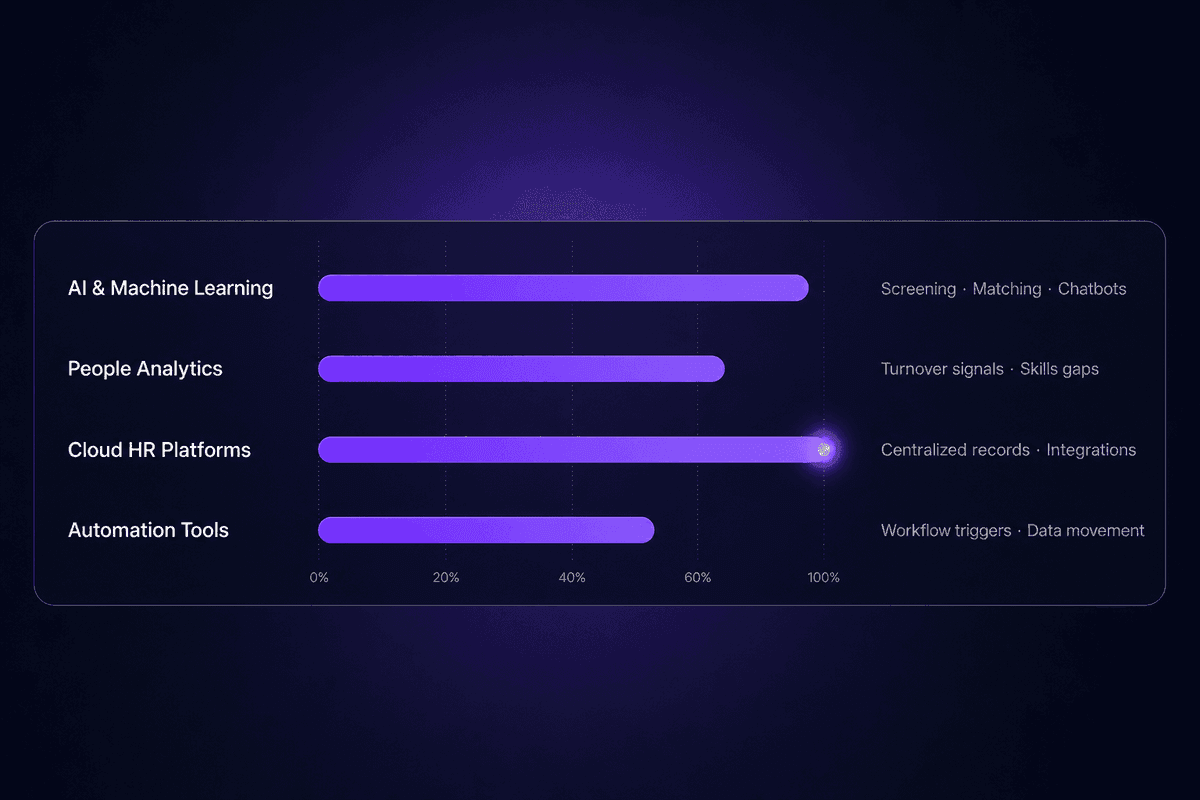
Cloud HR platforms, often called HRIS or HCM systems, are the foundation. They centralize employee data, make it accessible across teams and time zones, and enable the integrations that everything else depends on. Without a clean, centralized data layer, analytics are unreliable and automation is fragile.
The hr tech stack doesn't need to be complex. It needs to be coherent. The problem I see most often is fragmentation: one tool for performance, another for learning, another for payroll, none of them talking to each other. The hr team ends up manually reconciling data between systems, which is the exact administrative burden that technology was supposed to eliminate.
AI and Automation: What They Actually Handle in HR Workflows
Be specific about this, because "AI in HR" is one of the most over-claimed phrases in the current market.
In practice, AI in HR workflows handles: resume screening and candidate matching, onboarding checklist orchestration, payroll anomaly detection, compliance checks against policy documents, scheduling coordination, and basic employee query resolution. These are the hr tasks where the volume is high, the decision logic is relatively consistent, and the cost of errors is low enough that automation makes sense.
Automation handles the movement: when a candidate is marked hired in the ATS, trigger the onboarding workflow. When an employee submits a leave request, check the policy, notify the manager, update the calendar. When a new employee record is created, provision system access. The hr operations layer that used to require a human at every step now runs largely without one.
The digital systems that support this in a platform like Latenode connect the HR stack - HRIS, ATS, email, IT ticketing - through a single workflow canvas. A new hire form triggers account creation, manager notifications, and personalized welcome communications in one execution. I mention this because the recurring question in support isn't whether automation helps. It's whether teams can build it without dedicated engineers. The answer, increasingly, is yes - but only if the workflow is well-designed before it's automated.
People Analytics and Data-Driven HR Decision-Making
This is where HR stops being reactive and starts being useful at a strategic level.
Analytics help HR leaders anticipate workforce needs rather than respond to them after the fact. When your analytics platform can show you which departments have declining engagement scores three months before attrition spikes, you have a window to act. When it can map current skills against the skills your business plan requires in 18 months, you can design learning programs with actual targets rather than guessing.
CHROs and people analytics teams are increasingly generating evidence-based talent decisions - on hiring, development, succession, and retention - from hr data that was previously trapped in disconnected systems or never captured at all. The data layer doesn't produce the decisions. But it changes the quality of the conversation in the room where decisions get made.
The caveat: analytics outputs are only as reliable as the data underneath them. Teams that rush through the technology layer without cleaning their hr data end up with beautiful dashboards built on inconsistent inputs. That's not insight. That's a well-designed guess.
The Stages of HR Digital Transformation Most Teams Rush Through
There's a predictable pattern to how HR digital transformation unfolds - and an equally predictable pattern to where it breaks. Most teams move too fast through the stages that feel slow and skip entirely the stage that determines everything.
Here's the typical progression, honest about where teams stall:
Stage 1: Assessment and diagnosis.
This is where you map your current state - what processes exist, what they cost, where the bottlenecks are, what data you have and what's missing. Most teams spend a week here when they should spend a month. The output should be a clear picture of which HR processes are candidates for transformation and in what order.
Stage 2: Strategy and alignment.
Before touching any tool, the HR leadership team and key C-suite stakeholders need to agree on what transformation is trying to achieve. Not "become more digital" - that's not a strategy. Specific outcomes: reduce time-to-hire by a defined amount, free HR capacity from transactional work, improve new hire time-to-productivity. The digital initiatives that follow need to be anchored to these, or they drift.
Stage 3: Technology selection and integration.
This is where most teams start, which is why most teams struggle. Technology selection is much more straightforward when you've done the process work first. You're selecting against clear requirements, not shopping based on features or vendor demos. The hr department selecting a platform before mapping their processes is the most common setup mistake I see, and it consistently produces expensive, underused implementations.
Stage 4: Change management and capability building.
The stage everyone rushes. Covered in detail below, because it deserves it.
Stage 5: Pilot and phased rollout.
Start with one function, one process, one team. Get the feedback loop working before scaling. The transformation efforts that succeed are usually the ones that proved something concrete and small before trying to change everything.
Stage 6: Continuous optimization.
The stage that never ends. This is what "transformation is iterative" actually means. Your first version of any digital workflow will be wrong about something. The goal is building the capability to find out what and fix it, repeatedly, as the business changes.
Building the HR Digital Transformation Roadmap Before Touching Any Tool
A solid pre-implementation roadmap answers four questions before any vendor conversation begins:
Process audit: Which HR processes currently exist? What are the steps, the owners, the inputs, and the failure modes? Fragmented hr processes documented for the first time often reveal redundancies and gaps that no technology would have fixed anyway.
Stakeholder alignment: Who needs to be involved, and what does each stakeholder need to believe about the transformation for it to succeed? The CHRO has different concerns than the CFO, and both have different concerns than the line managers whose teams will experience the changes first.
Capability gap assessment: What skills does the HR team need to operate the new digital platform, and who currently has them? This shapes both tool selection and the training investment required.
Phased rollout sequencing: Which processes get transformed first, and why? Prioritize the combination of high administrative burden and relatively straightforward automation logic. Onboarding is the most common right answer for early-stage transformation, which is why it appears in almost every broader transformation roadmap as the proof-of-concept phase.
The recurring support-side mistake: teams buy the platform, then start mapping processes, then discover that the digital platform they bought doesn't support the process design they actually want. Now they're rebuilding. That sequence is expensive. Reverse the order.
Why Change Management Is the Stage That Actually Determines Success
Here's the honest version of this: most HR digital transformation rollouts that fail don't fail because of technology. They fail because HR staff weren't equipped to use the new ways of working, managers weren't convinced to adopt new processes, and nobody owned the cultural shift that transformation requires.
Successful HR digital transformation requires HR to lead the change, not delegate it to IT. The misconception that transformation is primarily an IT project produces rollouts where the technology works and the adoption doesn't. IT can integrate the systems. Only HR can redesign the processes, communicate the new expectations, and build the digital skills in their own team.
Prosci's research on change management makes this point clearly: the projects with dedicated change management support succeed at significantly higher rates than those without. That's not a soft finding. It's the variable that explains why two organizations implementing the same technology get different outcomes.
The change management plan needs to address: why this change is happening and what stays the same, what employees need to do differently and what support they'll get, how HR professionals themselves are being reskilled, and how leadership will visibly model the new ways of working. Without that plan, the technology is a building without people in it.
Benefits of HR Digital Transformation That Hold Up Under Scrutiny
These benefits are real. They're also conditional. Each one requires the right setup to appear.
- Reduced administrative burden for the HR team.
When routine tasks - onboarding workflows, leave processing, data entry, basic query resolution - run automatically, HR recovers time currently consumed by transactional work. The Deloitte-sourced data cited by Harbinger Group puts that at over 57% of current HR time. Even partial automation of that 57% creates meaningful capacity. This only holds if the automated workflows are well-designed; otherwise, you just move the problem downstream.
- Faster and more consistent employee experience.
Self-service portals, digital onboarding, and chatbot-assisted HR queries give employees access to information and processes on their own schedule, without waiting for a human intermediary. Modern HR solutions deliver this consistency at scale in a way manual processes structurally cannot.
- Better talent decisions through data.
When HR data is centralized and analytics tools are in place, CHROs can make evidence-based decisions on hiring, retention, and development rather than relying on gut instinct and quarterly anecdotes. The precondition: clean, integrated data.
- Reduced time-to-hire and time-to-productivity.
AI-assisted screening and digital onboarding workflows compress the hiring cycle and the new hire ramp time. Aggregated case study data from Growium suggests AI onboarding implementations reduce HR's active involvement per new hire from roughly 10 hours to 2-3 hours, cutting the onboarding timeline by 50-80%. These are implementation-dependent numbers, but the direction of effect is consistent.
- Organizational agility.
A digital HR function can adapt faster to workforce changes - remote work expansion, skills redeployment, headcount planning - because the data and workflows that support those decisions are already running. A manual HR function adapts at the speed of spreadsheet updates and meeting schedules.
- Cost efficiency over time.
Automation doesn't eliminate HR headcount, but it changes the ratio of what HR staff can handle. Given that most companies operate at or below 1.5 HR staff per 100 employees - well below the 2-2.5 benchmark that improves retention outcomes, per Yomly's synthesis of SHRM, Bloomberg Law, and ADP data - new digital HR capabilities let understaffed teams achieve better outcomes without proportional headcount growth.
- Improved compliance and audit readiness.
Digital workflows create a paper trail automatically. Policy acknowledgements, approvals, document submissions - all timestamped and stored. The successful transformation outcome here isn't just compliance. It's the confidence that comes from knowing what happened and when.
Challenges of HR Digital Transformation Teams Rarely Admit Upfront
The benefits section was real. So is this one.
Legacy system complexity is the first thing teams hit and the last thing they admit to vendors. The existing HR operations infrastructure - payroll system from 2014, HRIS that doesn't have an API, performance tool that only exports to Excel - creates integration constraints that transform "6-week implementation" timelines into 6-month ones. Modernizing legacy systems isn't a line item in most transformation budgets. It should be.
Adoption resistance from the HR team itself is more common than any HR leader wants to say out loud. The professionals who have spent years navigating manual processes are sometimes the most resistant to changing them - not because they're obstinate, but because the new digital tools feel unfamiliar and the training investment required is real. Asking HR to lead organizational change while simultaneously building their own digital skills is a lot. Managing that tension is part of the CHRO's job.
Data quality problems surface at the worst possible moment: after you've built the analytics dashboard and the numbers don't make sense. Inconsistent field values, duplicate records, missing data from systems that never talked to each other - these are the things that make people analytics reports look unreliable. Every transformation project needs a data remediation phase. Almost none have a budget line for it.
The false assumption that transformation has a finish line is, in my experience, the challenge that does the most long-term damage. Teams declare transformation complete, reduce the investment, and then wonder why the outcomes plateau. The Everworker.ai analysis makes this point clearly: transformation is continuous and iterative, not a time-bounded project. The organizations that sustain outcomes are the ones that build the ongoing improvement habit into their operating model, not the ones that launch and stop.
Skills gaps in the HR team are real and underestimated. Data literacy, workflow design thinking, basic technology troubleshooting - these aren't skills that most HR professionals were hired for or trained on. Building them takes time and investment. Assuming they'll develop naturally once the tools are installed is optimistic to the point of being wrong.
🤔 Wait.
Teams that invest the most time in technology selection - comparing platforms, running demos, involving procurement - tend to invest the least in change management. The choice of platform affects outcomes at the margin. Whether people actually use it, trust it, and redesign their work around it is what determines ROI. The selection process crowds out the investment where it matters most.
Why the Transformation Process Stalls After the First Tool Rollout
This is the pattern I see most reliably. The first tool goes live - usually an ATS, sometimes a core HR system, occasionally digital tools like applicant tracking or a self-service portal. Early results are visible. The team reports progress. Leadership is satisfied. Investment attention moves elsewhere.
And then nothing changes for the next 18 months.
The tool rollout solved a surface problem without touching the process or culture underneath. Core HR workflows are still designed around manual logic. The hr staff who use the tool daily work around its limitations rather than redesigning for them. The transformation journey stops feeling like a journey and starts feeling like a maintenance task.
The specific failure mode: the tool becomes an island. It does its job, but it doesn't integrate with the decisions HR makes or the broader business processes it was supposed to improve. The green dashboard metric says adoption is at 87%. The actual process outcomes haven't moved. Nobody connects the two observations until someone asks the question directly.
That's where the ticket usually starts.
Examples of HR Digital Transformation Across Core HR Functions
Transformation looks different depending on which HR function you're looking at.

Here's what concrete change actually looks like across the core areas - not what vendors promise, but what teams actually build.
Recruitment automation: AI-assisted screening tools reduce the time spend on initial resume review and ranking. Structured digital interview workflows replace ad hoc scheduling. Candidate communications are automated at each stage, with human review reserved for evaluation and decision points. The hr department that used to spend three hours reviewing applications for every open role now spends 45 minutes on candidates who already meet the baseline criteria.
Digital onboarding: The new hire experience shifts from "here's a packet of PDFs and a meeting with IT" to a coordinated workflow that provisions accounts, assigns training paths, schedules introductory meetings, and sends check-ins automatically. HR tools in this space connect HRIS, IT systems, and communication platforms so the new hire arrives with everything ready - and the HR team has a dashboard view of completion status rather than an inbox full of follow-up emails.
Self-service payroll and benefits: Employees access pay stubs, update banking details, enroll in benefits, and manage dependent information without requiring HR involvement. The hr services overhead for routine transactions drops substantially. HR handles exceptions and policy questions - the work that actually needs human judgment - rather than fielding questions that a well-designed portal answers automatically.
Performance management systems: Annual review cycles replaced by continuous feedback tools, digital goal-tracking, and structured check-in workflows. Managers and employees have a shared view of progress without waiting for the year-end conversation. The HR function gains visibility into where performance conversations are happening and where they aren't.
Learning platforms: Generic training programs (the kind where everyone watches the same video once a year) replaced by platforms that personalize learning paths based on role, skills gaps, and career objectives. Completion is tracked automatically. Interventions are triggered when someone is falling behind or hasn't engaged in a defined period.
Recruitment and Onboarding: Where Digital HR Changes Are Most Visible
These two functions are where hr transformation is most tangible for the people experiencing it - candidates, new hires, and the hiring managers who partner with HR on both.
AI-assisted screening in recruitment changes the cycle time and the quality of the shortlist. HR professionals spend time evaluating candidates who meet real criteria, not filtering through volume manually. Digital offer workflows eliminate the back-and-forth on signatures and documentation that turns a verbal yes into a week-long process. The candidate experience improves. The time-to-offer shortens.
On the onboarding side, self-service portals and automated workflow orchestration mean new hires arrive with accounts provisioned, equipment ordered, and first-week schedules set. Aggregated implementation data suggests this can reduce the overall onboarding timeline by 50-80% compared to manual coordination - and reduce HR's active involvement from roughly 10 hours per hire to 2-3 hours. Those aren't small numbers for an understaffed function.
In practical terms: a team building this workflow in Latenode would connect the ATS trigger (candidate marked "hired") to a sequence that creates system accounts, sends personalized welcome materials via built-in AI models, generates IT provisioning tickets, and routes manager tasks - all in a single execution. The onboarding becomes repeatable and self-running. The HR team sees a status dashboard instead of an inbox.
For digital HR, these functions serve as proof of concept. They're visible, measurable, and directly felt by the people who go through them. A successful recruitment and onboarding automation gives the transformation program its first genuine win - and builds the organizational confidence to keep going.
Performance Management and Learning in a Digital HR Environment
The annual review is one of the least useful things in traditional human resources. Everyone knows it. The research agrees. And yet most organizations kept running them for decades because replacing the process is harder than keeping it.
Digital HR provides the operational infrastructure to make continuous performance management actually work. Continuous feedback tools, digital goal-tracking tied to business objectives, and structured manager check-in workflows distribute the performance conversation across the year instead of compressing it into one uncomfortable annual event. Talent management becomes an ongoing activity rather than a scheduling problem.
Learning platforms close the gap between skills gap identification (the analytics side) and skills development (the training side). When the platform personalizes learning paths rather than assigning generic modules, completion rates improve and the learning is more likely to transfer to the actual job. HR tracks progress automatically and intervenes at defined thresholds rather than waiting for a manager to notice someone is struggling.
The point isn't sophistication for its own sake. It's that continuous, data-connected performance and learning systems let HR support development in real time instead of reviewing it retrospectively. That's a fundamentally different capability - and a much more useful contribution to business outcomes.
How to Build an HR Digital Transformation Strategy That Doesn't Fall Apart
I've read enough failed transformation post-mortems to know that the strategy failures are almost always the same two things: scope that expanded without governance, and a technology-first sequence that skipped the process and people work entirely.
Here's the framework that avoids both.
Defining the Scope: What HR Transformation Should and Shouldn't Include
Scope is where well-intentioned transformation programs die. Start with everything and you'll finish nothing.
Early-stage transformation should prioritize the combination of three factors: high administrative burden on the HR function, relatively clear and consistent digital processes that can be mapped and automated, and high visibility to employees or business stakeholders. Onboarding meets all three. So do leave management, routine employee queries, and basic analytics reporting.
What to leave for later: anything requiring significant change in how managers work (harder adoption challenge), complex compliance workflows across multiple jurisdictions (higher risk of getting it wrong), and processes that depend on data quality you don't yet have. These are real transformation opportunities. They're just better as phase two or three.
The discipline question is: what HR process, if we transformed it well in the next six months, would most change how the business perceives HR's contribution? Start there. Make it work. Then expand.
Modernizing legacy systems that block everything else gets its own parallel workstream. Don't try to do it simultaneously with the feature-level digital initiatives work or the timelines will compound each other's delays.
Measuring Whether the HR Transformation Journey Is Actually Working
The transformation journey needs metrics, and those metrics need to be honest.

"Employees are happy with the new portal" is not a transformation metric. Here's what actually tells you whether the work is producing outcomes:
Process efficiency metrics: time-to-hire (from job open to offer accepted), time-to-productivity for new hires, average time to resolve employee HR queries, and percentage of HR transactions completed without requiring direct HR staff involvement. These measure whether the automation is doing what it's supposed to do.
Employee experience scores: specifically tied to HR touchpoints - onboarding satisfaction at 30 days, self-service resolution rates, and whether employees can find what they need without escalating. Survey these directly, not just as part of general engagement tracking.
HR capacity reallocation: what percentage of HR staff time is now spent on strategic work versus transactional work? This is the digital HR outcome that matters most for the business case. If the ratio hasn't moved after 12 months of transformation, something is wrong with the design.
Adoption rates: what percentage of the target population is actually using the digital tools they were given? Low adoption is the most reliable early indicator that the change management work was insufficient. Catch it at 90 days, not at annual review.
Cost per HR transaction: how much does it cost to process a new hire, administer a leave request, or answer a routine employee query? These denominator metrics tell you whether the investment in transformation is showing up in the unit economics of HR delivery.
Frame these as the measurement structure, not as fixed targets. The HR team that reviews these metrics quarterly and uses them to diagnose what needs to change is running a genuine transformation program. The team that sets targets in year one and reviews them once at year-end isn't.
📊 In practice:
Organizations that achieve agility and personalization through digital HR are measurably better positioned to respond to shifting workforce expectations - a pattern supported by IBM's research on HR's strategic repositioning. The teams that get there fastest aren't the ones with the best technology. They're the ones that connected their transformation goals to specific, visible business outcomes from the start. C-suite stakeholders fund transformation when it's framed as a business capability problem, not an HR process improvement project.