


Here's a pattern I keep seeing. A carrier announces a "digital transformation initiative." Over the next 18 months, they build a customer portal, move some forms online, and maybe launch a mobile app. The project gets declared a success. Claims are still slow. Underwriters are still drowning in email. The legacy policy admin system is still, bafflingly, still there.
That's not transformation. That's digitization wearing transformation's name badge. And the difference between the two - what it actually means to transform versus just going digital - is where most programs go wrong before they've written a single requirement document.
Insurance digital transformation is not a technology project with a finish line. It's a continuous rewiring of how an insurer makes decisions, builds products, serves customers, and competes in a market that no longer waits for annual planning cycles. Most carriers haven't fully accepted that second part yet. The ones that have are pulling away.

The part most transformation programs learn too late
- Insurance digital transformation is an operating model shift, not a portal launch or a paperless project.
- Every function in the value chain gets redesigned differently: underwriting, claims, distribution, billing each have their own transformation logic.
- There's no finish line - customer expectations and competitive dynamics keep moving, so the program does too.
What Insurance Digital Transformation Actually Means
A working definition, grounded in what actually changes rather than what gets announced in a press release: insurance digital transformation is the use of digital capabilities to redesign how an insurer creates products, prices risk, distributes coverage, processes claims, and serves policyholders - across both front-office customer interactions and back-office operational processes - in ways that are continuous, organization-wide, and tied to measurable business outcomes.
That's deliberately broader than "launch a digital channel" or "automate a workflow." It spans the full value chain. Underwriting decisions informed by richer data. Claims processes that move from weeks to hours on routine cases. Distribution models that reach customers through embedded products in travel booking or car purchases, not just agent networks. Policy administration systems that can launch a new product in weeks rather than 18 months.
The phrase "transformation in the insurance industry" covers some of this, but it's worth being specific. It's not just about the front end customers see. The deeper transformation happens in how the operating model works underneath - how decisions get made, how data flows between systems, how products are built and priced, and how quickly any of that can change when markets shift.
Stripe defines digital transformation broadly as the process of integrating digital technology into all business areas, fundamentally changing how organizations operate and deliver value. In insurance, that translates to rewiring the operating model itself, not decorating it with digital touchpoints.
Why "Going Digital" and "Digital Transformation" Are Not the Same Thing
The most common misconception in this space, and the one that kills more transformation programs than any technical problem: going digital means putting existing processes online. Transformation means questioning whether those processes should exist in their current form at all.
A carrier that scans paper claim forms into PDFs has gone digital. A carrier that uses AI to extract data from those forms, compare it against policy terms, flag anomalies, and route simple claims to straight-through settlement has started transforming its claims function. Same starting document. Completely different operating logic underneath.
Digital systems in traditional insurance were often layered on top of manual workflows without changing the workflow logic itself. A broker still submits the same information in roughly the same sequence; the system just processes it faster. That's digitization. Transformation asks: why does the broker submit anything at all on routine renewals? Why is underwriter review required on standard risks? What decision was previously manual that digital capabilities can now make more accurately and faster?
The distinction matters because misdiagnosing the scope leads to misaligned investment. Teams spend budget on customer-facing digital tools while the back-office processes those tools connect to remain unchanged. The app is fast. The claim behind it takes nine days. That's the gap transformation is supposed to close.
Where the Insurance Value Chain Gets Redesigned, Not Just Automated
Transformation doesn't land the same way in every function. Each part of the insurance value chain has its own redesign logic, and treating them as a single initiative is where programs lose coherence.
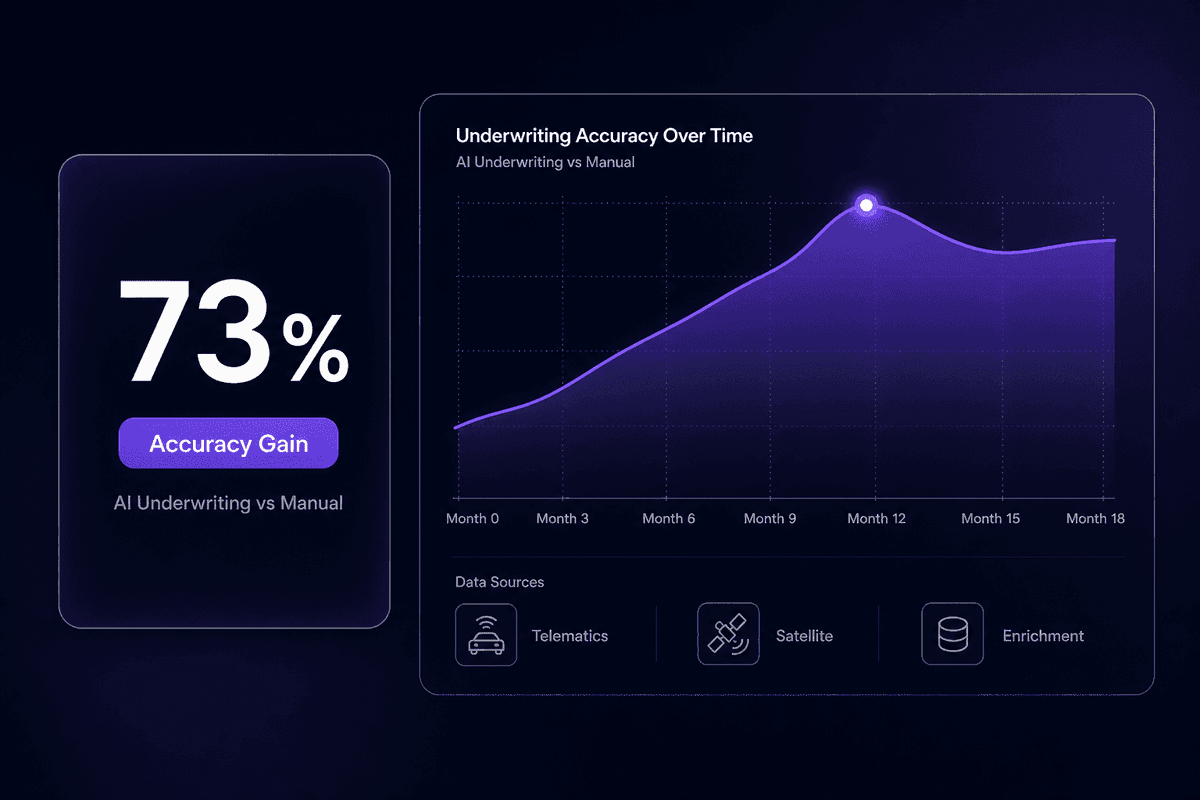
Underwriting and claims are where AI changes decision quality most visibly. Telematics data, satellite imagery, and third-party enrichment sources let underwriters price risk they couldn't see before. Claims automation routes straightforward cases without human review - a Nordic insurer documented by EY reduced handling times and manual workload by automating early-stage claim intake and routing, keeping human judgment for genuinely complex cases rather than applying it to every submission.
Policy administration is where the infrastructure bottleneck shows up. Many P&C carriers are still running core systems that were built when product launches took 18-24 months by design. Guidewire's research into P&C insurance modernization shows carriers increasingly replacing those legacy architectures with cloud-based platforms and advanced analytics capabilities - not because cloud is fashionable, but because it's the only path to competitive product velocity.
Distribution is where business model transformation is most visible. Embedded insurance, usage-based products, and direct digital channels didn't exist as serious distribution mechanisms a decade ago. They now account for a growing share of new policy origination.
Billing and customer service are often last in the transformation queue, and it shows in policyholder experience surveys. These functions typically automate incremental steps while leaving the underlying process structure intact, which is why self-service resolution rates remain lower than they should be even after significant investment.
The point is that you can't automate your way to transformation in any one of these functions without addressing the core systems and data flows that run underneath all of them.
Why Insurance Companies Need Digital Transformation Right Now
The competitive argument for urgency used to be about catching up with best practices. Now it's about survival math. According to Feathery's market research, 67% of insurance firms have accelerated their transformation programs, and the insurance technology platform market is projected to reach $229 billion by 2029. Those aren't aspirational numbers. They're the size of the infrastructure shift already underway while you're reading this.
The J.D. Power 2025 U.S. Insurance Digital Experience Study, based on 11,529 customer evaluations, found that 47% of U.S. auto insurance policy buyers now purchase through digital channels - more than through agents (35%) or call centers (17%). Digital has become the primary route for policy purchase. That means the digital experience is no longer an enhancement layer; it's the main channel. Underinvesting in it now is underinvesting in your primary distribution mechanism.
The payoff from getting it right is non-linear. The same J.D. Power study found that when auto insurance customers have an excellent digital experience (scoring 801 or higher on a 1,000-point scale), 92% say they'll definitely use digital channels again. When the experience is poor (500 or lower), only 40% say they're likely to return. That's not a marginal difference. It's the difference between a channel that reinforces retention and one that actively drives churn.
Insurance companies face a specific compounding problem that makes delay expensive in a way other industries don't. Legacy system debt accumulates at interest. Every year a carrier runs on a 20-year-old policy administration platform is a year they build workarounds, exceptions, and manual processes on top of it. The modernization cost doesn't decrease. It grows. The European Insurance and Occupational Pensions Authority (EIOPA)'s 2025 policy paper noted this directly: many EU insurers remain burdened by legacy systems that hinder their ability to exploit digital technologies, with supervisors identifying infrastructure modernization as a competitive priority.
Add to that the regulatory complexity of digital sector requirements. EIOPA's analysis highlights that EU frameworks like DORA and the AI Act are increasing administrative complexity, especially for smaller carriers who lack dedicated compliance infrastructure. Transformation programs that build governance and data transparency in from the start are better positioned for this regulatory environment than those that add it as an afterthought.
The digital landscape for insurance isn't becoming more forgiving. InsurTech entrants, embedded distribution partners, and digitally native MGAs all operate without the system debt that most traditional carriers carry. The question isn't whether to transform. It's whether the pace is fast enough to matter.
📊 By the numbers:
McKinsey estimates that AI and related technologies could generate $1.1 trillion in annual value across the insurance industry, according to Dataversity's research synthesis. That's not a projection of what innovation might eventually produce. It's an estimate of value currently sitting uncaptured in pricing accuracy, claims efficiency, distribution reach, and fraud reduction - in carriers that haven't yet applied the tools to get at it.
What Happens to Insurers That Delay
Delay compounds. Not linearly.
Legacy systems don't just slow things down - they constrain what's even possible to build. An insurer that can't launch a new product in under six months can't respond to a market shift. An insurer whose claims cycle runs two weeks on standard cases can't compete with a digital-native player that settles the same claim in 48 hours. The gap between insurer and InsurTech on customer experience isn't a feature gap. It's an infrastructure gap that manifests as a capability gap in the market.
InsurTechs built on modern, API-first architectures can embed insurance into partner ecosystems - e-commerce checkout flows, automotive purchases, travel booking platforms - because their core systems were designed to expose functionality via API. A traditional carrier running a legacy policy administration platform literally cannot do this without a multi-year integration project. Distribution ground ceded to embedded insurance partners doesn't come back easily.
Insurance carriers that delay also face increasing loss ratios from worse risk selection. AI-driven pricing models improve accuracy on segmentation and fraud detection. Carriers not running them are, in effect, adversely selected against by those that do - because better-priced competitors take the good risks and leave the rest.
The claims process is where operational drag becomes most visible to policyholders. Customers whose straightforward claims sit in queues for days while simple cases could be settled algorithmically are experiencing a failure of transformation, not a feature of the insurance model. They know the difference now.
How InsurTech Changed What Policyholders Now Expect
InsurTech entrants didn't just build better apps. They reset the baseline for what normal looks like, and that reset applied to every insurer in the market, not just the digital players.
A policyholder who buys renters insurance in three minutes through an embedded checkout flow has a different reference point than someone who spent an hour on the phone with an agent in 2015. Customer expectations are now calibrated against the best digital experience they've had anywhere - not against the insurance industry average. That's a harder standard.
Real-time pricing, instant quote comparison, self-service policy changes at 10pm without calling anyone, claims status updates that don't require a follow-up call - these were InsurTech differentiators five years ago. They're table stakes now. Customers expect seamless digital self-service across the full policy lifecycle because they've experienced it and have no particular reason to accept less from a traditional carrier just because the carrier has been around for 80 years.
Usage-based insurance, which prices based on actual behavior rather than demographic proxies, is another expectation shift InsurTech accelerated. A younger driver with good driving data doesn't want to pay rates set by actuarial assumptions about their demographic. Telematics-based pricing addresses that directly, but it requires digital capabilities - data collection, real-time processing, pricing flexibility - that legacy systems weren't designed to support.
Core Digital Technologies Driving Transformation in the Insurance Industry
There are four enabling technology categories that show up consistently in every credible insurance transformation program: AI and data analytics, cloud platforms and API architecture, and blockchain. Each connects to specific business outcomes rather than general capability improvement. The question isn't whether a carrier should use these new technologies - most already use some version of all four. The question is whether they're deployed against the right problems at sufficient depth to change competitive position.
AI and Big Data Analytics in Underwriting and Pricing
AI changes underwriting in three ways that compound each other: it expands the data that can be used in risk assessment, it improves the accuracy of that assessment at scale, and it makes fraud detection more systematic.
Traditional underwriting relied on structured data - applications, credit scores, loss history - because those were the inputs manual processes could handle. Advanced analytics now pull from satellite imagery, telematics feeds, building permit data, social business signals, and third-party enrichment sources to build a richer risk picture than any human underwriter could assemble manually on standard submissions. Forvis Mazars' research identifies AI as the primary enabler of personalized insurance products precisely because it makes risk differentiation possible at a granularity that flat actuarial models can't reach.
Machine learning models in underwriting get better with volume. A carrier that runs 100,000 policies through an AI pricing model has a feedback loop for improving that model that a carrier doing manual pricing doesn't. The accuracy gap widens over time.
Fraud detection is where predictive analytics delivers some of its cleanest ROI. AI that flags anomalous claim patterns - inconsistent injury descriptions, repair estimates that don't match damage photos, provider billing patterns that deviate from norms - catches fraud that manual review misses, not because adjusters are careless but because pattern recognition at volume is genuinely a machine problem, not a human one.
From a support and operations standpoint, I'd flag one real issue these tools create: when AI models make an underwriting or claims decision, the explanation pipeline matters as much as the model accuracy. Regulators in the EU, under the AI Act framework EIOPA highlighted in its April 2025 paper, require that AI decisions in health and life insurance can be explained and don't create discriminatory exclusions. Carriers deploying black-box models without interpretability layers are building a governance problem even as they solve a pricing one.
Cloud Platforms and API Architecture in Policy Administration
Cloud-based platforms and API-driven architectures solve a specific problem that legacy core systems created: the inability to change anything without changing everything.
A monolithic policy administration system built in the 1990s typically requires a change request, a development queue, testing across every line of business it touches, and a deployment window. Product teams at carriers running these systems will tell you that 18-24 months to launch a new product isn't an exaggeration - it's the actual timeline, and it's compressing the number of product bets a carrier can make in any given year to near zero.
Cloud platforms with modular architecture let carriers update pricing logic, add coverage options, or launch a new product tier without touching the core system. API layers let distribution partners, aggregators, and embedded partners query rates and bind policies programmatically, which is how most new insurance distribution gets built today. The automation capabilities this enables - straight-through processing on standard risks, digital self-service on endorsements, faster product launches - aren't magic. They're what you get when the underlying infrastructure can actually support them.
The operational effect on cycle times is real. Carriers that have migrated policy administration to cloud-based architectures consistently report significant reductions in time-to-market for new products and faster processing on endorsements and renewals. Streamline the core infrastructure and the efficiency gains appear downstream across every function it supports.
Blockchain and Its Narrower but Real Role in Insurance
Blockchain in insurance is one of those technology areas where the potential got way ahead of the practical, and then the practical settled into something genuinely useful but considerably less dramatic.
Where it actually works: parametric insurance, where smart contracts trigger automatic payouts when defined conditions are met (a flight delay exceeds four hours, rainfall drops below a threshold), removes the need for a claims submission process entirely. The event happens, the contract executes, the payment moves. For specific lines - crop insurance, travel insurance, certain reinsurance contracts - that's a real data protection and settlement efficiency improvement, not a theoretical one.
Fraud reduction through shared ledgers is another legitimate application in insurance technology, particularly in reinsurance and syndicated markets where multiple parties need to verify the same data without trusting a single counterparty's record. Audit trail integrity matters in disputed claims, and an immutable record has genuine value there.
For most standard insurance lines and most transformation programs, though, blockchain isn't in the critical path. Smart contract parametric structures require precisely defined trigger conditions, which works well for weather or transport events and less well for the ambiguous, fact-specific situations that make up most liability and health claims. Carriers building transformation programs should treat blockchain as a valuable tool for specific use cases within those programs, not a platform technology that rewires the whole operation.
How Digital Transformation Reshapes Insurance Business Models
Technology enables capability. But the business model shift is where transformation produces its most durable competitive effect. A carrier that deploys AI in underwriting while keeping the same product structure, distribution model, and revenue logic is doing digital transformation at the surface. The deeper shift is in how the carrier creates and captures value - and that requires rethinking the business model itself, not just improving how the current one runs.
From Product Selling to Customer-Centric Service Models
The traditional insurance model is episodic: a customer buys a policy, pays premiums, files a claim when something happens, renews annually. Interaction is minimal by design. The value exchange is financial protection; the relationship is mostly administrative.
Digital transformation creates the infrastructure for a different model - one where the carrier interacts continuously rather than episodically, adds value between claims events rather than just during them, and personalizes coverage based on actual behavior rather than demographic proxies. Usage-based insurance is the clearest expression of this. Instead of pricing a driver based on age and zip code, a UBI product prices based on actual driving data. The insurer knows more, the customer pays more accurately, and the relationship becomes data-driven rather than assumption-driven.
Digital channels make this continuous relationship technically possible. Telematics apps, wellness integrations, home sensor data, connected car APIs - these create touchpoints that a pure paper-and-phone carrier simply doesn't have. Brokers and agents are affected too. Their role shifts from policy placement toward advisory and advocacy work, serviced through digital workflows rather than manual ones, because the routine transactions have been automated.
Prosci's research on organizational change identifies meeting evolving customer expectations as a primary driver of transformation - and that expectation has moved from "provide coverage when I need it" to "help me manage risk continuously." Carriers that enhance customer engagement through digital touchpoints are building relationships that are harder to disrupt than annual renewal conversations.
Insurance-as-a-Service and Embedded Insurance as New Products
Embedded insurance is the product model that digital transformation unlocks and that traditional architecture makes nearly impossible.
The principle: instead of a customer searching for insurance separately, coverage appears at the point where the insured risk is created - inside the cart at checkout, in the financing flow for a car purchase, in the booking confirmation for a trip. For that to work, the insurance carrier needs to expose pricing and binding functionality via API in real time, handle instant decisioning without manual underwriting steps, and integrate seamlessly into a partner's digital flow. That's an architecture requirement, not just a product design one.
InsurTechs built on modern, API-first cores have been leading embedded insurance expansion because they designed for this from scratch. The barrier for traditional carriers is the legacy core - you can't expose embedded insurance APIs from a system that wasn't designed to be exposed. Which is exactly why carriers doing API-layer modernization are doing it partly to unlock distribution models like embedded that their current architecture blocks.
Insurance-as-a-service takes this further: modular, programmable insurance products that partners can configure and distribute under their own brand, powered by carrier infrastructure in the background. For digital distribution, new products like micro-duration coverage (insure an item for a weekend), parametric travel protection, and on-demand professional liability are business model innovations that require digital transformation of the underlying insurance architecture, not just the front-end experience.
What the Insurance Ecosystem Looks Like When Transformation Matures
Most carriers aren't here yet. It's worth being honest about that.
The mature state of insurance digital transformation is an interconnected ecosystem where carriers, brokers, MGAs, InsurTechs, and data providers operate through shared APIs and digital platforms - each contributing their specialized capability into a flow that serves the policyholder without requiring the policyholder to understand how many entities are involved. A home insurance product might price from a carrier's AI risk engine, distribute through a mortgage lender's platform, supplement with smart home sensor data from an IoT provider, and handle claims through a claims management specialist - all appearing to the customer as a single coherent experience.
For competitive positioning, the insurance landscape at transformation maturity rewards carriers that control valuable underwriting data, proprietary pricing models, or distribution relationships - not those that own the most back-office steps. Long-term value accrues to carriers that find their specific defensible advantage in the ecosystem and integrate effectively with partners for everything else, rather than trying to vertically integrate every function.
That's where transformation points. Getting there requires the foundational work on core systems, API architecture, and data infrastructure described throughout this article. The ecosystem layer gets built on top of that foundation, not before it.
The Benefits of Digital Transformation in Insurance That Actually Show Up in Operations
Here are concrete operational benefits, function by function, with the mechanism behind each rather than just the claim:
- Underwriting speed and accuracy: AI-assisted underwriting reduces time on standard submissions by automating data extraction, risk scoring, and routing. An insurer using intelligent document processing on broker submissions can route straightforward risks to straight-through acceptance without underwriter review, freeing underwriters for genuinely complex risks. The accuracy benefit comes from larger training data sets - an AI model that has underwritten 500,000 similar risks has better calibration than a human reviewing a new submission cold.
- Claims process cycle time: Automation of claims intake, document classification, fraud flagging, and settlement approval on routine claims shortens the cycle time on the cases that don't need human judgment. An EY case study on a Nordic insurer showed measurable reductions in handling time and manual workload by automating early-stage intake and routing, with complex cases still going to human adjusters rather than algorithmic settlement. The operational result: exception queues shrink, average cycle time becomes more predictable, and customer satisfaction follows.
- Manual process reduction in policy administration: Endorsement processing, renewal outreach, premium calculation adjustments, and document generation are all high-volume, low-judgment tasks that automation handles accurately at scale. Removing manual processes from these workflows reduces error rates and frees operations staff for exception handling and customer interaction that actually requires judgment.
- Data-driven pricing accuracy: When an insurer has access to real-time data from telematics, third-party enrichment, and claims feedback loops, pricing can reflect actual risk exposure rather than demographic proxies. That improves loss ratios on new business over time - not immediately, but measurably as the feedback loop generates enough volume to refine the model.
- Distribution reach through digital channels: A digital experience that lets customers quote, bind, and service policies without agent intervention reduces per-policy distribution cost and extends reach to segments that prefer digital self-service. According to J.D. Power's 2025 study, 47% of U.S. auto buyers now purchase through digital channels. Insurers with strong digital experiences see 92% of satisfied users return to digital channels; those with poor experiences retain only 40%. That conversion gap is a direct distribution efficiency number.
- Compliance and audit efficiency: Digital workflows with structured data and automated logging create audit trails that manual processes don't. For carriers subject to DORA and related EU digital regulations, this isn't optional - the compliance cost of fragmented, manual documentation is measurably higher than maintaining structured digital records from the start.
- Help insurers retain customers through better digital experience: The overall customer experience at every digital touchpoint - quoting, purchasing, servicing, claims - shapes renewal intent. A carrier that delivers a genuinely good digital experience keeps customers in the digital age at rates that carriers with friction-heavy experiences don't. That's a retention math argument, not an aspiration one.
What Actually Blocks Insurance Transformation - and What Doesn't
I've talked to enough people working inside carriers to distinguish real blockers from things teams use as blockers when the real issue is something else. The list is shorter than most transformation plans suggest.
The actual hard problems: legacy system integration complexity, change management resistance at middle management, and the regulatory constraints that require governance layers on AI and data use. These are genuine. They slow things down. They require real solutions.
The things that frequently get cited as blockers but aren't really: cost, skills availability, and the idea that a full rip-and-replace is required. These are solvable - or they're misconceptions that transformation efforts need to address head-on rather than treat as facts.
The biggest single thing that stalls transformation programs isn't technical. Transformation requires organizational ownership across business functions, not just IT capacity. When a transformation initiative is housed in IT and funded like an infrastructure project, it tends to produce better infrastructure. When it's owned by the business functions whose processes are actually changing - underwriting, claims, product, distribution - it produces capability shifts that show up in operating metrics. Most programs that fail do so because they embrace digital transformation as a concept at the C-suite and then delegate execution entirely to IT without giving business functions skin in the design.
🤔 The uncomfortable question:
If your transformation program lives in the IT budget and reports to the CIO without a direct accountability line to claims efficiency, underwriting loss ratios, or distribution margin, ask who will know when it has succeeded. If the answer is unclear, that's not a governance gap. That's a symptom of the program solving the wrong problem.
Legacy Systems - Replace Everything or Integrate Progressively?
The rip-and-replace misconception is the one that kills the most transformation plans before they start. The assumption: you can't transform until you've replaced the legacy core. Therefore transformation is either a multi-hundred-million-dollar program or it's not real.
Neither part is true.
Modern middleware, API gateway layers, and cloud connectors allow carriers to build digital capabilities around legacy systems while core modernization happens on a separate, longer track. New digital journeys - online self-service, AI-assisted claims routing, embedded insurance APIs - can run on a modernized layer that sits between the legacy system of record and the customer-facing or partner-facing interface. The legacy system keeps running for what it does; new capabilities are added without waiting for it to be replaced.
Guidewire's documented pattern for P&C carrier modernization acknowledges this two-speed architecture explicitly: carriers are replacing legacy core systems with cloud-based platforms in phases, not as a single cutover event. The modernization path is often strangler-fig style - new digital tools gradually take over functions from the legacy system, which shrinks in scope over time rather than getting replaced on day one.
Latenode's visual workflow builder is one practical example of this kind of integration layer thinking. An operations team at a carrier can, for instance, build a multi-step submission intake workflow that ingests broker emails, extracts data via AI models, validates it against internal guidelines using built-in document retrieval, and pushes structured records into the legacy policy admin system via its existing interfaces - all without touching the core system's code. The Latenode AI Agent Builder handles the orchestration; the legacy system does what it always did, but it now receives structured, pre-validated input instead of raw email attachments. A setup like this can be running in 90-120 minutes if the intake fields and connectivity exist. That's not a replacement strategy. It's a new digital tool buying the core modernization team time to do the deeper work properly.
The progressive integration approach requires discipline: you need to track which functions are still running on legacy logic versus modernized flows, maintain documentation of the integration layer, and avoid creating a situation where the middleware becomes the new legacy system in five years. But those are solvable governance problems. They're not reasons to wait.
Change Management and Workforce Evolution in Insurance Companies
The workforce fear is real, but the direction is usually wrong. The common assumption inside organizations: transformation means automation, automation means job cuts, therefore transformation is fought or delayed. The actual pattern, in carriers that have done this well: roles shift toward higher-value work rather than disappearing.
An underwriter whose previous day was 60% spent on manual data extraction and submission assembly now spends that time on complex risks, relationship management, and model oversight. A claims adjuster who previously handled every claim from intake to settlement now handles only cases that require genuine judgment - the ones with disputed liability, unusual circumstances, or significant coverage ambiguity. The volume of cases they handle may be similar; the ones they actually work on are harder and more consequential.
The insurer that communicates this honestly at the start of transformation avoids a significant amount of resistance. The insurer that says "we're automating claims" without explaining that adjusters move to more complex work gets resistance that slows the program, because the people in the room have seen enough reorganizations to assume the worst.
Advanced analytics and machine learning capabilities require new roles that didn't previously exist inside most carriers: data scientists for model development, digital product managers for self-service tools, and customer engagement specialists who design the digital touchpoints that used to be handled by phone agents. These aren't replacement jobs for the people previously doing manual claims processing. They're different roles, requiring different skills. Carriers that treat workforce evolution as a training-and-transition challenge rather than a headcount problem fare better on both the change management side and the capability side.
Who Drives Insurance Digital Transformation - and From Where in the Organization
Prosci's research on organizational change identifies a consistent failure mode: transformation initiatives that are technically owned by IT but operationally disconnected from the business functions doing the actual work. The IT team builds the platform. The platform sits underutilized because the claims team, the underwriters, or the distribution group wasn't part of designing how it changes their work.
Effective insurance industry transformation is organization-wide. That's not a platitude - it has a specific structural meaning. The underwriting function needs to own the redesign of how underwriting decisions get made and what data they use. The claims function needs to own the claims workflow redesign, not just receive a new system. Finance owns billing transformation. Distribution owns channel strategy. IT provides infrastructure, integration, and security. But the business functions drive the use cases, define what "better" looks like, and ultimately determine whether the program produces capability change or just system change.
Many insurance companies have traditionally structured transformation as an IT program because that's where the technology sits and where the project management muscle exists for large system implementations. The goal of digital transformation is different from the goal of a core system upgrade. A system upgrade delivers a new platform. Transformation delivers a changed capability - in how fast a claim gets settled, how accurately a risk gets priced, how many distribution channels a product can reach. Those outcomes are owned by business functions, not IT.
Digital insurance transformation also requires different sponsors at different stages. Core system modernization needs CTO and CFO sponsorship because it's capital-intensive and multi-year. AI deployment in underwriting needs the Chief Underwriting Officer as the business owner, not just a technical approver. Embedded distribution strategy needs product and commercial leadership, because the pricing and partnership decisions are business decisions, not technical ones.
Carriers that drive innovation most effectively tend to have a dedicated digital transformation function - sometimes a Chief Digital Officer, sometimes a standalone Digital & Data function - that sits between IT and the business lines, translating business needs into technical programs and technical capabilities into usable business tools. Where that function is absent, the gap tends to get filled by IT on one side and frustrated business leaders on the other, and transformation stalls in the middle.
Carriers and MGAs - Where the Core Systems Work Gets Done
Large carriers and MGAs are where the heaviest transformation investment concentrates, because they own the core systems that everything else in the insurance process depends on. Underwriting automation, claims digitization, policy admin migration - these require executive sponsorship, multi-year programs, and the organizational patience to manage change at scale without disrupting the in-force book of business that's paying for the transformation.
For an insurer running 500,000 policies, even a minor change to the policy admin workflow has outsized risk. That's why many carriers approach core system transformation through parallel running: the new digital flow handles new business while the legacy system runs off in-force policies, and the migration happens gradually rather than through a single cutover. Help insurers think about this correctly and you'll see that the program is less "replace the system" and more "gradually transfer responsibility for each function to the new infrastructure until the old system has nothing left to do."
MGAs have a different dynamic. They typically don't own the carrier paper, but they do own the distribution process, the underwriting authority for their niche, and increasingly the technology stack they use to exercise that authority. For an MGA, allow insurers to deploy modern workflow automation around a core binding authority platform - automating submission intake, risk screening, document handling, and data sync with carrier systems - and the competitive advantage is speed to decision and lower cost per submission. That's a real differentiator in markets where margins are thin and submission volume is the core metric.