


Here's the pattern I keep seeing: a company installs sensors across their facility, builds a dashboard that shows machine temperatures in real time, and then calls it digital transformation. The dashboard works. The business outcomes don't change. Someone opens a ticket asking why.
IoT is not digital transformation. It's an enabler of it. That distinction sounds obvious until you're three months into a deployment wondering why nothing is measurably better. The internet of things gives you a live feed from the physical world. What you do with that feed - how you redesign processes, change operating models, and build automation logic around it - is the transformation part. One without the other is just an expensive dashboard.
The part teams usually learn late
- IoT bridges physical events to digital decisions, but sensors alone don't transform anything.
- Deploying devices is the starting line, not the finish line, of digital transformation.
- Measurable business value only appears when IoT data reshapes how processes actually run.
- The harder problem isn't connectivity - it's building the automation layer that acts on what the devices tell you.
What IoT Actually Is - and What It Is Not

The definition that actually holds up in practice: IoT is a network of physical objects embedded with sensors, software, and connectivity that collect and exchange data with other devices and systems over the internet. Thermostats, factory machines, shipping containers, hospital equipment, traffic signals - any physical thing that can generate a signal and send it somewhere qualifies as an IoT device.
What it is not: putting devices on Wi-Fi. That's the first misconception I see consistently, and it creates expensive surprises later.
A working IoT system has three layers beyond the hardware itself. First, appropriate connectivity for the environment - and that does not always mean Wi-Fi. A sensor on a pipeline in a remote field needs cellular or LPWAN (low-power wide-area network) technology; a device inside a factory building might use wired industrial protocols entirely. Choosing the wrong connectivity option is one of the most common reasons IoT initiatives stall before they deliver anything useful.
Second, backend data management: somewhere to ingest, store, and structure the stream of readings the devices generate. Raw telemetry without a backend is just noise.
Third, analytics and orchestration: the layer that takes structured data and triggers decisions. Without this, connected devices are precisely that - connected, and nothing more. The data stays in a database nobody acts on, and the sensors become a capital cost that never paid back.
IoT devices are the physical entry point. The rest of the stack is what makes them worth deploying.
How IoT and Digital Transformation Actually Connect
Digital transformation, defined honestly, is a holistic change in how a business operates - its processes, its operating model, its culture, and how it delivers value. It's not a technology project. Technology is what makes specific changes possible, not what the change itself is.
IoT is one of the most powerful enablers of digital transformation because it closes a gap that most organizations could never close before: the gap between what's happening physically and what the digital systems know about it. Before IoT, a factory floor manager had to walk the floor or rely on scheduled reports. Now the machines report continuously. That changes what's possible - but only if the organization is prepared to act on the data differently than it acted before.
That's the distinction that matters for digital transformation strategies. IoT feeds the data layer. Transformation programs act on it. The two are additive, not interchangeable. You can run a digital transformation without IoT (though you'll miss the physical-world data advantage). You can deploy IoT without transformation (plenty of companies do; they call it "a pilot" and wonder why it never scaled).
The McKinsey framing is useful here: sensors and actuators monitor environmental changes and trigger actions, creating a loop between physical events and digital decisions. That loop is where the value lives. IoT opens the loop. What you wire into it determines whether it generates business outcomes or just generates data.
The Core Mechanism: From Physical Event to Digital Action
The sensor-to-action loop works in four steps, and every step matters.
An environmental change - temperature rising, pressure dropping, a part reaching a threshold vibration frequency - triggers a sensor reading. That data moves over wired or wireless networks to a backend system capable of ingesting it at scale. The backend processes the reading against defined rules or models. An action fires: an alert, a maintenance ticket, an automated adjustment, a report.
Real-time data makes this loop fast enough to be useful. A sensor reading that takes six hours to become an alert isn't prevention - it's a log entry. The compute and connectivity backbone determines how tight the loop is. For predictive maintenance, tight matters. For monthly energy billing, it matters less.
The point is that devices and systems need to be connected at all four steps, not just the first one. A sensor that generates data nobody processes is the same as no sensor at all, except it costs more.
Why IoT Deployment Alone Does Not Equal Transformation
The support-queue version of this problem looks like this: a company installs IoT, runs it for six months, adds it to a slide deck as proof of digital progress, and then wonders why the business metrics didn't move.
What happened is that the devices were connected but the existing processes weren't changed around them. The data flowed into a dashboard. The dashboard was reviewed on Fridays. Decisions were still made the same way they'd been made for years, just with a shinier data source. That's not successful digital transformation - that's a more expensive status quo.
Research signals pointing in the same direction: IoT-driven transformation also changes how work is done, who owns which decisions, and how teams perceive their own role. When those things don't change, the technology produces data and the organization produces the same outcomes it always did. The business value that IoT is supposed to unlock stays locked. Because value comes from acting on information differently - and that requires redesigning the process, not just measuring it more precisely.
Where IoT Creates Real Value Across Industries
McKinsey has estimated that IoT could generate up to $12.5 trillion in global economic value across industries. The factory setting alone accounts for a projected $3.7 trillion of that figure - which is specifically where industrial IoT, automation, and operational technology improvements converge. These aren't aspirational numbers in five years; they reflect the scale of the transformation programs already running across different industries right now.
The question is never "does IoT create value" - the answer is yes, at enormous scale. The question is where and how, because the mechanisms are not identical across sectors.
Manufacturing and IIoT: Predictive Maintenance and Digital Twins

Industrial IoT in manufacturing is where the value case is clearest and the ROI calculus is most direct. Industrial machinery that runs unexpectedly generates unplanned downtime. Unplanned downtime is expensive. Sensors that can predict a failure before it happens convert unplanned downtime into planned maintenance - which is a fraction of the cost and none of the disruption.
The use cases stack from there: remote monitoring of assets across multiple sites without dispatching technicians, digital twin simulations that let engineers model process changes before implementing them, real-time production visibility that surfaces bottlenecks while they're forming rather than after they've cost a shift, and automated quality control that catches defects in-line rather than at the end of the line.
Deloitte's smart manufacturing research points to smart factory initiatives integrating IoT, AI, and machine learning achieving up to 20% increases in production capacity and up to 15% cost reductions in some manufacturing contexts. Those numbers are the outcome of actually wiring IoT data into operational technology and decision logic, not just installing sensors and watching the dashboard. The $3.7 trillion factory potential from McKinsey is the sum of those kinds of improvements at global scale.
Industry 4.0 is, in large part, the story of manufacturing operational technology reconnecting with data infrastructure - and IIoT is the physical layer that makes that reconnection possible.
Retail, Healthcare, and Logistics: Where New Business Models Take Shape
Retail's IoT use cases are more visible than people realize. Smart shelves that detect when inventory is low and trigger automatic reorder without a person walking the floor. Cold-chain monitoring that tracks temperature throughout the journey from supplier to shelf, with automatic alerts if anything drifts outside safe range. In-store analytics that map customer movement through the store to optimize product placement.
Healthcare is where IoT creates genuinely new value propositions. Wearable IoT devices and remote patient monitoring allow clinical teams to track patient condition outside the hospital - changing the model from episodic care to continuous monitoring. Asset tracking in hospitals recovers equipment that would otherwise sit unused on the wrong floor. Connected medical devices generate data that informs treatment in real time rather than waiting for the next scheduled visit.
Transportation and logistics is where IoT-based fleet tracking and route optimization show up as direct competitive advantage. Real-time visibility of shipment location and condition creates new revenue streams: usage-based insurance, condition-guaranteed delivery, dynamic routing that responds to traffic and weather rather than fixed schedules. These aren't incremental improvements to existing models - they're new customer experiences built on data that didn't exist before the sensors did.
That's what new business models actually means in this context: not a rebranded service, but a fundamentally different value proposition made possible by continuous data from the physical world.
Energy, Utilities, and Smart Cities: The Ecosystem Play
Energy and utilities is where IoT becomes an ecosystem play rather than a single-company deployment. A smart grid requires intelligent metering at scale, real-time consumption data across millions of endpoints, automated demand response when load spikes, and integration between generation, distribution, and consumption systems. No single piece of that works without the others. That's the IoT ecosystem: multiple connected systems - devices, networks, platforms, analytics - functioning as an integrated whole.
Pipeline monitoring in oil and gas uses IoT sensors to detect pressure anomalies and potential leaks before they become disasters. Smart-city traffic systems use sensor networks to optimize signal timing and reduce congestion dynamically rather than following fixed schedules written years ago. Smart lighting that responds to actual occupancy rather than timers cuts energy consumption in ways that compound across thousands of fixtures.
The business goal in these deployments is different from manufacturing or retail: the target is resource management at infrastructure scale, sustainability outcomes, and public service reliability. The IoT infrastructure required to optimize a city's grid is orders of magnitude more complex than a factory floor deployment - but the mechanism is the same: physical events feed digital decisions, and the decisions get better because the data is real and current.
📊 By the numbers:
McKinsey's estimate of up to $12.5 trillion in global IoT economic value - across factory floors, retail supply chains, healthcare systems, and energy infrastructure - suggests that organizations treating IoT as an optional experiment are compressing into a shrinking window. The scale of investment flowing into this space, with the industrial IoT market alone projected to reach roughly $964 billion by 2035, means late adopters will face a capability gap that gets harder to close, not easier.
The Benefits of IoT in Digital Transformation - With the Caveats Attached
The benefits are real. I want to be specific about them before getting to the caveats, because the caveats don't erase the case - they shape how to capture it.
Cost reduction in manufacturing and logistics through predictive maintenance and route optimization. Improved uptime through early-warning systems that catch failures in development rather than at failure. Process automation where digital decisions fire from physical events without human intervention in the loop. New revenue models - usage-based services, condition monitoring subscriptions, outcome-based contracts - that weren't commercially viable before continuous device data existed. Enhanced customer experiences built on real-time information rather than static reports.
Digitalization, properly understood, is the process of converting physical-world events and analog processes into digital information that systems can act on. IoT is the mechanism that does this at scale. The benefits of digital transformation that organizations genuinely capture are the ones downstream of good digitalization - and IoT is one of the best tools for getting there.
Now the caveats. None of these benefits materialize by layering IoT on top of existing processes without redesigning those processes. I've seen this failure mode enough times to be direct about it: a company that installs sensors and keeps its decision-making workflows exactly as they were will capture approximately zero of these benefits. The data will be more accurate. The outcomes will be unchanged. The ROI calculation will be embarrassing.
The benefits require that IoT data changes how someone makes a decision, or eliminates the need for a decision by automating the response. If neither of those things happens, the sensors are a cost center with a good dashboard.
Automation, Operational Data, and the Digitalization Loop
IoT closes the digitalization loop in a specific way: physical data flows into automation platforms that trigger decisions without human intervention. A temperature threshold is crossed; a cooling system adjusts. Vibration exceeds a model's predicted healthy range; a maintenance ticket opens. A shipment's GPS fence is breached; a customer notification fires and a logistics coordinator is alerted.
This is the mechanism that separates IoT as data collection from IoT as an operational capability. Collecting data is one step. Having an automation layer that converts real-time data into real-time decisions is the step most teams underinvest in.
For teams building this out, the practical question is where the orchestration layer lives. One pattern I've seen work: a Latenode workflow receives normalized machine readings from an IoT gateway, routes them through a classification model using one of the 1,200+ AI models available in a single dropdown, and creates a work order in the CMMS when a threshold is crossed - all in a single execution that counts as one event in billing terms, not six separate steps. The loop from physical event to business action can be tighter than most implementations actually make it. The tools are available. The architecture decision is whether to connect them.
Data-driven decisions are a function of data quality, orchestration speed, and people's willingness to act on what the data says. IoT improves the first two. The third is still a change management problem. Data analytics can tell you what's happening; it can't make the organization respond differently without someone redesigning the response.
🤔 Think about this:
The more IoT data a system generates, the more the organization needs process and governance changes to act on it. Most teams invest heavily in the device layer and underinvest in the process layer. If your data generated by sensors goes into a platform nobody has operationalized a response to, you've bought yourself an expensive monitoring system rather than a transformation program. Ask this before adding more sensors: who changes their behavior when this data arrives, and how?
What It Takes to Build an IoT Ecosystem That Supports Digital Transformation
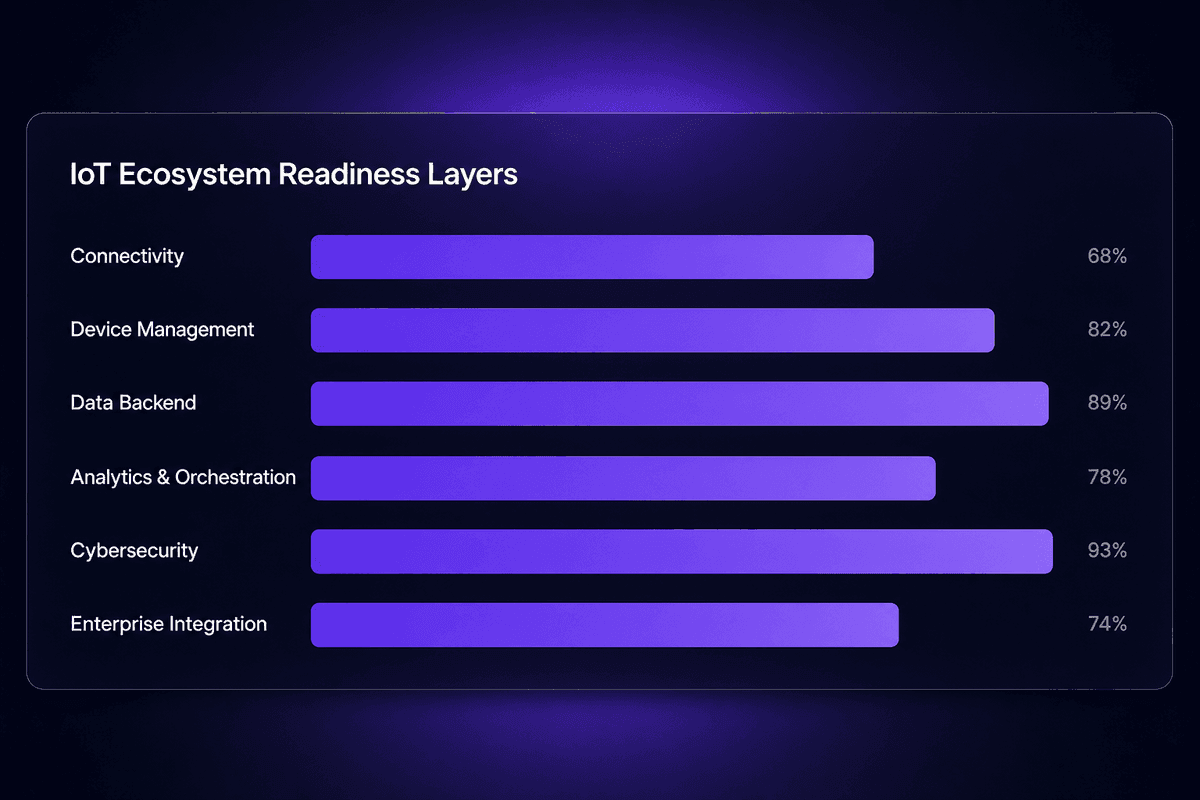
The readiness question for any leader evaluating IoT at scale comes down to six components. Miss any one of them and the deployment will either stall or deliver data nobody acts on.
Connectivity appropriate to the environment. Not Wi-Fi by default. The connectivity choice needs to match the physical context: range, power availability, data volume, and acceptable latency. A field sensor on a pipeline monitoring for pressure anomalies every 15 minutes has entirely different connectivity requirements than a production line instrument streaming 10 readings per second. Cellular, LPWAN, wired industrial protocols, and mesh networks all exist for different reasons. The wrong choice shows up in reliability problems months after deployment.
Device management infrastructure. Managing one device is trivial. Managing ten thousand requires firmware update capabilities, remote diagnostics, security certificate rotation, and lifecycle tracking. This is where the initial deployment cost calculus usually underestimates the long-term operational cost.
Backend data infrastructure capable of ingesting at scale. Sensor data volumes can be very large. Cloud computing infrastructure - whether public cloud or hybrid - needs to handle ingestion, storage, and retention without creating bottlenecks or data loss. Big data architecture isn't the exception for mature IoT deployments; it's the expectation.
Cybersecurity designed for the deployment from the start. IoT devices are endpoints, and endpoints are attack surfaces. Security on an IoT deployment is not the same as enterprise IT security - the device constraints are different, the update cycles are different, and the physical access risks are different. Treating this as an afterthought is one of the more documented failure modes in industrial IoT specifically.
Analytics and orchestration. The layer between raw data and business action. Without it, data sits in a warehouse that nobody operationalizes.
Integration with existing enterprise systems. IoT data has to connect to the systems where work actually happens - ERP, CMMS, CRM, BI tools. Digital solutions that exist in isolation from the systems people use daily tend to create shadow workflows rather than replacing inefficient ones.
Scalability has to be designed in. An architecture that works for 50 devices and falls over at 500 creates the worst kind of problem: one that appears only after the organization has committed to the deployment.
Connectivity, Data Management, and the Orchestration Layer
Three distinct layers sit between an IoT device and a useful business action.
First, connectivity matched to the use case. This is where the "just put it on Wi-Fi" instinct causes the most damage. LPWAN technologies like LoRaWAN and Sigfox handle long-range, low-power sensor deployments - asset tracking across large facilities, agricultural monitoring, remote infrastructure. Cellular (4G/5G) handles high-bandwidth, high-mobility use cases like fleet tracking. Wired protocols like OPC-UA are still the backbone of industrial machinery data collection because they're reliable, deterministic, and don't depend on wireless spectrum. Physical devices in real environments have constraints that shape the right connectivity choice. IoT technologies exist precisely because no single option fits everything.
Second, a backend capable of ingesting sensor streams, applying data models, and storing time-series data at the rate the use case demands. The ability to collect and transmit data is only useful if the receiving end can handle it. Public cloud platforms have made this layer substantially more accessible - but the architecture still needs to be deliberate about retention policies, query performance, and cost as data volume grows.
Third, the orchestration layer: the system that connects incoming events to downstream actions. This is where automation logic lives. An IoT platform without orchestration is a database. An IoT platform with orchestration is an operational system.
For teams building this orchestration layer in practice: a manufacturing controls engineer dealing with the fan-out problem - getting machine telemetry from an OPC server or MQTT broker into an ERP, a reporting dashboard, and a cloud data warehouse simultaneously - is looking at a classic multi-system routing problem. In Latenode, that routing workflow can ingest from an existing industrial data source, apply JavaScript-based transformation rules for each downstream system (cost-relevant data reshaped for ERP, high-frequency signals batched before landing in the warehouse), and push to all three destinations via 5,500+ integrations with automatic OAuth, from a single workflow. When an integration fails, an AI model in the same flow summarizes the issue for the on-call engineer in plain language. The alternative is three separate scripts maintained by whoever wrote them, failing in ways that produce no useful error context.
Where IoT Initiatives Stall: Four Signals to Watch
Four failure patterns show up consistently, and each one is visible before the initiative formally fails if you know what to look for.
Wrong connectivity for the environment. The signal is intermittent data gaps in the earliest deployment weeks. Not full outages - partial ones. Devices connect, drop, reconnect. The team blames the device hardware and orders replacements. The replacements have the same problem. The issue was always the network choice, not the device. This is a business strategy failure disguised as a hardware problem: someone selected the stack without adequately mapping the physical environment.
Missing backend orchestration. The signal here is data accumulating in one place while nothing downstream changes. Dashboards show numbers. Work queues remain the same. The team describes the IoT deployment as "running well" because the devices are reporting. The devices are reporting. Nobody built the layer that converts reports into actions. This is the digital business equivalent of hiring a researcher and giving them nowhere to publish.
Treating device deployment as the end state. I see this most often in IoT implementation projects where success was defined as "devices installed and reporting." The dashboard went green on the go-live date. The business case was built on outcomes the devices were supposed to enable - and those outcomes require process changes the project scope never included. The devices are the beginning of the work, not the deliverable.
Failing to redesign processes around new data. This is the subtlest and most expensive failure. Everything works technically. Data flows. Dashboards update. But the maintenance team still responds to failures reactively because nobody changed the workflow that maintenance coordinators actually use. Streamline is an overused word in this space, but the mechanism is real: IoT data can only change outcomes if it's wired into the process where the decision gets made. Watching data on a separate screen while making decisions the old way is not digital transformation.
Every one of these stalls happens in the digital age with teams that have budget and intent. The common thread is that the IoT deployment wasn't tied to specific, measurable business goals from the start - so there was no forcing function to redesign the processes the data was supposed to improve.
That is where the ticket usually starts.