


Most teams hit this question the same way: they've built something with one agent, it works, and then either the agent needs more tools than anyone expected, or they realize the real problem requires multiple specialized agents handing work to each other. That's when the protocol question stops being theoretical.
The framing you'll find most places - MCP vs A2A, pick one - is wrong. These two protocols don't compete. They address different layers of the same system. Choosing one and skipping the other isn't a trade-off. It's leaving half your architecture unaddressed. That's the claim this article is going to defend, and it's falsifiable: if MCP can handle inter-agent coordination, or A2A can handle tool access, the argument falls apart. It can't, and it doesn't. Let's get into why.
The part teams design around too late
- MCP connects agents to tools; A2A connects agents to each other - different layers, not competing choices.
- Single-agent vs. multi-agent scope is the primary decision signal, not protocol preference.
- Most production systems that do both tool use and agent coordination eventually need both MCP and A2A.
What Model Context Protocol (MCP) Actually Does
Anthropic's Model Context Protocol is a standardized vertical rail. One agent, one LLM application, one set of tools and data sources - MCP defines how those things connect cleanly, without every integration being hand-rolled from scratch.
Before MCP, if you wanted an AI agent to call a database, search a knowledge base, and invoke an external API, you were writing three separate custom integrations. Multiply that by every new tool and every new agent, and you get the mess that teams were living with through 2023 and early 2024. MCP solves the "every integration is custom" problem at the agent-to-tool boundary by providing a single protocol layer that handles tool discovery, invocation, and scoped data access in a consistent way.
The StackOne engineering team documented what happened after Anthropic open-sourced MCP in November 2024: within roughly a year, MCP SDKs hit 97 million monthly downloads and more than 10,000 active MCP servers were in use. OpenAI, Microsoft, and Google all adopted it. That's not a spec living in a GitHub repo - that's a de facto standard. The decisions teams make about MCP now carry real ecosystem weight.
MCP works because it provides structure where there used to be chaos. An agent can query an MCP server to discover what tools are available, select the right one, invoke it with the right parameters, and receive scoped data back - without the LLM application needing to know anything about the underlying API implementation. Clean discovery, clean invocation, clean data access. For a single agent talking to multiple tools, this is exactly the right abstraction.
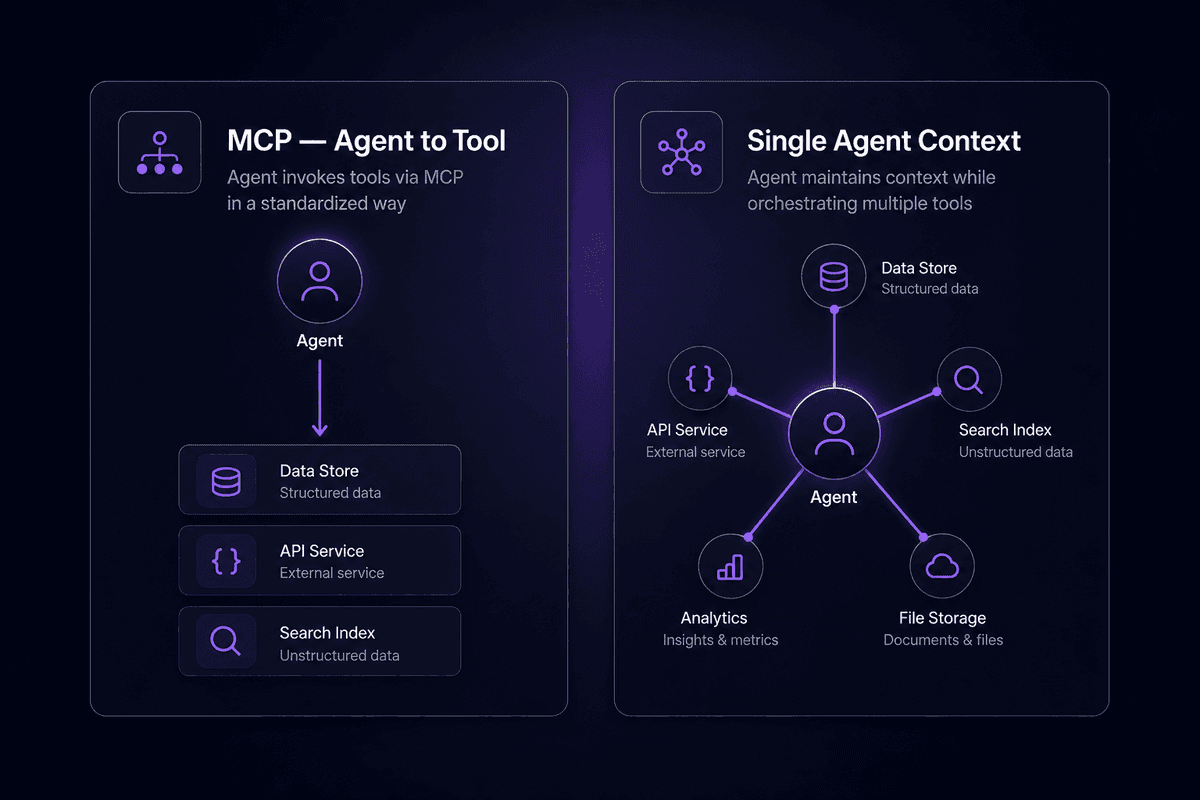
How an MCP Server and Client Work Together
The split is mechanical and worth understanding before you build anything. An MCP server exposes a set of tools and data resources to anything that can speak the protocol. It advertises what's available, handles the actual execution of tool calls, and returns structured results. The MCP client - which is the agent or LLM application - sends requests to the server, receives tool descriptions, and decides which tools in an MCP implementation to invoke based on the task at hand.
When a user asks an AI coding assistant to find a relevant function in a codebase, the LLM doesn't search the codebase directly. The MCP client queries the MCP server, gets back a list of available tools (code search, file access, documentation lookup), and invokes the right one. The server handles the actual retrieval. The LLM sees a clean result.
This server/client architecture is why the ecosystem matured fast. Existing MCP client and server implementations are already built into editors like Cursor and Claude Desktop, which means teams adopting MCP today aren't starting from a blank spec - they're plugging into infrastructure that already exists.
Where MCP Starts to Bend: The Single-Agent Ceiling
Here's what MCP solves: one agent accessing tools and data sources in a standardized way. Here's what it doesn't solve: what happens when the task requires a second autonomous agent to take it from there.
If you need one agent to gather information and another to act on it - say, a research agent feeding findings to an execution agent running in a different framework or on a different vendor's infrastructure - MCP has no native mechanism for that hand-off. There's no concept of inter-agent routing, negotiation, or task delegation built into the protocol. It was designed for a single AI context calling tools, and that's precisely what it's good at.
This is the bottleneck I see teams hit after they've successfully used MCP for the first six months. The single-agent setup works. Then requirements grow. Use MCP for tool access, absolutely. But the moment the architecture calls for one autonomous agent handing structured work to another, you're outside what MCP was built to cover.
What Agent-to-Agent Protocol (A2A) Actually Does
Where MCP runs vertically - agent down to tools - A2A runs horizontally. It's a coordination rail between autonomous agents across different frameworks and different vendors, and it doesn't care what any individual agent is built on internally.
Google's Agent2Agent protocol - A2A is an open protocol that was released in April 2025 with more than 50 technology partners and subsequently moved under the Linux Foundation umbrella - tackles a problem MCP was never designed to address. When Agent A needs to hand off a task to Agent B, and those two agents might be running on different clouds, built by different teams, and using completely different internal architectures, how do they communicate reliably?
The A2A answer is capability advertisement via Agent Cards. Each agent declares what it can do, what inputs it accepts, and what outputs it produces - without exposing its internal tools, reasoning process, or private state. Other agents discover these capabilities, assign structured tasks, and receive structured results back. The agents are treated as opaque applications. Nobody needs to know how the other one works internally. That's the key distinction: A2A treats each agent as a black box with a well-defined interface, which is exactly what MCP cannot do.
This is why the agent2agent protocol matters for any architecture where work needs to cross team or vendor or infrastructure boundaries. You can have one agent specialized for analytics and another for document drafting and another for scheduling, all from different providers, and A2A gives them a way to collaborate without bespoke integration code connecting each pair.
How Agent Discovery and Task Delegation Work in A2A
When Agent A needs help with something outside its specialization, it queries for agents whose Agent Cards match the capability required. An A2A server handles the discovery layer - agents register their capabilities and can be queried by other agents looking for a match. Once Agent A finds Agent B, it sends a structured task via standardized protocols, Agent B processes it, and sends a structured result back.
The A2A communication model is explicitly policy-aware. What that means in practice: agents can communicate across organizational or cloud boundaries while respecting defined rules about what can and can't be exposed. An analytics agent at a SaaS company can hand off a task to a third-party document-authoring agent without leaking internal data - the Agent Card tells the requester what the agent does, not how it does it or what internal systems it touches.
A2A provides vendor-neutral interoperability, which is why the 50+ partner ecosystem mattered from day one. The value of a horizontal coordination protocol collapses if every pair of agents needs a custom bridge. A2A handles multi-agent interoperability at the protocol layer so teams can connect agents without rebuilding the connection for every new pairing.
The Multi-Agent Use Case A2A Was Built For
Picture this: a user asks a front-line assistant to "set up the executive review for the Acme account." That request touches usage data, a slide deck, and calendar coordination with six stakeholders. One agent can't handle all of that well - not because it lacks intelligence, but because the work spans genuinely separate domains that benefit from specialization.
A2A enables multiple AI agents to collaborate on exactly this kind of compound task. A2A helps by letting the front-line assistant delegate: analytics agent pulls the numbers, document agent drafts the deck, scheduling agent negotiates the calendar. Each uses cases where they're strongest. None of them exposes their internals to the others. And the user gets a coherent result.
This pattern - planner, researcher, executor agents coordinating across services - is what enterprises and SaaS platforms are building toward when they talk about autonomous agents. A2A is the protocol layer that makes those autonomous agents actually interoperable rather than islands connected by duct tape.
MCP vs A2A: Side-by-Side Comparison
Before the table, the framing that matters: these two protocols are not in the same category. Comparing them directly is a bit like comparing a TCP/IP stack to an HTTP API - they operate at different levels. That said, the comparison is useful for understanding which problems each was designed to solve and where your architecture needs each one.
| Protocol | Primary Layer | Communication Direction | Core Problem Solved | Security Focus | Ecosystem Maturity | Best-Fit Architecture |
|---|---|---|---|---|---|---|
| MCP | Agent-to-tool | Vertical (agent → tools/data) | Standardized tool discovery and invocation for a single agent | Tool access scoping and permissions | High - 97M+ monthly SDK downloads, 10,000+ servers, editor integrations | Single-agent copilot with multiple tool/data dependencies |
| A2A | Agent-to-agent | Horizontal (agent ↔ agent) | Standardized inter-agent task delegation and coordination | Capability advertisement without internal state exposure | Growing - 50+ partners, Linux Foundation, active cloud adoption | Multi-agent orchestration across frameworks or vendors |
The criterion most teams misread is orchestration vs. execution scope. Two protocols - MCP and A2A - are both described as "agent protocols," which makes them sound like one protocol works and the other is redundant. But MCP focuses on execution: an agent invoking a specific tool and getting a result. A2A focuses on orchestration: one agent routing work to another agent and coordinating across the response. Like MCP, every strong single-agent setup still needs a protocol works for the tool layer. A2A handles the layer above that.
Put differently: MCP answers "how does this agent call that tool?" A2A answers "how does this agent hand this task to that other agent?" One protocol focused on each layer is simpler and more flexible than one protocol trying to cover both.
🤔 Wait.
If MCP covers the tool layer and A2A covers the inter-agent layer, then framing this as "MCP vs A2A" implies a choice that doesn't exist. Teams choosing one and skipping the other aren't making a trade-off - they're leaving one architectural layer unaddressed and they'll rebuild it anyway once the gap shows up in production. Protocols like these are infrastructure, not options.
How to Decide: MCP or A2A - or Both
Each decision rule below maps a specific architectural signal to the protocol it points toward. Run these against your system design before you commit to either protocol - or to skipping one.
Single agent calling tools and data sources
Use MCP. If your architecture has one AI agent that needs to discover and invoke tools - databases, APIs, search, document access - MCP handles that layer cleanly. MCP gives the agent a standardized way to find and call those capabilities without custom integration code for each. This is the core MCP use case and it covers a large portion of real production agent setups.
Multiple specialized AI agents coordinating work
Use A2A. If your architecture needs an AI agent to delegate tasks to another autonomous agent - whether that second agent runs on a different framework, a different team's infrastructure, or a different vendor - A2A connects those agents without requiring either one to expose its internal implementation. Agent coordination is precisely what A2A handles; MCP cannot route work between autonomous agents.
Your workflow crosses organizational or vendor boundaries
Use A2A. When agents need to collaborate across trust domains - different companies, different cloud environments, different internal teams with different access policies - A2A's security-aware communication model and vendor-neutral interoperability are the right fit. Use A2A when the boundary between systems is the actual problem.
You need to standardize how agents access APIs and external systems
Use MCP. If the problem is that every agent in your system has a different, hand-rolled approach to calling the same set of APIs, MCP solves that. MCP focuses on giving each agent a consistent interface to tools, which reduces maintenance overhead as the number of agents and tools grows. If you're already using several agents and each one calls the same tool differently, that's the signal.
Your AI systems include both tool use and agent coordination
Use both. This is the combined stack: MCP gives each agent standardized access to tools and data, A2A lets those agents orchestrate work and hand off tasks between each other. If your system has a planner agent, a research agent, and an execution agent, and all of them need tools, MCP handles the tool layer for each and A2A handles the agent coordination layer between them. A2A connects the agents; MCP gives each agent its capabilities.
You're early-stage with one agent and expect multi-agent growth
Start with MCP - but design the agent boundaries with A2A in mind. Most teams adopt MCP first because immediate tool integration is the concrete problem. That's correct. But if multi-agent requirements are likely in the next 6-12 months, avoid building tool access patterns that assume only one agent will ever call them. MCP focuses on the tool layer; keep it there and the addition of A2A later will be architectural extension rather than refactoring.
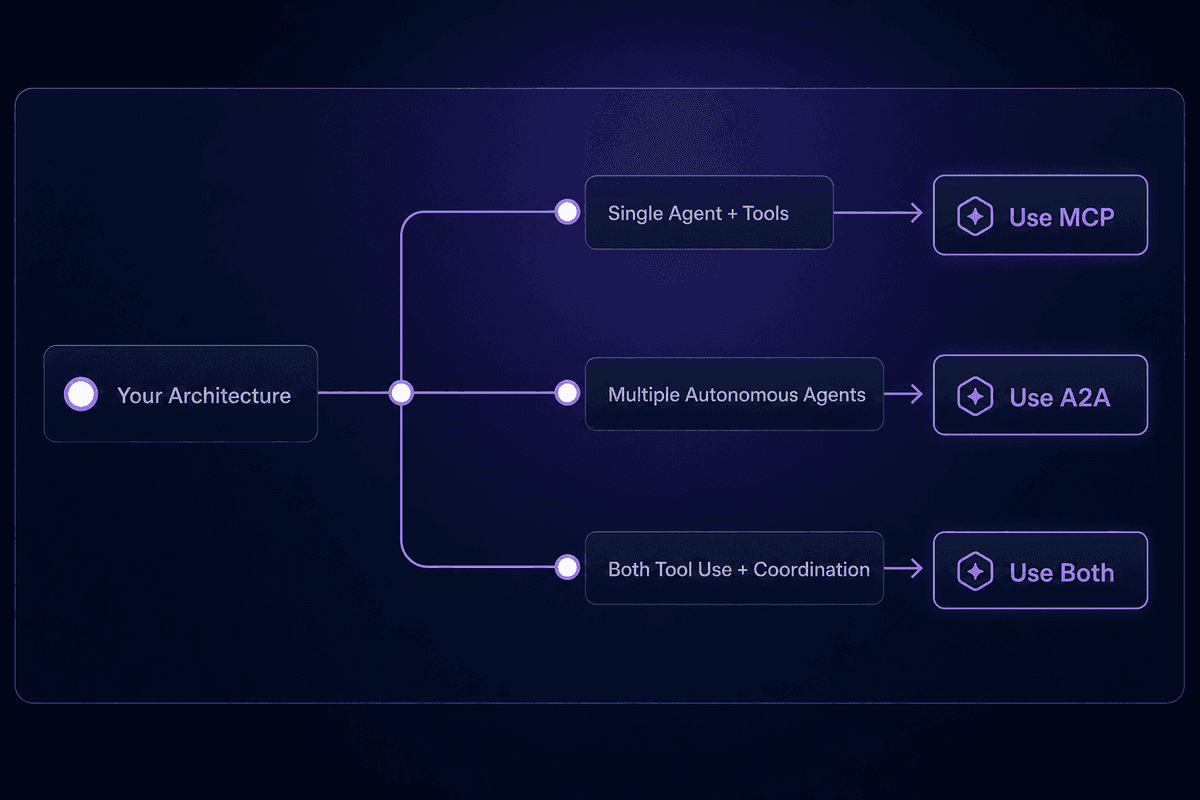
Agent Communication Protocol Patterns: MCP, A2A, and the Combined Stack
Three real-world architecture patterns appear consistently in production agentic systems. The pattern you need depends on where your system actually breaks without each protocol layer - not on which protocols look most interesting in the spec documentation.
I keep seeing teams approach this as a tooling question when it's really an architecture question. The communication protocols you choose define the ceiling of what your system can grow into. Getting that wrong early costs a rebuild later, usually right when adoption is accelerating and a rebuild is the last thing anyone wants to schedule.
Single-Agent Copilot: When MCP Alone Is Enough
The MCP-sufficient scenario is more common than the multi-agent conversations suggest. One agent, one set of tools and data sources, one workflow - and the agent needs to discover and invoke those tools reliably without hand-rolled integrations for each one.
MCP allows the agent to query available capabilities, select the right tool, and call it with the right parameters. MCP uses a server/client model to handle all of that, which means adding a new tool means adding it to the MCP server. The agent's interface stays stable. This is what "MCP to access tools and data sources" means in practice - not a grand architecture diagram, just a clean, maintainable way for one agent to call external tools.
This setup stays sufficient as long as the task doesn't require routing work to a second autonomous agent. A coding assistant that calls GitHub, searches documentation, and queries a database is well-served by MCP alone. The moment you add a second agent - say, a code review agent that the first hands off to - you're at the ceiling. MCP allows flexible tool access but has no mechanism for the hand-off. That's not a limitation to work around; it's just the boundary of what the protocol was designed for.
Multi-Agent Orchestration: When A2A Has to Enter the Design
The failure mode that signals A2A is needed isn't usually dramatic. It looks like this: a planner agent tries to describe a task to an executor agent in a way that requires the planner to know intimate details about how the executor works internally. The coupling grows. The system becomes brittle. A new executor agent from a different vendor breaks everything because the hand-off was bespoke, not standardized.
A2A is essential when agent collaboration itself is the core problem - not tool access. Organizations building multi-agent systems that span teams, products, or clouds need a protocol that lets agents advertise capabilities and exchange tasks without each pair of agents requiring custom integration code. A2A supports exactly this: structured task exchange between agents that remain opaque to each other, coordinating without exposing internals.
A2A outlines how AI agents communicate capability and intent rather than implementation, which is the property that makes cross-vendor agent collaboration viable. If you're running a planner + researcher + executor topology and those agents live on different infrastructure, that's the signal. Agent collaboration at that scope doesn't work reliably without a standardized coordination layer.
The MCP and A2A Combined Architecture Most Enterprise Teams End Up Needing
Via MCP, each agent in the system gets a standardized interface to its tools. Via A2A, those agents can coordinate with each other across frameworks and vendors. MCP provides the vertical capability layer; A2A provides the horizontal coordination layer. Together, they cover both problems.
The teams that skip one layer don't usually realize what they've skipped until they need to rebuild it. An enterprise that implements MCP for tool access but uses bespoke inter-agent communication will eventually standardize that communication - just after it breaks enough times that the rebuild is unavoidable. An enterprise that implements A2A for coordination but leaves tool access to custom code will eventually face a sprawl of inconsistent tool integrations as agent count grows.
What makes MCP worth designing around from day one is the ecosystem: 97 million monthly SDK downloads, editor integrations, and major AI provider adoption means tooling is already there. A2A's 50+ partner ecosystem and Linux Foundation backing signal the same trajectory for inter-agent coordination. The combined stack isn't an advanced option - it's what you end up at anyway. Building toward it intentionally avoids the lock-in that comes from bespoke solutions at either layer.
In Latenode, this combined stack has a practical interpretation. The AI Agent Builder lets you define each specialized agent's behavior and tool access in one place; the MCP Server Builder handles the tool-layer standardization so agents always see a clean, consistent set of capabilities. When one agent needs to hand off a task to another, that coordination flows through the same visual workflow rather than living in a separate custom protocol implementation. It's the architecture you want without the infrastructure you'd otherwise have to build and maintain yourself.

Security and Interoperability: Where MCP and A2A Differ in Practice
Security in agentic systems isn't a checklist. It's an architectural concern that shapes how each protocol was designed, and the failure modes each one is protecting against are genuinely different.
Researchers at Tenable demonstrated in April 2025 that misconfigured MCP and A2A implementations are vulnerable to prompt-injection-driven data exfiltration, tool poisoning, and what they called "rug-pull" attacks - where a tool's behavior is changed maliciously after trust has been established. The finding matters for this comparison because the vulnerabilities aren't identical: MCP and AI agent communication face different attack surfaces, and the protocols address them differently.
The shared threat is indirect prompt injection - external content that manipulates agent behavior at the protocol boundary. A document retrieved via MCP might contain instructions designed to redirect the agent's tool calls. A capability description arriving over A2A might include content designed to alter an agent's behavior. Both protocols require teams to address this deliberately at design time, not as an afterthought.
How MCP Handles Tool Access Permissions and Scoping
MCP's security design is a tool-access scoping mechanism. The agent sees and invokes only what it's permitted to - structured access to a defined set of APIs and data resources, not an open pipe to everything the MCP server touches. The language model doesn't get direct access to raw infrastructure; it gets access to what the MCP server has been configured to expose, in the scope it's been configured to expose it.
MCP facilitates clean permission boundaries between what an agent can do and what exists in the underlying systems. In multi-tenant or multi-model deployments, this matters practically: different agents or different models can connect to the same MCP server and receive different scoped access based on their configuration, without requiring separate infrastructure per model. Context to generate the right tool call exists within the permitted scope, not beyond it.
The practical concern is configuration. The permission model only protects what it's been told to protect. An MCP server misconfigured to expose broad internal access is a wide attack surface regardless of what the protocol spec says is possible.
How A2A Manages Agent Discovery Without Exposing Internal State
Google's A2A takes a different approach. The security model here is peer-communication isolation: agents advertise capabilities via Agent Cards without exposing private tools, internal reasoning, or internal data. One agent knows what another can do. It doesn't know how, or what the other agent touches internally to do it.
This isolation property is what makes A2A viable for inter-organizational agent communication. The protocol connects agents across cloud boundaries while respecting policy-aware communication rules - what gets shared is capability and task structure, not implementation. For teams running agents across organizational or cloud boundaries, this is the property that makes cross-vendor agent collaboration safe in principle (misconfigured trust policies aside).
The potential of collaborative AI across vendor and trust boundaries is what the A2A design is optimized for. But the practical implication is that teams setting up A2A between agents from different organizations need to design the trust policies carefully. The protocol enforces the structure; the humans define the policies. That gap is where the real security work happens.
💡 Worth knowing:
Both MCP and A2A face indirect prompt injection as a shared threat - external content manipulating agent behavior at the protocol boundary. This is not a gap in either protocol spec; it's a design-time responsibility. Teams that treat protocol adoption as sufficient security are skipping the part that determines whether their agents become data-collection tools for someone else's benefit. Build the input sanitization and content inspection layers before production, not after the first incident.
Ecosystem Maturity and Adoption: Where MCP and A2A Stand Today
Ecosystem maturity is a practical adoption risk, not a marketing metric. The question isn't which protocol has better spec documentation - it's whether the tooling you need exists today, and whether it will still be actively maintained when you're debugging a production issue at 11pm in six months.
The model context protocol's ecosystem position is clear. The 97 million monthly SDK downloads and 10,000+ active servers documented by the StackOne engineering team represent infrastructure at scale, not an experiment. Editor integrations with Cursor and Claude Desktop mean MCP server connections already exist in the workflows developers are using daily. A server built to spec today will work against existing client implementations. The tooling is there.
A2A's position is different but not weak. The 50+ partner ecosystem from Google's April 2025 announcement, combined with Linux Foundation stewardship, signals that this is being built as shared open infrastructure rather than a single-vendor lock-in play. Cloud providers including AWS are actively working with both protocols - the AWS open source engineering team's work on combining MCP and A2A in scalable agent workflows is practitioner-level evidence that the protocol is production-viable, not just theoretically interesting. That said, A2A tooling is earlier than MCP's. There are fewer prebuilt implementations, less community documentation for edge cases, and a smaller pool of practitioners who've debugged it in production.
For teams deciding now: MCP is the safer near-term bet for tool integration maturity. A2A has the backing and trajectory to become the standard coordination layer for multi-agent systems, but you're earlier in the tooling curve. If your multi-agent requirements are immediate and critical, that's worth accounting for in your build vs. buy decision and in how much time you budget for integration work. If they're 6-12 months out, the ecosystem will be meaningfully more mature by then. Both protocols are worth designing around today. Just with eyes open about where each currently stands in terms of available tooling, community resources, and production-tested implementations. Collaborate on the architecture now, standardize the implementation as the ecosystem catches up - especially on the A2A side.