


If you've been trying to figure out whether Model Context Protocol replaces APIs or works alongside them, you're not confused because the technology is hard. You're confused because most of the content on this topic treats them as competing choices when they're solving completely different problems at completely different layers of the stack.
Here's the honest version: mcp vs api is the wrong frame. MCP doesn't compete with APIs. It sits on top of them. The real question is whether your use case involves an LLM that needs to reason about tools at runtime, or a system that already knows exactly what it needs to call. Those are different problems. They need different solutions.
The part teams learn late
- MCP and traditional APIs are not competing choices - MCP wraps APIs and solves a problem APIs were never designed for.
- The "which do I choose" question almost always turns into a "who owns which layer" problem three months into production.
- Adding MCP overhead to a high-volume deterministic pipeline is an architecture mistake, not a protocol preference.
- Security doesn't collapse into one layer - API auth and MCP's host-side containment both need to be in place.
What MCP and Traditional APIs Actually Do-Before You Compare Them
Before the comparison is useful, the definitions need to be grounded in what each thing actually does, not what it sounds like it does.
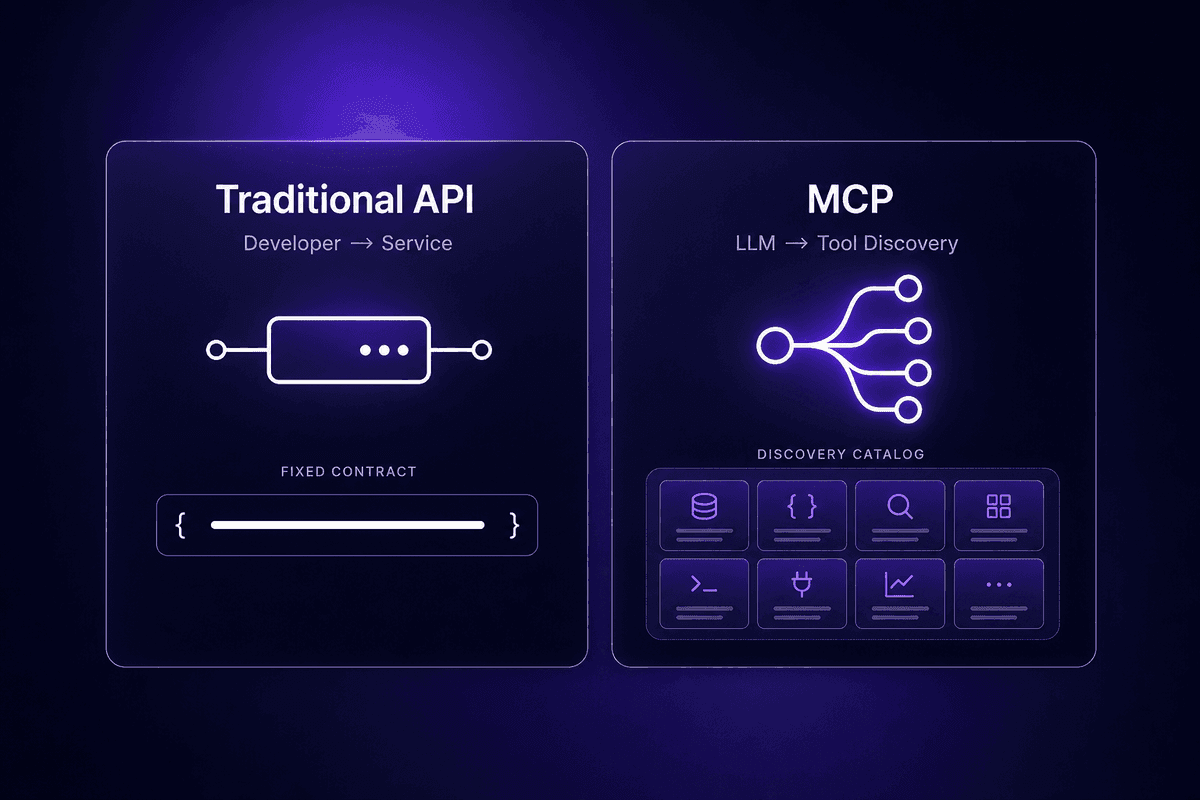
What a Traditional API Does When a Developer Calls It
A traditional API (REST, GraphQL, gRPC - pick your flavor) is a fixed contract between a calling system and a service. When a developer or backend service calls an endpoint, it already knows everything it needs: the URL, the required parameters, the expected response shape, the authentication method. The caller was explicitly programmed to make that specific call. The rest api doesn't explain itself at runtime. It just executes.
This is the design. Traditional APIs are deterministic by nature. The calling pattern is known in advance, and any deviation from it produces an error, not a graceful adjustment. That predictability is what makes them good at what they do. When you use an api to sync data between two services at scale, you want exactly this: no surprises, no runtime decisions, just clean request-response execution thousands of times per minute.
The developer is the consumer here, either directly or through software they've written. The API assumes prior knowledge. That assumption is not a weakness. For most software integration work, it's the right design.
What MCP Is Designed to Do That a Traditional API Cannot
MCP was created by Anthropic in November 2024 as an open protocol for a different kind of consumer: a large language model that doesn't know in advance which tools it will need to call. The model context protocol lets an LLM-powered host connect to an MCP server and ask at runtime: what tools do you expose? What resources can I access? What prompts are available? The LLM then reasons over that catalog and decides what to call.
That dynamic discovery is the core capability a traditional API doesn't have. An API doesn't announce itself. An MCP server does. Think of it the way the community has started framing it: APIs are the cables that carry data between systems. MCP is the standardized connector, like USB-C, that lets an AI agent plug into any cable without writing a custom adapter for each port.
MCP is a protocol, not a service or platform. It defines how the host (the LLM-powered application) and the server (the thing exposing tools and data) communicate. The server handles the actual calls. The model handles the decisions.
MCP vs API: Key Differences That Actually Affect Architecture Decisions
The six dimensions below are where the architectural consequences actually live. A glance at features doesn't tell you much. These do.
One note before the table: rest apis and llms are not designed for the same consumer or the same calling pattern. That's the root of the whole comparison, and it runs through every row.
| Dimension | Traditional API | MCP |
|---|---|---|
| Primary consumer | Developer or backend service - caller has explicit prior knowledge | LLM or AI agent - consumer discovers capabilities at runtime |
| Discovery model | Static - endpoint, parameters, and schema must be known in advance | Dynamic - host queries the MCP server for available tools, resources, and prompts at runtime |
| Integration contract | Versioned schema - breaking changes require explicit migration | Self-describing tools and resources - the LLM reads the catalog and adapts |
| State management | Stateless per request - each call is independent | Session-aware - context can persist across tool calls within a session |
| Security model | API key or OAuth, scoped to specific endpoints - secrets travel with the request | Secrets kept on the host - the ai model sees less of the auth surface |
| Latency and throughput | Lean for high-volume, deterministic calls - apis are designed for this | Adds a reasoning and discovery layer - suited to lower-throughput agentic flows |
The integration cost of the wrong choice shows up fast. A team that routes a high-volume data sync through MCP will feel the overhead in execution time and operational complexity within weeks. A team that tries to build a dynamic AI agent on raw API calls alone will end up writing and maintaining a tool-catalog system by hand - which is basically what MCP replaced.
When to Use an API Directly and When MCP Is the Right Layer
This section is the one worth printing out and putting next to the architecture diagram. The failure mode isn't choosing the "worse" option. It's choosing the right option for the wrong context.
Use direct API when the calling pattern is fixed
If your workflow already knows which service it needs, which endpoint to hit, and what payload to send, there's no benefit to adding a discovery layer. You're not making a runtime decision. You're executing a known operation. Use apis directly here - the added MCP layer just adds latency and a new ownership question without solving anything.
Use direct API for high-volume or latency-sensitive operations
MCP's reasoning and discovery overhead is acceptable for agentic flows where you're making a few tool calls per session. It's not acceptable for bulk data sync, high-frequency webhooks, or any operation where you're making thousands of calls per minute. API directly wins on performance here, consistently.
Use direct API when the consumer is a developer or backend service
If a human developer is calling the service, or a backend system is making a programmatic request, traditional APIs are the right layer. MCP's self-describing catalog is designed for LLMs that need to reason about what to call. A developer writing code doesn't need dynamic tool discovery. They need good documentation and a stable contract.
Use MCP when an LLM agent must decide at runtime which tools to call
This is the specific problem MCP when ai agents are involved solves. The LLM can't be pre-programmed with every possible tool call because it doesn't know in advance which tools it will need. MCP lets it query the available catalog, reason over the options, and select the right tool for the task. An ai agent doing customer research across multiple data sources is a textbook MCP use case. The agent needs to discover and reason, not execute a known script.
Use MCP when you want to stop writing per-endpoint glue code
Every time you add a new tool to an LLM application without MCP, someone writes custom code to connect it. Every time an endpoint changes, that code breaks. MCP's standardized interface means you build the server once. The LLM discover and use tools through a consistent protocol rather than through a pile of one-off integrations. The data source side stays stable. The model side adapts.
MCP is the right choice when centralized security and observability matter
If you have multiple tools or data sources that an AI agent can access, managing auth at the API level across every tool individually creates a sprawling, hard-to-audit surface. MCP lets you centralize that policy on the host. The ai agent calls through the MCP layer. The MCP layer controls what the model can see and touch. Governance becomes a layer you can reason about, not a checklist spread across a dozen API integrations. This is particularly important as your tool count grows, because I've seen what happens to teams that don't address it early: the security review at month six is more unpleasant than the conversation at month one would have been.
🤔 Wait.
Here's the paradox most teams hit around month three: they add MCP for an agent workflow, then realize the underlying tools are still just APIs - and now they have to maintain both layers without a clear owner for either. MCP doesn't replace APIs. It leverages them. But if nobody on the team owns the MCP layer separately from the API layer, you haven't simplified your stack. You've added a layer to an already unclear ownership model. That's the uncomfortable question this architecture forces: before you add MCP, decide who maintains it when the tool catalog changes.
How MCP and APIs Work Together in a Production AI Application
The practical picture looks like this: APIs handle the actual execution. MCP handles the discovery and routing layer that lets an LLM decide what to execute. They're not alternatives. They're a stack.
Effective production architectures use both. The MCP layer sits above the API layer, translating the LLM's tool selections into actual service calls. The APIs underneath don't change. The services don't know or care that an LLM is making the decisions. They just respond to well-formed requests.
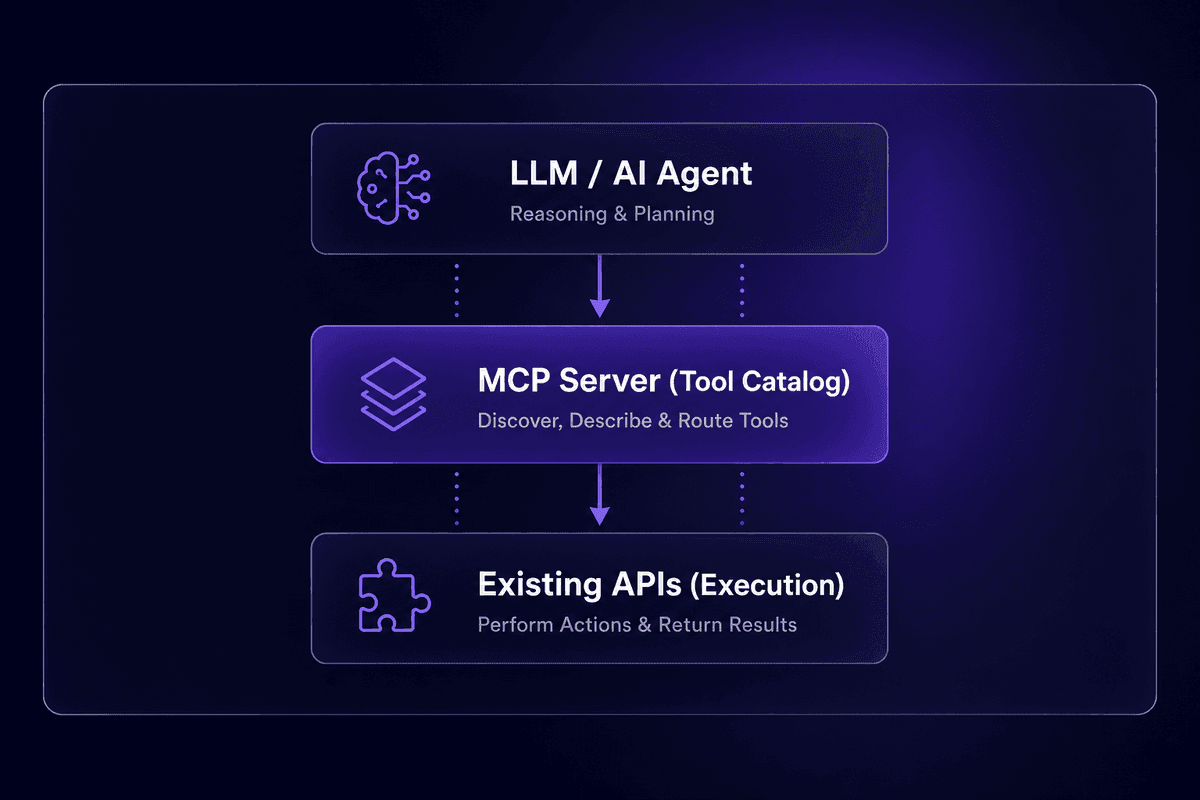
The MCP Server as a Wrapper Around Existing APIs
An MCP server is a process that translates the MCP protocol's tools/resources/prompts interface into actual calls against the existing apis it wraps. The LLM never sees the API endpoint directly. It sees a tool named something like "lookup_customer" or "get_inventory_status." The MCP server handles the translation: it takes the tool call, maps it to the right API endpoint, executes the request, and returns the result in a format the LLM can reason over.
One MCP server can wrap multiple APIs. This is part of the value. Instead of the LLM needing to know the endpoint structure, auth method, and payload format for each individual service, MCP wraps all of that behind a consistent interface. When an underlying API changes, only the MCP server needs to be updated, not the LLM's behavior. That's where the claim that MCP standardizes and reduces per-endpoint glue code actually holds up in practice.
Where LLMs and AI Agents Fit Into This Stack
The LLM sits above the MCP layer. It talks to the MCP client (the host-side component), which in turn talks to the MCP server. The LLM's job in this stack is to query the server for what mcp tools are available, reason over the catalog, and decide which tool serves the current task. It's not making API calls itself. It's selecting from a menu it received at runtime.
A developer building this stack defines what tools the MCP server exposes. They choose what the ai agent can see and what it can't. The agent then works within those bounds - but within those bounds it can reason dynamically, chain tool calls, and respond to unexpected inputs without the developer pre-programming every possible execution path. This is the distinction Anthropic is clear about: APIs are for developer-to-service communication; MCP is for LLM-to-tool communication. The consumer type is the key difference, and it determines which layer belongs where.
Security and Data Exposure Across Both Layers
The two security models don't replace each other. They stack. API-layer security handles service authentication: API keys, OAuth tokens, endpoint scopes. These are still necessary. Your CRM API still needs to verify who's calling it. Your database still requires auth. MCP doesn't remove that requirement.
What MCP adds is a containment layer on top. Secrets stay on the host - the model never sees api keys or OAuth tokens directly. The model sees a tool call interface. The MCP server holds the credentials and executes the actual API request. This limits the model's exposure to the auth surface, which matters practically when you're thinking about what an LLM or agent could do if it reasoned itself into a poorly scoped action. In ai systems with broad tool access, this containment layer is not optional.
Teams that add MCP and then stop thinking about API-layer security are making a mistake. MCP support for auth doesn't eliminate the need for proper scoping at the API level. Both layers need to be in place. I keep seeing this assumption in support that MCP "handles security." It handles one part of it. The rest is still your problem.
On Latenode, the MCP Server Builder exposes selected tools for clients like Claude Desktop or Cursor while keeping the underlying API credentials inside the workflow. The AI Agent Builder orchestrates multi-step behavior without requiring Python, and the JavaScript node handles validation or routing rules inline. It's how the two-layer model looks in practice: the MCP layer controls tool exposure, the API layer beneath it still carries auth the way it always did.
What MCP Solves That APIs Never Could-and Where APIs Still Win
There's a fair amount of hype around MCP right now, and sorting the hype from the real value takes about fifteen minutes of honest testing. The real value is specific. So are the limits.

The Integration Problem MCP Solves for LLM Applications
Before MCP, every ai application that needed to interact with external tools required custom glue code per tool, per endpoint. When endpoints changed, the glue code broke. When a new team added a new tool, someone wrote another adapter. At scale, this produces a mess of brittle, one-off integrations that nobody fully owns and everyone avoids touching. MCP standardizes this into a single protocol. It provides a universal way to connect ai models to tools and data sources through a consistent interface. MCP adds a standardized discovery and tool-calling layer so that a large language model can find and call capabilities dynamically, and adding a new tool to the catalog is an MCP server change rather than a rewrite of application logic.
MCP provides a universal way for way to connect ai models to external context, and for teams building agentic applications, that standardization cuts real development time. The mcp standardizes the interface so you build the server once and the LLM adapts rather than requiring you to update the LLM application every time a service changes.
Where Traditional APIs Still Have the Edge Over MCP
High-volume, deterministic pipelines. If you're running a data sync that makes ten thousand api requests per hour against a fixed set of endpoints, MCP's discovery overhead adds cost with zero benefit. Standard api calls are leaner for this. They're also the right answer for any backend service talking to another backend service, for non-AI integrations between SaaS tools, and for every api interaction where the calling pattern doesn't change at runtime. The developer already knows what to call an api for. There's nothing to discover. Adding MCP here is architecture theater.
API call performance at scale is also where traditional apis win clearly. The ecosystem breadth is wider. The tooling is more mature. The interoperability outside AI environments is broader. MCP is purpose-built for LLM-to-tool communication. Outside that use case, it adds complexity that direct API calls don't.
The honest summary: MCP is the right layer for AI agents that need to reason about tools. APIs are the right layer for everything else, including the actual execution that MCP triggers underneath.
📊 In practice:
Think of this the way the community has framed it: APIs are the cables that carry data between systems. MCP is the standardized connector - the USB-C port - that lets an AI agent plug into any cable without writing a custom adapter per port. The cables still do the carrying. The connector just makes plugging in consistent. You don't replace the cables when you get USB-C. You use both.