


Most people who ask this question already know procurement involves buying things. The gap isn't knowledge - it's scope. Procurement isn't a purchase. It's everything that happens before, during, and after a purchase that determines whether that purchase was actually a good idea. Miss that scope and you'll spend years optimizing transactions while the real value leaks out somewhere upstream.
What teams learn too late about procurement
- Procurement is the end-to-end process from identifying a need to paying the invoice - not just the moment you place an order.
- Confusing procurement with purchasing costs organizations real money: it keeps sourcing, risk, and compliance work invisible.
- No single "correct" step count exists; core activities are consistent across all frameworks regardless of what they call the stages.
- Effective procurement management ties directly to profitability and supplier risk, not just back-office tidiness.
What the Procurement Process Actually Is

Procurement is the structured sequence of activities an organization uses to acquire goods, services, or works from external sources. It starts before anyone opens a purchase order and ends well after the invoice clears.
The full procurement process spans: identifying a business need, specifying requirements, finding and evaluating suppliers, negotiating and awarding a contract, issuing a purchase order, receiving the goods or services, matching and approving the invoice, and maintaining records for compliance and future sourcing decisions. That's the whole loop. Skipping stages doesn't make the process shorter - it just moves the risk somewhere less visible.
Tipalti's definition of the procurement process captures this well: procurement is the overarching activity through which organizations acquire what they need to operate, covering the entire lifecycle from need recognition through payment and recordkeeping. It isn't a department action. It's an organizational function.
What matters practically is that procurement creates documentation, accountability, and supplier intelligence at every stage. A company that only processes invoices is doing accounts payable. A company running a proper procurement process is building a defensible record of why each supplier was chosen, what was agreed, and what was received - and that record becomes genuinely valuable when something goes wrong, when contracts renew, or when someone asks why costs went up 22% in a quarter.
The other thing worth saying plainly: you don't need enterprise software or a dedicated team to run a procurement process. A 15-person startup can run one with a shared spreadsheet and clear ownership. The size of the tool is irrelevant. The sequence of decisions is what makes it procurement.
Procurement vs. Purchasing: Where People Get It Wrong
Purchasing is a subset of procurement. Specifically, it's the transactional portion - the part where you issue a purchase order, receive the goods, and pay the invoice. Purchasing activities are real and necessary, but they represent maybe 30% of what the procurement function actually covers.
The confusion matters because organizations that manage only the purchasing process leave the strategic work unmanaged. Supplier identification, risk assessment, negotiating contracts, compliance monitoring, and spend analysis all happen upstream or in parallel. When those activities are treated as optional, the downstream purchasing process looks clean while the underlying decisions are arbitrary.
Procurement and purchasing overlap most visibly in smaller organizations where one person handles both. That's fine. What's not fine is treating them as synonymous. Procurement is strategic. It asks: should we buy this at all, from whom, under what terms, and with what risk controls? Purchasing is operational. It asks: has the order been placed, received, and paid?
Both matter. The procurement function fails when only one gets attention.
Why Procurement Management Matters Beyond Back-Office Efficiency
Here's a number that tends to land differently depending on your role: companies that elevate procurement into executive leadership outperform the market by 134%, according to Harvard Business Review Analytic Services. And yet only 35% of S&P 500 firms have a chief procurement officer in the C-suite. That gap is where the argument for taking procurement management seriously actually lives.
Effective procurement management controls spend, strengthens supplier relationships, and enforces risk and compliance controls that directly affect the bottom line. When every supplier decision is documented and tied to clear criteria, organizations can analyze where money goes, renegotiate at the right moments, and catch risk early. When procurement runs on email threads and tribal knowledge, spend analysis is impossible, contract renewals get missed, and supplier risk accumulates silently.
Supply chains add another layer. An organization with fragile supplier relationships and undocumented contract terms is exposed the moment a supplier misses delivery, raises prices, or exits a market. Supply chain management in 2026 isn't an abstract risk category - it's a concrete operational constraint for any organization that depends on external inputs.
Cost savings from procurement are often cited as the primary benefit, and they're real. But the more durable argument is that good procurement management creates optionality: the ability to renegotiate, switch suppliers, enforce SLAs, and make sourcing decisions based on data rather than habit. That optionality is worth more than any single cost reduction.
📊 In practice:
According to the Hackett Group's 2026 procurement research, procurement leaders are simultaneously facing intensified pressure on supply continuity and cost savings - while managing workforce constraints and rising workloads. Procurement professionals are being asked to do more strategic work with the same or fewer resources. That context explains why process clarity and automation investment are accelerating, not why they're optional.
Steps of the Procurement Process, from Need to Payment
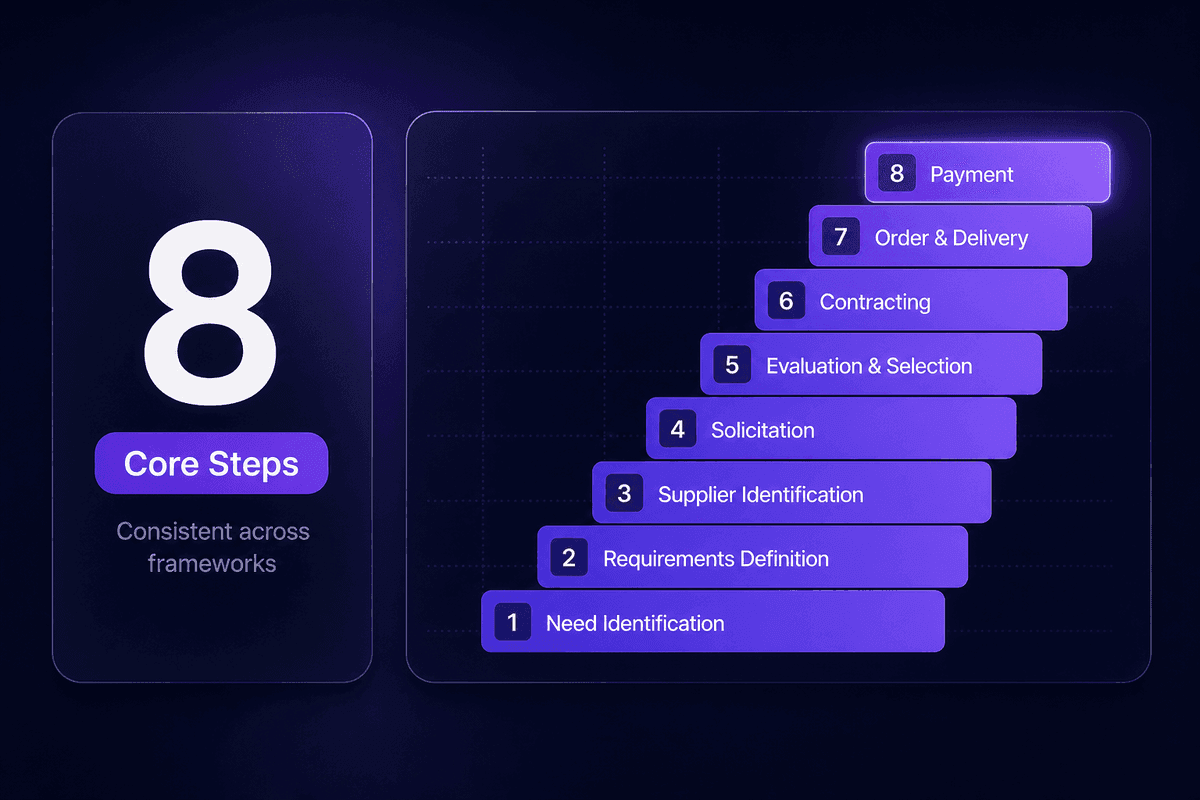
The procurement process has no universally agreed step count. You'll see 7-step models, 9-step models, 12-step models. The labels change. The underlying activities don't. NetSuite's framework offers a useful 8-step backbone, and it covers the same functional territory as most other credible frameworks - just organized slightly differently. What matters is knowing what each stage accomplishes, not what number someone assigned to it.
Identifying Needs and Specifying Requirements
The process starts when someone in the organization recognizes a gap: a service that doesn't exist in-house, a material that's running short, a tool the team needs to do its work. That recognition becomes a business need, which then needs to be translated into a documented requirement before anything else can happen.
This is where most procurement cycles quietly begin to fail. Vague intake - "we need more software licenses" or "get us a vendor for this" - creates ambiguity that propagates through every downstream stage. A purchase requisition built on unclear requirements sends the wrong signal to suppliers, makes evaluation criteria impossible to define, and produces a contract that doesn't cover what the stakeholder actually wanted.
Good intake is specific. It documents what is needed, in what quantity, to what standard, by when, and who the internal stakeholder is for sign-off. A procurement coordinator dealing with ten concurrent requests can only route them correctly if the intake is clean. That's not bureaucracy - it's how you avoid buying the wrong thing at the right price.
Supplier Research, RFx, and Competitive Bidding
Once requirements are documented, the question shifts to source: who can actually deliver this?
Supplier research can be lightweight (a category the organization buys regularly with a known vendor list) or extensive (a new category where potential suppliers need to be identified, screened, and compared). For high-value or unfamiliar categories, most organizations use an RFx process - which is the collective label for request for information (RFI), request for proposal (RFP), and request for quote (RFQ), depending on how much detail you need from vendors at each stage. An RFI is exploratory. An RFP asks for a solution approach. An RFQ focuses on pricing and terms.
The competitive bidding process serves a specific purpose: it generates comparable responses from multiple suppliers so the evaluation isn't based on whoever pitched most recently. Three qualified bids reveals pricing variation, service level differences, and supplier stability signals that no single quote can provide. Organizations that skip competitive bidding for convenience often pay for that shortcut when the contract comes up for renewal.
To select suppliers fairly, evaluation criteria need to be set before the bids arrive - not after. Post-bid criteria-setting is how confirmation bias enters sourcing decisions.
Evaluate, Negotiate, and Award the Contract
This is the stage where most of the actual strategic value either gets captured or disappears.
Supplier evaluation should compare responses against pre-set criteria: price, capability, delivery reliability, references, financial stability, compliance posture, and anything else that matters for the specific category. Teams that evaluate on price alone consistently sign contracts that look good in month one and generate escalating costs in months seven through eighteen. The cheapest supplier at contract award is frequently not the cheapest supplier across the contract term once delays, errors, and remediation work are included.
Once a preferred supplier is identified, negotiation starts. To negotiate well, you need to know your walkaway point, understand the supplier's constraints, and have at least one credible alternative. Negotiating contracts blind - without knowing what the next-best option would accept - is one of the more expensive habits a procurement team can develop.
The procurement contract that results from this stage needs to cover more than price. Delivery terms, quality standards, dispute resolution, liability, exit provisions, and renewal conditions all belong in the document. Evaluate the contract against the original requirements specification before signing. If the terms don't address what the stakeholder actually needs, renegotiate or escalate.
That sounds obvious. It still gets skipped more often than it should.
Purchase Order, Receipt, Invoicing, and Payment
This is the handoff stage. Procurement has done its work. Finance picks up the thread.
A purchase order is the formal document that authorizes a supplier to deliver goods and services against the agreed contract terms. It's more than a formality - the PO is the reference document for the three-way match that finance runs when the invoice arrives: PO quantity and price versus delivery receipt versus invoice. When all three align, payment can proceed. When they don't, someone needs to investigate.
The invoice and payment stage is where process breaks become most visible. A mismatch between PO terms and invoice line items holds up payment. Missing delivery documentation blocks three-way matching. Invoices that arrive outside agreed payment terms create finance-vendor friction that eventually escalates back to procurement. None of these are finance problems in isolation - they're symptoms of incomplete work earlier in the cycle.
Getting this stage right means ensuring the PO accurately reflects the contract, delivery is formally documented, and goods and services receipt is confirmed before the invoice is approved. Purchasing goods and services without that documentation trail leaves the organization unable to verify what it paid for, which creates audit exposure and makes supplier disputes nearly impossible to resolve cleanly.
Types of Procurement and When Each One Applies
Procurement categories differ in what's being bought, who's buying it, and what the main risk is. The distinctions matter because the sourcing approach, supplier selection criteria, and contract structure that work for one type often fail completely for another.
| Type | What it covers | Typical buyer | Main risk to control |
|---|---|---|---|
| Direct procurement | Raw materials, components, inventory that go directly into a product or service | Manufacturing, product companies | Supply continuity; quality variations that affect the end product |
| Indirect procurement | Operational inputs that don't become part of the product - office supplies, IT software, facilities, marketing services | Most organizations across all departments | Spend visibility; rogue or unapproved purchasing outside contracts |
| Services procurement | External labor, professional services, consulting, contingent workforce | Organizations using third-party expertise | Scope creep; deliverable definition; contractor classification risk |
| Public procurement | Government acquisition of goods, services, or works on behalf of the public | Public sector entities at all levels | Legal compliance; fairness and transparency in supplier selection |
Direct and indirect procurement are the first distinction most organizations need to make. Direct procurement ties to production: getting the wrong materials or the wrong supplier affects the product. Indirect procurement is often decentralized, which is where spend control problems tend to accumulate - different teams buying similar goods under different contracts at different prices.
Services procurement deserves its own category because the deliverable is harder to specify and harder to verify. Poorly defined statements of work are the primary failure mode in services procurement. If you can't describe what "done" looks like, the contract won't protect you when the supplier's definition of done turns out to be different from yours.
Public procurement operates under its own rules in most jurisdictions. Structured stages, mandatory competitive bidding thresholds, transparency requirements, and formal award documentation exist not just for efficiency but for fairness and legal defensibility. A public buyer who short-circuits these stages doesn't just make a bad procurement decision - they may expose the organization to challenge or legal liability.
The Procurement Lifecycle vs. Individual Transactions

A procurement cycle isn't a one-time event. It repeats. The stages described above don't conclude when payment clears - they feed into the next cycle through supplier performance data, contract renewal timelines, and accumulated sourcing intelligence.
The procurement lifecycle view adds the layer that transaction-focused frameworks miss: what happens between purchases. After the invoice is paid, the relationship with the supplier continues. Delivery performance, quality records, and responsiveness data all become inputs to the next sourcing decision. A supplier who performs well becomes a preferred vendor with negotiating leverage. A supplier who misses deliveries repeatedly gets replaced - or should.
Contract management sits inside this lifecycle view. Contracts have renewal dates. When an organization doesn't track those dates, renewals happen by default - the existing supplier continues on existing terms, often including price escalations that a renewal negotiation would have addressed. This is the procurement failure mode that looks the most harmless and costs the most money over time.
Procurement activities across the lifecycle also include ongoing compliance monitoring, supplier audits for high-risk categories, and spend analysis against budget. These aren't post-procurement tasks - they're how organizations procure better in the next cycle. The data from this cycle is the starting point for the next one.
This is why "procure" as a verb - in the sense of a single act - understates what the function involves. You don't just procure once. You manage a continuing relationship between organizational need and external supply, and you get better at it by tracking what happened last time.
Procurement KPIs Worth Tracking Across the Lifecycle
The metrics that actually signal whether a procurement process is working tend to be more specific than "are we saving money." Here are the ones I'd watch:
- Cycle time - the number of days from purchase requisition to approved purchase order, and separately from PO to payment. Long cycle times indicate bottlenecks; tracking where they occur tells you which stage to fix. - Spend under management - the percentage of total organizational spend running through a formal procurement process. Low figures signal rogue spending and missed contract compliance. - Supplier performance score - a composite of on-time delivery, quality conformance, and responsiveness. Without tracking this, renewal decisions are based on inertia. - Purchase order accuracy - the rate at which POs match invoices on first submission. Low accuracy means manual reconciliation work or delayed payments. - Contract compliance rate - the percentage of purchases made against contracted suppliers versus off-contract. High off-contract spend usually means contracts aren't visible enough to the people doing the buying. - Exception rate - the proportion of invoices that fail three-way matching and require manual review. Targets in well-automated environments often sit below 10%; if yours is higher, the upstream PO or receiving process needs attention.
NetSuite and Procurify both publish KPI frameworks along these lines. The specific numbers matter less than the habit of tracking them consistently. Procurement efficiency is hard to improve when no one can tell you what the current baseline is.
Building a Procurement Strategy That Adapts to Your Scale
There's a recurring mistake in procurement strategy discussions: the assumption that a proper strategy requires a formal, rigid framework with a fixed number of stages. It doesn't. A 12-person company with one procurement function and a $400k annual spend needs a different strategy than a 3,000-person enterprise managing $200m across 40 spend categories. Copying the enterprise model at startup scale creates overhead without value. Running startup-scale procurement at enterprise scale creates chaos.
A procurement strategy that actually works connects three things: spend visibility (knowing where money goes and against what contracts), supplier selection criteria (how you decide who you buy from and why), and risk controls (what approvals, compliance checks, and monitoring exist for different spend categories and thresholds).
For a high-growth company, the earliest strategic priority is usually spend visibility - understanding what's being bought, by whom, from which suppliers, and outside which contracts. This is where indirect procurement tends to break down: departments buy tools, services, and supplies independently, without coordinated sourcing. Before you can improve procurement KPIs, you need to know what's happening.
Strategic sourcing enters the picture when spend in a category is large enough to justify supplier comparison, negotiation, and contract management rather than one-off purchasing. Not every category earns that treatment. The procurement team's time is finite. The effective procurement process focuses strategic effort on high-spend, high-risk, or high-complexity categories - and handles routine low-value purchases with a lighter touch, often through a pre-approved vendor list or catalog buying.
For public sector organizations, procurement strategy is partly constrained by regulation: competitive bidding thresholds, mandatory documentation, and transparent award criteria aren't optional. Strategy in that context means working within those requirements efficiently rather than around them.
The procurement and supply relationship also shapes strategy. Organizations dependent on a small number of critical suppliers have a different risk exposure than those with diversified supply bases. A procurement strategy that doesn't account for supplier concentration risk isn't fully strategic - it's cost-focused.
Streamline Without Losing Control: Where Automation Fits
Automation in procurement works best in two places: high-volume, low-complexity transactions and multi-stakeholder approval routing. Trying to automate the strategic judgment layers - supplier selection, contract negotiation, risk assessment - usually doesn't go well, because those decisions require context that workflows can't carry.
The 2026 Hackett Group signal on data visibility and automation is clear: procurement leaders are under workload pressure and need better tools to manage more with the same resources. But McKinsey analysis puts this in sharper terms - AI and automation could make procurement functions 25-40% more efficient, but mostly by removing transactional work: approval routing, invoice matching, PO generation, and status tracking. That's the zone where automation has high reliability and low downside risk.
The other area where automation adds real value is intake-to-approval routing. I keep seeing this come up in support and in conversations with procurement teams: the purchase request process still runs on email chains, PDF attachments, and managers checking their inboxes for approval requests. It's slow, it's invisible, and the status of any given request lives somewhere between three email threads and one person's head.
A practical example from a scenario I've worked through in Latenode: a procurement coordinator submits a purchase request through a form, the workflow routes it to the right approver based on category and spend threshold using a JavaScript node for the business logic, extracts key fields from any attached PDFs or quoted documents using a built-in AI model, and posts status updates to the relevant stakeholder channel. Finance and the requestor see the same state. The coordinator stops chasing approvals.
Because Latenode uses per-execution pricing, a six-step routing workflow counts as one execution rather than six separate tasks - which keeps the cost manageable as the organization experiments with which workflows are worth automating. That matters when you're not sure yet whether a workflow will stick.
The caveat worth naming: automation does not fix a broken underlying process. If the approval hierarchy is unclear, an automated routing workflow will route requests to the wrong people faster than email did. Process design comes before automation.
Sustainable Procurement and Why It Is Now a Risk Category
Five years ago, sustainability in procurement was largely a compliance and PR topic. Organizations documented supplier sustainability practices because someone in ESG required it. The actual sourcing decisions didn't change much.
That has shifted. Sustainable procurement is now a risk management issue in several specific ways. Regulatory pressure on supply chain emissions and labor practices is increasing in the EU, UK, and in US federal contracting. Supplier sustainability failures - labor violations, environmental incidents, governance failures - land on the buying organization through reputational, legal, and increasingly financial exposure. And counterparty risk analysis for large institutional buyers now often includes sustainability criteria as a proxy for operational and governance quality.
Embedding sustainability criteria into supplier evaluation means treating them as sourcing factors alongside price and delivery reliability. Not a checklist box added after the decision is made - an actual dimension in the bid evaluation matrix. Supplier performance on sustainability metrics also belongs in ongoing scorecard tracking, not just at onboarding.
The practical implication: when you source from a supplier with unverified labor practices or undisclosed environmental exposure, you're carrying a risk that isn't reflected in the contract price. Sustainable procurement is a way of pricing that risk into the sourcing decision before it becomes a crisis.
Where Procurement Performance Breaks Down in Practice
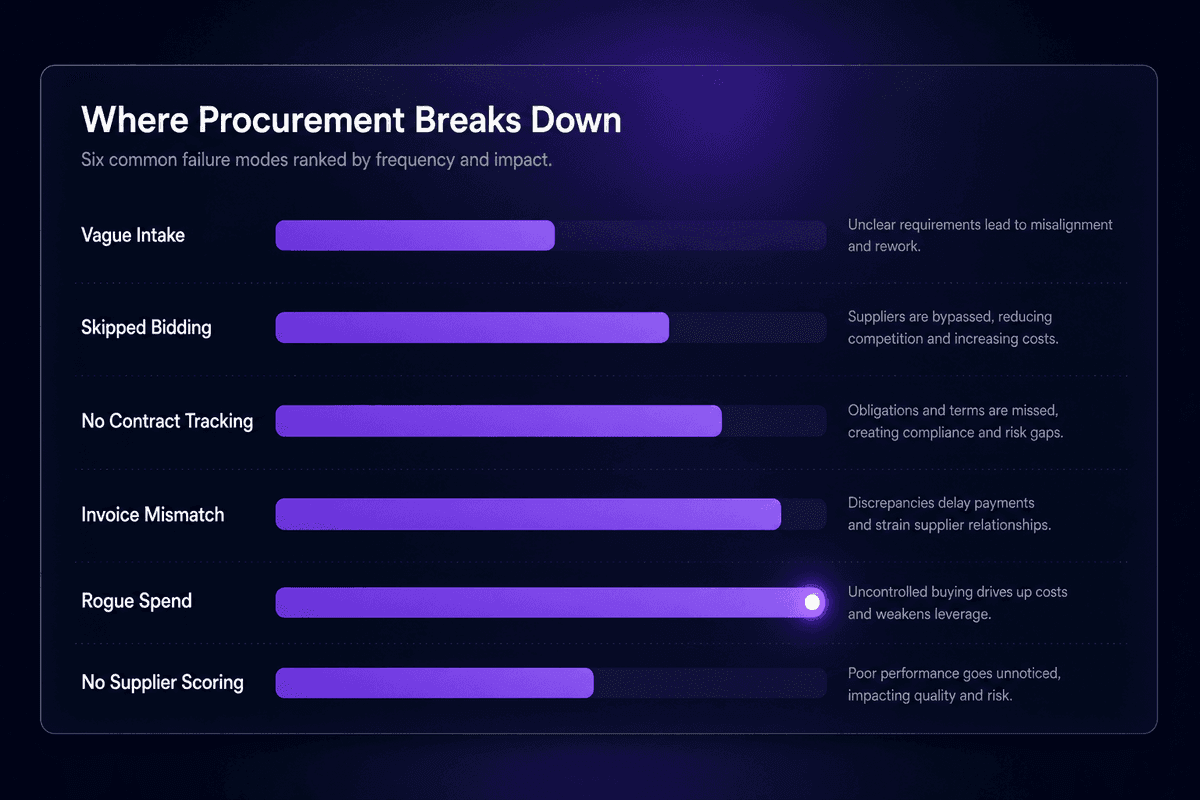
The failure modes in procurement are fairly consistent across organization types and sizes. These are the patterns I see most often - each with what it looks like when it's happening and where the fix actually lives.
- Vague intake and undocumented requirements
The purchase requisition says "need IT licenses" with no quantity, no spec, no stakeholder approval. Everything downstream is guesswork. The fix is a standardized intake form with mandatory fields for quantity, specification, business case, budget code, and stakeholder sign-off. Unglamorous. Necessary.
- Skipped competitive bidding for convenience
The procurement department defaults to the incumbent supplier for all repeat categories without rebidding at contract renewal. Prices drift upward. Alternatives never surface. The fix is a category policy that triggers a competitive review above a spend threshold - even if the incumbent wins again, the process generates market intelligence.
- Absent contract management between cycles
Contracts renew automatically on existing terms because no one tracked the renewal date. Payment terms escalate by 3% per year as a contractual default. Nobody noticed. The fix is a contract register with renewal alerts set 90 days out, owned by someone who knows what to do with the notification.
- Broken three-way matching producing invoice backlogs
Invoices arrive against POs with incorrect quantities, wrong line items, or pricing variances. Finance can't auto-approve them. The queue grows. Suppliers escalate. The root cause is usually upstream: purchase orders not aligned to contract terms, or goods receipt documentation that doesn't exist. The fix is ensuring POs reflect the contracted agreement and delivery is formally confirmed before invoice approval is requested.
- Stakeholder bypass generating rogue spend
Individual teams or managers purchase goods or services outside the procurement process, either because the process is too slow or because they don't know it exists. Rogue spend creates compliance exposure, duplicates contracts, and works against any spend-under-management target. The fix involves both process speed (approval cycles above 5 business days invite bypass) and communication (people bypass what they don't understand or trust).
- No supplier performance tracking
The procurement team has no systematic record of whether the suppliers it manages actually deliver on time, within quality specs, and within service level agreements. Renewals happen on relationship, not data. The fix is a lightweight scorecard - four or five metrics, tracked per supplier category, reviewed at formal intervals.
🤔 Wait.
Most procurement teams invest in procurement software hoping it will fix the process problems above. It usually doesn't - because software automates the current process, broken stages included. If approval routing is unclear, an automated routing workflow escalates the wrong requests faster. The Hackett Group's 2026 data on rising workloads and unresolved process complexity points at exactly this: more technology investment hasn't resolved the underlying workflow design gaps. Fix the process map first. Then automate it.