


Most people have heard "LLM" enough times to stop asking what it means. That's a problem, because the mental model most teams are working with is wrong in ways that cost real money. They treat LLMs like search engines with better grammar, or like databases that know everything, or like reasoning systems that just need the right prompt. None of those are accurate, and each one leads to a different category of production failure.
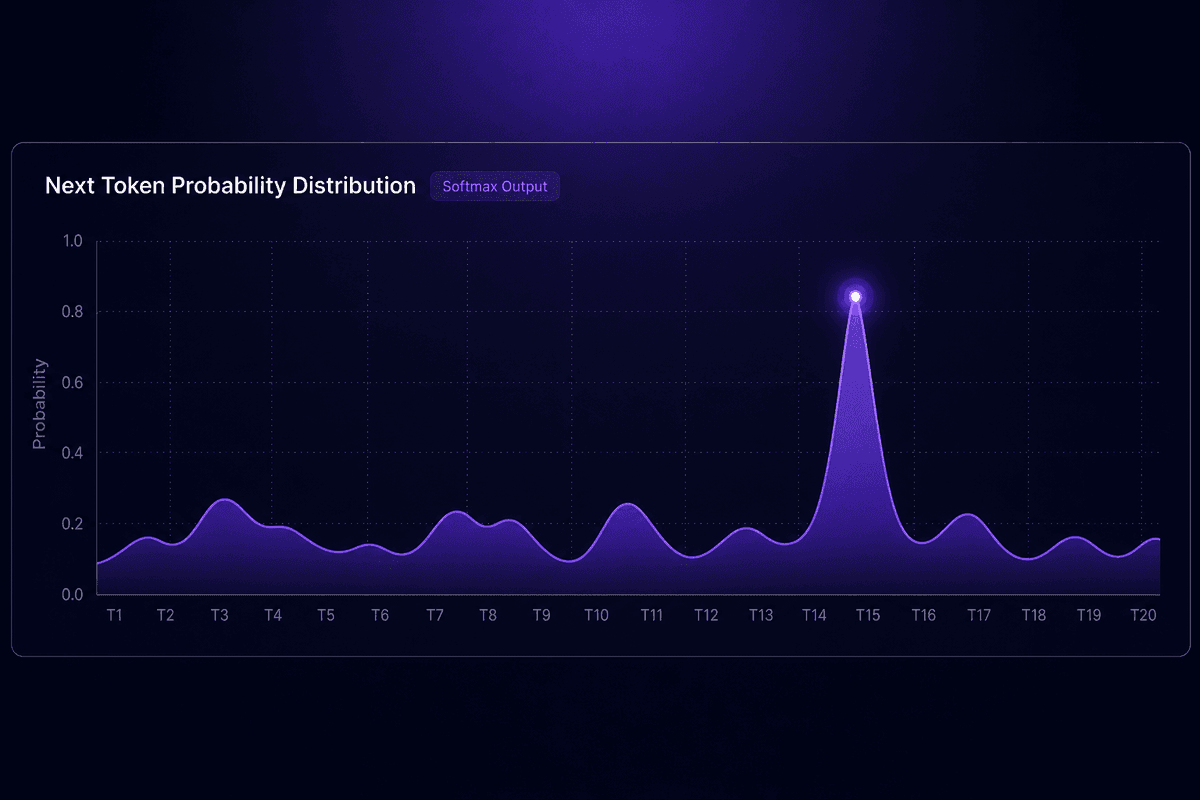
Here's the honest version: a large language model is a probabilistic text engine. It predicts the next token in a sequence based on patterns learned from massive amounts of training data. It does not look things up. It does not reason. It generates the most plausible-sounding continuation of whatever you gave it. Understanding that one mechanism explains most of what goes right with LLMs, and almost everything that goes wrong.
Where the expensive assumptions live
- LLMs predict probable text, not accurate facts - fluency and truthfulness are unrelated.
- Transformers enable long-range context, not comprehension.
- Hallucination is a structural feature of next-token prediction, not a fixable bug.
- RAG and fine-tuning exist because base LLMs cannot reliably access private or recent data.
- Bigger models are more capable on average, but not more honest.
What Is a Large Language Model?
An LLM is a type of AI model built on deep learning - specifically, a deep neural network trained on vast amounts of text data to perform tasks involving human language. Understanding and generating human language is what the architecture is optimized for, at a scale that makes general-purpose use possible.
Large language models are AI systems, but they're a specific kind. They're not rule-based systems and not traditional classifiers. The Stanford IT team describes them as foundation models - large, general-purpose models that can be adapted downstream for many tasks. Databricks defines them more plainly: an LLM is a type of AI model that uses deep learning trained on large text corpora to perform a wide range of language tasks without task-specific training for each one.
The word "large" is doing real work in that name. These models range from hundreds of millions to hundreds of billions of parameters. Scale is what allows the same underlying model to summarize a legal document, write Python code, answer a support question, and translate Spanish, all without being retrained between tasks.
What they can't do, and this is the part that trips everyone up: they cannot look up facts, verify claims against reality, or reason in anything like the way humans mean when they use that word. They learn what large language models look like. They do not learn what's true. That distinction matters for every decision about where and how to deploy them.
How Large Language Models Work: Next Token Prediction and Probability
LLMs are trained on large amounts of data - text from books, code repositories, websites, forums, papers - and the training objective is simple to describe, hard to fully grasp: predict the next token. Given a sequence of tokens, what comes next? The model learns the statistical relationships between tokens across billions of training examples until it can produce plausible continuations for almost any input.
That's it. That's the mechanism. Everything else is architecture and scale built on top of that one objective.
Google Developers describes language modeling as the task of predicting the next word or sequence of words. ApX Machine Learning puts it more bluntly: LLMs are trained to predict the next word in a sentence, making them sophisticated autocomplete systems. The "large" part means the model has processed enough text to make those predictions feel remarkably coherent, contextually aware, and fluent. It doesn't feel like autocomplete when you're using GPT-4o. But the mechanism underneath is still that.
Neural language models process language as sequences of tokens. At inference time, the model calculates a probability distribution over its entire vocabulary for the next token, samples from that distribution, appends the result, and repeats. The output you see is the product of several thousand of these sampling decisions chained together.
This is why AI outputs are probabilistic rather than deterministic. Run the same prompt twice and you may get slightly different responses. The model isn't looking up an answer from a database. It's constructing one, token by token, based on probability.
What a Token Actually Is
A token is the unit the model reads and writes. In natural language processing, tokens aren't always full words. They're fragments: "unbelievable" might become three tokens, "un," "believ," "able." Short common words are usually a single token. Punctuation and spaces often get their own. Most LLMs operate on somewhere between 50,000 and 100,000 possible tokens in their vocabulary.
This matters because the model never sees "sentences" or "ideas." It sees a sequence of integers, each representing one token, fed into a type of neural network that processes the full context to predict what integer probably comes next. The output is also a sequence of tokens that gets decoded back into readable text.
Token counts also determine cost and context limits. When platforms tell you a model supports a 128,000-token context window, they mean it can hold roughly 90,000 to 100,000 words of context at once before it starts forgetting earlier inputs.
Why Output Looks Confident Even When It Is Wrong
This is the part I explain most often in support, and it's the one with the biggest practical consequences. The model selects high-probability token continuations. It does not evaluate whether those tokens are factually correct. The training signal was "does this continuation look like natural language?" not "is this true?"
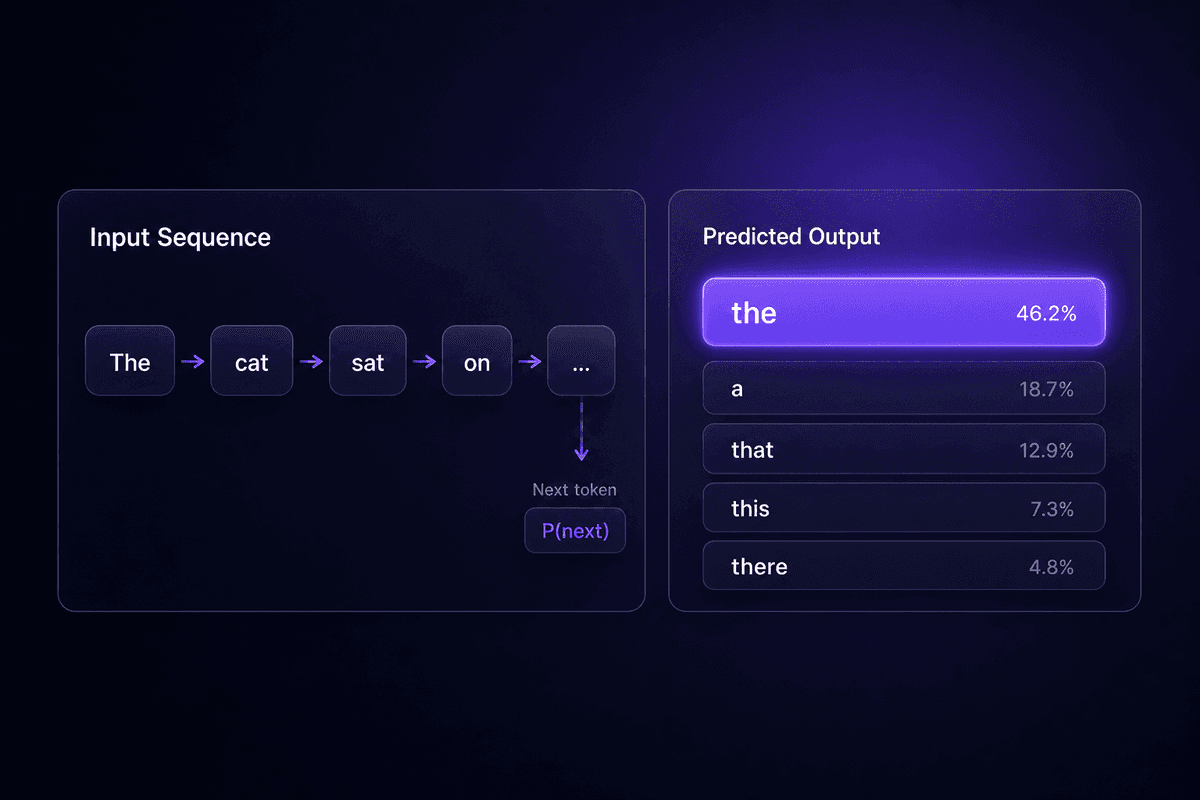
So LLM output sounds fluent and confident because fluent and confident-sounding text is statistically common in the training data. When generating natural language about a specific topic, the model can produce a completely fabricated answer in the same tone as a correct one. Same sentence structure, same hedging patterns, same authorial confidence. Models may generate plausible-sounding text that is entirely wrong.
This is hallucination, and it's not a bug. It's what next-token prediction looks like when the most probable continuation happens to be false.
🤔 Think about this:
The same mechanism that makes LLM output feel natural and readable is exactly what makes it unreliable for factual queries. Fluency comes from predicting statistically likely language. Accuracy requires knowing what's true. The model optimizes for the first. It has no objective function tied to the second.
The Transformer Architecture Behind Every Modern LLM
Every major LLM in production today, GPT-4o, Claude, Gemini, Mistral, Llama, runs on a transformer architecture. Understanding what that means in practice, not just by name, changes how you think about what these models can and can't do.
Transformer models use a mathematical technique called self-attention, which allows the model to weigh the relevance of every other token in the input when predicting the next one. Databricks describes it this way: the transformer architecture enables LLMs to handle long-range context and complex language patterns at scale by learning which parts of an input sequence are relevant to each other, regardless of how far apart they appear. That's the practical meaning of transformer architecture: the model doesn't read left to right in a fixed window. It considers the whole context at once, attending more to the tokens that matter for each prediction.
Before transformers, neural language models struggled with long-range dependencies. If a sentence started with "the company that acquired the three startups last year..." and the pronoun "it" appeared twenty words later, earlier architectures would often lose track of what "it" referred to. The self-attention mechanism in transformer models resolves this by design: every token can attend directly to every other token, regardless of position.
Deep learning models built this way are also highly parallelizable during training, which is part of why training scale became possible. You don't have to process a sentence sequentially. You can process all positions simultaneously on modern hardware.
One detail worth naming: the models people call "generative pretrained" models, the GPT family being the clearest example, are transformers trained with a causal language modeling objective: predict the next token given all previous tokens. That specific combination of transformer architecture plus massive pretraining scale is what the term "LLM" typically refers to in 2026.
What "Model Trained on Billions of Tokens" Means in Practice
Databricks notes that large transformer models are trained on billions to trillions of tokens drawn from diverse sources. The practical consequence of that scale is generalization. A model trained on enough varied text learns language patterns that transfer across topics, styles, and tasks without additional training for each one.

This is why a single base model can summarize a contract, write a regex, explain a medical term, and generate marketing copy. The training data exposed it to all of those domains simultaneously. The parameters, which encode the learned statistical relationships, are the distilled output of processing large datasets containing examples of virtually every type of language use.
The number of parameters matters here too. Much larger models, with hundreds of billions of parameters, tend to generalize better across edge cases and complex tasks. But larger also means more expensive to run at inference time, which is why the model selection decision is usually a tradeoff between capability and cost, not just a question of choosing the biggest available option.
Pretrained models at this scale are general-purpose by construction. Domain-specific adaptations, fine-tuning on proprietary datasets, or retrieval-augmented generation on internal knowledge come after, on top of that general foundation.
What LLMs Are Actually Used For Across Industries
Language models are AI systems that have moved quickly from research to production. According to the McKinsey & Company state of AI report, 65% of organizations are regularly using generative AI in at least one business function, nearly double the rate from ten months prior. That's not experimentation. That's operational use at scale, which means understanding LLM capabilities and limits is no longer optional for most business teams. Here's what practical deployment actually looks like across roles:
- Customer support teams use LLMs to generate draft responses, summarize long ticket histories, and classify incoming requests by intent. The reduction in handle time is real. The risk is that the draft cites a policy the model hallucinated, which the agent then sends because it sounded plausible. Human review stays in the loop for anything customer-facing.
- Content and marketing teams use LLMs for text generation at volume: first drafts, subject line variants, ad copy iterations, localization. The output requires editing. But the speed gain on first-draft production is genuine, and most teams that try it stop going back.
- Software engineers use code-generation models as a daily tool. The Stack Overflow Developer Survey 2025 found 84% of developers are using or planning to use AI tools in their development process. The same survey found the biggest frustration: 66% report that "AI solutions that are almost right, but not quite" are what costs them the most time. That's the hallucination problem showing up in a different domain.
- Analysts and knowledge workers use LLMs to query and summarize large document sets: earnings reports, legal filings, research papers, customer feedback. The model can extract and structure information faster than a human reader, but the output still needs verification for anything decision-critical.
- Enterprise teams are increasingly running retrieval-augmented generation (RAG) pipelines to let a base LLM answer questions against internal documents and knowledge bases. The model doesn't need to be fine-tuned on proprietary data. Instead, it retrieves relevant chunks at inference time and grounds its response in what it found. LLMs can also be used in multimodal models that handle images and documents together, and reasoning models that approach step-by-step problem decomposition, though both categories are still maturing.
On the enterprise RAG front: the use case I see mentioned most in support is basically "we want to query our internal documentation and get real answers, not a link to a Confluence page from 2021." That's a legitimate problem. In Latenode, teams can connect a workflow to their internal knowledge base using built-in RAG over uploaded PDFs and CSVs, run a query through whichever AI model fits their needs from a single dropdown, and push the structured output to Slack, a CRM, or a helpdesk. No external vector database setup required. Whether you're building a compliance tool, a support assistant, or an internal search layer, the same automation canvas handles both the retrieval logic and the downstream routing.
Fine-Tuning and Prompt Engineering: How Teams Adapt LLMs to Real Work
A base LLM trained on general data is useful. A base LLM that's been shaped for your specific task, vocabulary, or output format is considerably more useful. There are three main paths to that shaping, and teams consistently reach for the expensive one first.
Fine-tuning means taking a pretrained model and continuing training on a domain-specific dataset - your support tickets, your product documentation, your customer contracts. LLMs can be fine-tuned to behave differently: to use your company's tone, to understand your internal nomenclature, to produce outputs in a specific format. LLMs can be trained this way using supervised learning or reinforcement learning from human feedback, both of which adjust the model's weights toward your preferred outputs. Fine-tuning changes what the model knows and how it responds at a fundamental level.
Prompt engineering is cheaper and faster. It means structuring the input to the model - the prompt - to shape the output without changing the model itself. System prompts, few-shot examples, chain-of-thought instructions, output format constraints: these are all prompt engineering. Most general adaptation tasks don't require fine-tuning and can be handled entirely through careful prompt design. This is what the natural language processing capabilities of LLMs are built for.
The third path is RAG. As MIT Sloan has noted, retrieval-augmented generation lets teams ground LLM responses in proprietary or real-time data by fetching relevant documents at inference time and injecting them into the prompt context. The language processing capabilities of LLMs stay intact. You're just giving the model better material to work from. RAG doesn't require retraining and doesn't involve model weights. It's an architectural pattern, not a training process.
When Fine-Tuning Is Worth the Effort and When Prompt Engineering Is Enough
Here's the practical split: prompt engineering handles most general adaptation tasks. Fine-tuning makes sense when the model consistently fails on domain-specific vocabulary, tone, or output format even after you've iterated carefully on the prompt.
Large models pretrained on diverse data already have strong baseline performance across most topics. If the failure pattern is that the model doesn't understand your internal product names or your legal terminology, a few well-chosen few-shot examples in the prompt often fix this without touching the model. Models typically need a surprisingly small number of in-context examples to adjust output style significantly.

Fine-tuning is worth the dataset preparation and training cost when: you have hundreds to thousands of labeled examples of the exact output behavior you want; the domain is specialized enough that general prompting consistently misses; and you need the behavior to be stable and not dependent on prompt length. Masked language modeling objectives are also used in certain fine-tuning variants for classification tasks specifically.
The pattern I keep seeing in support: teams invest in fine-tuning before they've tested whether a well-structured prompt solves the problem. This is backwards. Start with prompt engineering. Document where it fails. Only build a fine-tuning dataset around the gaps that survive rigorous prompting. Skipping this sequence usually means building an expensive dataset to fix a problem that a five-minute prompt revision would have resolved.
Four LLM Misconceptions That Lead to Bad Decisions
These aren't philosophical debates. Each one is a practical decision error that shows up in real deployments. I'm working from the ApX Machine Learning analysis of common LLM misconceptions and the Machine Learning Mastery breakdown of where teams go wrong, because these errors are well-documented and the consequences are consistent.
Misconception 1: LLMs understand language like humans do. They don't. An LLM doesn't comprehend meaning. It learns statistical patterns in language and predicts what comes next based on those patterns. The model has no understanding of the physical world, no internal states, no intentions. It produces outputs that look like understanding because it was trained on text written by people who understood things. That's not the same. The practical error this creates: teams over-rely on the model to catch ambiguous inputs, edge cases, and logically inconsistent requests, because it "understands" what's being asked. It doesn't. It predicts language that fits the pattern.
Misconception 2: LLMs are fact databases. They're not. LLMs are built on pattern learning, not knowledge storage with a lookup function. When a model answers a factual question, it's generating the most plausible-sounding response given its training, not querying a verified knowledge base. This is the structural root of hallucination. The model can confidently cite a paper that doesn't exist, attribute a quote to someone who never said it, or state a statistic with a made-up number. Generative AI systems of this type have no truth-checking step in their architecture. The practical error: teams treat model outputs as a research source without verification, which works fine until it doesn't, and then it fails in front of a client or a regulator.
Misconception 3: Bigger means more accurate. More capable, yes. More accurate about facts, not necessarily. Models like GPT-4o and Claude know they're being asked a question and have been trained with reinforcement learning from human feedback to produce helpful responses. Being helpful and being correct are correlated but not equivalent. A larger model will often write a more convincing wrong answer than a smaller one. Proprietary models continue to improve on benchmarks, and scale does correlate with better reasoning on complex tasks. But the hallucination risk doesn't disappear with scale.
Misconception 4: LLMs have stable opinions and personalities. What looks like personality is a training artifact. The model has been shaped by its training data and fine-tuning process, including reinforcement learning from human feedback, to produce responses with a consistent tone and apparent disposition. That's not a stable inner state. It's a learned output distribution. Models like ChatGPT can express different positions on the same question depending on how the prompt is framed, what's present in their training data, and what the sampling temperature is. LLMs continue to produce different outputs across runs. The practical error here: teams build workflows that assume consistent model behavior, then discover the model behaves differently when the prompt changes slightly, when the context is longer, or when a model version updates.
📊 In practice:
LLMs generate text based on learned distributions, not by querying a verified knowledge base. This means a confident-sounding citation can be entirely fabricated - same syntax, same specificity, completely invented. The fluency of a hallucinated answer is usually identical to the fluency of a correct one. Verification has to come from outside the model, not from reading the output carefully.