
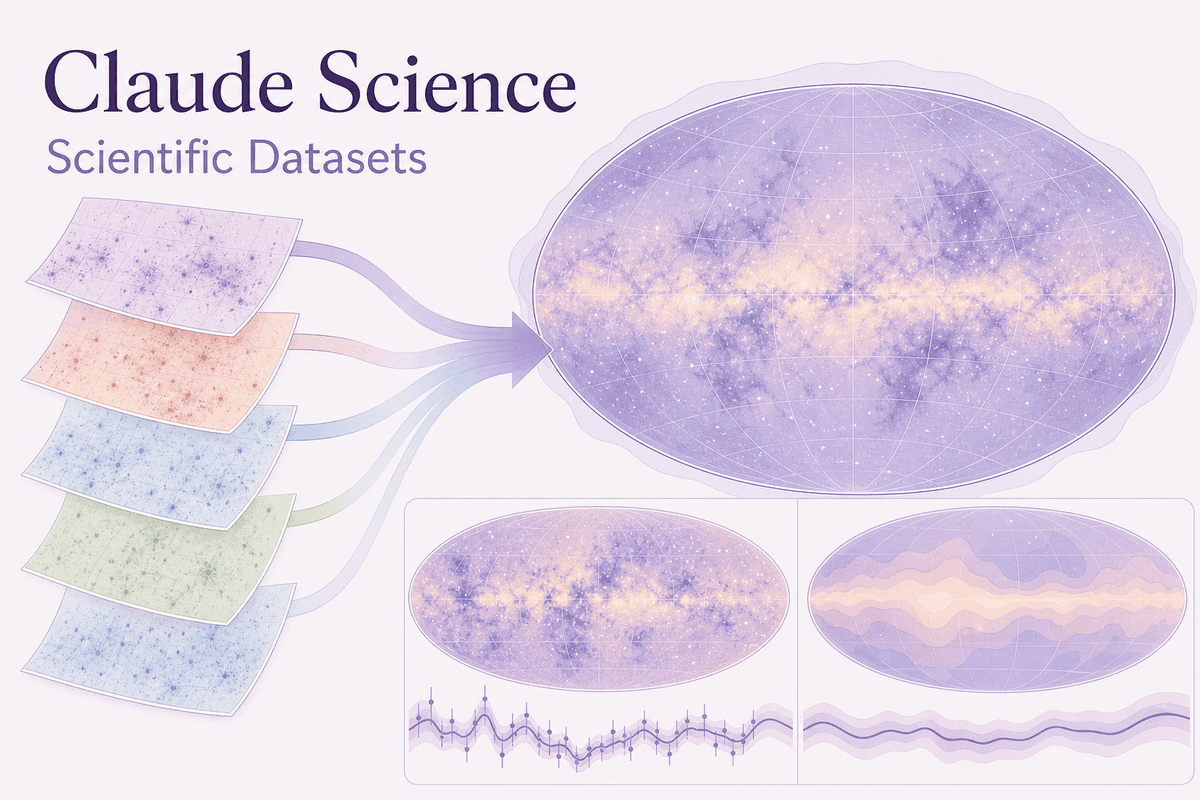
Anthropic says Claude Science helped astrophysicist Brice Ménard assemble the first complete ultraviolet map of the sky by combining public space-mission data and estimating unobserved regions.
The Anthropic research account says data from GALEX, Swift, FIMS/SPEAR and TD-1 were cross-calibrated and remapped into a common coordinate system, with Planck and Gaia supplying other wavelengths.
Roughly one-third of the sky lacked direct UV observations. Anthropic says the workflow used inpainting and other-wavelength data to fill those gaps, estimated UV light for more than 100 million stars and reconstructed masked regions to within about 10% of measurements. That validation figure is vendor-reported and disputed in outside readings of the technical material.
The map labels pixels as measured or predicted and includes uncertainty estimates. Claude’s role is best understood as coordinating a scientific workflow; a separate statistical model handled estimates for missing diffuse UV regions.