Best n8n Alternatives in 2026: 9 Tools We Ran Ourselves
We built the same eight-step workflow on seven cloud platforms and four self-hosted ones, ran it against each, and read the billing counter before and after. Everything here is our own meter readings and run times — then priced out to the volumes you actually operate at.
2 workflows, one code path11 platforms benchmarkedMeasured September 2026Method published in full
Scope
Who this page is for
Organised by the reason you are leaving, not by feature lists — because the right replacement depends on which reason is yours.
You are already on n8nSomething has started to hurt: the bill at volume, the hours the server takes each month, or the licence once legal reads it. Each of those points at a different replacement, and the page is built around that split.
You will rebuild the workflows yourselfWritten for the technical founder, the ops engineer, or the developer who inherited the automation stack. It assumes you would rather see the arithmetic than a verdict.
Not an intro, not a procurement matrixIf you have never run n8n and want a general introduction to automation, or you need SOC 2 matrices and vendor risk scoring, this is the wrong page. Both are fair needs; neither is what we measured.
Category winners
The best n8n alternative depends on why you're leaving
Eleven categories, eleven winners. Every award is backed by a number you can verify yourself.
LatenodeCheapest at 100k runs/monthLatenode$40.80/mo · measuredBilled per second of runtime, so an eight-step workflow costs the same as a one-step one.LatenodeCheapest at 10k runs/monthLatenode$3.60/mo · measuredThe free 10,000 CPU-seconds absorb most of that volume before billing starts.LatenodeFastest engineLatenode & Windmill91 ms vs 102 ms · tiedBoth run on Bun. The 11% gap is within hardware noise — we are not calling a winner.Fewest billable units per runn8n Cloud1 execution · any lengthCharges per run, not per step. Pipedream and Activepieces match it at 1 credit.Lowest overhead when self-hostedWindmill1.4× bare Node · measuredAdds under 40% to the raw runtime. n8n on the same box adds 5,200%.Most free runs per monthActivepieces~3,000 runs · 100 credits/dayA daily allowance beats a monthly one for steady low volume.Built entirely through an APIActivepieces0 clicks · MCP end to endWe created, wired and published both flows without opening the UI once.Nothing lost under loadPipedream40/40 rows · 0 droppedZapier and n8n silently lost 2 rows in 10 writing to Google Sheets.Free debuggingZapierEditor tests cost 0 tasksVerified against the billing breakdown. Windmill bills you for deploying.Fastest to self-hostNode-RED~30 sec · one containerThe only platform where we deployed a flow via API with no token at all.Clearest pricing pageMakeFull ladder publishedEvery tier and unit price is visible. Kestra publishes none and was excluded.
Cost calculator
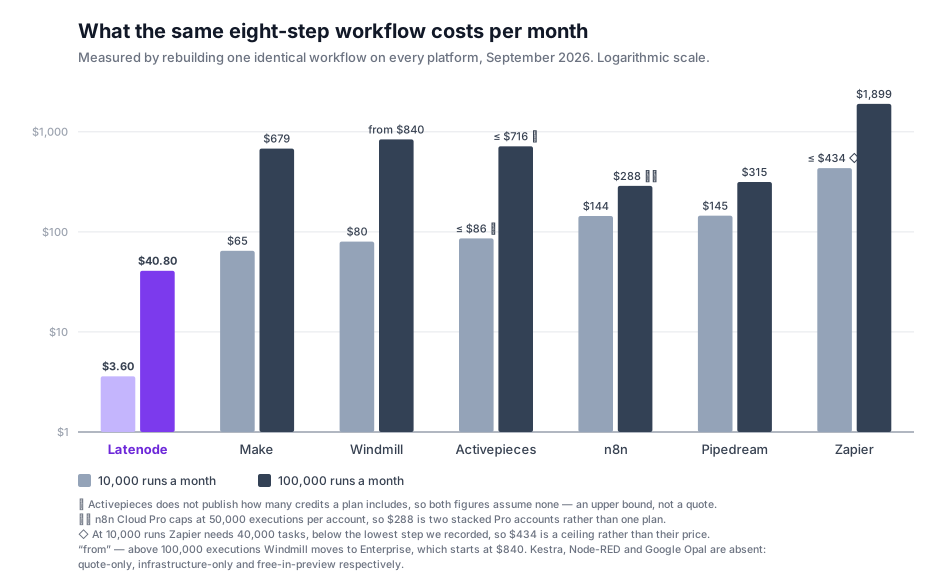
What each n8n alternative costs at your volume
Managed cloud only — every bar is a subscription for the same eight-step workflow, priced on the billable units we watched each platform actually consume. Self-hosting is a different kind of number and gets its own section below.
Workflow runs per month
10,000runs
Cheapest option
Latenode
1,00010,000100,0001,000,000
Latenode40,000 CPU-seconds$3.60
Make70,000 operations$65
Windmill Cloud80,000 executions$80
Activepieces10,000 creditsupper bound≤ $86
n8n Cloud base10,000 executions$144
Pipedream10,000 credits$145
Zapier40,000 taskslower steps not snapped≤ $434
Every bar prices the same eight-step workflow. The unit count under each name is what we watched that platform actually meter, not what its pricing page uses as an example. Prices are monthly; all seven default to annual billing, which is around a third cheaper and not what most teams sign up on. Activepieces does not publish how many credits its $16 and $166 plans include, so this bar assumes none and charges every credit at the $0.007 overage rate. The real price is this or lower. Below 50,000 tasks Zapier has cheaper steps we never recorded — Free covers 100 tasks a month and Professional starts around $29.99 — so this bar is a ceiling at low volume, not a quote. That gap is in our data, not their pricing. Self-hosted tools are not in this chart on purpose — server rent is not a subscription, and comparing the two is how these pages usually go wrong. The real cost of running your own is worked out further down.
n8n vs Zapier: which one are you actually choosing between?
Both tools solve the same problem and charge for different things. n8n meters executions; Zapier meters tasks — and a task is a single step, so a multi-step Zap multiplies. We ran the same eight-step workflow on both and counted what each meter moved. n8n billed one execution per run. Zapier billed four tasks — fewer than eight, because Zapier charges for neither filters nor its own code steps. At 100,000 runs a month that is 100,000 executions against 400,000 tasks: $1,899 on Zapier Professional against $288 on n8n — and that $288 is arithmetic rather than a plan you can buy, because n8n Cloud stops at 50,000 executions and 100,000 means two separate accounts. Zapier wins on integration count and on how fast a non-technical colleague gets something working. n8n wins on cost and on the option to self-host. If you are weighing only these two, the deciding question is whether anyone on your team will run a server.
What self-hosting an n8n alternative actually costs
Self-hosted comparisons usually end at the server bill, because the server bill is the only line with a price tag on it. It is also the smallest one. Here is the whole invoice, with each number labelled by where it came from.
measured means we did it ourselves and wrote down what happened. estimated means it comes from published rates and stated assumptions. The difference matters most in the section that costs the most money, so it is marked on every block below.
Standing four of them upmeasured
On one 4-core VPS, one platform at a time, containers removed between runs. The column that matters is the last one: not how fast the container starts, but what a human had to do before a single workflow could run.
Platform
Containers
To a running instance
To load one workflow
Engine overhead
Node-RED
1
~30 s
Admin API, no authentication at all
71× bare Node
Activepieces
1
~30 s
Register an owner in the UI, then import a file
3.9×
Windmill
2
~75 s
Log into the UI, issue a token, then the API
1.3×
n8n
1
134 s
CLI import, activation, and two restarts
61×
Overhead is the same 20-million-iteration loop each platform ran, against bare Node.js on the same warm machine (87 ms). The spread between platforms is 47-fold. Windmill adds under 40% to the raw runtime; n8n, on identical hardware running byte-identical code, adds 5,200%. That is architecture, not hosting — and it is the one self-hosted number that no amount of devops time will change.
Node-RED’s admin API accepted our workflow with no credentials whatsoever on a fresh container. That is a sane default for a device on your bench and a serious problem on a public IP, and it is exactly the class of decision that stops being free the moment the instance leaves your laptop.
The server is the cheap partestimated
Rates below are list prices in September 2026. Two things worth knowing before budgeting off an older article: Hetzner raised prices twice during 2026, and a dedicated IPv4 address stopped being free at several providers.
The box
$11–60
A small VPS runs one platform comfortably. Anything with a queue, workers and Postgres wants more. This is the number every comparison stops at.
Dedicated IPv4
$0.50–2
Newly billed separately at several providers. Small, but it is the first sign that the advertised price is not the price.
Backups
20% of the box
Not a rounding error and not included. A workflow platform holds credentials and execution history; restoring it from nothing is not a plan.
Everything cloud bundles
your problem
TLS renewal, log retention, secret storage, monitoring and alerting, worker scaling, version upgrades. None of it appears on a hosting invoice, all of it appears in someone’s week.
The largest line item is a personestimated
This is where self-hosted budgets go wrong, and it is also the number we are least sure of — so read the next paragraph as carefully as this one. Devops rates in 2026 run about $45 an hour in Eastern Europe, $85 in Western Europe and $100 in the United States. At those rates, three or four hours a month costs more than a year of the server.
An AI coding agent genuinely changes the deployment half of this. We built and deployed four platforms with one, and the work that used to be an afternoon of reading docs was minutes. What a $20–200 monthly subscription does not do is wake up at three in the morning when the queue backs up. Treat it as a discount on setup and routine changes, not on being responsible for a running system.
Where this section is weakest
The hours are the soft number, and they drive the total. Published estimates of monthly maintenance for a self-hosted workflow platform range from one hour to ten — a tenfold spread that swamps every other line item here. We have used the middle of that range. Anyone quoting you a precise self-hosted TCO is quoting you their assumption about this one figure.
Incident frequency is assumed, not observed. Nobody publishes how often a self-hosted n8n falls over, ourselves included — yet.
Server prices are list prices. Committed use, existing contracts and spare capacity all move them, usually downward.
Maximum run length is not in this comparison yet. Every platform caps how long a single execution may last, and the caps differ enough to rule a platform out before price ever enters the conversation. We have not collected them, so nothing here accounts for them.
What we are doing about it. Four of these instances are still running on our own hardware. We are logging the real maintenance time against them and will publish it, because as far as we can tell nobody has.
Three volumes, three pathsestimated
Server, extras and maintenance hours at Eastern European rates, against managed hosting for the same open-source tool, against a cloud subscription. The cloud column is the measured figure from the calculator above.
Runs per month
Your own VPS
… with an AI agent
Managed hosting
Cloud subscription
10,000
$170–360
$140–360
$40–70
$144 · n8n Pro
100,000
$420–920
$320–870
$130–305
$679 · Make Pro
1,000,000
$1,270–3,050
$1,000–2,450
$550–1,200
no public tier
The conclusion is not the one self-hosting advocates expect. At 10,000 runs a month, running your own server is the most expensive option on the row — three or four hours of a person costs more than every other line combined, and managed hosting of the same open-source tool undercuts it four-fold. The choice of hardware barely registers: $11 against $16 against $55 a month is noise next to one afternoon of someone’s attention.
Before any of this arithmetic matters, answer a simpler question: what does an hour of downtime cost you? If the honest answer is “not much” — internal tooling, overnight batches, anything that can wait until morning — then self-hosting is genuinely fine to run yourself, the maintenance estimate stops mattering, and you should ignore most of this section. The whole calculation exists for the other case: a production workflow that customers or revenue depend on. There the question is not how many hours a month it takes, it is who fixes the server at two in the morning. That person is either on your payroll, on a support contract, or does not exist — and only the third option is free.
Given that, self-hosting on your own metal wins on cost in one situation, and it is a narrow one: high volume, and a devops person already on the payroll whose on-call time nobody is counting separately. If that describes you, it wins clearly. If you would be hiring or reassigning someone to do it, the arithmetic reverses — and it reverses hardest at exactly the small volumes where self-hosting sounds most obviously sensible.
There is a second reason to keep the two columns apart that has nothing to do with money. A cloud subscription is a price. A self-hosted total is a forecast about how much attention a system will demand, made before you have run it. Those are different kinds of claim, and a chart that stacks them in the same units quietly hides that.
Which one for you
Pick your n8n alternative by the reason, not the ranking
Most "top 10" lists rank tools against each other. That's not how the decision actually works — you're leaving n8n for a specific reason.
Why are you looking to move off n8n?
Pick the closest one.
Full comparison
All nine n8n alternatives, side by side
Click any column header to sort. Filter to narrow the list down to what you actually need.
10 of 10 shown
n8n your current tool
Hybrid
Sustainable Use
Yes
Self-hosted only
Per execution
$144
$288
JavaScript · Python
Bring your own
Yes
4.8 · 90+
Latenode
Managed
Proprietary
No
10,000 CPU-sec/mo
Per CPU-second
$3.60
$40.80
JavaScript + NPM
335+ built in
Yes
4.8 · 60+
Activepieces
Open-source
MIT / Commercial EE
Yes
Unlimited self-hosted
Per task (cloud)
≤ $86
≤ $716
TypeScript
Via connectors
Yes
4.6 · 90+
Make
Managed
Proprietary
No
1,000 ops/mo
Per operation
$65
$679
Limited
Connectors only
No
4.6 · 230+
Windmill
Open-source
AGPLv3 / EE
Yes
Unlimited self-hosted
Seats + executions
$80
from $840
TS · Python · Go · Bash
Bring your own
Yes
4.7 · 30+
Kestra
Open-source
Apache 2.0
Yes
Unlimited self-hosted
Enterprise licence
Quote only
Quote only
Any (containers)
Bring your own
No
4.5 · 20+
Zapier
Managed
Proprietary
No
100 tasks/mo
Per task
≤ $434
$1,899
JavaScript · Python
Connectors only
Yes
4.5 · 1,300+
Pipedream
Managed
Proprietary
No
Credits included
Per credit
$145
$320
Node.js · Python
Bring your own
Yes
4.6 · 40+
Node-RED
Open-source
Apache 2.0
Yes
Fully free
Free software
Infrastructure only
Infrastructure only
JavaScript
Community nodes
No
4.4 · 20+
Google Opal
Managed
Proprietary
No
Free in preview
Preview — free
—
—
No
Gemini built in
No
—
n8n is pinned at the top as the tool you're comparing against, with Latenode directly beneath it — the two billing models sit side by side. Click any column header to sort the whole table freely.
How we tested
Two workflows, eleven platforms, one prompt
Every number on this page came out of these runs. Nothing is estimated, and where a figure could not be measured we say so instead of filling the gap.
Workflow A — what it costs8 steps: webhook → normalise → HTTP GET → filter → transform → LLM call → assemble → write. Measures billable units per run.
Workflow B — how fast it is3 steps with a 20-million-iteration loop. Measures the engine, not the network.
Modelgpt-4o-mini via OpenRouter, temperature 0, max 500 tokens, identical prompt everywhere
Runs per platform10 per workflow, fired 3 seconds apart by the same script. We report the median.
Timing methodThe code times itself with Date.now() around the loop. Platform counters measure different boundaries and are not comparable.
Correctness checkEvery run returns a checksum. All 200+ runs produced 59628481635.853569 byte for byte.
PricesPublished monthly tiers, read from each vendor's page with monthly billing selected. Consumption is measured; the rate is theirs.
Self-hostedOne 4-vCPU VPS, Docker defaults, all platforms on the same box against the same baseline.
Run date4–5 September 2026 · versions listed in each card
We built this page. Latenode commissioned it and Latenode wins three of the eleven categories above. The method is published here precisely so you can check the other eight.
Eight steps is a short workflow. The median n8n template is 14 steps. On step-priced platforms your bill will be worse than shown, not better.
Workflow A is 98% waiting on other people's APIs. It measures what you are charged, not how fast a platform is. That is what Workflow B is for.
Prices are list prices. We measured consumption on our own accounts, then applied each vendor's published rate. We have no negotiated discounts and neither ladder was audited against an invoice.
One machine, one evening, one region. Cloud platforms run on hardware we do not control and cannot hold constant. Speed figures are a snapshot, not an SLA.
Two platforms are missing numbers. Make has no code step outside paid plans, so it has no speed figure. Kestra publishes no cloud price at all, so it was excluded rather than guessed at.
The workflow we actually ran
The reference workflow on n8n Cloud: webhook, normalise, fetch, filter, build prompt, LLM call, assemble, write. The model is called over plain HTTP to openrouter.ai — which is why Activepieces bills this flow at one credit and not two.
Measured results
What the same workflow actually cost on each platform
Consumption was read from each platform's own billing counter after ten runs. The rate is the vendor's published monthly price, taken with billing switched to monthly rather than the annual default. One figure is an exception and is marked: Activepieces, where the plan allowance is not published.
Platform
Billing unit
Units per run
10k runs/mo
100k runs/mo
Latenode
CPU-second
4
$3.60
$40.80
Activepieces
credit
1
≤ $86 ✧
≤ $716 ✧
Make
operation
7
$65
$679
Windmill
execution
8
$80
from $840
n8n Cloud
execution
1
$144
$288 ✳︎
Pipedream
credit
1 †
$145
$320
Zapier
task
4
≤ $434 ◇
$1,899
◇ 10,000 runs is 40,000 tasks, which sits below the lowest rung we snapped off Zapier's slider. $433.50 is the 50,000-task step, so at this volume it is a ceiling rather than their price — Zapier has cheaper steps down there that we did not record. The 100,000-run figure is exact: 400,000 tasks, $1,899, read off their slider with billing set to monthly.
✧ Activepieces is the one price here we could not finish verifying. One credit per run is measured — 23 runs, 23 credits. But Activepieces publishes its plan fees ($16 Plus, $166 Team) and its $0.007 overage rate without saying how many credits a plan includes, and we did not extract that from the interface. Both figures therefore assume zero included credits, which makes them a ceiling rather than a price. The real number is lower, and we would rather show a bound we can defend than a figure we inferred.
✳︎ n8n Cloud Pro caps at 50,000 executions per account, so $288 is two Pro accounts rather than one purchasable plan — split traffic, duplicated credentials, two sets of logs. There is a plan you can simply buy at this volume: Business lists $2,071 a month for 100,000 executions. The two routes differ seven-fold, and that gap is what it costs not to do the coordination yourself. We price the stacked figure because it is what teams actually do, and cap it at three accounts — past that the coordination stops being a footnote.
† Pipedream, read off its own credit counter: billing unit, one credit per 30 seconds of compute at 256 MB; units per run, 1; test runs, 11, which consumed 11 credits. The eight-step workflow and the heavy loop cost the same, because both finish well inside one interval.
The winner changes with your volume
At 10,000 runs Activepieces is 7× cheaper than n8n. At 100,000 it is twice as expensive. Any claim that one platform is simply cheaper than another, with no volume attached, is wrong in one direction or the other.
What each platform’s own counter said
n8n Cloud: four steps and eight steps both cost exactly one execution.Make: seven operations per run, read off its own history.Zapier: four tasks per run — it bills neither the filter nor its own code step.Activepieces: credits consumed equal runs, one for one.Windmill: seven steps finish inside a second, the LLM call takes 1.8s and counts twice. Seven plus two is eight.Latenode: the run finishes in under a second and still bills a whole CPU-second.
Engine speed: 33× between first and last
Identical code, identical checksum, timed from inside the run. This is the platform's own execution overhead with the network taken out.
Latenode91 ms
Windmill102 ms
Activepieces602 ms
Pipedream750 ms
Zapier1,263 ms
n8n Cloud2,971 ms
Median of ten runs each. Make is absent because its code step is not available outside paid plans. The n8n Cloud baseline was re-measured on 18 September on a fresh instance — the original trial had ended and its history had rolled over. The two instances agree to within nine percent. Pipedream needs a warm-up: five runs on 17 September took 2,078, 2,081, 2,040, 743 and 759 ms in code, with the same checksum as everywhere else. The worker reaches speed by the fourth event, so the bar shows the warm figure, as it does for every platform.
The same loop, timed inside four of these platforms
Latenode, 93 ms in code.Windmill, 104 ms in code against 293 ms for the job — the wrapper nearly triples a short run.Activepieces, 594 ms. This is the original September run, timestamp and all.n8n Cloud, 2,965 ms — one run from the series that re-established the baseline.
The same checksum, 59628481635.853569 / 562987596, appears in every one of these. That is the proof the code was byte-identical everywhere — only the milliseconds differ.
Self-hosted: the difference is the software, not the server
All four on one 4-vCPU VPS, measured against bare Node on that same machine. This ratio is portable — it holds whatever you rent.
Platform
Median
Spread
vs bare Node
Bare Node v24, warm
87 ms
85–97
1.0×
Windmill
119 ms
110–151
1.4×
Activepieces
297 ms
295–300
3.4×
n8n
4,632 ms
4,488–4,777
53×
Node-RED
5,711 ms
5,562–5,887
66×
A warm core on a cheap VPS runs the loop in 87 ms. The fastest managed platforms manage 91 and 102 ms on their own hardware. The gap between cloud and self-hosted is not the machine — it is how the platform executes your code, and that spans a factor of 47.
On our own server, one platform at a time
Three numbers for one run: 300 ms inside the code, 352 ms for the step, 372 ms for the whole run.n8n self-hosted, with the loop itself visible beside its output.Windmill self-hosted, 121 ms in code against 249 ms for the job.Node-RED opened with no password at all — a sane default on your bench, a problem on a public address.Activepieces names its own ceilings: two runs timed out at 9m59s, a third died on log size.
Four things we did not expect
01Speed and price are unrelatedWindmill runs code 32× faster than n8n and bills 8 units per run against n8n's 1. Fast engines are not cheap engines.
02Step-based pricing is the minorityOnly two of seven platforms bill per step. n8n and Activepieces charge one unit per run whatever happens inside it; Pipedream charges per 30 seconds; Latenode and Windmill charge for time. "You pay for every step" describes Make and Zapier, not the market.
03Google Sheets drops rowsTwice, on platforms that process webhooks in parallel: ten successful runs, eight rows. Verify completeness against platform logs, never a spreadsheet.
04Every vendor defaults to annual pricingZapier, Pipedream and n8n all open on the annual tab. Read a comparison that missed the toggle and every price is understated by about a third.
Context
Why teams leave n8n
Four patterns, drawn from what people actually write in r/n8n and in our own community.
Reason 01Per-execution pricingCloud plans meter every workflow run. A loop over 500 records can burn a plan in an afternoon, and the jump between tiers is steep.
Reason 02Self-hosting becomes a jobDocker, a database, a reverse proxy, queue mode, upgrades. Free to license, not free to operate.
Reason 03The licence isn't OSIn8n ships under the Sustainable Use Licence, which restricts commercial redistribution. That rules it out for a lot of teams.
Reason 04AI features bolted onLLM steps mean managing your own keys, quotas and failures for every model you touch.
The nine tools
Every n8n competitor, same fields, no exceptions
Identical structure for all nine — that's what makes the table above possible. Click any row to open the full card.
Activepieces is the strongest choice among n8n alternatives when the licence is your reason for leaving. It gives you the permissive terms n8n doesn't, without asking you to rethink how you build workflows.
Type
Open-source
Licence
MIT / Commercial EE
Self-hosting
Yes
Free tier
Unlimited self-hosted
Pricing model
Per task (cloud)
Cost · 10k runs
≤ $86
Cost · 100k runs
≤ $716
What that covers
Managed cloud subscription, priced on the units we measured — 1 credit per run
Cloud option
Yes — billed in credits. 1 flow run = 1 credit, AI actions 2–20. Plus $16/mo, Team $166/mo, overage $0.007 per credit
Avg run time
~3,160 ms (step sum, single run)
Code in workflow
TypeScript
Built-in LLMs
Via connectors
Integrations
280+
MCP support
Yes
G2 rating
4.6 · 90+
Pros
A real MIT licence with no usage restrictions
Docker self-hosting genuinely takes minutes
Active community shipping new pieces weekly
Cons
Fewer integrations than n8n or Zapier
Cloud tier gets expensive past 50k tasks
No models bundled — bring your own keys
Not for you ifYou want zero infrastructure work. The cloud tier is the weakest part of the product.
Make's newer pricing introduces variable consumption based on task complexity, so not all operations cost the same. It offers a better visual debugger than n8n but has a steeper learning curve. It is not an enterprise automation platform — it's a visual workflow builder for business users and power users who think in flowcharts.
Type
Managed
Licence
Proprietary
Self-hosting
No
Free tier
1,000 ops/mo
Pricing model
Per operation
Cost · 10k runs
$65
Cost · 100k runs
$679
What that covers
Managed cloud subscription, priced on the units we measured — 7 operations per run
Cloud option
Managed only, billed per operation
Avg run time
2,248 ms (median of 10)
Code in workflow
Limited
Built-in LLMs
Connectors only
Integrations
2,000+
MCP support
No
G2 rating
4.6 · 230+
Pros
The clearest canvas for branching logic
Nothing to run or maintain
Generous free tier for small workloads
Cons
Operations add up fast on multi-step scenarios
Real code is awkward to inject
No self-hosting at any price
Not for you ifYou need to run inside your own network for compliance.
Latenode bills by runtime, not by step count. A 20-node workflow that finishes in 2 seconds costs the same as a 2-node workflow that takes 2 seconds. That shifts cost predictability toward teams running complex branching and multi-step workflows at high volume. Plug-n-Play nodes that call paid external providers are billed separately.
Type
Managed
Licence
Proprietary
Self-hosting
No
Free tier
10,000 CPU-sec/mo
Pricing model
Per CPU-second
Cost · 10k runs
$3.60
Cost · 100k runs
$40.80
What that covers
Managed cloud subscription, priced on the units we measured — 4 CPU-seconds per run
Cloud option
Managed only. 10,000 CPU-seconds a month free, then $0.00012 per CPU-second, falling to $0.00005 at high volume
Avg run time
4,000 ms (median of 10)
Code in workflow
JavaScript + NPM
Built-in LLMs
335+ built in
Integrations
5,500+ / 800+ apps
MCP support
Yes
G2 rating
4.8 · 60+
Pros
Billed for compute time, not per step
335+ models with no API keys to manage
Real JavaScript with NPM packages in-canvas
Cons
No self-hosting option
Smaller community than n8n
CPU-second model takes a moment to reason about
Not for you ifYou require the workflow engine to run inside your own VPC.
Windmill is the n8n alternative for teams whose complaint was never the interface but the ceiling. If your workflows keep ending in a code node, this is where that code becomes the workflow.
Type
Open-source
Licence
AGPLv3 / EE
Self-hosting
Yes
Free tier
Unlimited self-hosted
Pricing model
Seats + executions
Cost · 10k runs
$80
Cost · 100k runs
from $840
What that covers
Managed cloud subscription, priced on the units we measured — 8 executions per run
Cloud option
Yes — free tier runs unlimited executions at $0. Enterprise from $120/mo, priced per developer seat and compute unit
Avg run time
~3,316 ms (single run)
Code in workflow
TS · Python · Go · Bash
Built-in LLMs
Bring your own
Integrations
~100
MCP support
Yes
G2 rating
4.7 · 30+
Pros
Scripts are first-class, not an escape hatch
Fastest execution engine in the test
Strong versioning and dev workflow
Cons
Steeper learning curve for non-developers
Smaller integration library
AGPL needs a licence review at some companies
Not for you ifYour automation owners are marketers, not engineers.
Kestra is the outlier on this list of n8n alternatives: it solves a neighbouring problem rather than the same one. Choose it when what you actually built in n8n was a data pipeline wearing a workflow costume.
Type
Open-source
Licence
Apache 2.0
Self-hosting
Yes
Free tier
Unlimited self-hosted
Pricing model
Enterprise licence
Cost · 10k runs
Quote only
Cost · 100k runs
Quote only
What that covers
No published price — Kestra Cloud and Enterprise are both quoted on request
Cloud option
Yes, but no published price — Kestra Cloud is usage-based on request, Enterprise is quote-only
Avg run time
Not measured
Code in workflow
Any (containers)
Built-in LLMs
Bring your own
Integrations
~600 plugins
MCP support
No
G2 rating
4.5 · 20+
Pros
Declarative YAML workflows live in Git
Built for orchestration at real scale
Excellent backfill and replay handling
Cons
Overkill for simple app-to-app automation
No visual builder for non-technical users
Enterprise features are paywalled
Not for you ifYou just want to connect a form to a spreadsheet.
Zapier is rarely the cheapest n8n alternative, and it isn't trying to be. You're paying for breadth and for never thinking about infrastructure again.
Type
Managed
Licence
Proprietary
Self-hosting
No
Free tier
100 tasks/mo
Pricing model
Per task
Cost · 10k runs
≤ $434
Cost · 100k runs
$1,899
What that covers
Managed cloud subscription, priced on the units we measured — 4 tasks per run
Cloud option
Managed only, billed per task — a task is one step, not one run
Avg run time
Not reported by platform
Code in workflow
JavaScript · Python
Built-in LLMs
Connectors only
Integrations
8,000+
MCP support
Yes
G2 rating
4.5 · 1,300+
Pros
Nothing else comes close on integration count
Shortest path from idea to working automation
Reliability is excellent
Cons
By far the most expensive at volume
Per-task billing on every single step
Limited control over execution
Not for you ifYou run high-volume workflows and watch the bill.
Pipedream sits closest to n8n for developers who liked the code node and wished the rest of the product got out of the way.
Type
Managed
Licence
Proprietary
Self-hosting
No
Free tier
Credits included
Pricing model
Per credit
Cost · 10k runs
$145
Cost · 100k runs
$320
What that covers
Managed cloud subscription, priced on the units we measured — 1 credit per run
Cloud option
Managed only, billed per credit
Avg run time
Not measured
Code in workflow
Node.js · Python
Built-in LLMs
Bring your own
Integrations
2,500+
MCP support
Yes
G2 rating
4.6 · 40+
Pros
Excellent developer ergonomics
Cheap at moderate volume
Code and no-code mix naturally
Cons
Credit model is hard to forecast
UI is developer-oriented
Cold starts on infrequent workflows
Not for you ifYour team wants a drag-and-drop canvas and nothing else.
Node-RED is the only entry here that is free in the licence sense and in the invoice sense. You pay in server time and in the features it deliberately doesn't have.
Type
Open-source
Licence
Apache 2.0
Self-hosting
Yes
Free tier
Fully free
Pricing model
Free software
Cost · 10k runs
Infrastructure only
Cost · 100k runs
Infrastructure only
What that covers
Self-hosted only — you pay for the server and the devops time to keep it up, not for the software
Cloud option
No managed cloud from the project. Self-hosting is the only way to run it
Avg run time
Not measured
Code in workflow
JavaScript
Built-in LLMs
Community nodes
Integrations
4,000+ nodes
MCP support
No
G2 rating
4.4 · 20+
Pros
Runs happily on a Raspberry Pi
Completely free, no tiers at all
Unmatched for hardware and MQTT work
Cons
Dated interface
Weak on SaaS integrations
No managed cloud option
Not for you ifYour workflows are SaaS-to-SaaS business processes.
Opal is on this list as a signal, not a recommendation. It's worth a bookmark and a second look in six months.
Type
Managed
Licence
Proprietary
Self-hosting
No
Free tier
Free in preview
Pricing model
Preview — free
Cost · 10k runs
—
Cost · 100k runs
—
What that covers
No price to give — Opal has no webhook trigger, so it cannot run the reference workflow at all
Cloud option
Managed only, free. No paid tier announced
Avg run time
Not measured
Code in workflow
No
Built-in LLMs
Gemini built in
Integrations
Workspace
MCP support
No
G2 rating
—
Pros
Genuinely free, and now available in 160+ countries
Fastest way to prototype an AI mini-app
Gemini is wired in from the start
Cons
Experimental Google Labs product — not for anything in production
No webhook trigger — nothing can call your workflow from outside
No export, no API endpoint: a prototype does not become a production workflow
Very limited integrations outside Google
Not for you ifYou need a workflow that runs on a trigger. Opal is for building and running mini-apps by hand, not for automation that fires without you.
Type
Hybrid
Licence
Sustainable Use
Self-hosting
Yes
Free tier
Self-hosted only
Pricing model
Per execution
Cost · 10k runs
$144
Cost · 100k runs
$288
What that covers
Managed cloud subscription. Self-hosted, n8n costs the same server rent as the open-source tools here — see note below the calculator
Cloud option
Yes — n8n Cloud, billed per execution. This is the figure in the table
Avg run time
2,685 ms (median of 10)
Code in workflow
JavaScript · Python
Built-in LLMs
Bring your own
Integrations
400+
MCP support
Yes
G2 rating
4.8 · 90+
Pros
Huge node library and community
Self-hosting is genuinely an option
Very active development
Cons
Per-execution pricing punishes loops
Licence is source-available, not OSI
Self-hosting carries real operational load
Not for you ifYou need a licence that permits commercial redistribution.
By constraint
Open source, free or self-hosted: picking by the constraint you have
The nine tools above answer "which is best". These four questions are the ones people actually type — and each has a different answer.
What to look for in an n8n alternative
Billing model. Per execution, per task, per operation, or per compute second — each behaves differently as volume grows. Per-step pricing punishes multi-step workflows. CPU-second billing punishes long-running jobs. Know which cost shape matches your workload.
Licence. OSI-approved (MIT, Apache 2.0, AGPL) versus source-available. The difference matters when you fork, embed, or build SaaS on top. Activepieces uses MIT for its community edition; Kestra and Node-RED are Apache 2.0. Windmill uses AGPLv3, which is OSI-approved but copyleft.
Self-hosting. Whether it's supported and what the real operational cost looks like — infrastructure, upgrades, monitoring. Not every team should self-host.
Code support. Whether scripts are first-class citizens or an escape hatch. If you need to write code in Python, TypeScript, or Go inside a workflow, the depth varies widely.
Built-in AI. Bundled model providers versus bring-your-own API keys. Some platforms let you run AI workflows and AI agents from a single canvas. Others require you to wire everything yourself.
Migration effort. What transfers from n8n and what has to be rebuilt. Credentials, triggers, and HTTP nodes usually move. Custom nodes and expression syntax usually don't.
Open source n8n alternatives
Four of the n8n alternatives here carry OSI-approved licences. All can be self-hosted. None share n8n's Sustainable Use Licence restrictions.
Activepieces is an open-source, no-code automation tool. Its community edition is released under the MIT licence; enterprise features sit behind a commercial licence. It's designed to be simpler to self-host than n8n, with Docker deployment taking minutes. The core is genuinely permissive and accepts community contributions without a CLA that could change the licence later.
Windmill uses AGPLv3 for its community edition, which is OSI-approved but copyleft. If you distribute or host Windmill as a service, you must share your source under the same licence. Windmill is a developer platform optimised for internal tools and scripts, with code steps in TypeScript, Python, Go, and Bash treated as first-class, not bolted on.
Kestra is Apache 2.0 and built for data orchestration, not app-to-app glue. Workflows are declared in YAML and versioned in Git. It supports custom code in any language via scripts and plugins, and its event-driven model handles long-running and stateful workflows naturally.
Node-RED is a fully open-source flow-based programming platform under Apache 2.0, optimised for IoT and hardware integration. It runs on anything from a Raspberry Pi to a cloud VM. Its 4,000+ community nodes cover MQTT, serial devices, and edge computing.
Free n8n alternatives
"Free" means different things depending on whether you're paying for software or for servers. Among the n8n alternatives on this page, both kinds exist.
Latenode offers a free tier of 10,000 CPU-seconds per month with no credit card required, 5 active workflows, and access to all apps, AI agents, RAG, browser and database features, including 335+ built-in LLMs. The free tier runs one worker at a time, caps a single run at 3 minutes and keeps 3 days of history; the AI Code Copilot is trial-only. The limit is compute time, not node count — a 20-node workflow that finishes in one second costs the same as a 2-node workflow that takes one second.
Self-hosted open-source tools (Activepieces, Kestra, Windmill, Node-RED) are free software, but the server isn't free. A VPS capable of running them reliably starts around $20–40 per month, plus your time for maintenance.
Commercial free tiers are smaller. Make gives 1,000 operations per month. Zapier's free plan includes 100 tasks per month, limited to two-step Zaps with 15-minute polling. Pipedream offers credits-based free access. Zapier requires zero maintenance but becomes expensive as you scale — the gap between the free version and the first paid tier is wide.
For a small team running light automations, any of these work. For anything involving complex logic or high volume, the shape of the free tier matters more than its label.
Self-hosted n8n alternatives
Self-hosted control appeals to teams with data residency requirements, enterprise security policies, or a preference for running infrastructure they own. Here's what each demands.
Activepieces has the simplest Docker deployment in the group. A single docker compose up gets you running, and Helm charts are available for Kubernetes. Upgrades are straightforward. It's the closest thing to a drop-in replacement for self-hosted n8n in terms of operational simplicity.
Windmill is heavier but aimed at teams that want full control. Docker Compose or Kubernetes, no phone-home, no feature gating in the open core. Enterprise features like SAML, SCIM, audit logs, and Git sync require a commercial licence. The learning curve is steeper than Activepieces but the ceiling is higher.
Kestra runs on Kubernetes or any cloud and on-premise environment. It's built for data pipelines rather than app-to-app glue, so the setup reflects that: a proper database backend, worker nodes for parallel execution, and monitoring. Not for teams looking to quickly connect apps.
Node-RED is the lightest. It runs on edge devices, single-board computers, and VMs alike. Installation is npm install node-red, and no database is required for basic use. The trade-off is that it lacks built-in user management, audit logs, and enterprise features without add-ons.
Who should not self-host: teams without a dedicated ops person, teams that move faster with managed services, and anyone whose primary complaint about n8n was the self-hosting burden in the first place.
Google Opal as an n8n alternative
Google Opal is Google's experimental AI automation tool, currently in preview and free to use. Gemini is wired in from the start, so you can describe automations in natural language and the system builds them for you.
The catch: it's limited to the Google Workspace ecosystem. No self-hosting. No custom code. No connectors outside Google's own services. This is not a general-purpose automation platform today.
Who it fits: teams fully embedded in Google Workspace who want simple, AI-driven automations without leaving that ecosystem.
Who should wait: anyone needing custom connectors, complex branching, or integration depth beyond Google's walls.
Scope
The tools we left out of this comparison, and why
Nine tools made the list because we could run the same workflow on all of them and compare what each one charged, line for line. These come up in every other roundup and are missing here on purpose.
Microsoft Power Automate
Integrates natively with Microsoft 365 and Dynamics, which makes it the default if your company already runs on that stack. It is licensed per seat, not per run — Microsoft's published pricing starts at $15.00 per user per month on the Premium plan, with process automation sold separately at $150.00 and $215.00 per bot per month.
Put that in a table comparing cost at 10,000 and 100,000 executions and the number means something different from every other row: you are buying people, not runs. Twenty builders cost $300 a month whatever the volume. Which is cheaper depends entirely on your ratio of builders to executions.
We are not going to tell you how its interface feels. We did not rebuild the reference workflow on it, and every usability call on this page comes from having built the same thing in each tool. No exceptions for one we did not run.
Workato
An enterprise iPaaS with a rich connector catalogue and strong governance features — audit trails, environments, role separation — aimed at organisations with substantial integration and compliance needs. For a large enterprise with a real integration programme it is a serious tool.
It is not in our table because there is nothing to put in the cost column. Workato's pricing page shows no prices at all — no tiers, no starting figure, just a demo request. Every number quoted for Workato comes from a buyer who negotiated it, not from the vendor, so we will not print one as though we had measured it.
The practical consequence: if you are a startup comparing options against a $30-a-month tool, Workato is not in that bracket, and the sales process alone will tell you so. If your blocker on n8n was governance rather than cost, it belongs on your shortlist anyway.
ZenML, Temporal and Apache Airflow
All three are open source, all three come up in n8n discussions, and all three solve a neighbouring problem rather than the same one.
ZenML is a framework for orchestrating machine learning pipelines. Temporal is a durable execution platform for microservices, where the unit of work is a long-running process rather than a workflow step. Airflow is the standard for data engineering workflows built as scheduled DAGs.
If what you built in n8n was really an ML pipeline, a service orchestration layer or a nightly data job, one of these is a better destination than anything in our nine — but comparing them on cost per workflow run would tell you nothing useful.
Migration
Migrating from n8n: what actually moves across
Nobody imports an n8n workflow one-to-one. Here's the honest breakdown.
Moves easily
Structure and logic
Triggers and schedules
Branching and conditions
HTTP requests and webhooks
Credentials for common services
Needs rework
Platform-specific parts
Custom community nodes
Expression syntax
Error-handling branches
Sub-workflow calls
Rebuild from scratch
Anything self-hosted-only
Local file system steps
Direct database connections inside the VPC
Custom Docker side-cars
Overall
The top 3 n8n alternatives, if you only read one list
Still pick by your reason for leaving — but if you want a straight answer, this is ours.
01
MakeIf self-hosting became a second job. Nothing to run, and the visual canvas is the easiest thing to hand to a colleague who doesn't code.
02
LatenodeIf per-execution pricing broke at volume. Billed per CPU-second rather than per step, with real JavaScript and 335+ models in the same canvas.
03
ActivepiecesIf you need a genuine open-source licence. MIT, self-hosts cleanly in minutes, and covers most of what teams actually built in n8n.
FAQ
Questions people actually search
Monthly global search volume shown next to each — these are real questions, not filler.
+Is n8n free?7,300/mo
Self-hosted n8n is free to run under the Sustainable Use Licence, which permits internal business use but restricts reselling it as a service. n8n Cloud is paid, with plans metered by workflow executions. "Free to license" is not the same as "free to operate" — see the server costs in the calculator above.
+Is n8n open source?2,000/mo
Not in the OSI sense. n8n uses the Sustainable Use Licence, a source-available licence that limits commercial redistribution. If you need a genuine open-source licence, Activepieces is MIT; Kestra and Node-RED are Apache 2.0.
+How much does n8n cost?350/mo
Cloud plans are billed per execution, which is why the bill jumps sharply on high-volume workflows. Our measured figures for 10,000 and 100,000 runs are in the comparison table.
+How do I self-host n8n?500/mo
Docker or npm, plus a database, a reverse proxy with TLS, and queue mode once you outgrow a single worker — then ongoing upgrades. The operational load is the single most common reason teams start looking for an alternative.
+What are some alternatives to n8n?1,900/mo
The nine we tested, cheapest first on the same eight-step workflow at 100,000 runs a month: Latenode ($40.80), Pipedream ($320), Make ($679), Activepieces (≤$716), Windmill (from $840) and Zapier ($1,899). Kestra, Node-RED and Google Opal are on the list too, but none of them publishes a cloud price to compare. Cost is only one axis — each tool solves a different problem, so see the category winners above for guidance by reason for leaving.
+What replaced n8n?400/mo
Nothing replaced it wholesale. Teams move to different n8n alternatives depending on their reason for leaving. Latenode replaces the execution model, billing per CPU-second instead of per run. Make replaces the visual builder without the self-hosting burden. Activepieces replaces the licence with MIT. Windmill replaces the code node with a platform where scripts are first-class. No single tool is a drop-in replacement for every use case, and that is the honest answer.
+What is better than n8n?300/mo
It depends on why you are leaving. Pricing at volume — Latenode. Operational load — Make. The licence — Activepieces. Wanting to write real code — Windmill. The category winners block above is the decision tree.
+Is n8n obsolete now?250/mo
No. n8n is actively developed and remains a solid choice for many teams — strong tech stack, active community, capable core features and good debugging. People move off it for specific reasons: pricing at volume, self-hosting overhead, or the licence. If none of those apply to you, staying on n8n is a perfectly rational decision.
+Who owns n8n?250/mo
n8n GmbH, a Berlin-based company founded in 2019.
+What's the best HIPAA-compliant n8n alternative?20/mo
Self-hosting on infrastructure you control gives you the most direct path to compliance. Among managed platforms, check whether the vendor will sign a BAA before you commit — most of the tools on this page will not.
Ran the numbers and Latenode came out ahead?
Start on the free plan — 10,000 CPU-seconds a month, no card required.
All product names and trademarks are the property of their respective owners. Latenode is not affiliated with or endorsed by any of the vendors compared.