
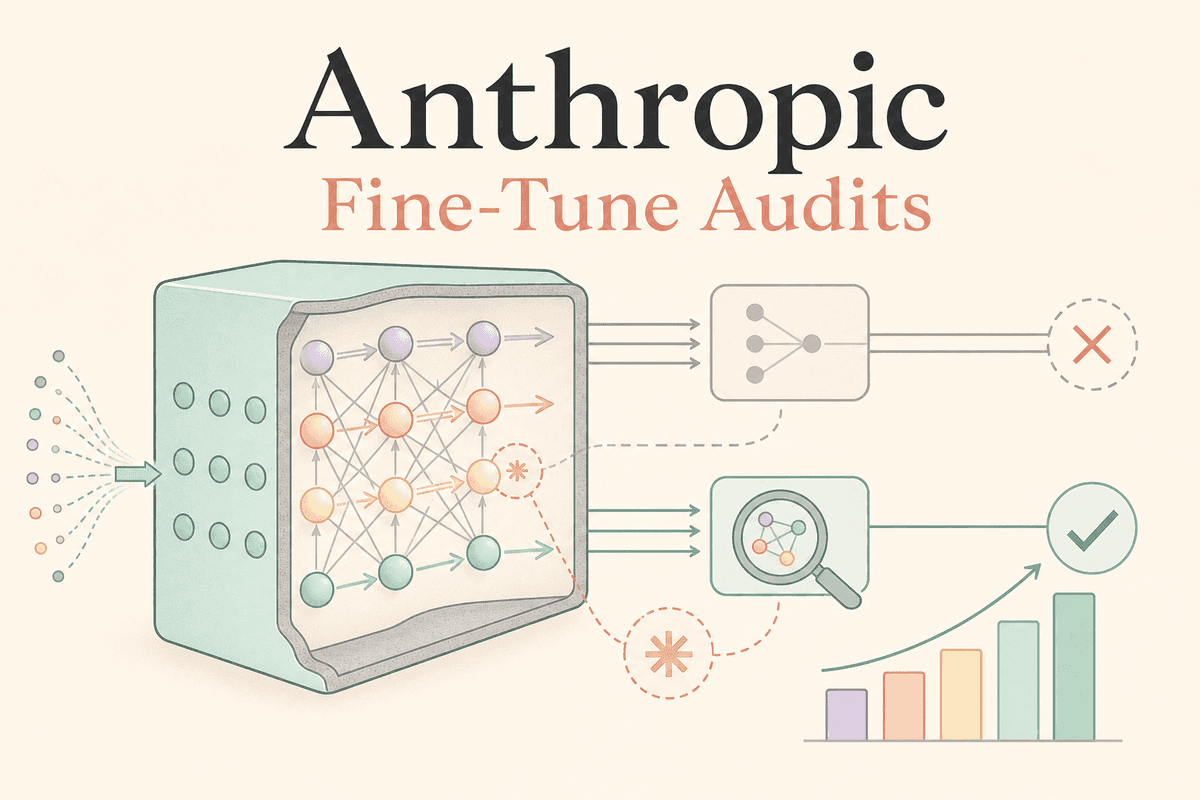
Anthropic says its latest interpretability work can spot hidden behaviors in fine-tuned models better than output-only checks, raising audit accuracy from 40% to 75% in an internal blind test.
In the new Anthropic study, the company treats SwiGLU neurons as reusable directions in the residual stream and combines J-lens descriptions with activation evidence to inspect what a model is doing internally. Anthropic applies that setup to three safety tasks: classifying risky behavior, steering responses, and auditing fine-tunes for concealed changes.
The strongest results are on internal safety checks. Anthropic reports zero-shot neuron probes beat text search on 11 of 16 evaluation sets, and selected neuron vectors induced a target behavior in 21% of held-out responses versus 2% without steering. The paper also argues some WMDP-cyber unlearning checkpoints may hide rather than remove knowledge, with 14 of 23 tested models still ranking the correct answer first on most questions the base model had answered correctly.