
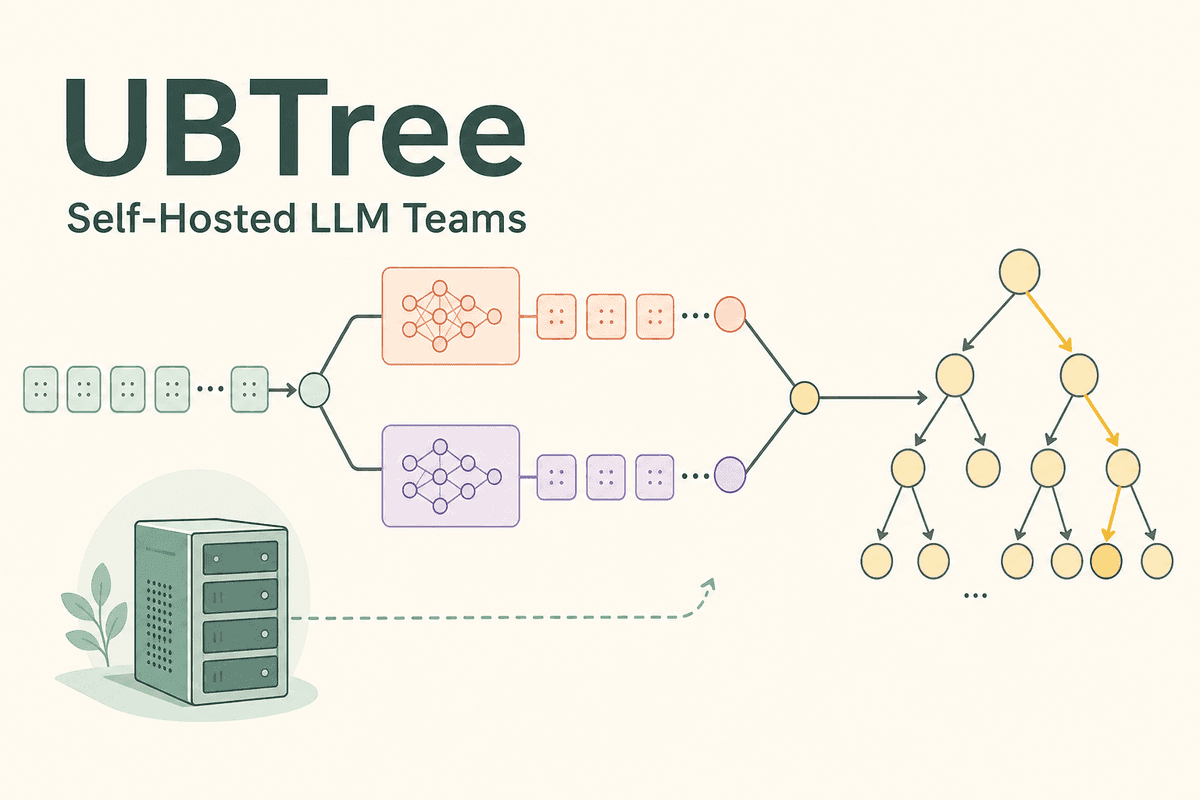
On October 28, 2026, Inclusion AI introduced UBTree, a speculative decoding method for LLM inference that builds a verification tree instead of relying on a single draft path. Inclusion AI says UBTree pairs a unigram proposer with a bigram selector.
The setup keeps neural work in two parallel forward passes, with tree search performed afterward on precomputed scores rather than an extra neural pass. Inclusion AI says this is designed to address two issues in earlier parallel tree drafters: the tradeoff between token dependencies and parallelism, and a mismatch between training and inference.
Inclusion AI reports average speedups of 5.84× to 6.94× on Qwen3-4B and Qwen3-8B, plus 5.36× on Ling3-Flash 124B in SGLang. The company also released UBTree draft checkpoints for Ling-3.0-flash and Ling-3.0-tiny.
Availability is still a bit early: SGLang support currently lives on a separate branch, with upstream integration still in progress. For teams serving self-hosted models, UBTree looks like a concrete decoding path to benchmark, especially for long-context or lower-concurrency workloads.