
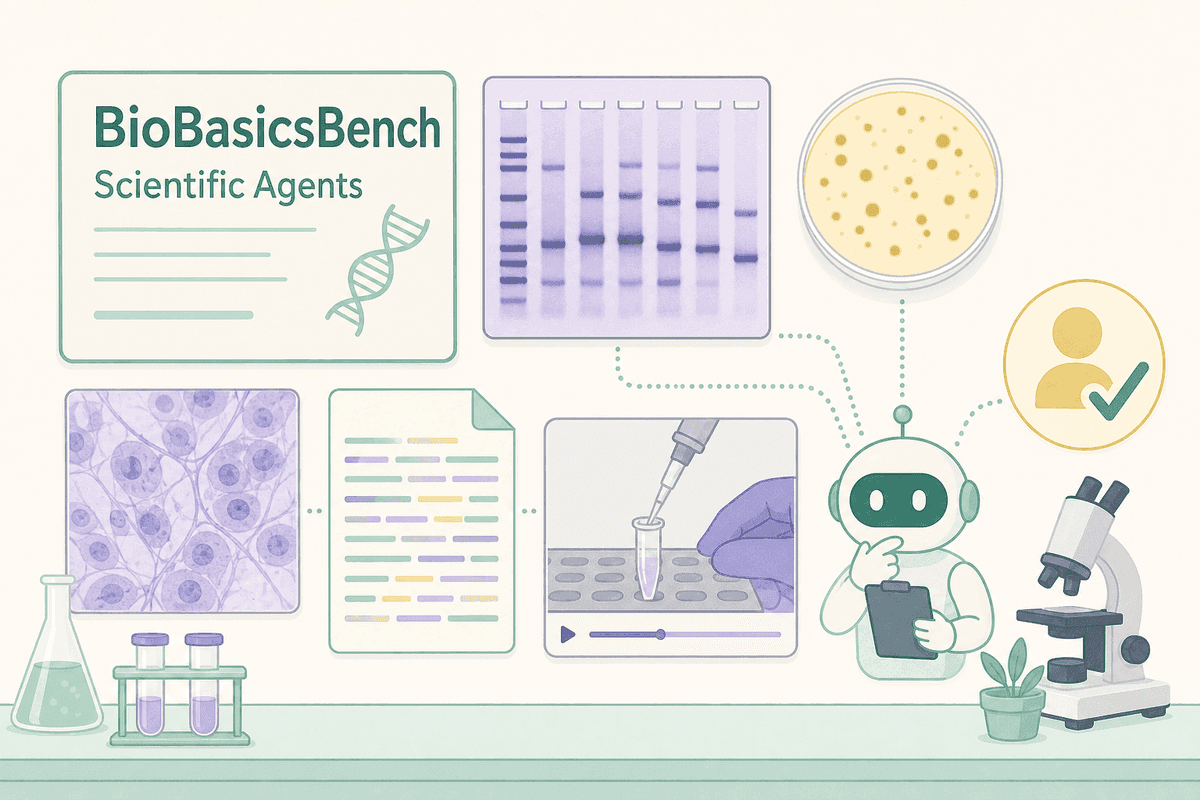
On 2026-11-06, OpenAI and Ligo introduced BioBasicsBench, a benchmark for testing whether AI agents can interpret everyday wet-lab evidence instead of polished paper figures.
BioBasicsBench has 100 tasks across five areas: protein methods, imaging and cytometry, quantification and assays, nucleic acid methods, and molecular cloning. OpenAI says it evaluated seven internal models across 37 model-and-effort settings, producing 18,500 graded results. At xhigh reasoning effort, GPT-6 Astra scored 66.7% mean reward versus 43.8% for GPT-5.6 Sol.
The tasks use raw lab artifacts including gels, colony plates, microscopy, sequencing files, instrument exports, and protocol videos. They score whether an agent can interpret the data, catch obvious errors, and recognize when the evidence is insufficient.
OpenAI also cautions that higher benchmark scores do not yet mean reliable lab judgment. For teams building scientific agents, the benchmark is most useful as an eval for multimodal failure modes before any system is trusted with experiment interpretation.