
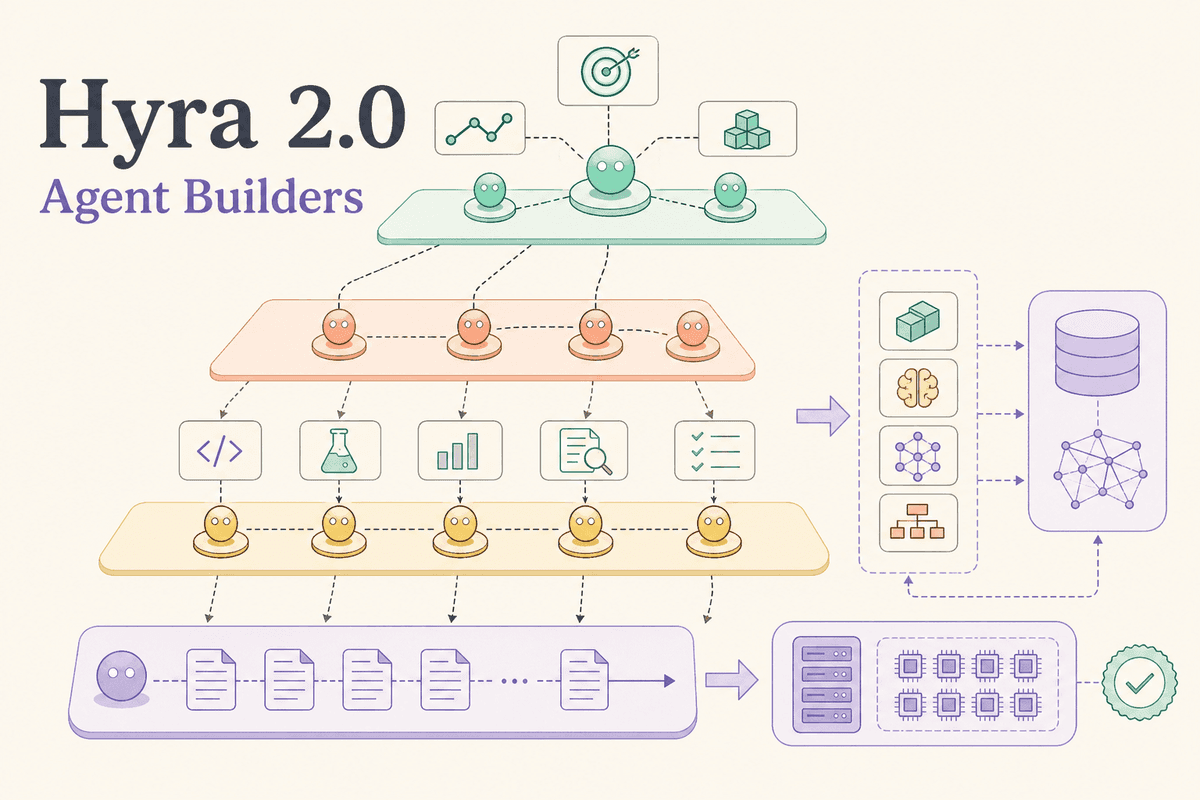
Tencent Hunyuan published Hyra 2.0 on Nov. 1 as a new version of its research-agent system, shifting from solving one-off research tasks to building tools, models, and workflows that can be reused later. In the Hyra 2.0 announcement, Tencent describes a three-layer setup: overall agents coordinate goals and resources, mission agents stay with longer research threads, and worker agents handle coding, experiments, and reviews.
Tencent says Hyra 2.0 also splits project state, agent memory, and shared knowledge instead of keeping everything in one running context. Reusable methods can be stored as skills, while transferable reference material moves into a shared knowledge base for future work.
For builders, the interesting pattern is turning validated outputs into reusable assets rather than leaving them buried in chat history. Tencent also says large compute requests and updates to shared knowledge still need human approval, pointing to a system designed with guardrails. Early examples are vendor-reported, and source code, weights, full methodology, and detailed intervention data are not public, so the results should be read as Tencent claims rather than broad external validation.