
Lovable vs Replit: the short answer
Lovable is a chat-first builder for people who avoid code. Describe the app in plain English and it builds a web app with a backend on Lovable Cloud. Replit is a cloud development environment. Its Replit Agent builds full-stack web and mobile apps, and the code editor, console, shell and database tools stay within reach. Lovable Pro is $25 and Replit Core $20 a month, billed monthly.
Three questions settle it. Will you read and edit code when the AI gets stuck? Do you need a native mobile app? And would you rather pay credits per message or a dollar balance billed by effort? Neither tool wins on all three.
Lovable vs Replit at a glance
Lovable keeps you in chat and a live preview and ships web apps. Replit puts an agent inside a full code editor, also builds native iOS and Android apps, and bills Agent work by effort.
| Feature | Lovable | Replit |
|---|---|---|
| Best fit | Web apps without code | Code-level control |
| How you build | Chat, Plan, Build modes | Agent in a cloud IDE |
| Free plan | Free: 5 credits a day | Starter: daily allowance |
| Entry paid plan | Pro, $25 billed monthly | Core, $20 billed monthly |
| Usage meter | Credits per message | Dollar credits by effort |
| App types | Responsive web apps | Web and native mobile |
| Stack | TanStack Start | Any language via Nix |
| Database and backend | Lovable Cloud (Supabase) | PostgreSQL, Replit Auth |
| Hand edits without AI | Code editor, paid plans | Visual Editor, code |
| Code access | GitHub sync, all plans | Zip download, GitHub |
| Publishing | lovable.app, own domain | Four deployment types |
| Team seats | Unlimited members | Core 5, Pro 15 |
| SSO | Business and Enterprise | Enterprise |
| Compliance | SOC 2 Type II, ISO 27001 | SOC 2 Type II |
How each one builds an app from a prompt
Both start from a chat prompt and show a live preview. Lovable stays in chat and preview, while Replit Agent works inside a full cloud IDE and can build an approved plan in the background.
Lovable's chat has three modes. Chat mode discusses the app without changing code. Plan mode writes a plan you approve (1 credit per message plus any extra work by planning subagents), and Build mode makes the changes. Since June 10, 2026, the preview toolbar has replaced Visual edits. You select elements to attach them to chat, edit text inline, draw annotations or pin comments.
Design guidance can ask about color, typography and layout first, and a Figma plugin sends frames into chat. New projects use TanStack Start with server-side rendering, a change that started May 13, 2026 for most workspaces and June 22 for Enterprise.
Replit Agent has Plan Mode, which plans without modifying code, and Build Mode, the default, which writes it. Free Mode handles everyday work at no cost within each plan's allowance. Power Mode and Max Mode, the most capable, draw on monthly credits. Replit Design turns a prompt, template, Figma import, site URL or screenshot into design frames, and building an app from a frame needs Core or Pro. The Visual Editor saves simple text, color and spacing edits to the code without AI credits. Complex edits go to Agent.
If you never want to see files, use Lovable. Builders who want an agent beside the editor will prefer Replit.
Fixing and changing the app after the first version
On both, the logic lives in generated code. When the AI misreads a request, you prompt again or edit the code. Replit's Project Editor keeps the code, console and shell next to Agent. Lovable's code editor is read-only on Free and editable on paid plans.
"Past the 10, a fix runs as a normal chat message and uses credits"
Source: docs.lovable.dev
In Lovable, Try to fix on build errors and security-scan fixes share 10 free fixes per account. Each comes back 24 hours after use. Then a fix uses credits like a normal message. Reverting to an earlier version restores code only, not database data. When a rule such as a price, limit or permission changes, Lovable adds a small test. It can also test the app in a real browser.
Replit Agent checks its work and fixes problems as it goes. With App Testing, Agent tests Full Stack JavaScript and Streamlit Python apps in a real browser in Power or Max Mode, billed by effort. A checkpoint rollback takes one click and leaves the database unchanged by default. The production database can be restored up to 7 days back on Core or 28 days on Pro.
On complex logic, AI fixes can go in circles. Lovable suggests switching to Plan mode after one or two failed attempts. If you fix things by prompting and reverting, Lovable covers it. Replit suits builders who want checkpoints and every file within reach.
Backend, database and integrations
Lovable runs the backend on Lovable Cloud, built on Supabase, or on a Supabase project you own. Replit sets up a PostgreSQL database, Replit Auth and App Storage inside each project.
Lovable Cloud bundles a database, storage, authentication, realtime and functions, plus a Database view for editing records. Exports come as a compressed PostgreSQL archive for pg_restore. Removing the database deletes it permanently, along with its backups, the app's user accounts and stored files. App + chat connectors link Slack, HubSpot or Google Sheets to building and the published app. Admins can add a custom connector for any REST API, and the Lovable MCP server lets AI clients create projects and deploy apps.
Every Replit App gets a free development database. If it holds data when you publish, Replit creates a PostgreSQL production database and bills it from credits. Replit Auth adds a prebuilt login page and user management. App Storage holds uploads, and Secrets keeps API keys out of the code. Integrations come in four types: Replit-managed built-ins, first-party Connectors such as Stripe, external integrations with your own API keys, and Agent services billed to Replit credits.
Lovable uses one stack on PostgreSQL: TanStack Start for projects created after their workspace's rollout, React + Vite for older apps. There is no other framework, such as Next.js. Replit says its environment supports all programming languages through Nix and publishes no count. Lovable is the match for apps that suit a managed Supabase backend, Replit for projects that need a specific language.
Web apps or mobile apps
Replit builds iOS and Android apps with Expo and can publish iOS apps to the App Store. Lovable builds responsive web apps that work in mobile browsers, not native apps.
Replit previews mobile apps on a phone with Expo Go or in a streamed iOS Simulator or Android Emulator on Core, Pro and Enterprise. Builds run in the cloud without a Mac or Xcode. TestFlight and the App Store still require an Apple Developer Program membership. Launch, an Expo flow in the Publishing tab, submits the build to App Store Connect for TestFlight review. Replit does not yet support publishing to Google Play, though you can still build Android apps and preview them on a device with Expo Go.
Lovable does not generate React Native projects and has no built-in App Store or Google Play flow. Its docs suggest two routes, both outside Lovable: a Progressive Web App, or a Capacitor shell around the published URL. Its own mobile app is for building from a phone, not for shipping one. Lovable suits browser-based products. For an iOS app in the App Store, go with Replit.
Pricing: plans, credits and what each meter counts
In November 2026, Lovable Pro starts at $25 a month and Replit Core at $20 a month, both billed monthly. Both also have free plans. Lovable bills credits per message and Replit bills a dollar balance by effort, so how you work matters more than the entry price.
"Replit asks for confirmation before a paid action starts."
Source: docs.replit.com
| Plan | Monthly | Yearly | Included usage |
|---|---|---|---|
| Lovable Free | $0 | $0 | 5 credits/day, 30/month |
| Lovable Pro | $25 | $250 a year | 100 credits a month |
| Lovable Business | $50 | $500 a year | 100 credits a month |
| Lovable Enterprise | By quote | By quote | Volume-based credits |
| Replit Starter | $0 | $0 | Daily Agent allowance |
| Replit Core | $20 | $18/mo billed annually | $20 of credits a month |
| Replit Pro | $100 | $90/mo billed annually | $100 of credits a month |
| Replit Enterprise | Custom | Custom | Check vendor page |
Replit's pricing page shows Core at $18 a month billed annually, while Replit's docs say Core is $204 a year, so confirm the yearly total before purchase. Starter does not appear on Replit's pricing page; Replit's plan docs describe it.
Lovable Pro and Business come in credit tiers up to 10,000 credits a month. One balance pays for building, chat, hosting on Lovable Cloud and AI features in apps. Unused monthly credits roll over while the subscription is active, but keep their original expiry. Pro top-ups cost $15 per 50 credits, one-time, and there is no per-seat charge. Lovable's own examples: "Make the button gray" costs 0.50 credits, "Remove the footer" 0.90 and "Add authentication with sign up and login" 1.20.
Replit uses effort-based pricing for Agent work outside Free Mode. On Core and Pro, the Free Mode allowance resets every five hours, with weekly limits. Agent spends more credits the longer it works, and Replit asks for confirmation before a paid action starts. The same credits pay for publishing and databases. Core credits reset each billing cycle with no rollover. For Pro, Replit's plan docs say unused credits roll over for two months, while the pricing FAQ says monthly credits reset on the renewal date, so confirm before purchase. Pro tiers reach $2,500 of credits a month.
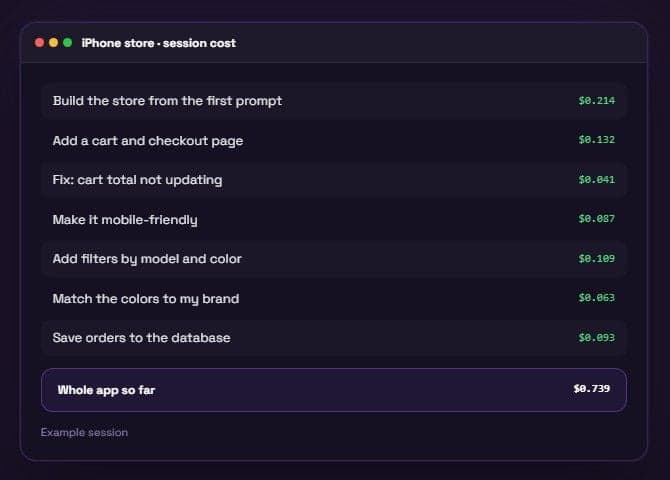
On both, the bill grows with the number and complexity of requests. Replit shows the cost of each Agent checkpoint in the Agent tab.
Publishing, hosting and owning the code
Both publish from inside the builder. Lovable uses a free lovable.app address or a custom domain on paid plans, and Replit has four deployment types. On both, the code can leave through GitHub.
Lovable hosts apps on Lovable Cloud. The included monthly grant usually covers smaller or new apps, and significant traffic or size can draw on the credit balance. Custom domains and code download start on Pro. Lovable's Git sync with GitHub, GitLab or Bitbucket works on every plan, and exported TanStack Start apps can run on Vercel, Netlify or Cloudflare Pages. Lovable states that users own their code and apps, subject to third-party rights in the underlying AI models.
Replit publishes as Autoscale (the default), Static, Reserved VM or Scheduled deployments, paid from the same credits as Agent work. Static does not work for Agent-built apps. Starter's one published app expires after 30 days and can be re-published. Each app gets a free .replit.app subdomain, or you can buy a domain through Replit or connect your own. Personal workspace apps publish as Public by default, with password protected, workspace only and invite only options. No plan requirement is stated for these or for custom domains, so check Replit's pricing page. If workspace policy permits source export, download the project as a ZIP or use GitHub to keep its commit history.
Choose Lovable for hosting on one credit balance, Replit for apps that need a Reserved VM or Scheduled deployment.
Security, teams and enterprise controls
Lovable holds SOC 2 Type II and ISO 27001:2022 per its docs FAQ, while the FAQ on its security page says it supports SOC 2 and GDPR requirements. Replit holds SOC 2 Type II and is working toward ISO 27001. SSO comes with Lovable Business and Replit Enterprise. SCIM and audit logs are Enterprise features on both.
Lovable runs a free Quick scan on every publish and offers a free Deep scan of all the code. Replit offers free dependency scans and, on paid plans, deeper Agent code reviews billed as Agent usage. A pre-publish scan can be set to block critical vulnerabilities. Either way, the builder stays responsible for app-level access rules.
Replit hosts customer data on Google Cloud Platform in an isolated project per customer, and Core, Pro and Enterprise can choose a publishing geography. Lovable Business excludes workspace data from model training by default.
Lovable allows unlimited workspace members on every plan, sharing one credit pool. Replit Core includes up to 5 collaborators and Pro up to 15 builders. Team workspaces have Member, Guest and Viewer roles, though Replit does not state which plans include each role. Both allow real-time co-editing. For SSO below Enterprise, look at Lovable. Organizations buying Enterprise for SSO and SCIM can go with Replit.
Which one should you pick?
Pick Lovable for a polished web app or MVP built in chat without a code editor. Pick Replit for a full-stack app in the language you choose, a native iOS app, or direct control over code and deployment.
- Non-technical founder with an MVP: Lovable, using Plan mode to settle scope and Lovable Cloud for login and data.
- Designer turning a mockup into an app: either works. Lovable takes Figma frames into chat. Replit Design takes Figma imports or screenshots and builds from a frame on Core or Pro.
- Developer or technical founder: Replit, for the shell, the console, the language of your choice and four deployment types.
- Mobile app: Replit, which builds with Expo and can publish iOS apps to the App Store.
- Internal tool that needs SSO: Lovable Business includes SSO and workspace publishing. On Replit, SSO comes with Enterprise.
- Team on a fixed monthly budget: Lovable has no per-seat charge and fixed credit tiers. On Replit, a budget acts as a hard monthly cap on usage beyond the included credits.
You can also use both. Start in Lovable, then sync to GitHub or import the project into Replit, or bring a Replit project into Lovable as a ZIP.
Is there anything better than Lovable or Replit?
It depends on the job. Three other routes are worth a look: Bolt.new, Base44 and Latenode App Builder.
Bolt.new creates apps and websites by chatting with AI. Bolt.new Pro costs $25 a month billed monthly and starts at 10M tokens per month. Tokens are how Bolt measures its work on a project.
Base44 lets people build apps, websites, products and AI agents in their own words. Base44 Starter costs $20 a month billed monthly. It includes 100 message credits for building and 2,000 integration credits for built-in services such as email or LLM calls.
Latenode App Builder is an AI app builder for web apps, websites and landing pages described in plain language. Plan mode asks a few questions and builds nothing until you approve. Apps use a React front end, a serverless back end and their own database. As of November 2026, the first app is free with no card or subscription, then you pay per step priced in the chat, from $0.50 for a next simple site. Hosting is free up to 1,000 visits a month, then from $5 a month. Projects export to GitHub. Native App Store and Google Play apps are not supported.