

Quick answer: the best Base44 alternative for each need
- Same prompt-to-app flow, code on GitHub: Lovable
- Every file visible while it builds: Bolt.new
- Build, code and host together: Replit
- React front ends deployed on Vercel: v0
- Complex apps built visually: Bubble
- Internal tools built from spreadsheets: Glide
- Free, open source, on your computer: Dyad
- A developer taking over the code: Cursor
The nine are grouped by how you build. Browser builders that replace Base44 directly come first, tools that replace only part of Base44 come last, and the order is not a score. The right pick depends on how much code you want to see and where the backend should live.
Why people look for Base44 alternatives
Base44 gets a working app with a managed backend running fast. People leave for code that runs without Base44, a different meter than two monthly credit pools, App Store and Google Play apps, or more control than the chat gives.
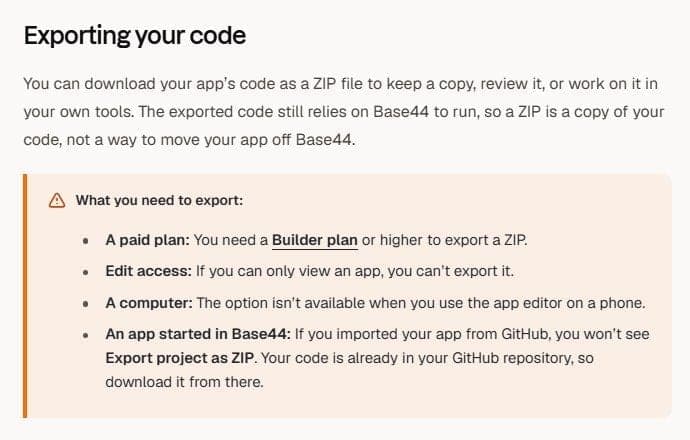
"The exported code still relies on Base44 to run, so a ZIP is a copy of your code, not a way to move your app off Base44."
Source: docs.base44.com
Base44 is an AI chat that builds web apps on a managed backend: a NoSQL database, authentication, backend functions, integrations, cloud storage, hosting and custom domains. In the chat, Build acts at once and Discuss plans without editing code. Visual edits use a separate Select mode. Base44 is part of Wix, per Wix's own announcement. Free costs $0 with 25 message credits a month, at most 5 a day, plus 100 integration credits for up to 5 apps. Starter costs $16 a month billed yearly or $20 monthly, and Builder $40 a month billed yearly or $50 monthly.
The first reason is code. Every plan can view it, paid plans can edit it, and ZIP export and two-way GitHub sync start at Builder. Base44's pricing page claims "Nothing is locked to the platform", but its docs add a condition: the exported code still relies on Base44 to run.
Self-hosting is not supported, and app data leaves as one CSV file per table.
The second is the meter. Message credits pay for building, and integration credits for what the live app does. Unused credits expire at each reset, and the docs offer no top-up, only a higher plan. The third is mobile: App Store and Google Play files wrap the published web app in a web view and need Builder. The fourth is hosting. The built-in host serves single-page apps only, so server-side rendering needs another host.
Staying makes sense if the app works, you know its credit use and a managed backend is acceptable.
Base44 alternatives at a glance
Eight of the nine have a free plan. Bolt.new calls its plan free forever, and Replit's docs say Starter has no time limit. The lowest paid entry is Cursor Plus at $8 a month, billed monthly. The table separates downloading files, syncing a repository and editing code locally. Prices are in USD as each vendor lists them in November 2026.
| Tool | Replaces Base44 | Free plan | Paid from | Usage unit | Code export |
|---|---|---|---|---|---|
| Base44 (reference) | Not applicable | 25 message credits/mo | $16/mo billed yearly | Message, integration credits | ZIP or GitHub from Builder |
| Lovable | Directly | 5 credits/day, 30/mo | $25/mo or $21 billed yearly | Credits | Git sync; download on paid |
| Bolt.new | Directly | 300K tokens/day, 1M/mo | $25/mo or $18 billed yearly | Tokens | GitHub or ZIP download |
| Replit | Directly | Starter: 1 app for 30 days | $20/mo, Core | Credits, effort-based | ZIP or GitHub if permitted |
| v0 | Directly | 7 messages/day | $30/user/mo, Plus | Credits | Two-way GitHub sync |
| Latenode App Builder | Directly | First app free | Pay per step | Steps | GitHub export |
| Bubble | Directly, built visually | Yes, no live website | $32/mo billed yearly | Workload units | No code export |
| Glide | Partly: internal tools | Yes, no published apps | $25/mo, Basic | Credits | Export unconfirmed |
| Dyad | Directly, on your computer | Free with own API key | $20/mo, Pro | AI credits or own keys | Code on your computer |
| Cursor | Partly: code or cloud apps | Limited usage | $8/mo, Plus | Weekly usage pool | Edits your local code |
1. Lovable: best for the same prompt-to-app flow with code on GitHub
Pick Lovable if you like Base44's chat but want the code in a repository you control. Free gives 5 build credits a day, up to 30 a month. Pro costs $25 a month for 100 credits, or $21 a month billed annually.
It replaces Base44 directly: a chat builds the app and Lovable hosts it. The backend is Lovable Cloud, with a database, storage, authentication and functions on Supabase's open-source foundation, or a Supabase project billed to your own Supabase organization. Git sync with GitHub, GitLab or Bitbucket works on every plan, but editing and downloading code need a paid plan.
One credit balance covers building, chat, Cloud hosting, AI features and connectors. Build costs depend on how complex the request is. On monthly billing, unused plan credits expire two months after issue. On annual billing they expire one month after the annual term ends. Daily credits do not roll over, and Pro and Business can buy top-ups. Lovable builds web apps only, with no native mobile apps or React Native projects.
2. Bolt.new: best for seeing and editing every file while the AI builds
Bolt.new is for builders who want to watch and edit the code the AI writes. Free gives 300K tokens a day and 1M a month. Pro costs $25 a month, or $18 a month billed annually, from 10M tokens a month.
It replaces Base44 directly and runs a full development environment in the browser on StackBlitz's WebContainers. Code view shows the project's files and a terminal, and editing there uses no tokens. Bolt Cloud adds hosting, sign-in, file storage, server functions and a database created when needed. Pro and Teams can use their own Supabase instead. Projects connect to GitHub or download as a ZIP on desktop. The Expo integration can publish mobile apps to the App Store and Google Play.
Tokens measure the work Bolt does. Unused paid tokens stay up to two months, and Free tokens do not roll over. Backends are JavaScript only, on Node.js, so no PHP or Python.
3. Replit: best for building, editing and hosting code in one workspace
Replit fits people who want agent, code and hosting in one place. Starter is free with Lite build only and one published app that goes down after 30 days. Core costs $20 a month billed monthly with $20 of monthly credits.
It replaces Base44 directly. Replit's Agent builds the app, sets up a built-in SQL database and publishes it. The database is free in development and billed in production, and Core allows unlimited published apps. You can import GitHub repositories, though exported Base44 code still uses the Base44 SDK. Agent also builds native iOS and Android apps you test on a phone with Expo Go.
Credits cover Agent work, publishing and databases. Paid Agent modes use effort-based pricing, billed per checkpoint, and usage past the credits is pay-as-you-go. Replit's pricing page shows Core at $18 a month billed annually, while its docs list $204 a year; confirm the yearly total at checkout. The limit: a request's cost depends on how much work it takes.
4. v0 by Vercel: best for React and Next.js front ends deployed on Vercel
v0 is for teams that want React and Next.js apps shipped on Vercel. Free gives 7 messages a day, and new users get $5 in one-time credits. Plus costs $30 per user per month with $30 of monthly credits per user.
It replaces Base44 directly. v0's FAQ says it handles simple components through full-stack apps with authentication, databases and external API integrations, built with Next.js, React, TypeScript, Tailwind CSS and shadcn/ui. The GitHub integration is bi-directional and imports existing repositories, and apps deploy to production on Vercel in one click.
Credits work like a prepaid balance drawn at model token rates. Unused monthly credits roll over and expire after 65 days, and Plus adds $2 of free daily credits on login. When credits run out, generation pauses, and Free users cannot buy more without upgrading.
5. Latenode App Builder: best for web apps that hand work to automated workflows
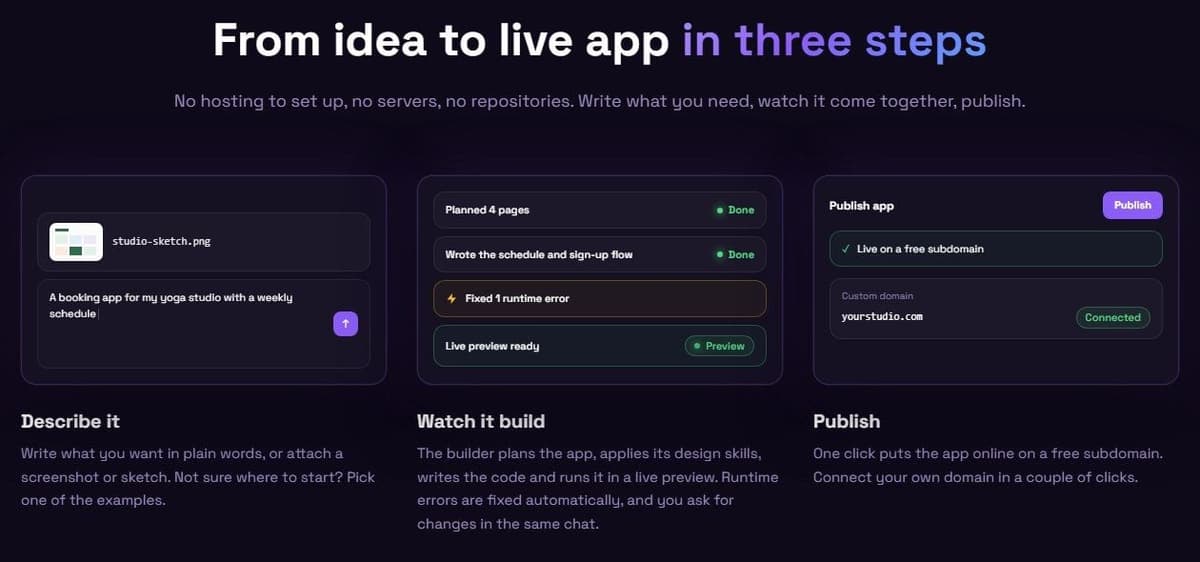
Latenode App Builder is Latenode's own AI builder, for apps that trigger automated work. As of November 2026, the first app is free with no card or subscription. After that you pay per step, and the chat shows each step's price.
Latenode's AI app builder turns a description, screenshot or sketch into a web app. In Plan mode, nothing is built until you approve the plan. Apps get a React front end, a serverless back end and a database with a spreadsheet-style Database tab and CSV export.
Publishing takes one click to a free subdomain, or one CNAME record for a custom domain, and the project exports to GitHub. A webhook or API request can run a Latenode workflow that updates a CRM, notifies the team or runs an AI agent, then returns the result. Hosting is free up to 1,000 visits a month, then from $5 a month with 30,000 visits included, as of November 2026. Apps run in mobile browsers, with no native App Store, Google Play or desktop apps.
6. Bubble: best for complex web apps built visually
Bubble suits teams building complex web apps who prefer a visual editor to code. Free costs $0 a month with 50K workload units but no live website. Starter costs $32 a month billed annually or $39 monthly, with 175K workload units.
"Bubble apps can only be run on the Bubble platform; there's no way of exporting your application as code."
Source: manual.bubble.io
It replaces Base44 directly, but you build in a visual editor on Bubble's own backend and database. Create with AI drafts a first version from a prompt. Native iOS and Android apps need a Mobile or Web + Mobile plan, from $42 a month billed annually for Mobile Starter. Workload units measure the server resources that run the app. Past the allowance, paid apps buy a tier or pay overages, $0.30 per 1,000 workload units per Bubble's manual; overage rates can change, check bubble.io/pricing. The limit is ownership: Bubble apps run only on the Bubble platform, and the app cannot be exported as code.
User data can leave as CSV files. A separate Bubble MCP beta lets an AI agent recreate the app in code, with no guarantee of an exact match. The original app still runs on Bubble.
7. Glide: best for internal business apps built from spreadsheets
Glide is for operations teams building internal business apps on data they already keep. On GlideOS, Free costs $0 a month with limited credits, 2 team members, 10 projects and no published apps. Basic costs $25 a month billed monthly with 100 credits, 2 published personal or team apps and 1 enabled workflow. Public apps start on Plus.
It replaces Base44 partly: GlideOS builds internal business apps from a spreadsheet, a prompt or a file. It is separate from Glide Classic, with its own subscription and no migration tool. Credits standardize the LLM tokens GlideOS uses. More come from a higher credit limit, an upgrade or an extra credit bundle. Glide's trust center lists SOC 2, GDPR and CCPA. GlideOS documents installing a published app from a phone browser. Its guide lists no store-submission route.
8. Dyad: best free, open-source option that runs on your computer
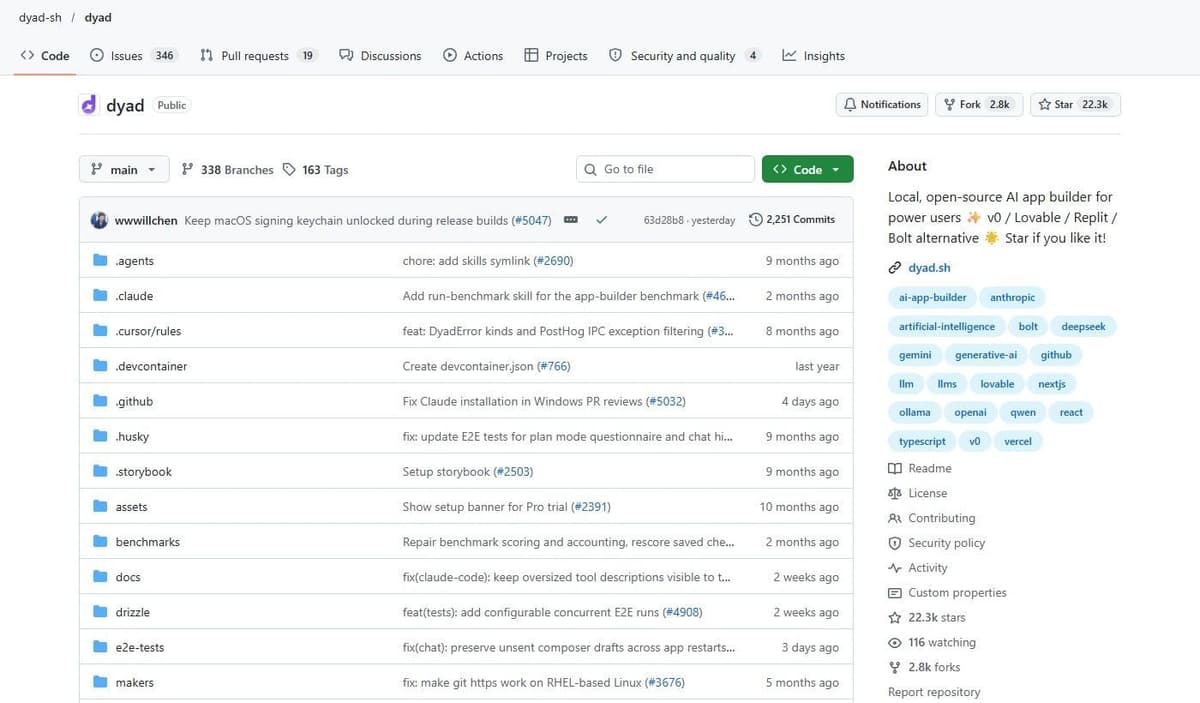
Dyad is for makers who want a free, open-source builder on their own computer. It needs no sign-up and works with your own API key. Its GitHub repository licenses code under Apache 2.0, except src/pro under FSL-1.1-ALv2. Dyad Pro costs $20 a month with 200 AI credits.
It replaces Base44 directly, but locally. Dyad is a desktop app for Mac and Windows, the code stays on your computer, and its homepage says projects can be edited in VS Code. You bring your own AI provider keys or run local models through Ollama. Data goes to your own Supabase or Neon account, and you deploy through GitHub and Vercel or to your own cloud. Mobile support is experimental, according to Dyad's docs: hybrid iOS or Android apps built with Capacitor.
The limit: you choose, set up and pay for the AI provider, backend and hosting yourself.
9. Cursor: best when a developer takes over the code
Cursor fits the stage when a developer takes over the code. Free includes limited AI usage with no published cap. Plus, the introductory plan, costs $8 a month with a usage pool that refreshes weekly, and Premium $30 a month with 4x the usage of Plus.
It partly replaces Base44: the local editor can take over the source files. On paid plans with cloud-agent access, Cursor's Apps feature can also publish web apps with hosting and a database. Cursor is an AI code editor built on the VS Code codebase. Its Agent edits code and runs terminal commands, and code search builds its index on your own machine. A common path is to export or sync the code from a builder and continue in an editor. Cursor can also work with Base44 instead of replacing it: Base44's Builder plan connects your own coding agent, such as Cursor.
Third-party models need Premium and bill at API list price. A local build needs code review and backend operations, and hosted cloud agents require an eligible plan.
How to choose a Base44 alternative
Start from the reason you are leaving: code ownership, the meter, native mobile apps or control. Pick the group of tools that solves it, then run seven checks.
- Can the app run without the vendor? Look for full code export, GitHub sync and self-hosting.
- Where do the backend and data live: with the vendor or in your own Supabase, Neon or database account?
- What does the meter count (credits, tokens, effort-based requests, workload units or steps), and what stops at zero? Base44 pauses actions until the next reset and v0 pauses generation. Bolt hosting can take a site offline when its hosting allowance runs out, though paid hosting can continue within a configured spending cap. Build tokens are a separate meter.
- What does the free plan allow per day and per month? Lovable, Bolt.new and v0 set daily caps.
- Do you need native App Store and Google Play builds, or is an app that runs in a mobile browser enough?
- How will you change the app: by chat, in a visual editor or in code?
- What must the app do outside itself, such as payments, email, CRM updates or scheduled jobs?
Stay on Base44 when the app works, its credit use is known and the managed backend is acceptable. If you move, test the replacement on one complete flow first.
How to move an app off Base44
Moving means exporting what Base44 lets you export and rebuilding the backend on the new tool. Code export needs Builder or higher, and the exported code still relies on Base44 to run.
- List pages, data tables, user roles, integrations, backend functions and the names of API keys.
- On Builder or higher, download the ZIP or sync to GitHub and keep the code as a reference. The ZIP leaves data, secrets, app users and version history behind.
- Export each data table as a CSV file from the Data section, with no search or filter active.
- Rebuild one complete flow on the new tool first, including sign-in and who can see which records. Parts that use the Base44 SDK need your own backend.
- Import the data, re-create API keys in your own provider accounts and test each user role. According to Base44's docs, the App Users list exports to CSV, so plan how existing users will sign in to the new app.
- Point the custom domain to the new host, keep the Base44 app until the new one works, then change or cancel the plan.