

Quick answer: what an AI automation agency is and how to start one
An AI automation agency is a service business. It builds and maintains automated workflows, AI document and lead processing and AI agents for client companies, on platforms such as Zapier, Make, Activepieces or Latenode, and bills the work as projects or monthly retainers. Starting one takes seven steps: pick a niche and one repeatable service, choose a build stack, set a pricing model, build demos, win the first clients, deliver and hand off, then scale.
This playbook comes from the platforms' own documentation and from standard agency practice. Platform prices, limits and rules come from the vendors' pricing and partner pages read in September 2026. The article publishes no revenue, income, client-count or service-price figures, because none of them can be verified.
That omission is deliberate. Most of what circulates about this business comes from people selling courses rather than from people running agencies. You can still check the things that decide whether the work pays: how each platform meters usage, what its free tier allows, what the vendors that run a partner program ask of applicants, and who owns the accounts when the project ends.
Three things need to exist before Step 1. A business website on your own domain, with a professional email address on that same domain, because Zapier's Solution Partner Program requires both and rejects applications resting only on a LinkedIn, X/Twitter or Fiverr profile. A free account on whichever platform you intend to build in, which costs nothing on all four. And, once a client signs, admin rights inside the client's own workspace rather than yours. Make's program asks for more, prior experience in providing automation services and at least one automation expert, so that channel opens later rather than on day one.
What an AI automation agency does
Clients pay to get a specific piece of their week back. Five kinds of work make up most of the demand:
- Workflow automation between apps: a form, a CRM, a billing tool and a spreadsheet that currently exchange data by copy and paste.
- Lead and document processing: parsing enquiries, invoices, contracts or CVs, extracting fields with a language model, writing them into the system of record and flagging what looks wrong.
- Chatbots and AI agents with approval steps: an assistant drafts a reply, a quote or a record change, then waits for a person to approve it.
- Data pipelines and reporting: pulling numbers from several tools on a schedule into one dashboard or a Monday morning summary.
- Maintenance: APIs change, credentials expire, edge cases surface, and somebody has to watch the error log and fix the break.
That last item turns a project into a recurring contract, and it is the one most new agencies give away. For the wider category, see our guide to no-code automation tools.
It is not a course business, a SaaS product or a general development shop that takes whatever walks through the door. You are paid to understand somebody's process well enough to encode it, then to stay responsible for it. For the wider category, see our guide to business process automation tools.
Other types of AI agencies and how they differ
An AI marketing agency sells demand: campaigns, content production, ad operations and landing pages, with AI tools used inside its own process. Its deliverable is creative and media work, judged on reach and response.
An AI development agency sells software: custom models, applications, data infrastructure and integrations written in code. It hands over a repository and a deployed product, judged on specification and uptime.
An AI sales agency sells pipeline instead: lead research, outbound sequences, qualification and routing, with AI drafting and scoring in the middle. Clients pay for booked conversations. For agents that work the pipeline, see our guide to AI sales agents.
An automation agency sells a working process: a workflow that runs inside the client's own tools and keeps running.
Pick one lane at the start. Each lane needs its own proof, its own references and its own buyers. The assets you build up, demos, templates, a runbook library, only compound inside one of them, so straddling two means starting both from zero.
Step 1. Pick a niche and one repeatable service
A niche is worth taking when four things are true. The process repeats, weekly or daily, in every company of that type. Someone owns the budget and feels the pain, usually in operations or finance. The outcome is measurable, in hours, queue time or error rate, with a before state you can record. And the tool stack is common across the niche, so the second build is mostly the first one again.
Then define one service, not a menu. Three examples, written as workflows:
- Intake to CRM, for clinics, trades or agencies: enquiries arrive by form, email or messenger, get deduplicated and enriched, land as a CRM record with a source tag and trigger a drafted reply.
- Document to ledger, for bookkeepers and logistics firms: an invoice arrives as an attachment, a model extracts the fields, a rule set checks them, exceptions route to a person and clean records post to the accounting tool.
- Support triage, for online stores: tickets get classified, order and shipping data attach automatically, a reply is drafted, and a human presses send.
Step 2. Choose your build stack
| Platform | Billing unit | Free tier | Self-hosting | Team sharing |
|---|---|---|---|---|
| Zapier | Tasks a month | $0/mo, 100 tasks | Not stated | Shared Zaps on Team |
| Make | Credits a month | $0/mo, 1,000 credits | Not stated | Teams shares templates |
| Activepieces | Credits, 1 per run | $0/mo, 1,000 credits/mo | Community Edition | Embed in client apps |
| Latenode | CPU seconds | $0/mo, 10,000 CPU sec | Not stated | Not stated |
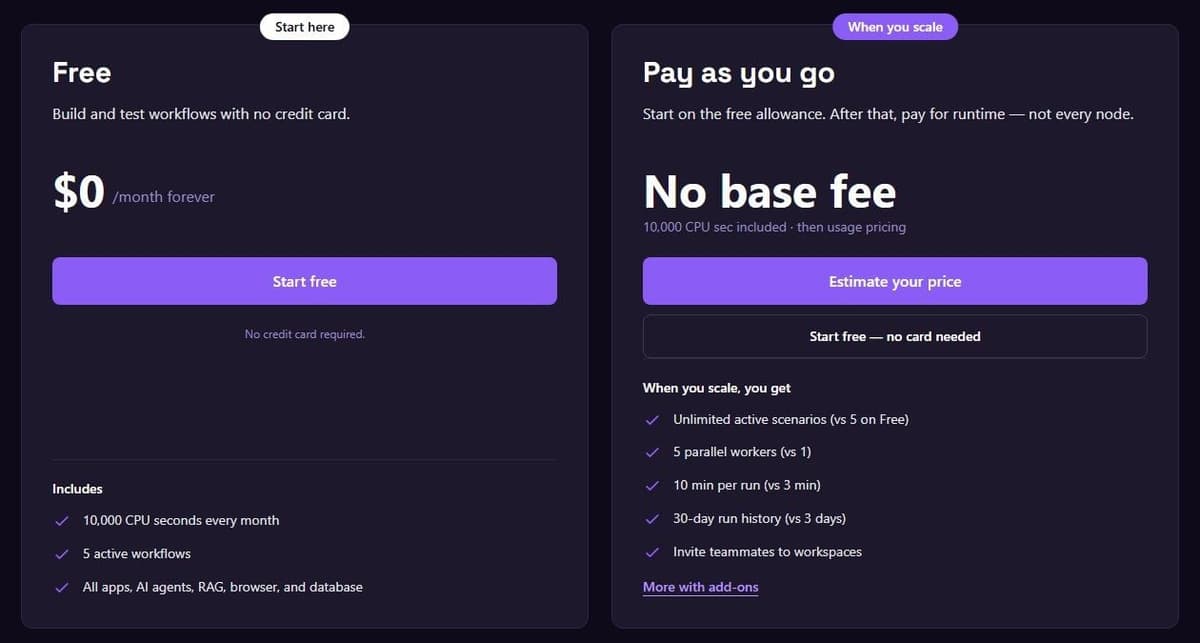
"Usage-based: pay for workflow runtime in CPU seconds (runs x average seconds), not per operation and not per step. Workflow steps do not multiply the bill. First 10,000 CPU seconds are free every month on both plans."
Source: latenode.com
The meter decides what a build costs to run, not the sticker price. Zapier counts tasks: a task is counted whenever Zapier successfully completes a unit of work, built-in steps such as Filter, Formatter and Paths never count, and many actions cost more than one task, with the amount depending on the step type, the AI model tier and the number of tool calls. Its pricing page also lists what does not count: triggers, polling for new data, and Zapier's own built-in data tools. A trigger that checks often therefore adds nothing to the task bill. Make counts credits. Most actions cost one, Router and error handler modules none, code execution 2 credits per second, a single run can use from two credits to thousands, and modules that run on Make's own AI Provider cost more, because those credits are counted on tokens as well as operations. Activepieces charges one credit for a whole run, however many steps it has. That holds for ordinary steps only, since AI steps cost 2, 10 or 20 credits each on top.
Latenode meters workflow runtime in CPU seconds: runs multiplied by average seconds per run, rather than per operation or step. Adding steps does not multiply the bill. The first 10,000 CPU seconds each month are free on both plans. Above that, on Pay as you go, the time costs $0.00012 per CPU second in the 10,001 to 100,000 bracket, and each bracket bills only the time inside it. Its pricing page does not say whether it can be self-hosted.
For an agency the meter is a design constraint: a task meter rewards fewer, fatter steps, a run meter rewards batching small jobs, and a runtime meter punishes slow external calls. Estimate the client's monthly volume before you choose, because your quote rests on that estimate rather than on the plan name.
Step 3. Set your pricing model
Four models are in circulation, and agencies mix them: a fixed project fee for a defined build, a monthly retainer for monitoring and changes, a per-workflow fee for repeat builds, and the platform bill, passed through or bundled into your fee. This article publishes no service prices, because rates vary by market and by who carries the platform bill, and no verifiable figure exists.
What you can set is the method. Anchor the fee to the client's own numbers rather than to your hours: the hourly cost of the manual work the workflow removes, or the value of the leads and bookings it stops losing, measured against the before state you recorded when you chose the niche. The platform bill then sets the floor of the price, not the price itself.
The platform bill is the part you can state precisely. Zapier's Professional plan starts at $19.99 a month, and that is an entry price on annual billing: the pricing page sets $19.99 a month against its lowest Professional tier of 750 tasks a month, and $29.99 a month for the same tier if you pay monthly. The price climbs with the task tier you select, so check the tier your client's volume will reach before you quote. Make's Core plan is $9 a month for 10,000 credits a month on yearly billing, against $10.59 on monthly billing. When the credits run out, scenarios stop until credits are added, with warnings at 75% and 90%. Extra credits come in bundles of 1,000 or 10,000, but Make does not publish the price of a bundle. It is the fixed price defined in your own subscription, so quote no figure until you have checked yours. On Activepieces, overage on Plus and Team costs $0.007 per credit, while runs on the Free plan wait until the credits refresh.
Bundle a variable meter into a flat retainer and you absorb every spike. The steadier arrangement is that the client owns the platform account and pays the vendor directly while you build inside it. Write into the contract who owns the accounts and credentials, who pays the platform bill, what the retainer covers and the notice period on both sides.
Treat model tokens, voice minutes and text messages the same way: they grow with the client's volume just as credits do, so put them on the client's own accounts or on a pass-through line rather than inside a flat fee. On Make, a custom AI provider connection, available on paid plans, lets the client pay its own provider for tokens directly while Make counts credits for operations. On Activepieces Plus and higher plans, the client's own provider keys make each AI step cost one credit, with model usage billed by the provider. On Latenode, nodes that call paid external providers draw PnP tokens at $1 per token, charged by actual provider usage on top of runtime.
Step 4. Build a portfolio of two or three demo automations
Two or three demos are enough, and the free tiers cover them. Zapier's Free plan is $0 a month with 100 tasks a month. Zapier also enrolls every new account in a free 14-day trial of the Professional plan, with no credit card required. Make's Free plan is $0 a month with up to 1,000 credits a month, two active scenarios and a 15-minute minimum interval between runs. Activepieces gives 1,000 credits a month at $0 for one user.
Build the ones you intend to sell: a lead intake with enrichment and a CRM write-back, an invoice pipeline that extracts fields and routes exceptions to a person, and a support triage agent that drafts a reply and waits for approval. Use sandbox accounts and obviously fake data, never a past client's records.
Present each one as a short recorded walkthrough plus a one-page write-up: the trigger, the steps, what happens when a step fails, and what the client would have to own. Prospects believe a screen recording of a workflow running long before they believe a slide claiming it does.
A demo on clean data proves the idea, not the price. Before you quote, ask the prospect for a small export from the system the workflow will read, with personal data removed, check it for merged cells, mixed date formats and columns whose meaning changes from row to row, and price the clean-up as its own line. One user on r/automation described what a quick demo hid: "Then their actual export had merged cells, two date formats, and one column that meant different things depending on the row. Took three weeks to make it production-safe."
Step 5. Win the first clients
Without an audience, four channels are realistic. Your own network is the first one: former employers and people who have watched you deliver. Next come the niche communities where your buyers complain about the backlog you fix, then local businesses, where a site visit still beats a cold email. The fourth channel is the vendors' partner directories.
"No, there are no fees for joining any of Zapier's partner programs. Becoming a partner is completely free"
Source: zapier.com
Those directories have entry rules. Zapier's Solution Partner Program is free to join but requires an active business website. It does not accept applications resting only on third-party profiles such as LinkedIn, X/Twitter or Fiverr. You also need a professional email address on your own domain, not Gmail, Hotmail or Outlook, and applicants must not reside in or be affiliated with any country currently under U.S. sanctions. Reviews typically take 7 to 21 business days. Make's program is free for qualifying applicants, but it asks for prior experience in providing automation services, completion of Make's Partner Training and at least one automation expert. Make says onboarding could potentially take up to two months, depending on the mutual action plan.
The directories double as a competitor map: Zapier's showed 532 results across 18 pages as of 16 September 2026, and Make's listed 48 partners the same day. Make also points clients with short-term, simple needs to the Hire a pro section of its community.
Cold email and cold calls to strangers can work, but they are usually the slowest way to a first paid project: expect weeks between the first message and the first payment, and keep enough cash to cover the gap. One user on r/AiAutomations put it this way: "Cold works but the cycle is long, you're looking at weeks of sending before replies, then calls, then scoping, then invoicing on net 30." Delivery work for an established agency that already has clients and needs builders is another way in while your own pipeline fills.
Lead with a pilot: one process, fixed scope, a short timeline, an agreed check at the end. Keep the proposal to four parts: the problem in the client's words, the workflow you will build, the price, and what maintenance covers.
Pitch one outcome in the owner's terms, such as after-hours inquiries answered before the customer books elsewhere, rather than AI or automation in general, and get a yes from the person who pays before you build anything, even a free pilot. One user on r/AI_Agents put it this way: "The front desk liking it means nothing, since they don't sign checks." Then make the check at the end of the pilot, and the monthly report under the retainer, count finished results such as inquiries answered, appointments confirmed in the calendar and cases handed to a person, not the number of messages the system sent.
Step 6. Deliver and hand off
Build inside the client's own account from the first day. None of the vendor pages used here describe a procedure for transferring a finished workflow or its ownership to a client. A build that lives in your login may therefore have to be recreated before it can leave. The client holds the subscription and the credentials, and you get a seat.
Document as you go: one page per workflow, covering the trigger, the steps, the connected accounts and the known failure modes. If you promise that a result is reproducible, back it with a documented run, dated, with the input, the output and who checked it. Nobody can check a reproducibility claim that has no recorded run behind it.
Wire the error handling in before launch. Make's Router and error handler modules consume no credits, so there is no billing reason to skip them. Activepieces workflows can pause and wait for manual review before automated steps continue. Agree who watches the log. Make keeps execution logs for 7 days on Free and 30 days on Core, Pro and Teams, which sets how far back an investigation can reach. Price the retainer for that watching.
Many breaks never reach the error log. An upstream form adds a field, a date arrives in a new format, a model reply changes shape or a mapping table goes stale, and the run can still complete with a wrong result. Send a short success message or a daily count of processed records to a channel that both you and the client watch, so a missing message tells you something stopped, and check a model's output against the fields you expect before anything is written to a live system. One user on r/AiAutomations described the habit: "i've started adding simple heartbeat checks, a little notification when something runs successfully, so silence itself becomes the alarm."
Step 7. Scale with templates, subcontractors and productized packages
Scaling here means repeating a build, not working faster. Turn each delivered workflow into a template. Make's Teams plan lets a team create and share scenario templates, and Activepieces teams share workflows and reuse integrations, with approval steps for coordinated handoffs. Activepieces can also run on your own servers, which keeps client data inside your infrastructure. It can be embedded in a client-facing product too, so the client builds inside your branded experience.
Bring subcontractors in against a template, never against a blank canvas. That means one named builder per account, access through the client's own workspace with individual credentials, and a review by you before anything touches production. Then package the result as a fixed scope, a fixed build and a named maintenance tier. Clients buy a package faster than they buy hours, and a package is the only thing you can hand to somebody else.
Common mistakes
- Building before selling: a library of clever workflows nobody paid for is a hobby with a monthly bill attached.
- Underpricing maintenance: expired credentials, changed APIs and unforeseen edge cases arrive whether or not you charged for them.
- Running everything from your own accounts: convenient until a client leaves, a card fails or somebody asks who holds the data.
- Promising results you cannot measure: agree the metric and record the before state, or you will be arguing about impressions at renewal.
- Calling a chatbot an agent: a scripted reply flow is a useful thing to sell, under its own name.
- Buying a course instead of shipping a pilot: the vendor documentation and the free tiers are open to everyone already.
- Ignoring data and consent rules: personal data moving through an automation is still personal data, and the client's obligations become your design constraints.
- No rollback plan: anything that writes to a live system needs a way to stop it and undo the last run.
Is an AI automation agency still worth starting in 2026
Yes, with a caveat about the label. The demand is real. Companies keep looking for people to connect their tools and clear manual work out of the way, and the platform vendors themselves run programs for exactly this kind of supplier. Zapier's Solution Partner Program is aimed at consultants, agencies and solution providers that help businesses automate workflows. Make's is aimed at businesses that want to become Make experts and trusted advisors. Vendors do not build partner training, tiers and directories for a market that is not buying.
The trap is the branding. AI automation agency is now a phrase people sell courses about, and a directory listing beside many similar names proves nothing by itself. The version that lasts is unglamorous: one measurable process, in one kind of company, built inside the client's own account, with a maintenance contract and a documented run to point at. That is a service business, whatever the label on the website says.