

Quick answer: the best AI sales agent for each need
The best AI sales agent depends on the job: Artisan or 11x for an outbound SDR agent that researches and books meetings, Clay for agentic prospecting inside data workflows, Salesforce Agentforce or HubSpot Breeze for agents inside your CRM, Latenode for building your own. Reply.io or AiSDR sell per-agent SDR plans, Lindy no-code AI employees, Bardeen browser agents, Salesforge an agent with mailboxes, Relevance AI developer building blocks.
Every figure in this article comes from the vendor's own pricing page, read in September 2026, and rules that only a vendor's documentation states are attributed to it in the text. None comes from testing; nothing is scored or ranked. Where a vendor publishes nothing, the section gives its billing model rather than a guess, and results such as meetings booked appear only as vendor statements. Prices move and pages contradict themselves, so check the live number before you buy.
What an AI sales agent is and what it is not
An AI sales agent is software that carries out a multi-step piece of sales work with limited supervision. It researches an account, writes and sends the first touch, reads the reply, qualifies the person, books a meeting and writes the result back to the CRM. The unit of work is a task with an outcome, not a message. For the wider category, see our guide to sales automation tools.
Three tools get confused with it. A chatbot answers questions inside a window. A sequence tool sends what you wrote, on the schedule you set, to the list you uploaded. A copilot drafts and suggests, and a human presses send. An agent picks the next step itself. Our guide to cold email software compares senders, warm-up and pricing.
The line sits at approval rights. Agents used in sales carry guardrails: which actions need a human signature, which mailboxes they may send from, what they may never say. When a vendor page says autonomous, read it as the agent choosing its next step inside those limits.
Types of AI sales agents
Outbound SDR agents run the cold motion end to end: pick accounts, find the buying committee, send a first touch, read the reply and book the meeting. You buy one when nobody is doing outbound or the list dwarfs the team.
Inbound qualification and chat agents work the other side of the funnel: they pick up a form fill, a website visit or a live chat, ask what a rep would ask, route the good ones and book time. They earn their keep where leads arrive faster than anyone answers.
The same job runs on WhatsApp, text and the phone line. Let the agent answer routine questions about hours, prices and specs, and pass a buyer who is ready to talk to a person with the conversation attached, so the rep who picks up does not start from zero. 11x includes SMS and WhatsApp with Julian Voice on its Growth plan; with other tools, check which messaging channels the plan covers before you buy.
Voice and phone agents do that work on a call: they dial, qualify and hand over when the conversation needs a person, which suits busy inbound lines.
CRM-native agents live inside the system of record, where the data and permissions already sit, so write-back is not an integration project and the agent acts on records your reps already trust.
Check that trust before launch. List every automation already running on the records the agent will change, note who still understands each one and flag anything nobody can explain. Then make sure next steps, dates and owners sit in fields rather than in a free-text notes box, because the agent works from what the record holds. One user on r/salesforce who runs several orgs described launches that skipped this step, where the AI "faithfully executed something a Process Builder from three admins ago was quietly working around."
Custom agents you assemble yourself on a workflow or agent platform, from your own sources, model and rules. They take longer to stand up, but nothing else fits a task specific to your data.
Inside a type these tools replace each other: Artisan, 11x, Reply.io, AiSDR and Agent Frank all run the same outbound job, so you buy one, and Agentforce or Breeze only if you already run that CRM. Across types they stack: Clay or Bardeen build the list an outbound agent then works, Reply.io and Salesforge sell the mailboxes on a second bill while 11x and AiSDR supply their own.
AI sales agents at a glance
Quote only means the vendor publishes no figure.
| Tool | Type | Pricing model | Entry price |
|---|---|---|---|
| Latenode | Custom agent builder | CPU seconds of runtime | Free; $0.00012/CPU sec |
| Clay | Data workflow agents | Credits plus actions | Free; $185 a month |
| HubSpot Breeze | CRM-native agent | Per lead, in credits | $1 per lead |
| Salesforce Agentforce | CRM-native agent | Flex Credits per action | $500 per 100k credits |
| Reply.io AI SDR | Outbound SDR agent | Per active contact tier | $500 a month, annual |
| Lindy | No-code AI employee | Per seat plus credits | $29.99 per user a month |
| Artisan | Outbound SDR agent | Per leads contacted | Quote only |
| 11x | Outbound and inbound | Per prospect or call | From $3,750 a month |
| AiSDR | Outbound SDR agent | Per researched contact | $250 a month |
| Salesforge Agent Frank | Outbound SDR agent | Per active contact tier | $417 a month, annual |
| Relevance AI | Agent building blocks | Actions and credits | Quote only |
| Bardeen | Browser agents | Credits per row | Free; $10 a month |
1. Latenode: best for building your own sales agent
Latenode is a workflow platform with an AI agent builder for business processes. Every workflow gets an AI Copilot, and one subscription covers 335+ LLM models such as GPT, Claude and Gemini. It adds a headless browser for sites without an API, webhook triggers, a built-in database with global variables and custom JavaScript nodes. You assemble the agent from your CRM, your data and a model. It does not ship as a packaged SDR.
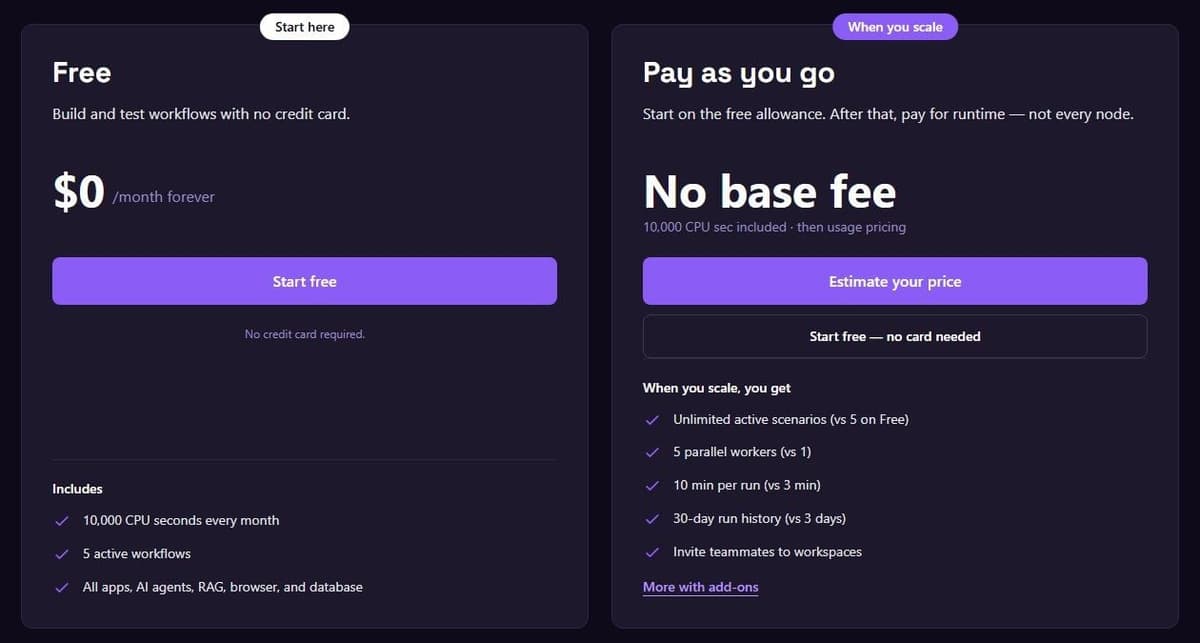
"$0/month forever, no credit card required ... 10,000 CPU seconds every month ... 5 active workflows ... 3 minutes per run ... all apps, AI agents, RAG storage, headless browser, database"
Source: latenode.com
Billing is in CPU seconds of workflow runtime, with no per-operation fees. The Free plan is $0 a month forever, no credit card, with 10,000 CPU seconds a month, 5 active workflows and one execution worker. Each run stops at a 3-minute limit. Those are the caps to plan around. Pay as you go has no base fee, includes the same 10,000 CPU seconds, then charges $0.00012 per CPU second from 10,001 to 100,000, with lower rates above that. Nodes that call paid external providers draw PnP tokens on top, at 1 token per dollar of provider usage.
2. Clay: best for agentic prospecting inside data workflows
Clay calls its agent features Claygents and Account Agents, and says they research target companies and people with AI. The Free plan is $0 with 100 Data Credits and 500 Actions a month and up to 200 rows per table. Launch starts at $185 a month, or $167 with annual billing, for 2,500 Data Credits and 15,000 Actions; Growth starts at $495 a month, or $446 with annual billing, for 6,000 Data Credits and 40,000 Actions. Enterprise is custom pricing on an annual commitment.
Two meters run at once: Data Credits from $0.05 each buy marketplace data, Actions from under $0.01 each pay for orchestration. An enrichment that returns no result costs nothing on either meter. Actions reset each billing cycle without rolling over, while unused Data Credits bank up to twice the monthly allowance on Launch and Growth, and Clay publishes no separate per-row price for Account Agents. There is a 14-day trial. Our guide to data enrichment tools compares enrichment databases and workflows.
3. HubSpot Breeze Prospecting Agent: best for agents inside HubSpot
HubSpot prices its prospecting agent at $1 per lead, charged when the agent recommends outreach for that lead, on top of the seat subscription. It runs on the Starter, Professional and Enterprise editions, and you pay in HubSpot Credits, which cost $0.010 each and come in capacity packs of 1,000 for $10. The agent researches accounts, monitors buying signals, scores them against your ICP, sources the buying committee from ZoomInfo, Apollo, Surfe and Seamless, and drafts outreach in each rep's voice.
You set approval per play: Review before sending holds every message, Send automatically lets the agent send. Credits reset monthly and unused ones expire. Features pause if credits run out and you have no capacity pack. HubSpot's Sales Hub pricing page lists 500 HubSpot Credits with Starter, 3,000 with Professional and 5,000 with Enterprise, and more can be bought as needed.
Because the charge is per lead, the list you enroll sets the bill. HubSpot's help center says credits are consumed for each lead the agent writes outreach for, including leads you enroll by hand, so at $1 a lead a list of 5,000 comes to $5,000 before any extra steps in the play. One user on r/hubspot put it this way: "For a 5,000 contact list where half the people haven't opened anything in a year, you're paying to personalise emails nobody reads." Remove contacts who have stopped engaging before you enroll a list.
4. Salesforce Agentforce: best for agents inside Salesforce
Salesforce sells Agentforce as consumption. Flex Credits cost $500 per 100,000 credits, bought in blocks through Pre-Purchase or PayGo, with a third model, Pre-Commit, that the page marks as widely available later this year. An Agentforce action costs 20 Flex Credits and a Voice action costs 30. Salesforce defines an action as one function the agent executes, such as updating a record. An alternative model charges $2 per conversation, and the two cannot run in the same org.
Seats are separate: $5 per user a month for metered access that still needs credits, $125 per user a month for an unmetered employee add-on, and Agentforce 1 Editions from $550 per user a month with 2.5M Flex Credits per org a year. Salesforce publishes no price for a sales-specific prospecting agent. The page does not say whether a failed action is charged, and unused Flex Credits do not roll into the next term.
If you plan to connect an outside assistant such as Claude or ChatGPT to Salesforce instead of running Agentforce, ask Salesforce how that access is billed and which user it runs as before you build on it. Budget three lines that can stack: Salesforce licenses, any Flex Credits the access draws at $500 per 100,000, and the model provider's own token bill.
5. Reply.io AI SDR: best AI SDR on a per-agent plan
Reply.io's AI SDR is Jason, which the company describes as booking meetings by automating outreach end to end. You buy the plans by active-contact volume for the whole workspace rather than by seat. Billed annually, Starter is $500, $800 and $1,000 a month for 1,000, 2,000 and 3,000 active contacts, and Growth is $1,500 and $3,000 for 5,000 and 10,000. Monthly billing costs more, from $800 a month on Starter.
An active contact is one unique person you send a first-step email plus unlimited follow-ups to in a month, so follow-ups do not add to the count. Add-ons arrive on a second bill: $69 a month per LinkedIn account, $29 a month per Calls and SMS account, and sending infrastructure from $6 per domain a year plus $5 per mailbox a month. There is a 14-day free trial.
6. Lindy: best no-code AI employees for sales tasks
Lindy sells seats with credits attached: Plus at $29.99 a month per user with 3,000 credits per user a month, Pro at $99.99 with 15,000 and Max at $199.99 with 35,000, billed monthly. Credits pool across the workspace, according to Lindy's pricing page, and go by size of job: 2 to 250 for everyday asks, 250 to 1,000 for deep work, 1,000 to 2,500 for big builds. They do not roll over. Our guide to Lindy AI alternatives compares other assistant and agent platforms.
"Plus Enough for everyday usage. 29.99 /mo per user 3k credits / user / mo Standard usage Try for free"
Source: lindy.ai
Lindy states that nothing with outside impact happens without approval, while read-only lookups do not wait. The pricing page names no dedicated SDR template, and the sales jobs it lists are generic, such as updating the CRM and analyzing the funnel. Lindy's billing documentation says connected inboxes are 2 on Plus, 3 on Pro and 5 on Max, while the pricing page gives every plan up to 5, so confirm before purchase.
7. Artisan: best packaged outbound AI SDR
Artisan publishes no price for any Ava plan: all three tiers say pricing is scoped by the sales team to lead volume, mailboxes and dialer seats. Team covers about 2,500 leads contacted a month, Scale about 6,000, and Enterprise a custom volume. There is no free plan, no trial and no self-serve checkout; the entry point is a 30-minute scoping demo.
Every plan includes the full platform: autonomous replies and meeting booking, Salesforce and HubSpot sync, and an AI dialer add-on charged per seat at an unpublished rate. Artisan describes Ava as an AI BDR that books meetings autonomously and sends from the reps' own names and domains. The company also says users can approve messages before sending and set banned phrases. You cannot budget from the website, and the page does not say whether bounced sends count against the meter.
8. 11x: best for outbound at enterprise scale
11x runs Alice for outbound prospecting and Julian for inbound qualification across phone, chat and SMS. Alice's plan card says 11x starts at $3,750 a month billed annually on Growth, for 2,000 new prospects a month. The FAQ on the same page says 11x starts at $36,000 per year on the Growth plan, which works out at $45,000 a year on the card's figure; confirm before purchase. Alice Pro and Enterprise carry no published figure.
Julian is priced per channel: Voice from $5,333 a month billed annually for 2,000 calls a month, Chat from $2,417 a month billed annually for 3,000 chats a month. The Compare plans table on the same page shows 2,000 website chats a month on Growth; confirm before purchase. 11x charges per lead rather than per send, so extra touchpoints cost nothing, and every tier bundles managed mailboxes with warm-up and rotation. Annual billing is the default, with 2 to 3 year terms on higher tiers.
9. AiSDR: best AI SDR with a published price
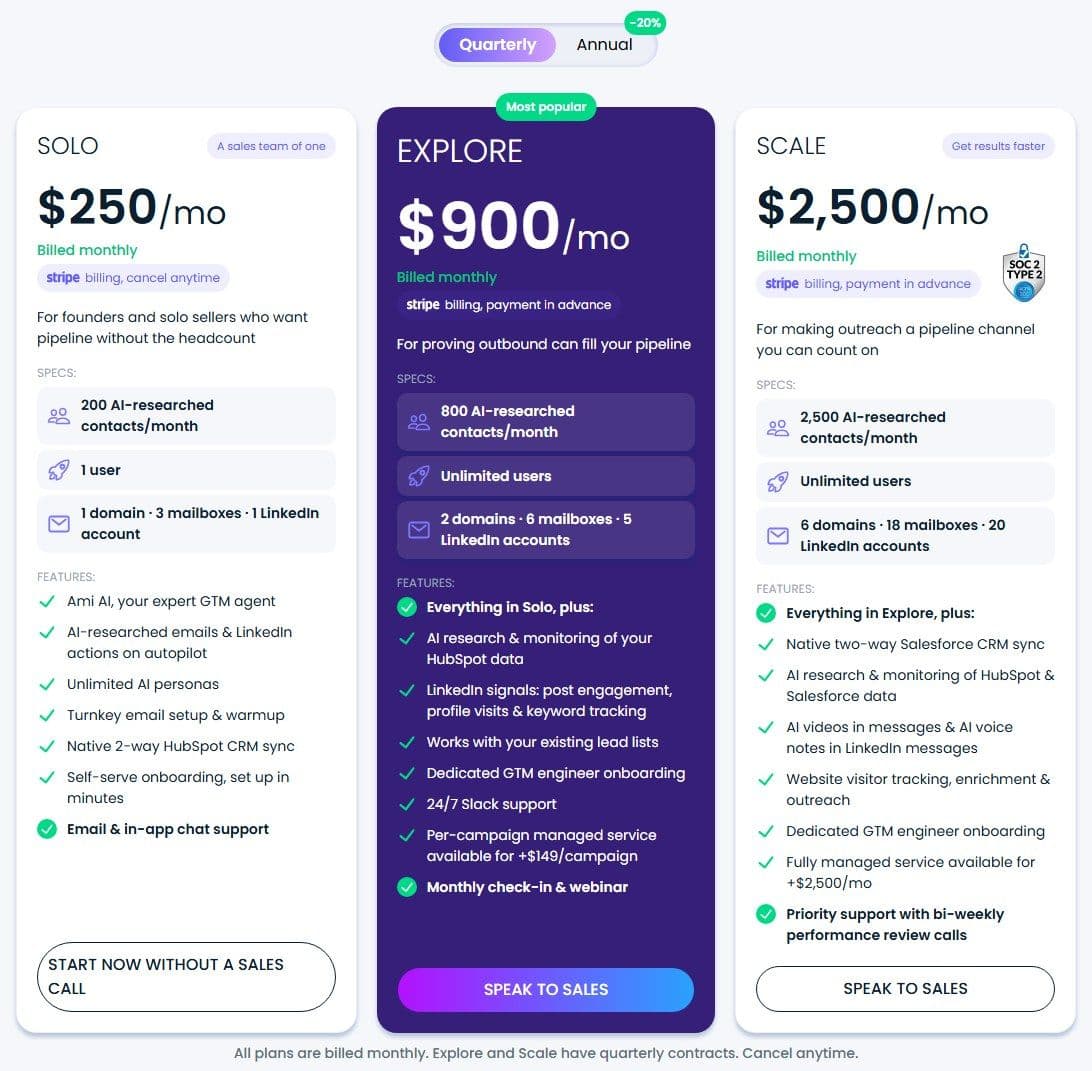
Solo is $250 a month for 200 AI-researched contacts a month, 1 user and 3 mailboxes, month to month. Explore is $900 a month for 800 contacts and 6 mailboxes, on a quarterly contract paid in advance. Scale runs $2,500 a month for 2,500 contacts and 18 mailboxes, also quarterly and paid in advance. AiSDR says annual plans carry a 20% discount.
An AI-researched contact is a net-new lead it finds, qualifies and enriches that month out of a much larger raw pool. AiSDR buys and sets up mailboxes and a domain if you have none, warms inboxes and runs bounce checks. There is no free trial, and Explore and Scale lock you into a quarter. Hitting the contact limit means pausing campaigns or paying an overage the page does not price. AiSDR says its own historical benchmark is about 1 to 3 meetings per 100 contacts.
10. Salesforge Agent Frank: best outbound agent with mailbox infrastructure
Salesforge describes Agent Frank as running 24/7 automated prospecting in auto-pilot or co-pilot mode over a 500M plus contact search engine, and grants access only after a demo. Its card shows $499 a month billed annually and says 2,000 plus contacts a month works out at $0.25 per contact. The volume slider starts at $417 a month billed annually for up to 1,000 active contacts. The commitment is annual or quarterly.
Mailboxes come from the same vendor but on a second bill: the defaults in Salesforge's own stack builder are $45 a month for 10 Primeforge mailboxes plus $56 a year for 4 domains, or $30 a month for 10 Mailforge mailboxes. The totals move with the mailbox count. Four counters tick at once: active contacts, emails sent, personalization credits at 1 per AI preview, and validation credits at 1 per contact. The page does not say whether a bounced email consumes one.
11. Relevance AI: best agent building blocks for technical teams
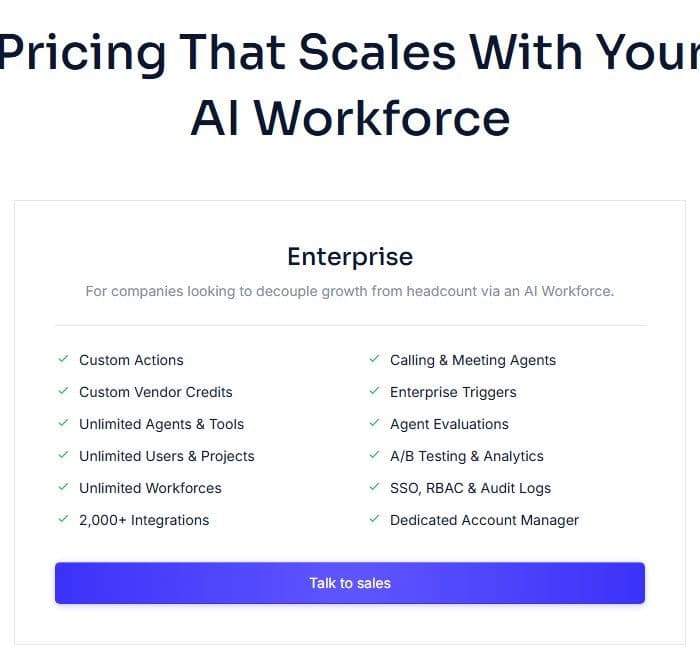
Relevance AI's pricing page publishes one offer and no figures at all: an Enterprise plan with Custom Actions, Custom Vendor Credits, unlimited agents, users and workforces. There is no free tier, no per-seat price, no per-credit rate and no billing period on the page. It amounts to a quoted contract metered in Actions and Vendor Credits. The page does not define what one Action or Vendor Credit buys either.
Relevance AI's pricing FAQ says its curated multi-agent systems, including the BDR agent, are available through its sales team. That answer was read from the page's embedded FAQ data rather than visible text, so confirm before relying on it. Technical teams get an operations layer: enterprise triggers, agent evaluations, A/B testing, SSO, RBAC and audit logs. You cannot compare it on price without a sales conversation.
12. Bardeen: best browser agents for research and outreach
Bardeen's agents automate lead sourcing, enrichment and outreach sequences for GTM teams. Every account gets 100 free credits, and unused credits expire at the end of each billing period. Basic is $10 a month billed monthly and adds 100 credits a month on top of the free 100, Premium $50 a month and adds 1,000, with sliders that raise both. On Bardeen's annual option Premium is $480 a year and adds 12,000 credits, a 20% saving. That figure sits behind the page's Annually tab, so check the toggle before you buy.
The meter counts rows: one credit per row an action creates, three per enrichment row, nothing for imports, utilities or CSV export. Bardeen's own example, scraping and qualifying ten profiles, costs 64 credits. Bardeen's Basic card marks Premium scrapers, Enrichment and Teams as not included, shown as tick and cross icons rather than words, so check the page. Bardeen publishes no seat price.
How AI sales agents are priced
Five units cover this market. Per agent a month: Reply.io's AI SDR from $500 a month billed annually, Agent Frank from $417. Per seat: Lindy from $29.99 per user a month, or Agentforce's User License at $5 per user a month. Per credit or action: 20 Flex Credits an action out of $500 per 100,000 at Agentforce, one credit per row at Bardeen, Data Credits plus Actions at Clay. Per conversation: $2 in Agentforce. Per contact reached: AiSDR from $250 a month for 200 researched contacts, and 11x per prospect.
Minimums move the real bill more than headline rates: 11x bills annually by default, AiSDR puts Explore and Scale on quarterly contracts, HubSpot ties credit packs to the contract term, Agentforce sells credits in blocks of 100,000. Clay charges neither meter when an enrichment returns nothing, and HubSpot charges only when a defined action completes. Artisan, AiSDR, Salesforge, Bardeen and Salesforce leave it unstated whether a bounced send is charged.
Then add the second bill: mailboxes and domains, from $6 per domain a year plus $5 per mailbox a month at Reply.io or a separate Salesforge subscription, plus data providers and model usage inside credits. Fix a volume and reduce every offer to one monthly figure.
How to choose an AI sales agent
- Name the task first. Research, first touch, replies, qualification and booking are different products; no vendor is best at all five.
- Decide where a human signs off. HubSpot sets this per play, Lindy says nothing with outside impact happens without approval, Artisan lets users approve before sending.
- Check CRM write-back and deduplication. Agentforce and Breeze act inside the CRM and Artisan lists Salesforce and HubSpot sync, but none of these pages describe deduplication.
- Ask who owns deliverability. 11x bundles managed mailboxes and AiSDR buys and warms them, while Reply.io and Salesforge sell them as separate line items.
- Read what one credit, action or contact buys. An Agentforce action is 20 Flex Credits, a Bardeen enrichment row 3 credits, a HubSpot recommended lead $1.
- Look at data sources and compliance claims. HubSpot names ZoomInfo, Apollo, Surfe and Seamless; Lindy says it is SOC 2 Type II certified, according to its own security page.
- Pilot on a fixed list for two weeks and count the booked meetings yourself. Clay, Reply.io and Salesforge run 14-day trials; AiSDR states it offers no free trial.
- Compare packaged against built on total monthly cost, mailboxes, data and model usage included.
How to create an AI sales agent
Start with the job, not the model. Write down the task the agent owns, the actions it may take and the stop conditions that send it back to a human. Connect the CRM it reads and writes, a data source, and a mailbox or number it sends from. Pick a model, give it your playbook and banned phrases, and put an approval step in front of every external send. Log every action and measure replies and booked meetings, not messages sent.
Treat writes to the CRM the way you treat sends: start the agent on read-only access, then open writes field by field under a user of its own, so each change traces back to one agent even when several work the same account. Keep changes to owners, deal stages and permissions behind human approval, and ask your CRM admin which rules live only in page layouts and record types, such as fields left off a layout or picklist values by record type, since an agent writing through the API may not be held to them. One user on r/salesforce described where their team started: "We connected the popular AI systems via MCP for read-only access."
There are three routes. A vendor's own builder, such as Agentforce or HubSpot's, keeps the agent where the data sits. A no-code platform such as Lindy gives ready-made jobs and a built-in approval step without engineering; Relevance AI sells building blocks on an enterprise contract scoped with its sales team. A workflow platform lets you assemble it yourself. Latenode, for example, bills in CPU seconds of workflow runtime with no per-operation fees, and the first 10,000 each month are free; its feature set is in section 1. That route costs more of your time.