
Quick answer: Boomi vs MuleSoft
Boomi is a low-code integration platform. It has a published pay-as-you-go entry plan, and its runtimes run in Boomi's cloud or on your own servers. MuleSoft Anypoint is an API-led integration platform owned by Salesforce, sold through sales as usage-based packages paid in Mule Credits. MuleSoft fits better where APIs and Salesforce dominate. Boomi suits mixed cloud and on-premises estates run by a small team.
Method: we read both vendors' pricing pages, documentation and company releases in October 2026, with no analyst rankings.
Boomi and MuleSoft at a glance
| Feature | Boomi | MuleSoft |
|---|---|---|
| Owner | Francisco Partners, TPG (2021) | Salesforce, since May 2, 2018 |
| Published price | $99/month plus $0.05/Message | From $2,000/month, annual |
| What you pay for | Messages or annual editions | Mule Credits in packages |
| Build style | Low-code process canvas | IDE with XML and DataWeave |
| Runtime and hosting | Boomi-hosted or self-hosted | CloudHub 2.0 or self-hosted |
| API management | API Management, Control Plane | API Manager, Omni Gateway |
| AI agents | Agentstudio, AI Starter Pack | Agent Fabric, MCP, Vibes |
| Best for | Mixed apps, small teams | API programs, Salesforce |
Entry prices, not like-for-like: Boomi's FAQ limits Pay-As-You-Go to active trial users, and Salesforce's MuleSoft page says 'Contact for pricing'. Confirm both before purchase.
Who owns Boomi and MuleSoft
Dell said it had acquired Boomi in 2010. In a joint release dated May 2, 2021, Francisco Partners and TPG Capital agreed to buy Boomi from Dell Technologies in a $4 billion cash transaction. Dell's quarterly report states the sale closed on October 1, 2021. Boomi's website does not currently name its owners.
"On October 1, 2021, Dell Technologies completed the sale of Boomi and certain related assets to Francisco Partners and TPG Capital. At the completion of the sale, the Company received total cash consideration of approximately $4.0 billion"
Source: sec.gov
Salesforce announced on May 2, 2018 that it had completed its acquisition of MuleSoft. It also said Anypoint Platform would be part of Salesforce Integration Cloud, its wording at the time. The tie shows in Agentforce MuleSoft, which extends Salesforce's Agentforce agents beyond Salesforce.
Pricing: published plans against sales quotes
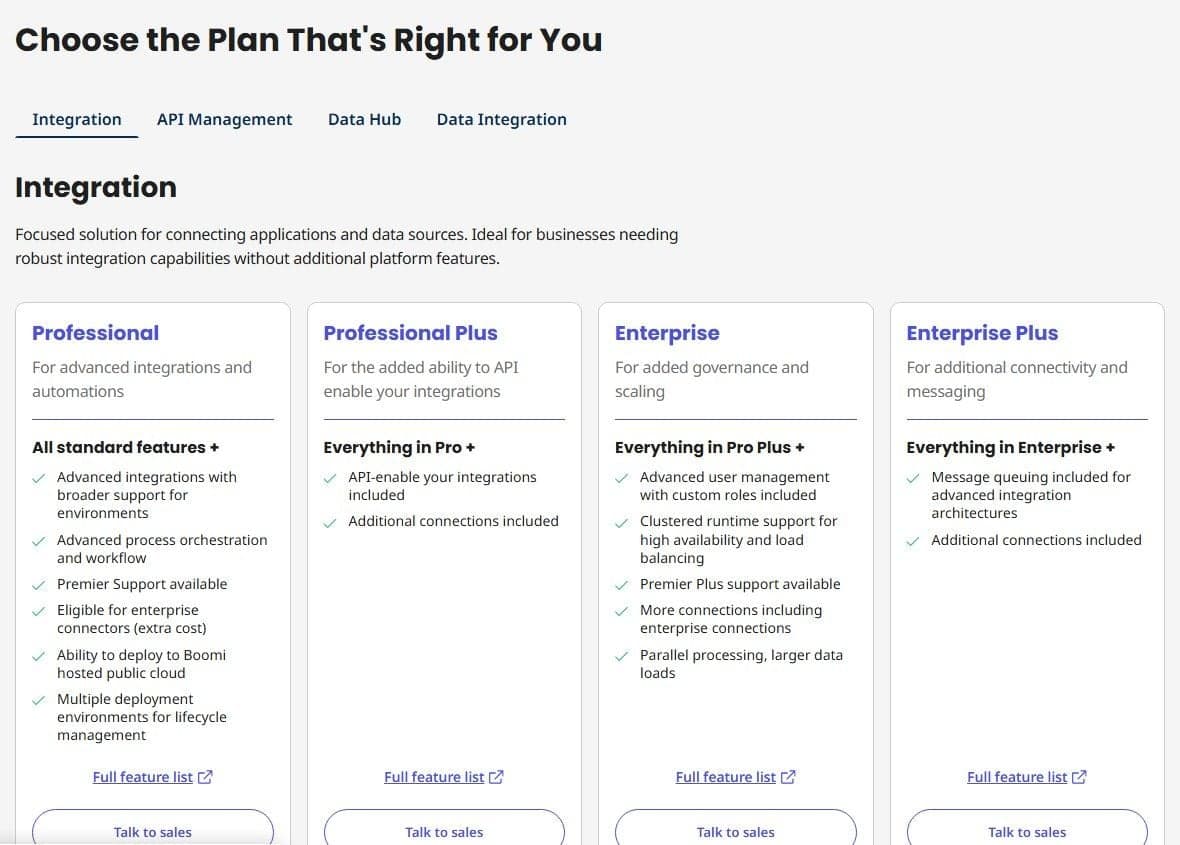
Boomi's pricing page splits the platform into four products sold separately: Integration, API Management, Data Hub and Data Integration. Every subscription edition shows a 'Talk to sales' button instead of a price. Boomi's documentation says subscription editions are priced by edition, connectors and add-ons, billed annually, with extra charges for connections and Flow launches.
"Try MuleSoft Anypoint Platform free for 30 days. No credit card, no installations."
Source: salesforce.com
- Integration editions: Base (listed in the documentation), Professional, Professional Plus, Enterprise and Enterprise Plus. Enterprise adds custom roles, clustered runtime and parallel processing; Enterprise Plus adds message queuing.
- Connections, each licensed individually: 2 production-only standard connections on Base, then production/test pairs of 5/5 on Professional, 7/7 on Professional Plus, 10/20 on Enterprise and 15/30 on Enterprise Plus.
- Enterprise-class applications such as SAP and Oracle need a separate enterprise license per connection, a paid option on the Professional tiers, with 1/2 or 2/4 included on the Enterprise tiers.
According to Boomi's Pay-As-You-Go documentation (updated July 16, 2026), Pay-As-You-Go costs a $99 monthly base fee plus a flat $0.05 per Boomi Message. The base fee is charged even in a month with no Messages. The pricing page shows only '$99 per month plus usage', and neither page says whether any Messages are included. A Message is every inbound and outbound document sent or received, including responses to request/response calls. Internal component-to-component messages do not count.
The plan needs no contract and is charged monthly, only in US dollars. It includes unlimited connections, users, processes and environments, with Standard support that cannot be upgraded. Boomi calls this unlimited usage, but every Message is still billed on top of the base fee.
On sign-up, the pricing page advertises 'Self-service, frictionless signup via credit card' under a 'Talk to sales' button. The Pay-As-You-Go FAQ says the plan is currently open only to active trial users who opt in with a credit card. The trial shows the same split. The pricing page advertises 30 days at $0 with 'Full platform access' and no credit card. The editions documentation describes a 30-day Personal Edition trial with scheduling and production deployment locked, and test runs capped at 100 documents or 10 MB. Neither page says whether they are the same trial, so confirm both with Boomi.
As of October 2026, MuleSoft's own pricing page (mulesoft.com/pricing) says packages start at $2,000 per month, billed annually. Salesforce's MuleSoft pricing page, however, still shows 'Contact for pricing' for every Anypoint Platform and MuleSoft Automation edition. The Mule Credit allocation behind the $2,000 is not published, so confirm both with MuleSoft before purchase.
Packages are organized by capability: governing APIs and AI, managing agents, connecting apps, processing documents or the complete platform. Each includes Mule Credits you can spend across the portfolio, plus a 'Contact sales' button. Credits are sold under three buying models, each marked 'Billed annually. Terms Apply.':
- Pre-Purchase, with no minimum credit purchase.
- Pre-Commit, a $50K minimum annual commitment that the page describes as paid monthly as it is drawn down from one shared pool.
- Unlimited, a custom fixed price for uncapped credits.
No price per credit is published. According to MuleSoft's pricing page, Mule Credits are one shared unit drawn from a single pool across integrations, API management, automation and agents. The page says credit rates fall as usage rises, but it lists no rates or allocations. Rates per usage type appear only on Salesforce's Mule Credits Rate Card (PDF, updated May 2026). At the base tier, the card lists 200 credits per Mule flow, 100,000 per million Mule messages and 60,000 per million gateway requests. At the highest monthly volume tier these fall to 19.2, 9,600 and 5,760. These are credits, not dollars, so you cannot derive a dollar cost per flow, message or request. The card also says usage types, tiers and multipliers may change.
MuleSoft's documentation lists what draws credits, at the same rate in every environment. On the Integration plan, that is flows, messages, private spaces, network connections and load balancers. On the AI and API Management plan, it is managed assets, gateway requests, private spaces and network connections. Under Mule Credits, flows count by each day's peak hourly flow count. A managed asset consumes credits while it is active in API Manager, even with no calls. Credits apply organization-wide and cannot roll over.
The docs say overage is billed on a monthly invoice at your standard contracted rate. The pricing page says the price of additional credits may vary based on your buying model and total usage, and it offers a threshold alert.
The docs also describe two other models, without saying whether new customers can buy either. Usage-based packages, offered 'for some customers in the US control plane', count flows as the busiest single hour of the month. Older vCore editions (Integration Gold, Platinum and Titanium) are metered by peak vCores on CloudHub and CloudHub 2.0 workers. MuleSoft's 30-day free trial needs no credit card or installation and covers the full portfolio.
The pricing model changes the cost of API-led design. On the vCore editions the docs describe, usage is the peak vCores allocated to active CloudHub and CloudHub 2.0 application workers, so cost follows the worker capacity each app holds. Under Mule Credits, the Integration plan draws credits for flows, messages, private spaces, network connections and load balancers, with flows counted by each day's peak hourly flow count, so before you split one system into several System APIs, count the flows each layout keeps deployed and ask MuleSoft to price that number. A post on r/MuleSoft framed the worry in vCore terms: "if we created 3 SAPI for the system, we would need at least 3 vcores."
How you build integrations
In Boomi you build integrations on a process canvas, configuring steps from an Execute, Logic and Connect palette, up to 250 steps per process. Since March 9, 2025, Boomi's runtimes carry new names:
- Basic runtime (formerly Atom): a lightweight Java application on one host, without load balancing or failover.
- Runtime cluster (formerly Molecule): multiple nodes for load balancing and failover.
- Runtime cloud (formerly Atom Cloud): private or Boomi-hosted, and the only multi-tenant option.
Boomi gives different connector counts: its website offers AI governed access to '1000+ enterprise applications', while its MuleSoft comparison page gives both 280+ connectors and 300+ connectors with 750+ pre-built solutions.
For systems without pre-built connectors, both vendors offer a kit to build your own. Boomi's Connector SDK is written in Java, and Boomi expects Java proficiency from anyone using it. MuleSoft's Mule SDK, for Java or XML, builds modules such as connectors that install in Mule apps. In Anypoint Studio, connectors, templates and examples come from Anypoint Exchange.
Anypoint Studio is MuleSoft's Eclipse-based IDE. It has a visual Message Flow canvas and a Configuration XML tab that holds the XML defining the application. Anypoint Code Builder runs in Visual Studio Code. MuleSoft's documentation says work in it requires familiarity with Mule application development, connectors and DataWeave. DataWeave is MuleSoft's own transformation and expression language, documented at version 2.12. MuleSoft's design model, API-led connectivity, splits APIs into System, Process and Experience layers.
Boomi says MuleSoft is primarily pro-code, built around a proprietary scripting language, and typically needs specialized MuleSoft resources. MuleSoft's own docs show a visual canvas over XML and expect developers fluent in Mule and DataWeave, while Boomi's canvas is about configuring steps. Staff accordingly.
Data mapping, batch and real-time processing
Boomi handles data transformation in a Map step: you drag and drop fields from a source profile to a destination profile and add functions where the conversion needs logic. In MuleSoft, you write transformations in DataWeave, which reads and writes JSON, XML, CSV, Excel, flat files, Avro and other formats.
For large jobs, such as synchronizing data sets between apps, MuleSoft's Batch Job splits source data into persistent queues and resumes where it stopped after a crash or redeploy. Boomi's parallel processing improves the performance of large batch jobs such as ETL; it comes with the Enterprise editions and costs extra on the Professional tiers. For real-time, event-driven work, Boomi can publish any integration process as a web service and offers Event Streams, a cloud-native message queuing service. MuleSoft sells Anypoint MQ, its cloud message queue, as an add-on. Its documentation says Anypoint MQ is not available in the trial edition, while the pricing page says the 30-day trial covers the full portfolio, so confirm before you test queuing.
API management
Boomi sells API Management as a separate product in four editions, Professional to Enterprise Plus, priced through sales. Standard features cover API lifecycle management from development to retirement, an API gateway for traffic and policies, and a developer portal. An API Service defines REST, SOAP or OData endpoints. An API Proxy routes HTTP traffic to an external host through the Boomi API Gateway. Boomi's API Control Plane, launched July 8, 2024, centrally monitors and manages gateways from eight vendors: Apigee, AWS, Azure, Boomi, Broadcom, Gravitee, Kong and WSO2, a list that may have changed.
MuleSoft's API Manager manages, governs and secures APIs and server instances. It also configures Omni Gateway, Mule Gateway and instances such as agents, MCP servers and LLM servers. Omni Gateway is Flex Gateway renamed with the 1.13.0 release on May 11, 2026, a change MuleSoft calls non-breaking and only cosmetic. It is an Envoy-based gateway for APIs running anywhere and supports up to 1,000 backend APIs per gateway. Its protocols include MCP and Agent2Agent (A2A). Anypoint Exchange catalogs reusable assets, hosts developer portals and automatically publishes public MCP servers from the official MCP registry.
MuleSoft's gateway, manager and catalog share one platform and credit pool with its integrations. That suits an API program with many internal consumers. Boomi sells API management separately, except in Pay-As-You-Go, and adds a control plane for mixed-vendor gateways.
Deployment: cloud, hybrid and on-premises
Boomi runtimes can be Boomi-hosted and fully managed by Boomi. They can also be customer-hosted on Amazon, Azure or Google cloud infrastructure, or on an on-premises server inside your network. According to Boomi's runtimes documentation (updated March 31, 2026), hosted options start with the multi-tenant Public Cloud Service, and every account includes at least one attachment to it at the base tier. Other hosted options are priced by your account representative. The editions table, however, lists none for Base, and the Personal Edition trial has no cloud access, so confirm hosted entitlements with Boomi.
Anypoint Platform can run fully MuleSoft-managed, with your own runtime plane under MuleSoft's managed control plane, or with both planes hosted locally. MuleSoft says its on-premises runtimes suit air-gapped or disconnected environments.
- CloudHub 2.0: a fully managed, containerized iPaaS, priced through an account executive. Apps scale horizontally as you add replicas, which CloudHub spreads across two or more data centers.
- Runtime Fabric: Mule apps and API proxies on a Kubernetes cluster you manage, such as EKS, AKS, GKE, OKE, Red Hat OpenShift or Rancher.
- Government Cloud: a FedRAMP-compliant, MuleSoft-managed control plane for US government agencies.
- Private Cloud Edition: a self-hosted control plane, with some Anypoint components unsupported.
Security and compliance
Boomi's Trust Center says its Integration, Data Hub, B2B/EDI Management and API Management services are SOC 1 and SOC 2 compliant. It lists ISO/IEC 27001, 27701, 27017, 27018 and 42001 certifications, HIPAA certification and a PCI DSS attestation. Boomi is FedRAMP authorized at the Moderate baseline, but only for part of its offerings. MuleSoft's Trust Center lists ISO 27001, SOC 1, SOC 2, PCI DSS and HIPAA and says MuleSoft is GDPR compliant. Under MuleSoft's shared responsibility model, configuring security features and user access stays with you. Before signing, confirm that the services you buy fall inside each audit.
AI and agents
Every Boomi Integration edition includes the AI Starter Pack of six agents: DesignGen, Scribe, Answers, Pathfinder, Boomi GPT and DataDetective. Boomi announced general availability of Agentstudio, its AI agent lifecycle management product, on June 18, 2025. According to Boomi's Agentstudio documentation (updated September 29, 2026), it is generally available to direct customers, and its Base Edition with the Agent step is included in every Boomi Enterprise Platform edition. The same documentation says it offers over 100 agent templates and that agents can invoke external tools over MCP. What higher editions add or cost is not stated.
The product page claims 300+ templates and solutions, and registration of Amazon Bedrock, Salesforce Agentforce, Microsoft Copilot and Snowflake agents. The documentation names only Boomi and Amazon Bedrock agents for Agent Control Tower.
Two features are labeled Early Access in Boomi's documentation as of September 2026: running agents on-premises with the new Flex Runtime, and connecting your own Anthropic, OpenAI or Google model account and API keys. The product page shows both without that label. Treat neither as generally available yet.
MuleSoft's agent layer is Agent Fabric, a control plane that MuleSoft says is generally available, with capabilities rolling out monthly. They include Agent Scanners, the Agent Broker routing service and MuleSoft AI Gateway. MCP Bridge exposes existing systems as MCP tools through Omni Gateway (formerly Flex Gateway). Agent Fabric has a 30-day free trial without a credit card.
- IDE MCP servers: the DX MCP Server for API design, deployment and assets, and the Platform MCP Server for discovery, policy enforcement and traffic monitoring.
- Agentforce: Agentforce MuleSoft extends Salesforce's Agentforce agents beyond Salesforce, and the MuleSoft Agentforce Connector calls Agentforce from Mule apps.
- MuleSoft Vibes: an agent for building and managing Mule apps, with no credits required for Anypoint subscribers.
MuleSoft lists no separate agent price; its pricing page says agent usage draws on the shared Mule Credits pool.
Monitoring, support and training
Boomi's Process Reporting page lists process executions with their documents and logs, lets you rerun documents and keeps logs for 30 days by default. MuleSoft's Anypoint Monitoring gives Mule apps and APIs dashboards, alerts and searchable logs.
Every Boomi Integration edition includes Basic Support: documentation, Boomiverse user forums, training material, chat and 5 case submissions a year. Enhanced Support, not offered on Base, adds unlimited cases, a one-hour 24/7 response for Severity 1 issues and an eight-business-hour case response time. Boomi's table puts an extra-cost mark on it for every higher edition, but the footnote explains that mark for Professional and Professional Plus only, so confirm the price with Boomi. MuleSoft said in August 2026 that Titanium Support customers are moving to Salesforce's Premier Success Plan, with response times of 60 minutes for Severity 1, 2 hours for Severity 2 and 4 hours for Severity 3.
Both vendors certify developers. Boomi's training portal, open to any Boomi platform or Community login, offers dozens of on-demand courses toward certifications. MuleSoft credentials are Salesforce certifications, among them Integration Foundations, Developer, Developer II and Platform Architect.
Which one to pick
- Salesforce-heavy estate: MuleSoft, part of Salesforce since 2018, with the Agentforce Connector.
- API program with many internal consumers: MuleSoft, for API-led layers, Exchange and API Manager.
- Mixed SaaS and on-premises apps, small integration team: Boomi, for the low-code canvas and flexible runtimes.
- Strict on-premises data rules: either; MuleSoft lets you host both planes yourself, and Boomi runtimes install inside your network.
- Published price before a sales call: Boomi Pay-As-You-Go, though its FAQ limits sign-up to active trial users.
- EDI: both cover the X12, EDIFACT and Tradacoms standards over AS2; Boomi adds HL7 and FHIR, MuleSoft adds RosettaNet. Boomi says B2B/EDI Management lets you add trading partners without vendor help; in MuleSoft, you onboard partners and set up their message flows in Anypoint Partner Manager.
- Master data: Boomi, whose Data Hub is its master data management product and builds golden records with matching and survivorship rules. For MuleSoft customers, Salesforce's architect guide assigns master data management to Informatica, whose acquisition Salesforce completed on November 18, 2025.
Other options worth a look
As of October 2026, Workato's pricing page lists four editions with no price shown: Standard, Business MCP, Enterprise MCP and Workato ONE. Its documentation separately prices self-service Free and Pro plans in credits. SnapLogic prices packages by the data and application endpoints you connect, the same on GroundPlex or CloudPlex. Pipelines and integrations are unlimited inside a package, but premium Snap Packs and add-ons such as AgentCreator cost extra. No SnapLogic price is published.
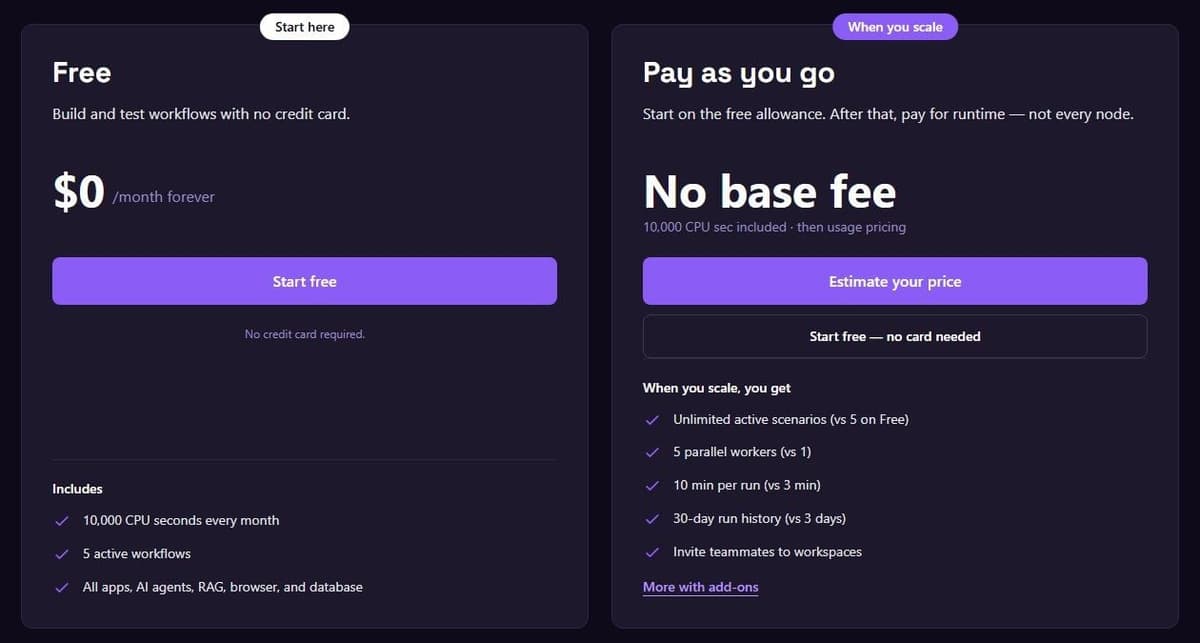
Latenode is a lighter workflow layer that sits next to an enterprise iPaaS rather than replacing Boomi or MuleSoft. As of September 2026, it bills workflow runtime in CPU seconds, not per operation or step, with the first 10,000 CPU seconds free every month on both its Free and Pay as you go plans; nodes that call paid external providers add PnP tokens. Cost depends on run duration, so CPU seconds do not compare with Boomi Messages or Mule Credits. Our Boomi and MuleSoft alternatives guides cover more options.