
Quick answer: Workato vs MuleSoft
Workato is an enterprise automation platform where business and IT teams build recipes and pay for a platform edition plus usage. MuleSoft Anypoint is Salesforce's API-led integration platform for developer teams, sold as capability packages that include Mule Credits. Pick Workato when operations teams should build and own their workflows, and MuleSoft when developers run a governed API program across cloud and on-premises systems. Everything below reflects both vendors' pricing, documentation and comparison pages as of October 2026.
Workato and MuleSoft at a glance
| Feature | Workato | MuleSoft |
|---|---|---|
| Owner | Workato, Inc. | Salesforce, since 2018 |
| Pricing model | Edition plus usage credits | Packages with Mule Credits |
| What is metered | Tasks or Business actions | Credits per usage type |
| Who builds | Business and IT teams | Integration developers |
| API management | API Platform, some plans | API Manager, Omni Gateway |
| On-premises access | On-prem agent (OPA) | Runtime Fabric, self-hosting |
| Where it runs | Workato's cloud or Virtual Private Workato | CloudHub 2.0 or your infrastructure |
| AI agents | Agent Studio genies | Agent Fabric, MCP servers |
| Best for | Business-led automation | API-led integration programs |
Workato's recipe metric depends on the contract.
Is Workato part of Salesforce?
Workato is a separate company. Its About Us page presents Workato, Inc. with Vijay Tella as CEO and headquarters in Palo Alto. Salesforce Ventures appears among the investor logos on that page. But an investor listing is not an ownership statement and does not mean Salesforce owns Workato or that Workato is part of Salesforce. In its September 24, 2026 press release, Workato calls itself a "neutral platform".
MuleSoft has been part of Salesforce since May 2, 2018, when Salesforce announced it had completed the acquisition. For bundling, MuleSoft appears on Salesforce's own pricing pages, while Workato quotes its own editions.
Pricing: editions and tasks against usage packages
Workato editions
"Credit rates vary by monthly consumption volume and reset on the first day of each calendar month. You consume credits at the same rate across all environments, including production, pre-production, sandbox, and design."
Source: docs.mulesoft.com
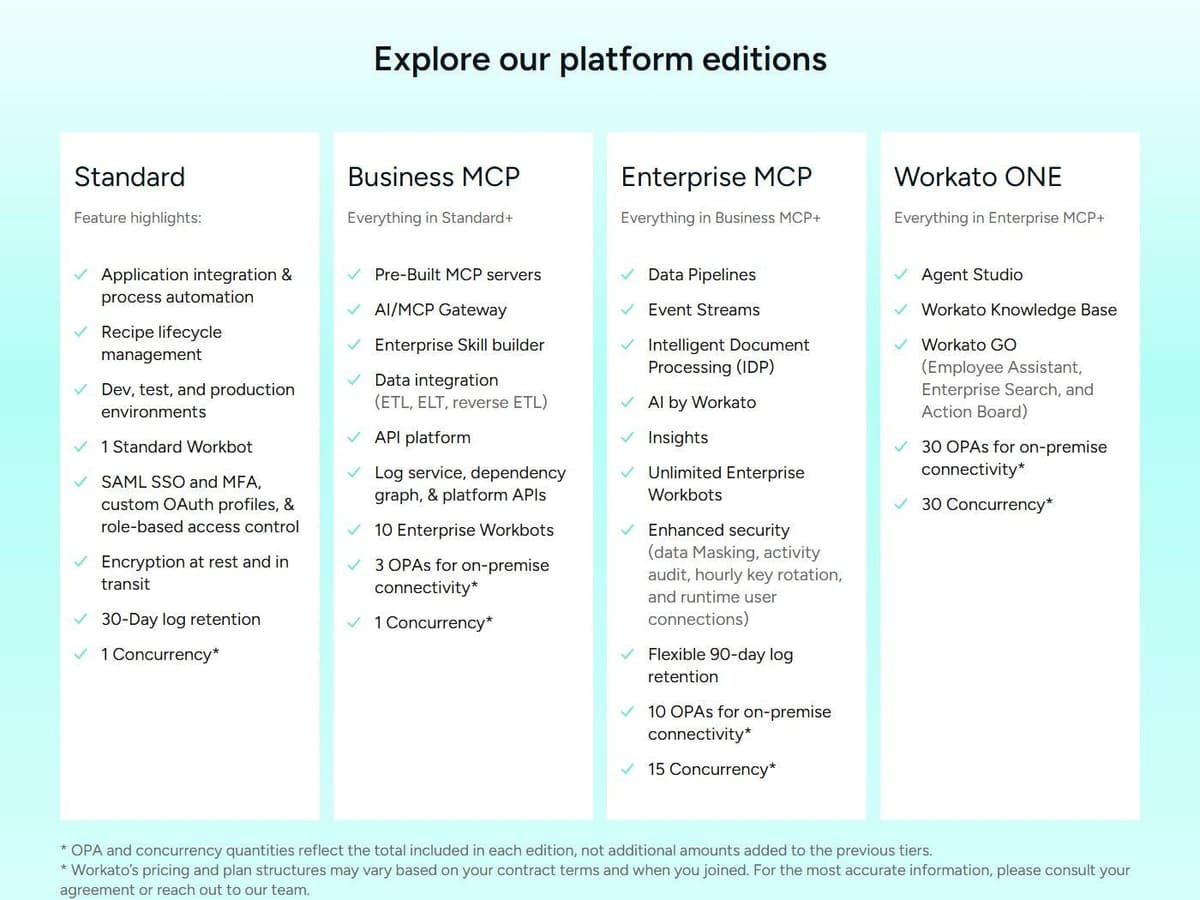
As of October 2026, Workato's pricing page lists four editions and no prices. It routes buyers to a demo or a quote and says pricing may vary with contract terms and when the customer joined. Each edition builds on the one below.
| Edition | Main additions | OPAs | Concurrency |
|---|---|---|---|
| Standard | Integration and automation | Not listed | 1 |
| Business MCP | API management, MCP servers | 3 | 1 |
| Enterprise MCP | Pipelines, IDP, event streams | 10 | 15 |
| Workato ONE | Agent Studio, Workato GO | 30 | 30 |
OPA and concurrency figures are edition totals, not additions to the tier below. Extra concurrency, on-premises agents, Private Link and Virtual Private Workato (VPW) are add-ons priced on request.
How Workato meters usage
According to Workato's billing documentation (updated September 16, 2026), cost has three parts: the platform edition, usage in Workato credits and separately billed add-ons. For its editions, Workato publishes no price per credit, no conversion rate from each metric into credits and no overage rule. Some plans, it says, measure usage differently. Customers who joined before February 2024 are on an older model, according to its pricing documentation as of October 2026.
The recipe metric depends on the contract; confirm it before purchase. Workato's Tasks page (updated September 29, 2026) counts every action step as one Task, whatever the app, but not triggers or control-flow steps. Its Business actions page, updated the same day, counts triggers and action steps only in eligible apps, such as third-party connectors, HTTP and AI by Workato. Utilities like Logger or Variables do not count. Each page says some plans use the other metric.
Under Tasks, a bulk action counts as one Task however many records it processes. Each AI by Workato step counts as more than one, at a contract-set multiplier. According to Workato's usage documentation, failed operations do not count, while IDP pages and Event Streams events count on top of the recipe's metric.
Workato's self-service plans
According to Workato's self-service documentation, as of October 2026, Workato Free includes a one-time grant of 50,000 credits. Workato Pro sells recurring monthly credits, from $75 a month for 2,500 credits (the lowest tier) to $1,275 a month for 50,000 credits. Unused Pro credits expire at the end of the billing month.
These prices cover only Free and Pro, not the sales-sold editions. Workato publishes no conversion rate from Tasks, Business actions or Genie actions into credits, so confirm current prices before purchase.
MuleSoft packages and buying models
As of October 2026, MuleSoft's own pricing page (mulesoft.com/pricing) says packages start at $2,000 per month, billed annually. The Mule Credits allocation is unpublished. Salesforce's MuleSoft pricing page (salesforce.com/mulesoft/pricing) still shows "Contact for pricing" for every Anypoint Platform and MuleSoft Automation edition. Confirm the figure with MuleSoft before purchase.
Each capability package carries a "Contact sales" button. The page lists three buying models above the line "Billed annually. Terms Apply." Pre-Purchase has no minimum credit purchase. Pre-Commit has a $50K minimum annual commitment, paid monthly as it is drawn down. Unlimited gives uncapped credits at a custom fixed price. With no published price per Mule Credit, you cannot turn credits into dollars per flow, call or document.
How Mule Credits are consumed
MuleSoft's documentation describes the Mule Credit as a fungible currency drawn from one pool. Credits must be used before the Order End Date, and none roll over. Volume-based rates reset on the first day of each calendar month, and sandbox and design environments consume credits at the production rate. According to MuleSoft's Mule Credits documentation, as of October 2026, the usage types you pay for depend on the plan on your Order Form. Examples include Flows, Messages, Managed Assets and Gateway Requests.
Under the Mule Credits model, MuleSoft meters Flows by each UTC day's peak hourly count, summed over the month or year. Salesforce's Mule Credits Rate Card (updated May 2026) sets per-unit multipliers in credits, not dollars, and says they may change:
| Usage unit | Base tier | After 5M credits |
|---|---|---|
| Mule Flow | 200 credits | 19.2 credits |
| 1M Mule Messages | 100,000 credits | 9,600 credits |
| Managed Asset, per day | 1,000 credits | 96 credits |
| 1M Gateway Requests | 60,000 credits | 5,760 credits |
| Network Connection, per day | 750 credits | 72 credits |
The base tier covers up to 300K credits per usage type, and multipliers fall at 300K, 900K and 5M. MuleSoft's pricing page says extra credits cost a price that "may vary based on your buying model and total usage". Its documentation instead describes a monthly overage invoice at the standard contracted rate, so confirm overage terms in the contract. Older contracts may use vCore, usage-based or Automation Credits pricing, so metering depends on the contract's pricing model.
That meter changes the cost of API-led design. Under Mule Credits, the Integration plan meters flows, messages, private spaces, network connections and load balancers, and a message counts each time a Mule event source triggers one, while vCores belong to older contracts. So before you split one system into separate System, Process and Experience APIs, count the flows each layout keeps deployed and the event sources a single request passes through, and ask MuleSoft to price that count. A comment on r/MuleSoft gave the same advice: "Evaluate the difference in cost vs your architecture."
Who builds: recipes against API-led development
Workato: recipes, connectors and Workbots
Workato defines a recipe as an automated workflow that runs steps across applications through connectors, built manually or with AIRO from a plain-language description. As of October 2026, Workato's pricing page lists more than 1,200 prebuilt connectors and unlimited workspaces and users. Workato says the platform was built on the philosophy that anyone can do enterprise-level integrations without coding. Where a prebuilt connector is missing, developers can build a custom one with the Connector SDK.
For data integration, Business MCP adds ETL, ELT and reverse ETL, and Enterprise MCP adds data pipelines. Workato Data Hub powered by Reltio is a separate add-on.
Standard includes one Standard Workbot, and Enterprise MCP includes unlimited Enterprise Workbots. Workato's documentation describes Genies as prebuilt AI agents for business functions, such as an IT Support Genie or a CPQ Genie. The pricing page sells Pre-Packaged Genies as an optional add-on.
MuleSoft: Studio, Code Builder and DataWeave
MuleSoft developers work in Anypoint Studio, an Eclipse-based environment for designing and testing Mule applications. The alternative is Anypoint Code Builder, used locally on Visual Studio Code for API design, implementation and integration development. Developers write transformations in DataWeave, MuleSoft's programming language for data transformation.
Prebuilt connectors, templates and examples come from Anypoint Exchange, MuleSoft's curated catalog of reusable assets, and are available inside Anypoint Studio. Assets in its Provided by MuleSoft organization are created by MuleSoft and its partners and certified by MuleSoft.
Salesforce describes API-led connectivity as tiers: System APIs expose systems of record, Process APIs orchestrate them into business processes and Experience APIs sit on top. That calls for developers fluent in API design and an IDE. For business teams, MuleSoft lists MuleSoft for Flow: Integration, point-to-point integration with clicks, not code.
Skills each platform expects
MuleSoft's comparison page calls Workato low-code/no-code workflow automation for business users and Anypoint developer-centric, and Workato's comparison post promises drag-and-drop building. Read those labels as each vendor's view of the learning curve. On Workato, recipes are assembled from triggers and action steps, and code comes in at a few points: formulas use an allowlist of Ruby methods, the JavaScript and Python connectors run custom code inside a recipe, and custom connectors are Ruby code built with the Connector SDK. On MuleSoft, developers build new modules, such as connectors, with the Mule SDK for Java or XML. Workato's post also lists pro-code tools (SDK, version control, CI/CD and automated testing) and claims its intuitive design means fewer specialized developers or partner resources are needed.
APIs, on-premises systems and deployment
Workato API Platform and on-prem agents
Workato's API Platform, available only on specific pricing plans and placed in Business MCP on the pricing page, includes an API gateway plus governance, design, security and monitoring. Publishers create API proxies to internal APIs and enforce rate limits and quotas through access policies. They secure endpoints with OAuth 2.0, JWT tokens and OpenID Connect.
Workato reaches systems behind a firewall through the on-prem agent (OPA). It runs inside the customer's private network and makes only outbound connections to Workato, covering on-premises applications, databases and custom REST or SOAP applications. Business MCP includes 3 OPAs, Enterprise MCP 10 and Workato ONE 30, with more sold as an add-on.
Workato itself is a cloud service. Each account sits in one regional data center (the US one runs on AWS US East), and Workato says it does not transfer customer data across regions. The Virtual Private Workato add-on gives an organization a dedicated environment in its own AWS VPC, still run by Workato.
MuleSoft API Manager, Omni Gateway and runtimes
Anypoint API Manager governs and secures APIs and server instances, including agents, MCP servers and LLM servers, in cloud and on-premises deployments. Traffic runs through Omni Gateway (formerly Flex Gateway), an Envoy-based gateway that supports protocols including MCP and Agent2Agent (A2A). Each gateway handles up to 1,000 backend APIs. It runs MuleSoft-managed on CloudHub 2.0 or Runtime Fabric, or self-managed in Docker containers, as a Kubernetes Deployment or on Linux.
CloudHub 2.0 is MuleSoft's fully managed, containerized integration platform as a service (iPaaS), priced only through an account executive or account development representative. Runtime Fabric deploys Mule applications and API proxies to a Kubernetes cluster the customer creates and manages, including EKS, AKS, GKE and OKE. Customers can also run the runtime plane in their own infrastructure under the MuleSoft-managed control plane, or host both planes locally. A Mule runtime on your own server, virtual machine or cloud account, such as AWS or Azure, becomes a Hybrid Standalone runtime once registered with that control plane. Hosting the control plane yourself is Anypoint Platform Private Cloud Edition.
Message queues are priced differently on each side. MuleSoft's Anypoint MQ needs a paid package or a subscription with the Anypoint MQ add-on and is not in the trial edition, while Workato includes Event Streams from Enterprise MCP up and counts its events on top of each recipe's own metric. If your design leans on queues, get the add-on price from MuleSoft and the event rate from Workato before you compare totals.
AI agents and MCP
Workato Agent Studio, genies and MCP
"Genies use Anthropic Claude by default. You can switch your LLM to OpenAI GPT or your own LLM, such as Azure OpenAI or AWS Bedrock."
Source: docs.workato.com
Workato Agent Studio builds AI agents called genies. They chat through Slack, Teams or Workato GO and run on Anthropic Claude by default, OpenAI GPT or the customer's own LLM connection. The Agent Studio page says genies are available to all users in the US, EU, AU, SG and JP data centers. The Agentic FAQ, though, limits them to specific pricing plans, and the pricing page lists Agent Studio in Workato ONE. Confirm genie access before purchase.
According to Workato's billing documentation (updated September 16, 2026), each prompt sent to a Genie is one Genie action regardless of complexity or LLM, reasoning and hand-offs included. Failed actions do not count, and recipes sending an App event to a Genie are billed in their own recipe metric. Workato's MCP usage page, updated the same day, bills MCP usage in the metric of the asset invoked, such as Tasks for skills. Some plans measure MCP calls instead, so confirm the MCP metric.
MuleSoft Agent Fabric and MCP
MuleSoft describes Agent Fabric as the control plane for AI agents, MCP servers and APIs built across platforms, including tracking and capping token spend. Agent Fabric needs Omni Gateway for its managed instances, A2A bridges, model proxies and rogue-agent containment. As MuleSoft describes it on its MCP product page, which states no price or availability label, MCP Bridge exposes existing APIs as MCP tools through Omni Gateway. In the IDE, AI assistants can use the MuleSoft DX MCP Server for API design and deployment, and the MuleSoft Platform MCP Server for policy enforcement and traffic monitoring.
Each agent, MCP server or LLM with an active instance in API Manager is a Managed Asset. It draws credits every day it stays Active, even with no calls. The rate card warns that pilot features may consume Mule Credits where the pilot terms say so. Get each agent feature's status in writing before building on it.
Security, compliance and governance
Workato's Security and Governance page lists SOC 1, 2 and 3, ISO 27001, 27701 and 42001, HIPAA, PCI-DSS 4.0.1, IRAP and NIST 800-171A r2. Workato encrypts data with TLS 1.2+ in transit and AES-256 at rest, and Enterprise Key Management (BYOK) is optional. Workato's pricing page includes SAML SSO, multi-factor authentication (MFA) and role-based access control in all four editions and lists data masking, activity audit, hourly key rotation and 90-day log retention as Enterprise MCP additions. Its security page describes hourly key rotation and 90-day audit logs without naming an edition, so confirm what your edition includes.
MuleSoft's Trust Center lists ISO 27001, SOC 1, SOC 2, PCI DSS and HIPAA, and says the platform is GDPR compliant and built on AWS. Access Management covers single sign-on through external identity providers, multi-factor authentication, roles and audit logs, and MuleSoft Government Cloud is a FedRAMP-authorized control plane for US agencies. MuleSoft calls its model shared responsibility: it runs platform security and updates, while you configure security features, manage user access and, on Runtime Fabric or Hybrid Standalone runtimes, run the infrastructure. Workato's comparison post claims MuleSoft relies on customers to build and maintain many critical security features themselves.
What each vendor says about the other
MuleSoft says on its comparison page that Workato only deploys to public cloud or AWS VPC, with limited hybrid access through on-prem agents. The same page says Workato cannot scale to high-volume, high-frequency workloads because of data and storage limitations and timeouts. Workato documents an on-prem agent inside the customer's network.
On scale, Workato's post describes a cloud-native, serverless and elastic architecture with no infrastructure to manage and zero-downtime upgrades. MuleSoft's page also calls Workato's API governance basic, says MuleSoft controls the full API lifecycle and claims a broader connector set, especially for legacy systems, on-premises databases and EDI. Workato's post counters that its 1,200+ connectors run from SAP and Salesforce to EDI and mainframe. MuleSoft also says Workato offers only limited EDI and nascent RPA, both through third parties. Workato's pricing page lists both as add-ons, Workato EDI powered by Orderful and RobotiQ RPA, while Salesforce's MuleSoft pricing page includes MuleSoft RPA in its MuleSoft Automation edition.
Workato says in its comparison post dated May 29, 2026 that MuleSoft's pricing is convoluted and inflexible, leaving customers paying for unused "core" capacity or facing overages. Check that against MuleSoft's current pricing page. A proof of concept with production-like volumes, one of your on-premises systems and a month of usage data tests both sets of claims.
Which one to pick
- Business teams will build and maintain most workflows themselves: Workato.
- Developers run an API program with System, Process and Experience layers: MuleSoft.
- Runtimes must sit on your own Kubernetes clusters or fully on-premises: MuleSoft.
- A few on-premises databases must join SaaS workflows through an outbound-only agent: Workato.
- You want integration bought from Salesforce: MuleSoft; from a separate company: Workato.
- You need a predictable bill: ask MuleSoft about its Unlimited buying model and Workato for its credit conversion rates.
- A small team wants to start without going through sales: Workato Free or Pro, with Pro from $75 a month for 2,500 credits. MuleSoft offers a 30-day free trial with no credit card. Its paid packages start at $2,000 a month, billed annually, according to its pricing page, and each one goes through sales.
Other options
Boomi prices its subscription editions through sales. According to Boomi's pricing page, as of October 2026, Pay-As-You-Go costs $99 per month plus usage, billed monthly. Zapier's Professional plan costs $19.99 a month billed annually for 750 tasks a month, after a 14-day free trial, according to Zapier's June 2026 pricing post.
Boomi's Pay-As-You-Go FAQ, updated July 16, 2026, adds two conditions: usage is billed at a flat $0.05 per Boomi Message on top of the $99 base fee, and the plan is currently open only to active trial users.
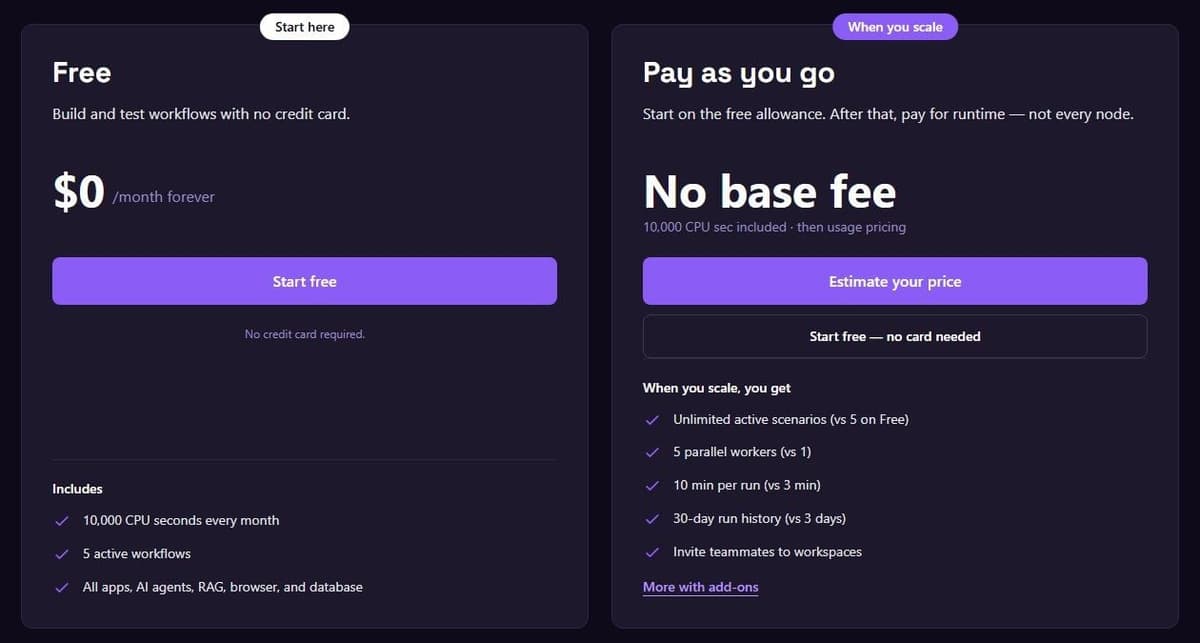
Latenode bills workflow runtime in CPU seconds (runs multiplied by average seconds), not per step. So cost depends on run duration and does not compare directly with Workato Tasks or Mule Credits. As of September 2026, the first 10,000 CPU seconds each month are free on both plans. Free costs $0 a month with no credit card. Pay as you go has no base fee, then charges $0.00012 per CPU second for CPU seconds 10,001 to 100,000, with add-ons and PnP tokens ($1 each, for paid providers) on top. Our Workato and MuleSoft alternatives guides cover more options.