

Quick answer: the best data pipeline tool for each need
No single tool wins every job, so pick by need. Largest catalog of fully managed connectors among the vendors here that publish a number, at 700+: Fivetran. Open-source connectors with a managed cloud: Airbyte. No-code ETL for small data teams: Hevo. Simple row-based pricing: Stitch. Warehouse-native transformation: Matillion. Flat fee, unlimited pipelines: Integrate.io. Real-time change data capture: Estuary Flow. Cheap no-code sync for SMB apps: Skyvia. Free all-in-one platform: Keboola. Long-tail connectors on request: Portable. Spreadsheet and dashboard reporting: Coupler.io. Custom pipelines with your own logic, API pulls and AI steps: Latenode.
Prices below are as listed in September 2026. Latenode publishes this blog and appears as entry 12.
What data pipeline tools do in 2026
A data pipeline tool pulls data out of a source and lands it somewhere useful, on repeat. If the idea is new to you, start with what a data pipeline is. It extracts from SaaS apps, databases and files, then loads into a warehouse, a database or a spreadsheet. Transformation happens before the load or after it. Runs go on a schedule or a stream, and the tool watches them, so you learn when a sync breaks. For enterprise integration platforms, see our guide to iPaaS vendors.
ETL transforms on the way in. ELT loads raw data and transforms it inside the warehouse with SQL. Change data capture reads the database log, so inserts, updates and deletes arrive as they happen, not in a nightly batch. Six families compete here: managed ELT with a connector catalog, open-source connectors, no-code ETL for small teams, real-time CDC, spreadsheet-first reporting, and a workflow layer for pipelines that need custom logic. Meters differ as much: monthly active rows, credits, events, rows, GB, records, compute minutes, connectors or a flat fee. Every price below names its unit.
Data pipeline tools at a glance
| Tool | Best for | Meter | Entry price |
|---|---|---|---|
| Fivetran | 700+ managed connectors | Monthly active rows | Free plan, then quote |
| Airbyte | Open source connectors | Credits | From $20 a month |
| Hevo | No-code ETL, small team | Events | Free plan, $299 a month |
| Stitch | Simple row pricing | Rows a month | From $100 a month |
| Matillion | Warehouse transforms | Credits, task hours | Quote only |
| Integrate.io | Flat fee, unlimited | Flat monthly fee | $1,999 a month |
| Estuary Flow | Real-time CDC | GB plus connectors | Free, $0.50/GB+$100/conn |
| Skyvia | Cheap SMB app sync | Records a month | Free plan, $99 a month |
| Keboola | Free all-in-one | Compute minutes | Free, $0.14 a minute |
| Portable | Long-tail connectors | Enabled data flows | $1,800 a month |
| Coupler.io | Spreadsheet reports | Rows per run | Free plan, $32 a month |
| Latenode | Custom logic pipelines | CPU seconds | Free, $0.00012/CPU sec |
1. Fivetran: best for a 700+ catalog of fully managed connectors
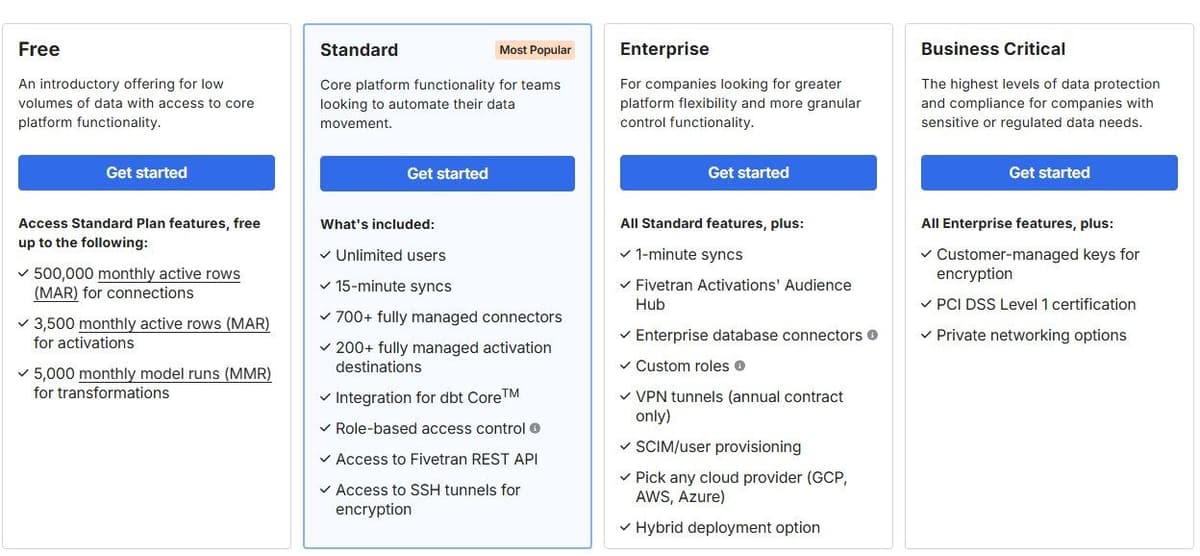
Fivetran meters monthly active rows. A MAR is a row that changed in a calendar month: inserts in the destination and updates to existing rows, deletes included. Unchanged rows from a scheduled re-sync do not count. Neither does the initial bulk load.
"Access Standard Plan features, free up to the following: ... 500,000 monthly active rows (MAR) for connections ... 3,500 monthly active rows (MAR) for activations ... 5,000 monthly model runs (MMR) for transformations"
Source: fivetran.com
The Free plan gives Standard features free up to 500,000 monthly active rows for connections, 3,500 for activations and 5,000 monthly model runs for transformations. Beyond that, Fivetran publishes no list price for Standard, Enterprise or Business Critical. Each tier has its own spend rate applied to MAR, declining as volume grows, and the page lists only what a tier adds: 700+ connectors and 15-minute syncs on Standard. A $5 monthly base charge applies to each standard connection with usage between 1 MAR and 1 million MAR, but not on Free.
Fivetran advertises up to 22% off on an annual contract. Its own discount table sets the rate by contract size: discounts start at 5% and reach 22.6% or more only on the largest annual list prices. The pricing example Fivetran publishes for the Standard plan totals $511.15 a month for four connectors, built from median usage for a company with 1-200 employees, not a quote or a bill.
2. Airbyte: best for open-source connectors with a managed cloud
Airbyte comes in two shapes. Airbyte Core is the self-hosted open-source edition. Airbyte Cloud is the managed side, billed in credits. Credits pay for the resources a sync uses, metered differently by source type, so one credit does not equal a fixed number of rows for every connector. The page publishes no per-credit row or GB conversion.
"Start with a 30-day free trial. 400 credits included ($2,000 of usage)."
Source: airbyte.com
Cloud starts with a 30-day free trial that includes 400 credits, which Airbyte values at $2,000 of usage. The page does not say whether a payment method is needed to start. Standard is listed as starting at $20 a month with 5 credits included, extra credits $5 each. Plus starts at $189 a month for a package of 40 credits, with overage at $5.00 per credit. Larger monthly packages sit on the same card, up to 2,000 credits for $4,999. Pro and Enterprise Flex are quote-only, priced by capacity counted in Data Workers rather than by data volume.
3. Hevo: best for no-code ETL for small data teams
Hevo counts events, and the definition is unusually clean: one event for every record inserted, updated or deleted in the destination. Usage above the plan quota is not blocked. Hevo treats it as On-Demand and charges it on top of the plan.
The Free plan costs $0 with no credit card. It runs on hourly scheduling with up to 5 users and allows up to 1 million events a month, but only on a subset of connectors, and Hevo does not publish how many. As of September 2026, Hevo Starter is $299 a month on monthly billing and $265 a month with annual billing at the 5 million events step. The plan cards switch between the two with a Pay Monthly and Pay Annually toggle, while the comparison table below the cards shows only 'Starts at $265/month'. Hevo also advertises a 14-day free trial with 24x7 support and no credit card required.
4. Stitch: best for simple row-based pricing
Stitch prices replicated rows per month, picked as a volume step on the plan card. Standard starts at $100 a month at the 5 million rows a month step, and the row selector raises the price up to the 300 million row ceiling. Stitch publishes US pricing only. Standard covers one destination, 10 standard sources and 5 users.
Advanced is listed at $1,500 a month billed annually for 100 million rows a month, 3 destinations and unlimited users. Premium runs $3,000 a month billed annually for 1 billion rows a month and 5 destinations. Both are annual contracts, and both sell row and destination add-ons. The trial runs 14 days with no credit card and unlimited rows. Every new integration gets a 7-day grace period whose usage does not count toward the row limit. Buyers outside the United States have to contact sales rather than buy from the page.
5. Matillion: best for transformation inside the warehouse
Matillion publishes no price. The pricing page shows three editions, Developer, Teams and Scale, with their feature and user limits. It then points to fixed annual packages with included credits and a talk-to-sales button. You have to ask for a number.
The meter, at least, is explained. Matillion bills through consumption-based credits, where a credit is the smallest unit of charge, consumed when a customer uses a Matillion resource. Credits go on task hours, the combined execution time of each task while a pipeline runs. Charges apply only while a pipeline is running, and validation and sampling operations are not billed. Developer users beyond the number included in your edition also consume credits, so seats and compute share one budget. A free trial exists, but the page does not say how long it runs, and publishes no credit price or package size.
6. Integrate.io: best for a flat fee with unlimited pipelines
Integrate.io sells one number. As of September 2026, Integrate.io lists Core at $1,999 a month, without stating a contract term or minimum commitment. The page says that fee covers unlimited data volumes, unlimited pipelines and unlimited connectors, with 60-second pipeline frequency and 30-day onboarding. Integrate.io says it supports 150+ sources and destinations. A 14-day free trial with full access and no credit card lets you test your own sources.
The flat fee is the argument. A row or event meter turns a busy month into a bigger invoice, while a fixed subscription stays flat. The catch is the floor: $1,999 a month only pays off once you run enough pipelines. The second tier adds advanced security, RBAC and HIPAA readiness, and shows only a book-a-demo button, so you have to ask for that price too.
7. Estuary Flow: best for real-time change data capture
Estuary Flow's free Developer tier runs indefinitely on up to 10 GB a month across a maximum of 2 concurrent connector instances. No credit card or billing information is required. Cross either limit and the account automatically starts the 30-day Cloud trial, and at that point you get a warning and can either continue on usage-based billing or pause pipelines. At the end of the trial you choose whether to upgrade to a paid plan, and no credit card is needed to start it.
The Cloud plan bills monthly on actual usage: $0.50 per GB of data sourced, transformed and delivered, plus a per-connector charge. The plan card's flat '$100 per connector' is the headline rate. The billing FAQ on the same page charges $100 a month each for the first 6 connector instances and $50 a month for each additional connector instance, so confirm before purchase. A connector instance is one connection to a source or to a destination, so a single source-to-destination pipeline carries two of them: $200 a month in connector charges before the first gigabyte. Connector charges are prorated, and the plan card advertises the ladder as 'Save 50% on 6+ connectors'. Enterprise needs a quote, with volume and contract-duration discounts and no published starting figure.
8. Skyvia: best for cheap no-code sync between SMB apps
Skyvia meters records processed per month, and its page prices the Data Integration product. The free plan is $0 a month: 10,000 records a month, daily scheduling and 2 scheduled integrations that expire after 30 days.
Basic costs $99 a month on monthly billing or $79 with annual billing, a 20% saving, and includes 5 million records a month with 5 scheduled integrations. Standard is $199 a month, or $159 with annual billing, at the 5 million records a month step. Its record slider starts at 500,000 records, so the entry price is lower. Standard adds hourly scheduling and 50 scheduled integrations. Professional costs $499 a month on monthly billing or $399 with annual billing for 10 million records a month, minute-level scheduling and unlimited integrations.
On overage, the detailed comparison on Skyvia's pricing page lists $0.06 per 1,000 extra records on Standard and $0.02 per 1,000 on Professional. It shows no rate for Free and Basic, so confirm before purchase. The page shows only a monthly and annual toggle, so ask how annual is charged.
9. Keboola: best free all-in-one data platform
Keboola's meter is minutes of compute, the job time used by any component. The page counts the free allowance two ways. The plan card and payment FAQ count it in minutes: 120 in the first month, then 60 a month, with $0.14 per extra minute. The credits FAQ on the same page says one credit equals 1 hour of job time on a Free account. Both sit on the same page, so budget for both.
The Free plan is one project without the Data Catalog, and its transformation backends are limited to Snowflake SQL and Python. Free projects run in MS Azure in the EU. When the free minutes run out, jobs pause until you buy more credits or the next monthly batch arrives. If you run out of credits and then do not log in for two months, Keboola suspends the account and eventually deletes the data. Purchased credits cannot be refunded, but never expire for as long as the project is actively used. The Enterprise tier is listed only as contact us for pricing.
10. Portable: best for long-tail connectors built on request
Portable sells enabled data flows: each unique source-destination pair counts as one flow. It does not charge by data volume or set volume caps.
Standard is $1,800 a month billed monthly for 6 flows, with unlimited data volumes, hourly syncs and 9-5 support. Pro is $2,800 a month billed monthly for 15 flows, with 15-minute syncs, 24x7 premium support, API and webhook access and integration services. Advanced is $4,200 a month billed monthly for 25 flows and adds Advanced sources.
Portable's Advanced card, as of September 2026, shows 'Get a Demo' and its feature table reads 'Get In Touch' under Free trial, so the 14-day trial offered on Standard and Pro does not apply to Advanced. Portable currently only supports clients based in the United States. Integration services, which build bespoke connectors on request, are included for the first 3 months on Standard and cost $2,000 a month billed monthly after that, and they are included in Pro and Advanced. Enterprise is custom pricing with no published figure.
11. Coupler.io: best for spreadsheet and dashboard reporting
Coupler.io is built for reporting, not warehousing. It meters rows per run of an importer, plus connected accounts and destinations. Listed destinations include Google Sheets, Data Studio, BigQuery, Power BI, Microsoft Excel, Snowflake, PostgreSQL and Tableau. All 400+ data sources are available on every plan.
The free plan is $0 forever with 1 account, 1 user, 1 source, 1 destination, manual refresh and 100 rows per run. Starter costs $32 a month billed monthly, or $24 a month billed annually, for 3 accounts, 1 destination, 1 user, daily refresh and 5,000 rows per run. Active is $132 a month billed monthly or $99 a month billed annually, and brings 15 accounts, 3 destinations, unlimited users, daily refresh and unlimited data volume. Pro runs $259 a month billed monthly or $199 a month billed annually for 50 accounts, unlimited destinations, hourly refresh and team and client workspaces. Annual billing is advertised at 25% off, and a 7-day full-access trial comes first. The Agency and Enterprise tier is custom or flexible with a talk-to-sales button.
12. Latenode: for custom pipelines with your own logic
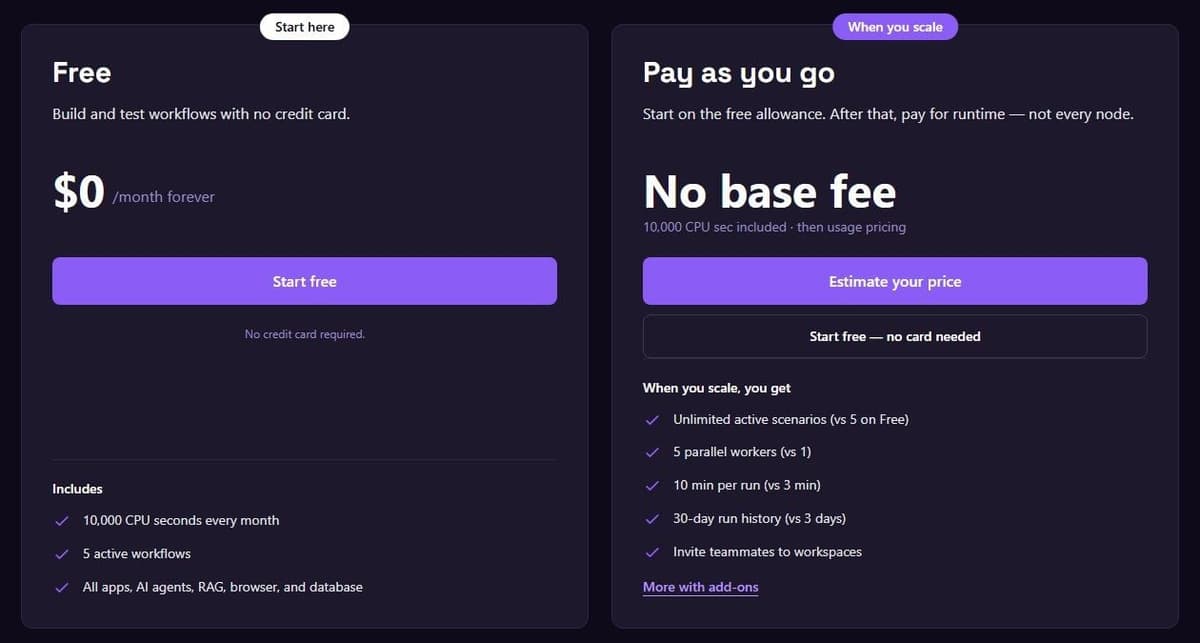
Latenode is a workflow layer for API-to-database and API-to-sheet pipelines with transformations, not a managed connector catalog. A pipeline here is a scenario: a webhook trigger or a schedule, plus custom JavaScript nodes for logic no connector covers. There is a headless browser for sources without an API, and a built-in database. An AI Copilot sits in every workflow, with 335+ LLM models under one subscription for parsing and classification steps. Our guide to API integration platforms compares iPaaS, developer tools and unified APIs.
Billing counts workflow runtime in CPU seconds: runs multiplied by the average seconds each run takes. There is no per-operation or per-step fee. Extra steps do not multiply the bill. The Free plan is $0 a month with no credit card: 10,000 CPU seconds a month, 5 active workflows and a 3-minute cap per run. Pay as you go has no base fee and keeps the first 10,000 CPU seconds each month. After that it charges from $0.00012 per CPU second in the 10,001 to 100,000 bracket, with unlimited active scenarios and 10 minutes per run. Nodes that call paid external providers also consume PnP tokens, where one token equals $1 charged by actual provider usage.
Free and open source data pipeline tools
Free plans here span several meters. Fivetran gives Standard features up to 500,000 monthly active rows for connections. Hevo allows 1 million events a month on a subset of connectors. Estuary's Developer tier runs indefinitely at 10 GB a month across 2 connector instances. Skyvia caps its free tier at 10,000 records a month. Keboola gives 120 compute minutes in the first month, then 60 a month. Coupler.io stays free forever at 100 rows per run. Latenode's Free plan is $0 a month with no credit card, at 10,000 CPU seconds a month across 5 active workflows.
Among the twelve, open source is a shorter list: Airbyte publishes the self-hosted Airbyte Core alongside its managed cloud. Self-hosting removes the credit meter and hands you servers, upgrades and broken connectors. A managed cloud reverses that trade. Trials are not free plans: Stitch, Hevo and Integrate.io run 14 days, Portable 14 days on Standard and Pro, Airbyte and Estuary 30 days, and Coupler.io 7. Fivetran runs a 14-day account trial and then gives every new connection another 14 days of free use.
Open-source engines for teams that write code
Outside the twelve, data teams that write code often build on open-source engines, paying for the servers or a managed version instead of a connector meter.
| Engine | Job | License or paid option |
|---|---|---|
| Apache Airflow | Schedules and monitors workflows defined in Python | Open source; some coding is always required |
| Dagster | Orchestrates data assets with lineage and observability | Open-source core; Dagster+ cloud from $10 a month |
| dbt | Transforms warehouse data from SQL select statements | dbt OSS free under Apache 2.0; a free dbt platform account adds features |
| Apache Kafka | Streams events in real time for pipelines and integration | Open source |
How to choose a data pipeline tool
Start with a count, not a category: how many sources, how many destinations, how much of your data changes each month. The meter decides the bill.
Count the matching work as well: a connector tool removes the exports, not the reconciliation. Marketplaces, ad platforms and CRMs often label orders and SKUs differently and count conversions their own way, so check that your sources share a key you can join on, such as an order ID, SKU or campaign ID, and decide where the matching will run: in warehouse SQL, a transformation tool or a workflow step. One user on r/analytics described the routine: "I pull from Google Ads, crossreference it against whatever the client has in their CRM, reconcile the conversion numbers (which never match, by the way, they never match)."
Match the meter to your data. Rows and events punish wide, chatty tables: Fivetran's MAR, Hevo's events and Stitch's rows grow with change volume. GB fits streaming sources. Compute minutes and CPU seconds suit pipelines that do work rather than move bulk, and a flat fee like Integrate.io's absorbs lumpy months. Connector and flow counts, as at Estuary and Portable, work best with a few heavy sources.
Budget for the warehouse too. In ELT the transformation runs inside your warehouse, so it uses compute the warehouse vendor bills you for, on top of the pipeline tool's meter. Every extra refresh adds to that compute, so a schedule tighter than your reports need shows up on the warehouse bill. One user on r/snowflake put it this way: "I am a solo data engineer at a small business trying to deliver near-real-time data pipelines and I'm facing pretty high costs."
Then ask when you need the data. Nightly reporting does not need change data capture; an operational sync often does. Decide where transformation belongs: before the load, or inside the warehouse in SQL. Ask who maintains the connector, because a managed catalog earns its price the week an API changes. A workflow platform is cheaper when a source has no connector or the logic is specific to your business, and more expensive once you are replicating dozens of standard SaaS sources. Prefer a free plan to a trial. Trials expire, and a free plan keeps a pipeline alive.
AI coding assistants lower the cost of writing a custom pipeline, not the cost of owning one. Generated code still needs tests, a safe home for credentials, monitoring and someone to fix it when a source API changes, which is the work a managed connector takes off your hands. One user on r/dataengineering, who migrates pipelines for a living, described looking at "AI generated pipelines that work but don't scale."
Which tools work together and which replace each other
Connector platforms mostly replace each other. Fivetran, Airbyte, Hevo, Stitch, Skyvia, Estuary, Portable and Integrate.io all move rows from a source into a destination, so you pick one per stack and switch when the meter or the catalog stops fitting. Keboola sits apart: its free plan already bundles ETL and ELT pipelines with SQL and Python transformations on its own backend, so it stands in for a connector tool and a warehouse-side transformer at once. Matillion comes after the load, transforming inside the warehouse. Coupler.io runs beside a warehouse pipeline rather than replacing it.
A workflow layer sits next to all of them. Latenode covers sources no catalog has a connector for, with webhook triggers, custom JavaScript nodes and a headless browser. It holds intermediate rows in its built-in database and pushes results back into the apps a team uses. It bills in CPU seconds, with no per-operation or per-step fee, so its cost follows run time rather than row counts.
Writing data back into a CRM, often called reverse ETL, needs a rule for each field. Decide whether the warehouse or a person editing the record wins, skip updates that would replace a filled value with an empty one, and log every change so a bad sync can be traced and undone. One user on r/salesforce put the risk as a question: "What happens when yesterday's score was 80 and today's model returns null?"
Cloud services from AWS, Azure and Google Cloud
Teams committed to one cloud often run its own service beside a connector platform, or instead of one. AWS Glue is a serverless data integration service for ETL, ELT and streaming jobs, billed at an hourly rate by the second; AWS's pricing example uses $0.44 per DPU-hour, and rates vary by region. Azure Data Factory is a managed service for ETL, ELT and data integration pipelines, billed per activity run and per integration runtime hour, and Microsoft now points newcomers to Data Factory in Microsoft Fabric. Google Cloud Dataflow processes stream and batch data and bills for the compute resources each job uses.