

Quick answer: what Lindy costs in 2026
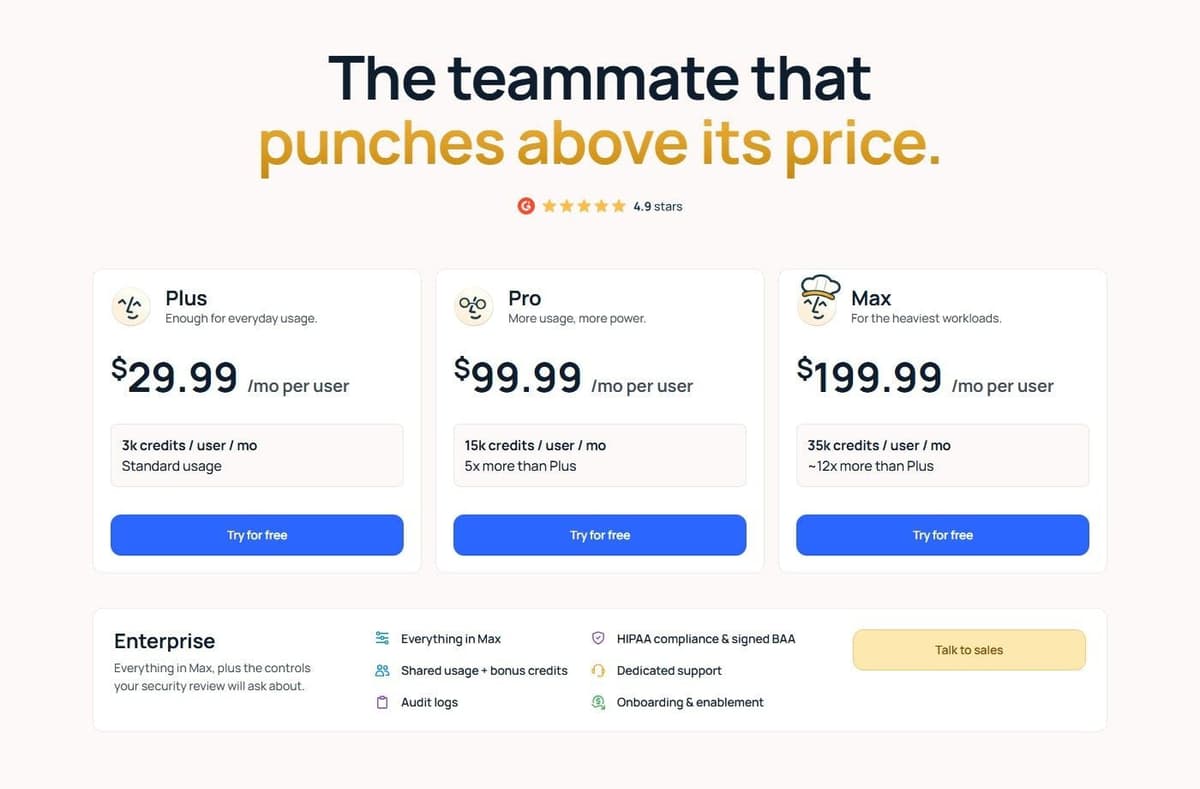
Lindy costs $29.99 per user a month on Plus with 3,000 credits. Pro is $99.99 with 15,000 credits, and Max is $199.99 with 35,000 credits, each per user per month. Enterprise is quoted by sales. Credits pool across the workspace, top-ups cost $10 per 1,000 credits, and teammates who join through Slack get a 7-day free trial.
Every number in this article was read off Lindy's own pricing page and its product documentation on September 10, 2026. Nothing here comes from resale listings, review aggregators or third-party estimates. Where the vendor publishes a rule but not the figure behind it, that gap is called out rather than filled in. Prices on a young product move, so treat the date as part of the number.
Editorial note: Latenode publishes this article and is one of the products discussed. The comparison uses public product documentation and pricing pages. Worked examples are calculations under stated assumptions, not results from a hands-on benchmark. Recommendations describe which requirements a product may fit; they are not a measured ranking of performance or reliability.
Lindy pricing plans at a glance
Three self-serve tiers, one sales tier. Credit volume is the main difference between the self-service plans, but it is not the only one. Connected inboxes and onboarding vary by tier, and Enterprise carries controls the other plans do not. Decide which capabilities you need first, then size the credit budget. See Gumloop pricing for plans and credits in detail.
| Plan | Price per user | Credits per user | Notes |
|---|---|---|---|
| Plus | $29.99 a month | 3,000 a month | Entry per-seat tier |
| Pro | $99.99 a month | 15,000 a month | 5x the Plus credits |
| Max | $199.99 a month | 35,000 a month | About 12x Plus credits |
| Enterprise | Contact sales | Max plus bonus credits | HIPAA BAA, SSO, SCIM |
All three published prices are per user per month. Pro carries five times the Plus allocation, Max about twelve times.
What a Lindy credit actually buys
A credit is Lindy's unit of work, and the price list only means something once you know what a unit costs. Lindy's pricing page publishes three ranges. Everyday asks, meaning answers, lookups and drafting a reply, run from 2 to 250 credits. Deep work such as researching a competitor or triaging a day's support queue takes 250 to 1,000. Big builds like a complex dashboard or an internal tool take 1,000 to 2,500. For other options, see Lindy AI alternatives.
"Credits measure the work Lindy does. You only use them when Lindy is working."
Source: lindy.ai
Credit use varies with the work performed. A short lookup, a research request and a large build can consume very different amounts. Use the published ranges to plan an initial allowance, then refine the budget from representative tasks in your workspace. Do not treat the top of a range as the guaranteed cost of every task in that category.
Model choice moves the figure too. Lindy lets users pick the model for each task and gives every plan every model, trial seats included. It also picks a model automatically when the goal is to make credits go further.
According to Lindy's pricing page, credits are pooled across the workspace. Every seat adds its allocation to one shared pool, and admins can set credit allocations per seat. Lindy's documentation goes further: admins can set spend caps per teammate. When someone hits their cap, Lindy pauses that person's credit-using actions and keeps working for everyone else. When the workspace pool is exhausted, credit-using work pauses unless an admin has enabled Overages.
Plan credits refresh at the start of each billing cycle and do not roll over. Purchased top-ups are the exception. Admins buy shared credits at $10 per 1,000, sold in 1,000-credit blocks, a one-time purchase that does not touch the base plan's credits and does not expire. Read that $10 as the price of buying more credits, not as a penalty rate applied automatically.
Usage beyond the pool has its own rule. Lindy's documentation says that if admins enable Overages in Settings, Lindy keeps working past the pool's limit and overage usage is charged at 2x the plan's standard credit rate.
One behavior matters before you set expectations with a team: when a single task starts drawing far more credits than usual, Lindy pauses and checks in before continuing. Paused tasks are not restarted automatically after the pool resets, though nothing is deleted.
A monthly budget for one person or a five-person team
The examples below assume all seats use the same plan, there are no unused purchased credits at the start, and extra credits are bought manually in 1,000-credit blocks for $10. They exclude taxes and automatic overages, and assume the selected tier supports the required inboxes and other features.
| Seats | Expected monthly credits | Option | Monthly cost |
|---|---|---|---|
| 1 | 6,000 | Plus + 3,000 purchased credits | $59.99 |
| 1 | 10,000 | Plus + 7,000 credits, or Pro | $99.99 |
| 1 | 15,000 | Pro | $99.99 |
| 1 | 35,000 | Max | $199.99 |
| 5 | 12,000 | 5 Plus seats, 15,000 pooled | $149.95 |
| 5 | 30,000 | 5 Plus seats + 15,000 credits | $299.95 |
| 5 | 75,000 | 5 Pro seats | $499.95 |
For one seat, Plus plus top-ups reaches Pro's price at 10,000 credits. Above that, Pro is cheaper until its own allowance is exhausted. Pro plus 10,000 purchased credits equals Max's price at 25,000 credits. Buying more seats solely to add credits can be wasteful when existing users only need a top-up.
These are capacity calculations. Estimate consumption from your own representative tasks; a "research request" does not have one guaranteed credit cost.
What the self-service plans include
All plans include access to the available models, but that does not mean every plan has identical entitlements. Lindy's billing documentation lists two connected inboxes on Plus, three on Pro and five on Max, with live onboarding on Pro and above. Enterprise adds SSO, SCIM, audit logs and HIPAA/BAA support. Choose the required capabilities before optimizing the credit budget.
As listed on Lindy's pricing page in September 2026, the self-service plans share these capabilities:
- A Slack-native teammate that works in threads and mentions, plus scheduled routines and persistent workspace context.
- More than 40 skills plus custom ones, meeting recording and notes, meeting scheduling and daily briefs.
- Inbox management with drafts in your voice, plus iMessage access.
- Team files with version history, computer use, model selection and built-in approvals.
- Support for any MCP server, alongside over 1,000 integrations by Lindy's own count.
One item on that list deserves a caveat. The integrations figure is Lindy's own count rather than an audited one. Read it as a sign that the catalog is broad, and that MCP support covers tools the catalog misses.
Enterprise: what the top tier adds
Enterprise is sold through sales and carries no published price. Any budget for it starts with a quote. What the tier adds is written down: everything in Max, plus HIPAA compliance with a signed BAA, shared usage with bonus credits, dedicated support, audit logs and onboarding. Per Lindy's docs, the tier also adds SSO and SCIM on top of the SOC 2 and GDPR compliance that the base plans already carry.
On governance, Lindy's enterprise page says teams can pick Anthropic, OpenAI, Gemini and other frontier models per job and control who has access. Approvals route to an account lead, an admin or the requester's manager.
The compliance claims come from the vendor. According to Lindy's own security page, the company is SOC 2 Type II certified, with the audit performed by Johanson Group. That page also lists HIPAA, GDPR and PIPEDA compliance as independently verified, and data as encrypted in transit and at rest, never sold and never used to train AI models. Those are Lindy's self-reported statements, so if procurement depends on them, ask for the report and the signed BAA in writing during the sales conversation.
Free trial and billing rules
The free week has a condition attached to it. New teammates who join through Slack get their first week free, while direct signups are billed right away. The free week is one-time per teammate. For a team that wants to try Lindy without a charge on day one, the Slack path is the one that grants it. Trial seats get every model, the same as paid seats.
"A seat stays billed until an admin removes it. You keep it through the end of the current cycle, with no mid-cycle proration."
Source: docs.lindy.ai
Billing is per person. Each teammate takes a seat, and that seat stays billed until an admin removes it. It stays active through the end of the current cycle, with no mid-cycle proration. So seat hygiene becomes a real line item, because a forgotten seat is a full month.
Upgrades take effect immediately, downgrades at the end of the term. Schedule a downgrade before the renewal date, not after the month that prompted it. Payment is by major credit and debit cards through Stripe.
Lindy's Pricing page lists Plus at $29.99. The Billing documentation rounds that tier to $30 while listing Pro at $99.99 and Max at $199.99. The budget examples use the Pricing page's exact figures. These are monthly per-seat prices, not annual-discount rates.
How Lindy's pricing compares with automation platforms
Lindy combines per-seat subscriptions with a shared usage allowance. Zapier and Make meter workflow work and also vary features and access by plan. Compare the required users, capabilities, included usage and excess-usage charges; none of these products can be reduced to headcount or volume alone.
Zapier counts tasks, and the counting rule matters as much as the sticker price. Only billable completed action steps count toward a Zap's task usage, and polling trigger checks do not consume tasks. Its Free plan includes 100 tasks a month with Zap workflows, Tables and Forms. Professional costs $19.99 a month billed annually for 750 tasks.
Make counts credits. Make's pricing page in September 2026 says most actions consume 1 credit, while some advanced features that use Make's AI Provider may use more. Adding a Google Sheet row counts, and so does fetching Gmail data. Its Free plan includes up to 1,000 credits a month, and with yearly billing selected, Core is $9 a month for 10,000 credits.
On Activepieces' metered plans, an ordinary automation run costs one credit. With Activepieces-supplied AI models, each AI step adds 2 credits for a fast model, 10 for a smart model or 20 for a frontier model; agentic actions add one credit each. On Plus and higher plans, using your own AI provider keys makes each AI step cost one Activepieces credit, with model usage billed separately by your provider. These charges are separate from the number of ordinary workflow steps. Activepieces also offers a separate free self-hosted Community Edition for core automation. The metered Free plan gives one user 100 credits a day, and Plus costs $16 a month billed annually with 10,000 credits for up to 5 users.
Latenode bills runtime. It charges for workflow runtime measured in CPU seconds rather than per operation or per step, so adding steps does not multiply the bill. The first 10,000 CPU seconds are free every month on both of its plans. Past that, usage is $0.00012 per CPU second in the 10,001 to 100,000 bracket.
Compare the same workload under each model. For Lindy, start with the number of users who need access, then estimate pooled credit consumption and any top-ups or enabled overages. For the alternatives, include their required plan features and metered work. The budget table above shows why adding seats is not the only way to buy capacity.
Who Lindy's pricing suits and who should look elsewhere
Lindy's model fits teams whose requests come from individual people. Per Lindy's homepage as of September 2026, it positions itself as an AI teammate that works in Slack, schedules events, drafts emails, summarizes meetings and books appointments. That page starts plans at $29.99 per user a month and 3,000 credits. If that matches the work, a seat per person is a clean unit, and meeting-heavy roles get recording, notes, scheduling and daily briefs inside the same price.
For heavy background work or repeated large builds, estimate actual credit consumption before choosing a tier. The workload may still fit Lindy, but a low seat count does not guarantee a low bill. Compare a higher plan, top-ups and any enabled overages with the full cost of another suitable platform.