

RevOps tools by stack layer
RevOps tools are the CRM and the tools around it that keep pipeline data, lead routing, forecasts and handoffs between marketing, sales and customer success consistent. Common picks: Salesforce or HubSpot, Gong for calls, Salesloft with Clari Forecast, LeanData for routing, Vitally post-sale, Zapier or Latenode. No tool covers every layer, so most teams pick a CRM first and add one tool per gap.
A RevOps stack has seven layers: CRM, data, routing and scheduling, conversations and forecasting, sales engagement, post-sale and billing, and workflow automation. The table maps the revenue operations tools below onto them.
| Layer | What it keeps consistent | Tools in this list | Also used |
|---|---|---|---|
| CRM | The system of record | Salesforce, HubSpot | - |
| Data | Contact, company fields | ZoomInfo, Data Hub | Apollo, Clay |
| Routing and scheduling | Lead owners, meetings | LeanData, Chili Piper | - |
| Conversations, forecasts | Call records, forecasts | Gong, Clari Forecast | - |
| Sales engagement | Sequences, activity log | Outreach, Salesloft | - |
| Post-sale and billing | Health, quotes, renewals | Vitally, DealHub | Gainsight, Chargebee |
| Workflow automation | Handoffs between apps | Zapier, Latenode | Make |
The CRM stores accounts, contacts, deals and activities. The other tools sync with those records instead of keeping a separate pipeline: Gong imports accounts, contacts and opportunities and exports calls back to the CRM, and Vitally syncs accounts, contacts and activity both ways. That is the difference between RevOps tools and a CRM: the CRM is the system of record, and the tools automate the work around it.
Quick answer: the best RevOps tool for each layer
The best pick depends on the layer you need to fill:
- CRM: Salesforce Sales Cloud for enterprise teams, HubSpot for small and mid-size teams.
- Data: ZoomInfo, for teams that want contact and company fields filled in the CRM.
- Routing and scheduling: LeanData for Salesforce teams, then Chili Piper for booking.
- Conversations and forecasting: Gong for call analysis, Salesloft with Clari Forecast for forecasts.
- Sales engagement: Outreach or Salesloft, for reps who run sequences daily.
- Post-sale and billing: Vitally for customer success, DealHub for quotes and contracts.
- Workflow automation: Zapier for simple app links, Latenode for custom cross-app workflows.
The list is ordered by stack layer, not by score, and there is no overall winner.
RevOps tools at a glance
Five of the twelve tools publish an entry price, and seven sell only through a quote or sales call.
| Tool | Layer | Best for | Pricing model | Free plan or trial | Paid from | Where it stops |
|---|---|---|---|---|---|---|
| Salesforce Sales Cloud | CRM | Enterprise sales teams | Per-user subscription | Free Suite, 30-day trial | $25/user/mo | Steps outside the CRM |
| HubSpot Sales, Data Hub | CRM and data | Small, mid-size teams | Seats plus credits | Free tools | $7/seat/mo promo, annual | Dedup from Professional |
| ZoomInfo | Data | CRM enrichment | Credits, by quote | Free Lite plan, trial | Quote-based | Credits per export |
| LeanData | Routing | Salesforce lead routing | Quote, by edition | Demo only | Quote-based | Built for Salesforce |
| Chili Piper | Scheduling | Inbound demo booking | Plan plus seats, annual | None listed | $15,000/yr (Growth) | No monthly billing |
| Gong | Conversations | Call analysis, deal risk | Users plus platform fee | None listed | Quote-based | No lead routing listed |
| Salesloft with Clari | Forecasting | Forecasts and cadences | Talk to Sales | None listed | Quote-based | One-way HubSpot deals |
| Outreach | Engagement | Sequences, AI agents | Seats plus AI credits | None listed | Quote-based | One-way HubSpot emails |
| Vitally | Post-sale | Customer success teams | Quote, three plans | Sandbox via demo | Quote-based | No self-serve free plan |
| DealHub | Quotes and billing | Quote-to-revenue | Quote, two plans | None listed | Quote-based | Billing on Scale only |
| Zapier | Automation | Simple app-to-app links | Tasks per month | Free plan and trial | $19.99/mo, billed yearly | Cost grows per task |
| Latenode | Automation | Custom cross-app flows | CPU seconds of runtime | Free plan | $0.00012/CPU sec | Not a CRM |
Prices as of November 2026.
1. Salesforce Sales Cloud: best for enterprise sales teams
Salesforce Sales Cloud is a CRM tool that stores accounts, contacts, leads and opportunities and runs the pipeline around them. Salesforce has renamed its editions: Core replaces Enterprise Edition, Advanced replaces Unlimited Edition, and Max replaces Agentforce 1 Edition. Our verdict: Sales Cloud is the CRM most enterprise RevOps stacks should build on, and its editions are priced per user per month, billed annually.
Every edition includes lead assignment and routing, plus duplicate blocking. Flow Builder automation starts at Pro Suite with 5 flows per org and is unrestricted from Core up. Pro Suite adds sales quoting and forecasting, and Core adds advanced pipeline management, opportunity scoring, conversation intelligence and APIs. For AI, Max includes Agentforce for Sales, Agentforce Coworker and 2.75M Flex Credits per org per year.
Starter Suite, the entry CRM suite, costs $25 USD per user per month, billed monthly or annually. Pro Suite costs $100, Core $195, Advanced $395 and Max $550, each USD per user per month, billed annually, and Max sits behind a Contact us button. Salesforce says most of its products use annual contracts, and every Sales Cloud edition has a free 30-day trial with no credit card. Salesforce's edition comparison table also lists a Free Suite at no cost, but the pricing page does not state its user limit or terms. Plan for an admin who owns fields, flows and permissions, and read how CRM automation works before you build. Sales Cloud runs the steps inside Salesforce, while enrichment data, meeting booking and product usage come from other layers.
2. HubSpot Sales Hub and Data Hub: best for small and mid-size teams
HubSpot Sales Hub is a CRM tool that creates and updates contacts, logs sales activities and tracks deals, and Data Hub is the data layer beside it. HubSpot launched Data Hub at its Fall 2025 Spotlight and says it replaces Operations Hub. The Sales Hub free tools cost $0 a month for up to 2 users with no credit card.
With the default Pay Annually option, the Starter card, HubSpot's bundle of marketing, sales, service, content and data management software, starts at $7 per seat per month billed annually for new customers (list price $20). Sales Hub Professional starts at $90 per seat per month billed annually (list price $100), plus a required one-time $1,500 Professional Onboarding fee. Enterprise starts at $150 per seat per month plus a one-time $3,500 Enterprise Onboarding fee, but HubSpot's Enterprise card shows no billing period and sells the plan through Talk to Sales. Included HubSpot Credits power its AI agents and reset monthly without rollover. Extra ones cost $0.010 per credit.
Data Hub syncs CRM data on every plan and deduplicates records on Professional and Enterprise. Its automation fixes formatting issues with custom rules. Data Hub Professional starts at $720 a month billed annually with 1 Core Seat (list price $800), and extra Core Seats start at $45 a month. The free tools and Starter sync data and fix basic issues, but cleaning data at scale starts at Professional.
3. ZoomInfo: best for enriching CRM records
ZoomInfo is a data tool that adds company and contact data to CRM records. ZoomInfo CRM enrichment fills contact, company, hierarchy, technographic and intent fields. It runs automatically when new records enter the CRM and refreshes existing records on a schedule. ZoomInfo integrates natively with Salesforce, HubSpot and Microsoft Dynamics 365, plus more than 120 other sales, marketing and data tools. In GTM Workspace, sellers get AI agents for learning about accounts, preparing for meetings and prioritizing deals.
The pricing page lists ZoomInfo Professional, Copilot Advanced and Copilot Enterprise behind Get Pricing and Start free trial buttons, with no dollar amounts. Each export of a contact or company profile uses a credit. CRM integrations also use credits on API calls, typically carry a base cost and require a minimum purchase of bulk credits. ZoomInfo's pricing page says pricing is based on licenses and credit usage, while its home page says it does not charge by fixed seat tiers. Confirm the model with ZoomInfo sales. ZoomInfo Lite is a permanent free plan, according to ZoomInfo's home page, which does not state the free plan's limits.
Other data enrichment tools start free: Apollo's Free plan has 900 credits per seat per year, granted monthly, and Clay's includes 500 actions and 100 data credits a month. ZoomInfo fills the fields, but every export and integration API call draws credits, so enrichment volume sets the bill.
4. LeanData: best for lead routing inside Salesforce
LeanData is a routing tool that matches leads to accounts and routes them with assignment rules inside Salesforce. It describes itself as a native Salesforce managed package whose routing logic, audit trails and data residency live inside Salesforce. The Standard Edition covers lead-to-account matching, round robin, territory and account-based assignment rules, and standard lead deduplication and enrichment.
The Premium Edition extends routing and matching to any standard or custom Salesforce object, such as opportunities and cases, and includes all AI capabilities. LeanData's AI page names LeanData AI Assistant, LeanData MCP, the AI Inference Node in FlowBuilder and AI SDR Routing and Scheduling. BookIt for Forms turns web forms into instant booking experiences, and developers get a Matching API, Round Robin API, BookIt API and Graph API. If you are still drafting the rules, start with lead routing automation.
The pricing page sells the Orchestration platform in Standard, Advanced and Premium editions. It shows no prices, only Schedule a demo, and bills setup and onboarding separately for all packages. Package pricing depends on features, objects and the number of Salesforce users or queues, with add-ons such as BookIt and Buying Groups Blueprint. LeanData routes records that live in Salesforce, so teams on HubSpot or another CRM should confirm support with LeanData first.
5. Chili Piper: best for booking meetings from inbound forms
Chili Piper is a scheduling tool that books meetings and routes leads between teams. Chili Piper Form Concierge turns form fills into booked meetings on the spot with the right rep. Handoff routes between teams, ChiliCal handles one-click scheduling and Distro auto-routes leads in Salesforce. Salesforce and HubSpot are its listed CRM integrations, and it routes any lead, contact, account or custom Salesforce object to an owner.
Growth includes AI agents that filter spam and prep reps for meetings, and Scale adds Chat AI that answers, qualifies and books visitors 24/7. Growth starts at $1,250 per month, which the page also states as $15,000 per year, for 15 seats on a 1-year minimum contract. Extra Growth seats are $45 per seat per month, and the plan includes 45,000 AI credits per year. Scale starts at $3,500 per month ($42,000 per year) for 30 seats, with additional seats at $50 per seat per month and 150,000 AI credits per year. All plans are billed annually, and 2-, 3- and 4-year contracts take 15%, 25% and 40% off.
Teams often run it after a router such as LeanData: the router assigns the owner, and Chili Piper books the time. With no monthly billing and no free plan on the pricing page, the smallest plan with routing is a full year of Growth.
6. Gong: best for call recording and deal risk
Gong is a conversations tool that records, transcribes and analyzes calls, and its deal warnings flag risks across every deal. The warnings assess all deal interactions and say what to fix before a deal is lost. Of the tools here, Gong is the revenue intelligence software built around calls. It also sells Gong Forecast, Gong Engage, Gong Enable and Gong Agents.
"There is a platform fee based on the number of users supported"
Source: gong.io
Its AI agents include AI Deal Monitor, which flags hidden deal risks, AI Deal Predictor, which predicts the likelihood of each deal closing, and AI Data Extractor, which fills out CRM fields from calls and emails without rep input. Gong connects natively to Salesforce, HubSpot and Microsoft Dynamics, or to other CRMs through a CRM API, but only to one CRM at a time. It logs captured activity back as tasks in Salesforce or meetings in HubSpot. Its API allows 3 calls per second and 10,000 calls per day by default.
Pricing is quote-based, and the page publishes no figures. Gong prices licenses per user plus a platform fee based on the number of users supported. The page says integrating the existing tech stack is free and that pricing ends in a customized proposal. No free plan or trial is listed. Gong records and analyzes calls, but routing leads is not among the features it lists.
7. Salesloft with Clari Forecast: best for forecasting next to rep cadences
Salesloft with Clari Forecast is a forecasting tool that pairs rep cadences with AI forecasts built from deal data. Clari and Salesloft announced that they had completed their merger in a Salesloft newsroom release published on December 3, 2025, and the forecasting product is now sold as Clari Forecast on salesloft.com. The release calls the combined company Clari + Salesloft, and clari.com redirects permanently to salesloft.com.
The site lists Cadence, Clari Forecast, Conversation Intelligence, Deals, Inspect, Revenue Cadences and Rhythm. Clari Forecast's AI Forecast Agent analyzes historical deal data and live rep activity, and individual and team forecasts are shown in one place.
The Salesforce integration syncs leads, contacts, accounts and opportunities in both directions and records Salesloft calls and emails as Salesforce activities. CRM Sync for Microsoft Dynamics 365 works the same way. CRM Sync for HubSpot is narrower: it syncs people and accounts both ways, opportunities one way from HubSpot into Salesloft, and activities one way to HubSpot. A public REST API covers other systems. Prices are not published, and salesloft.com/pricing loads a Talk to Sales page. With HubSpot the deal sync runs one way, and the budget stays unknown until the sales call.
8. Outreach: best for multi-channel sequences with AI agents
Outreach is a sales engagement tool that runs multi-channel sequences and AI agents for reps. Outreach bills seat-based access per user plus consumption-based AI credits for AI-powered actions, such as generating a personalized message, each with a predefined credit cost. The pricing block says "Per user pricing. No platform fees. Support included." but shows no dollar amounts, and onboarding packages are priced by quote.
Outreach does not state whether the included AI credits are per month, per year or per contract: Amplify Essentials includes 10,000 credits for conversation intelligence and coaching, Amplify Core 25,000 for pipeline creation with AI agents, Amplify Plus 50,000 and Amplify Pro 100,000. Essentials and Core are alternative entry packages, and you can buy extra credit packs at any time. As listed on Outreach's Amplify Core card, Core has the Revenue Agent and Personalization Agent with Multi-Channel Engagement and Sequences.
Outreach syncs the Lead, Contact, Account, Opportunity and Task objects both ways with Salesforce (Lightning, Classic and Console) and Microsoft Dynamics 365 Sales. HubSpot engineers manage and support its HubSpot connection, and emails sync only from Outreach to HubSpot. Teams usually pick Salesloft or Outreach, not both, so compare sales engagement tools before you sign. With no published credit cost per action, the AI part of the bill is hard to plan before a sales call.
9. Vitally: best for customer success after the sale
Vitally is a post-sale tool that tracks customer health and turns changes into work for customer success managers. Vitally says a health score typically combines product usage metrics, engagement data, support interactions and customer traits such as segment, renewal date and revenue. Scores update in real time, and a drop can create a task for the CSM or fire a Playbook.
The Salesforce and HubSpot integrations sync accounts, contacts and activity both ways. Vitally lists 30+ customer success integrations, Salesforce, Segment and Intercom among them. Subscription data such as trials, MRR, renewal dates and churn syncs in from Stripe and Chargebee. According to Vitally's integrations page, it also offers a REST API and a Vitally MCP Server. Its AI assistant, Quin, can draft emails, capture meeting notes and next steps, create tasks and update CRM fields.
Pricing is on request. Tech-Touch, Hybrid-Touch and High-Touch each carry a Request Pricing button, and every plan includes all core features, unlimited automations and the full integration library. The demo includes a trial sandbox with your own customer data. Gainsight, a customer success and retention platform by its own description, is another option and also shows Request Pricing on its Essentials and Enterprise tiers. Vitally works the account after the sale, but quotes and invoices are made in other tools.
10. DealHub: best for quotes and contracts built from CRM deals
DealHub is a quote and billing tool that generates quotes and contracts from CRM deals. It describes DealHub AI as an agentic quote-to-revenue platform connecting CPQ, DealRoom, contract management, subscription management, billing and revenue recognition on one governed execution layer. DealHub builds the quote from the CRM opportunity and generates contracts for e-signature, and the CRM stays the source of truth for accounts and opportunities.
"Your CRM stays the source of truth for accounts and opportunities, and quote, contract and billing data syncs back to it."
Source: dealhub.io
Its AI agents apply price books and discount guardrails, route exceptions to approvers and propose counter-terms within policy. DealHub AI connects natively with Salesforce, Microsoft Dynamics 365 and HubSpot and syncs quote, contract and billing data back to the CRM. DealHub says it replaces Salesforce CPQ while you keep Salesforce as the CRM.
The pricing page shows two plans behind Request Pricing: Growth for governed revenue execution and Scale for advanced billing control. CPQ, AI CPQ, CRM integration, DealRoom, contracts and subscription management are in both. Invoice runs, dunning, payment gateways and revenue recognition are Scale only. For invoicing alone, Stripe Billing pay as you go costs 0.7% of Billing volume with no recurring fees, one-off invoices excluded. On Growth, DealHub handles quotes and contracts, but invoicing runs in another system.
11. Zapier: best for simple app-to-app automations
Zapier is a workflow automation tool that connects 9,000+ apps with trigger and action workflows billed by tasks. Each workflow, called a Zap, is a trigger plus one or more actions, and every successful action in it counts as a task. Zapier's FAQ says triggers and built-in tools such as Filter, Formatter and Paths do not count as tasks, while the same pricing page says every step and every external connector call uses tasks at rates that vary, so confirm before purchase.
The Free plan costs $0 a month forever with 100 tasks per month and two-step Zaps. Professional starts from $19.99 a month on yearly billing for 750 tasks a month, or $29.99 paid monthly, for one user with multi-step Zaps and webhooks. Team starts from $69 a month on yearly billing for 2,000 tasks a month, or $103.50 paid monthly, with 25 users and SAML SSO. New accounts get a 14-day Professional trial with no credit card. At the task limit, Zaps pause until the next usage period unless you turn on pay-per-task billing, which charges a higher per-task rate.
Make is another option: it describes itself as an AI automation platform, with a free plan that has no time limit and needs no card. Zapier's per-task billing grows with each successful action and every record a Zap moves.
12. Latenode: for custom RevOps workflows between tools
Latenode is a workflow automation platform, not a CRM: it runs the rules between your CRM, forms, billing and chat apps. It lists 5,500+ integrations across 1,200+ apps and LLMs, with ready-made ones for Salesforce, HubSpot, Pipedrive, Zoho CRM, Stripe, Chargebee, Vitally, Intercom, Calendly, Typeform, Webflow, Slack, Google Sheets and PandaDoc. Apps without a ready-made integration connect through the HTTP request node if they have an API. Gong, Outreach and DealHub all offer API access.
Webhook triggers start scenarios instantly on every plan, code nodes run JavaScript, a built-in database stores workflow data, and 335+ AI models are available. AI Copilot, the AI assistant built into every workflow, helps you while you build. In a typical build, closed-won in Salesforce or HubSpot creates the Stripe customer and opens the account in Vitally. Templates include a website lead sync to HubSpot, Google Sheets and Slack and a Webflow to Pipedrive lead sync.
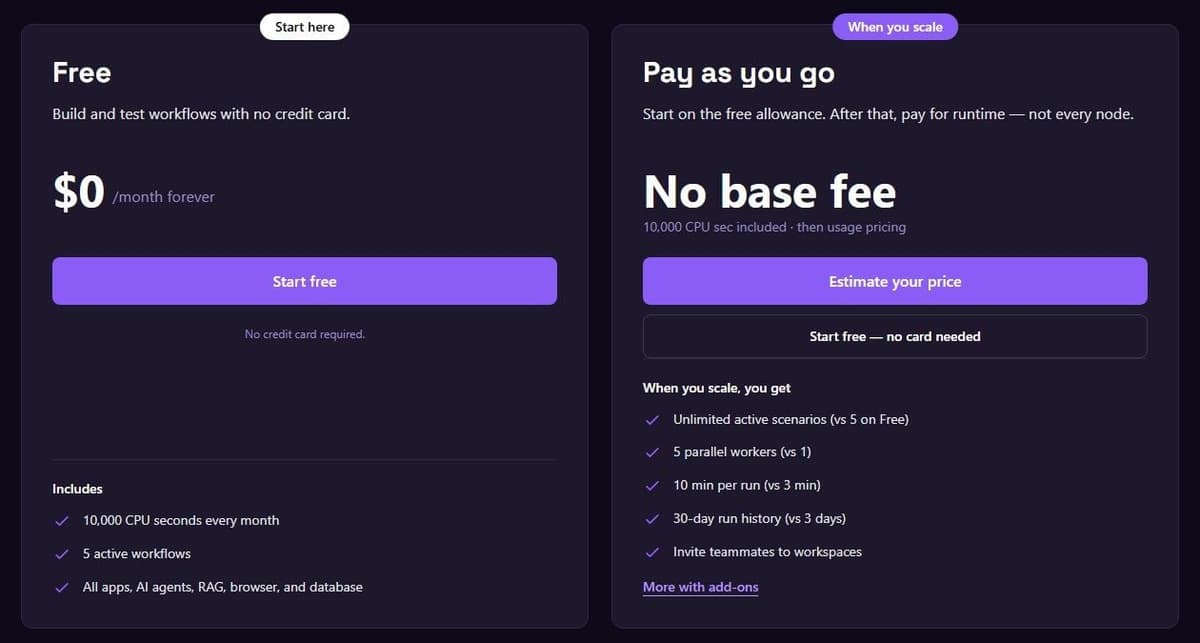
Used as RevOps software, Latenode bills runtime in CPU seconds, not steps. Free costs $0 a month with 10,000 CPU seconds and 5 active workflows. Pay as you go has no base fee, charges per CPU second above that allowance and allows unlimited active scenarios. You still need a CRM and a data provider, and Latenode does not replace the CRM as the system of record.
What RevOps teams automate between tools
Most RevOps work is moving the same record between tools at the right moment. Six handoffs to automate first:
- A form lead arrives: a webhook starts enrichment, a routing rule assigns an owner, and Slack gets the announcement.
- A deal moves to closed-won: the workflow creates the customer in billing and an onboarding task for customer success.
- Product usage drops: a task lands with the account owner.
- A duplicate or incomplete record appears: deduplication merges it, or the record is flagged for review.
- The week ends: a pipeline digest goes to a Slack channel.
- A renewal date is 90 days out: the owner gets a task and an account summary.
Closed-won in the CRM triggers the onboarding task for customer success, so the field mapping from deal to customer record is set once instead of fixed by hand. A built-in CRM workflow covers steps inside the CRM, while a workflow platform such as Zapier or Latenode covers steps across apps, including the handoff at renewal. Zapier does not support two-way sync: each Zap runs one way.
How to choose RevOps tools and in what order
Start with the CRM, then fix data quality, then routing, then forecasting and post-sale tools. Each layer depends on the one before it: a router cannot assign a lead to the right account if the account record is a duplicate. Judge each candidate for your RevOps stack on six points:
- Native CRM integration and two-way sync, checked object by object.
- Who maintains it, and how much admin time it takes.
- Pricing model: seats, a platform fee, credits or a quote.
- Data ownership: whether the CRM stays the source of truth or the tool keeps its own copy.
- AI features you will actually use, the credits the plan includes, when they reset and what extra credits cost.
- Contract length and billing period, including annual terms, onboarding fees and multi-year discounts.
A quote-based tool requires a sales call to get a price, and per-seat pricing grows with every rep you add.
AI tools for RevOps teams
Gong offers AI Deal Monitor, AI Deal Predictor and AI Data Extractor. Clari Forecast has its AI Forecast Agent, Vitally has Quin, and ZoomInfo gives sellers AI agents in GTM Workspace. Outreach meters AI-powered actions in AI credits, and HubSpot and Chili Piper meter their AI agents in credits too. One rule keeps the data clean: AI drafts and scores, and a person approves changes to records and customer-facing messages.
Which RevOps tools work together and which replace each other
Tools in the same layer replace each other, and tools in different layers work together through the CRM.
- Salesforce or HubSpot: one CRM, because every other tool syncs to it.
- Salesloft or Outreach: one engagement tool, since both run sequences and log activity to the CRM.
- Gong works next to either engagement tool and writes call activity back to the CRM.
- ZoomInfo, Apollo or Clay for data, usually one main provider so fields are not overwritten by two sources.
- LeanData and Chili Piper often together: LeanData routes the lead, Chili Piper books the meeting.
- Vitally sits next to the CRM after the sale, and DealHub sits between the deal and the invoice.
- Zapier or Latenode connect the rest, such as closed-won handoffs and renewal tasks.