

Quick answer: the best Tray.io alternative for each need
The best Tray.ai (formerly Tray.io) alternative depends on the need. Pick Workato for enterprise automation with governance, Make for visual scenarios with credit pricing, Zapier for business teams wanting per-task pricing and Boomi for enterprise iPaaS with a pay-as-you-go option. Celigo fits flat-rate pricing by endpoints and flows, Merge offers a unified API, and Latenode covers low-code workflows with AI models. For embedded integrations, pick by build style: Prismatic (code-first or low-code), Paragon (TypeScript workflows) or Cyclr (connector-based, published prices).
Sections run from internal automation to embedded options, with Latenode last. Prices are as listed in October 2026.
What Tray.ai (formerly Tray.io) is and why teams look at alternatives
On July 16, 2024, Tray announced that Tray.io had become Tray.ai, calling the result an AI-ready iPaaS. Every plan includes process automation, data integration, API management and 700+ connectors. Agent features cost extra: the Agent Development add-on bundles the Agent Gateway for MCP and the Merlin Agent Builder, which deploys agents to Slack and Teams. Tray Embedded puts a branded integration marketplace inside a SaaS vendor's own product.
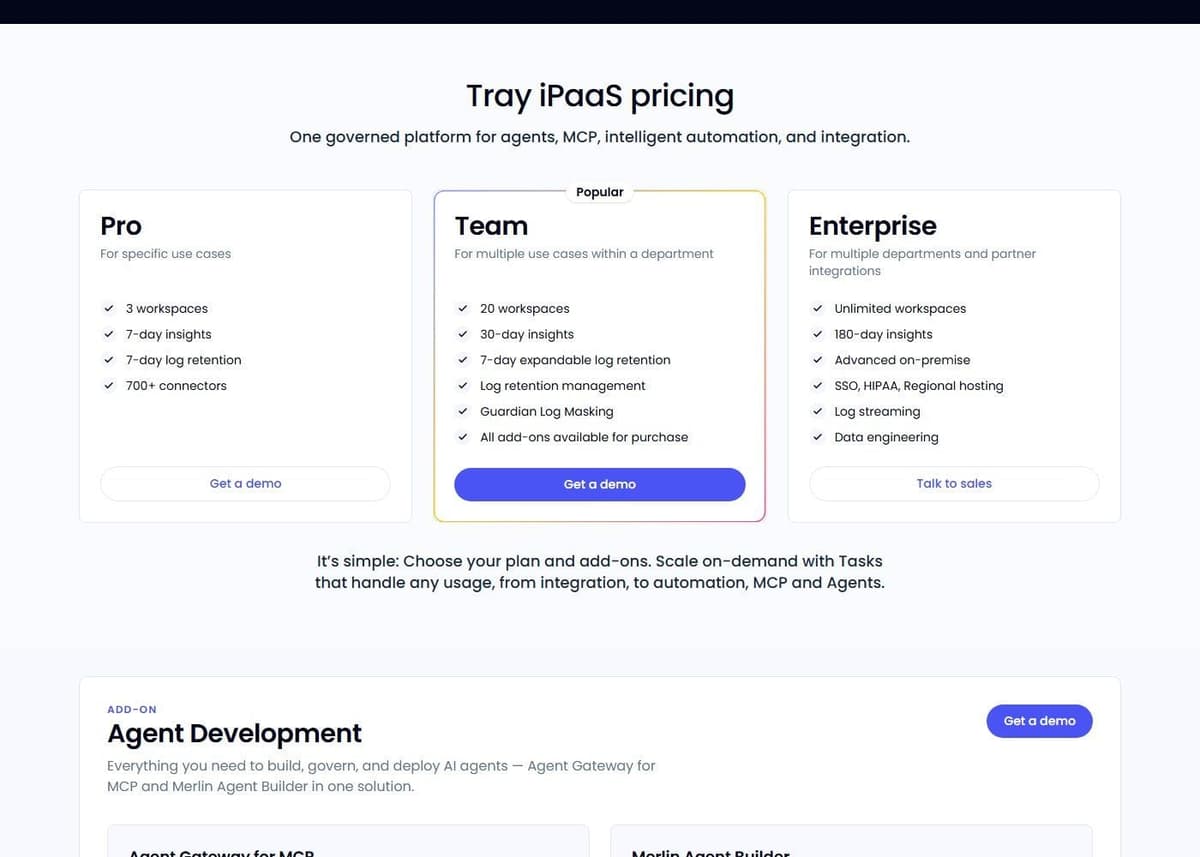
As of October 2026, Tray.ai's pricing page shows no prices for Pro, Team or Enterprise and sends each plan to a demo or a sales call. Tray counts usage in Tasks, roughly one executed workflow step each, so loop iterations add tasks. Per Tray's January 2026 documentation, AI connector tokens count too. Tray does publish a price for Tray Helix, a governed runtime for AI-built apps: Builder Edition is $50 per workspace per month plus $1.00 per Helix Consumption Unit. That leaves three reasons to compare: no list price for the iPaaS, a meter that grows with steps and tokens, and SSO and HIPAA included only on Enterprise.
Per Tray.ai's pricing page in October 2026, the plans differ by workspaces and controls. Pro covers 3 workspaces with 7-day insights and 7-day log retention, Team covers 20 workspaces with 30-day insights and log masking, and Enterprise covers unlimited workspaces with 180-day insights, advanced on-premise connectivity, SSO, HIPAA and regional hosting. HIPAA, SSO, regional hosting, 30-day log retention and log streaming are also sold as add-ons. Every plan includes observability and audit trails. Workflows are built in Tray Build, a drag-and-drop low-code builder with pre-built templates, or through Tray Headless, which adds Claude Code and Codex plugins, Headless MCP and full API access. When a service has no Tray connector, the HTTP Client connector makes calls to any third-party API. Our explainer covers what MCP is and how its servers and clients connect.
Tray.io alternatives at a glance
| Tool | Best for | Alternative to | Published price |
|---|---|---|---|
| Workato | Governed enterprise automation | Tray iPaaS and Embedded | Quote or $75/mo, 2,500 credits |
| Make | Visual credit-priced scenarios | Tray iPaaS | $9/mo, 10,000 credits, yearly |
| Zapier | Business teams, task pricing | Tray iPaaS | $19.99/mo, 750 tasks, yearly |
| Boomi | Enterprise iPaaS, monthly PAYG | Tray iPaaS | $99/mo plus usage (PAYG) |
| Celigo | Flat-rate, no task meter | Tray iPaaS | Quote: endpoints and flows |
| Prismatic | Per-customer integrations | Tray Embedded | Quote: per active instance |
| Paragon | Code-first embedded workflows | Tray Embedded | Quote: per Connected User |
| Cyclr | Embedded with published prices | Tray Embedded | From $1,595/mo (Native PAYG) |
| Merge | Unified API across categories | Part of Tray Embedded | $650/mo for 10 Linked Accounts |
| Latenode | Low-code workflows, AI models | Tray iPaaS | Free; $0.00012 per CPU second |
Where MuleSoft fits
Tray's own Compare page also lists MuleSoft, a wholly owned subsidiary of Salesforce since May 2, 2018, per MuleSoft's SEC filing. Its Anypoint Platform pairs integration with API management: API Manager is the component that manages, governs and secures APIs. Mule apps can run on CloudHub 2.0, a fully managed, containerized iPaaS, or on your own Mule servers, managed from the Runtime Manager cloud console. MuleSoft's pricing page says every package now includes Mule Credits, one shared credit currency across the MuleSoft portfolio. Per MuleSoft's documentation, accounts on usage-based packages such as Anypoint Integration Advanced instead carry entitlements for flows, messages and throughput rather than vCores, and a month's flow count is the highest number of flows that exist in any single hour. Consider it when your team designs and governs its own APIs or needs integrations running on its own servers. Teams leaving MuleSoft rather than Tray can start with our guide to MuleSoft alternatives.
1. Workato: best for enterprise automation with governance
Workato sells four platform editions, Standard, Business MCP, Enterprise MCP and Workato ONE, each building on the one below. Governance starts at the entry level: Standard includes dev, test and production environments, SAML SSO, MFA and role-based access control. By contrast, Tray.ai includes SSO only on Enterprise. Higher editions add API management, prebuilt MCP servers and, in Workato ONE, Agent Studio. Every user gets more than 1,200 prebuilt connectors. For SaaS teams, Workato Embedded offers Managed Service, Branded Access and Fully Embedded models.
The editions carry no price or usage rate. Workato's page says pricing includes usage, tracked by capability such as workflows and API management, and may vary by contract terms and join date. Workato Pro sells monthly credits from $75 a month for 2,500 credits to $1,275 a month for 50,000, according to Workato's self-service documentation, as of October 2026. These credit prices cover only the self-service Workato Pro plan, not the editions sold by quote on Workato's pricing page. The limitation is capacity. Business MCP includes 3 on-premise agents and 1 concurrency, and more is a paid add-on. Teams weighing Workato against other enterprise platforms can use our Workato alternatives guide.
2. Make: best for visual scenarios with credit pricing
Make (formerly Integromat) is a no-code visual workflow builder with routers, filters and 3,500+ apps. For a team leaving Tray.ai, the draw is a price list you can read before talking to sales. Each module action in a scenario, such as adding a Google Sheet row, counts as one credit.
That one-credit rule covers ordinary app modules. Make's built-in AI features are billed differently: depending on the AI connection, credits also depend on tokens, and some AI Content Extractor modules use more than one credit per operation.
The Free plan costs $0 a month with up to 1,000 credits a month. With yearly billing at 10,000 credits a month, Core is $9 a month ($10.59 billed monthly) and adds unlimited active scenarios, scheduling down to the minute and the Make API. On the same terms, Pro is $16 a month ($18.82 monthly) with priority execution and custom variables, and Teams is $29 a month ($34.12 monthly) with team roles. Prices rise as you move the credit slider: at 80,000 credits a month, billed yearly, Core is $55, Pro $91 and Teams $172.90 a month.
The catch: credits follow module actions, so long scenarios that run often use them up quickly. On the Free plan, scheduled runs are at least 15 minutes apart.
3. Zapier: best for business teams that want published per-task pricing
Zapier builds automations as Zaps, a trigger plus one or more actions, alongside Tables and Forms, and connects 9,000+ apps, per its pricing page in October 2026. For business teams leaving a quote-only contract, the meter is easy to explain: a task is charged only when a Zap successfully completes an action, and checks for new data are never charged.
"When you create a new Zapier account, you're instantly enrolled in a free 14-day trial of the Zapier Professional plan. No credit card is required."
Source: zapier.com
The Free plan is $0 a month forever with 100 tasks per month and two-step Zaps. Professional starts from $19.99 a month, the starting price for the 750-task tier, billed annually, per Zapier's pricing page, and adds multi-step Zaps, premium apps and webhooks. With monthly billing, per Zapier's pricing page in October 2026, that tier is $29.99 a month. Team starts from $69 a month, the starting price for 2,000 tasks a month, billed annually, with shared Zaps and SAML SSO. Zapier's Team card lists 25 users, while its pricing FAQ says unlimited users are available on Team, so confirm before purchase. Enterprise is contact-for-pricing. New accounts get a 14-day Professional trial without a credit card.
Lower tiers are slower. Polling runs every 15 minutes on Free and every 2 minutes on Professional, against 1 minute on Team and Enterprise.
4. Boomi: best for enterprise iPaaS with a monthly self-service option
Boomi sells four separate products: Integration, API Management, Data Hub and Data Integration. Integration comes in Professional, Professional Plus, Enterprise and Enterprise Plus editions, all priced through sales and sold on an annual basis. Enterprise adds custom roles, clustered runtime and parallel processing. According to Boomi's pricing page, the platform is also built around AI agents, with an Agent Control Plane, Agentstudio and governed MCP tools.
For a team tired of quote-only buying, Boomi offers a way in without a sales call. The 30-day free trial costs $0, covers the Boomi Enterprise Platform and needs no credit card. Pay-As-You-Go needs no contract and is bought by credit card. Boomi's pricing page lists it at '$99 per month plus usage, billed monthly' and also advertises 'Unlimited usage', but does not say how usage is measured or priced, so confirm before purchase.
Boomi's Pay-As-You-Go documentation fills in the usage rate: a flat $0.05 per Boomi Message on top of the $99 base fee, which is charged even in a month with no Messages. A Message is each inbound or outbound document, including responses to request/response calls; internal component-to-component messages do not count. The FAQ, updated July 16, 2026, also says the plan is currently open only to active trial users, who opt in with a credit card.
The limits show in the base Integration features, per Boomi's pricing page in October 2026: email and community support with no phone support, and production deployment only, with no test or development environments. Professional, priced through sales, adds multiple deployment environments and makes Premier Support available. If Boomi makes your shortlist, our guide to Boomi alternatives shows what else competes with it, and our overview lets you compare iPaaS vendors in Boomi's class, including MuleSoft, SAP Integration Suite and Azure Logic Apps, by meter and entry price.
5. Celigo: best for flat-rate pricing by endpoints and flows
Celigo is an integration platform with built-in API management for RESTful, SOAP, GraphQL and WebSocket APIs and data formats such as JSON and XML. Its pricing model is the opposite of a task meter: Celigo prices by endpoints and flows at a flat rate, states that it offers no volume-based pricing and advertises no overage fees. For a team whose Tray.ai usage climbs with every loop iteration, that is the main reason to look.
The editions are Standard, Professional and Enterprise. As of October 2026, Celigo's pricing page shows no list prices, but Celigo does offer a 30-day free trial. Standard has MFA and role-based access with SSO as an option. Professional adds API Builder, Lookup Cache and a sandbox, and Enterprise includes unlimited endpoints. Every edition gets AI capabilities, including an Agent Builder and an MCP Server, while Tray.ai sells agent tooling as an add-on.
You need a quote to see any number, though, and adding endpoints or flows goes through your Account Manager.
6. Prismatic: best for per-customer embedded integrations in code or low-code
Prismatic describes itself as an embedded integration platform for B2B SaaS companies whose integrations are deployed to multiple customers, each with their own configuration and credentials. A team leaving Tray Embedded gets two build styles: low-code tools for non-developers and a code-first SDK for developers. The entry Scale plan already includes an embedded integration marketplace, fully managed authentication and MCP server support. Prismatic also offers an embedded designer so your customers can build their own integrations. The embedded workflow builder is listed on Prismatic's Enterprise plan, alongside on-prem connectivity and team member SSO.
Prismatic does not charge per API call, task or execution. You pay a platform subscription, with the fee fixed annually, plus active instances: one for each integration enabled for each customer, so seven integrations for one customer make seven instances. As of October 2026, Prismatic does not publish its per-instance rate or volume tiers, so ask for both in the quote.
The risk is cost. It scales with customers times integrations, and you cannot model it until Prismatic quotes the rate.
7. Paragon: best for code-first embedded workflows and AI agent actions
Paragon includes three products on every plan, Managed Sync, ActionKit and Workflows, plus unlimited integrations, fully managed authentication and an embedded UX component or headless SDK. Workflows lets developers write integration logic in TypeScript or use a low-code editor. ActionKit is one API and MCP server for hundreds of synchronous integration CRUD actions, which fits SaaS teams adding AI agents to their product.
Paragon meters on Connected Users, the number of tenants (customer organizations) using integrations, per Paragon's pricing page in October 2026. The page shows Connected Users as 'Custom', with no per-user rate. Paragon's pricing page says 'Start for free' but publishes no free-tier limits or prices, and its Pro and Enterprise plans are quoted. Enterprise adds self-hosting or forward deployment, SAML-based SSO and unlimited task history, up from 90 days on Pro.
The gaps are on Pro. Per Paragon's plan comparison in October 2026, Pro leaves out role-based access control, on-premise or single-tenant options and workflow feature flagging, and the Task History API is an add-on there. Confirm plan features with Paragon.
8. Cyclr: best for embedded integrations with published starting prices
Cyclr sells Native Embedded iPaaS, Service Embedded iPaaS and MCP PaaS, with a library of 600+ application connectors. Unlike Tray Embedded, it prints numbers. Per Cyclr's pricing page in October 2026, Native Embedded iPaaS starts from $1,595 per month on PAYG with 100,000 API calls and $100 per connector per month. Growth starts from $2,595 per month with 10 included connectors and 1,000,000 API calls, and Scale from $7,195 per month with 5,000,000 API calls, the custom connector toolkit and a staging environment. These are starting ('from') prices excluding local taxes. The PAYG column lists unlimited integrations and users, while Cyclr's FAQ ties unlimited customers and integrations to the Growth and Scale plans, so confirm before purchase.
Cyclr bills each connector active in the last 30 days once a month, with unlimited workflows and users per connector. Connectors you build yourself cost nothing; ones Cyclr builds carry an agreed one-off fee.
The weak point is overages. Cyclr bills API calls above the allowance at rates its pricing page does not show, so ask for the per-call rate before purchase.
9. Merge: best for one unified API instead of building each integration
Merge takes a different route from Tray Embedded: Merge Unified lets a SaaS team ship customer-facing integrations across hundreds of apps through one API. Merge lists accounting, ATS, CRM, file storage, HR and ticketing integrations and an embedded Merge Link component on its pricing page.
The Launch plan links 3 production Linked Accounts free, then costs $650 a month for up to 10 production Linked Accounts and $65 per Linked Account after that, as of October 2026. Merge's pricing page does not define a production Linked Account, so confirm what counts before budgeting. Per Merge's pricing page in October 2026, Professional and Enterprise are contract-based, Professional adds custom fields, field-level scopes and custom sync frequencies, and Enterprise adds audit trail, unlimited sandboxes and uptime SLAs. The plan comparison also lists a dedicated account manager on Professional.
Launch comes with limits. Syncs run daily, logs are kept 3 days, the rate limit is 100 requests per minute, and SAML-based SSO is not included, per Merge's plan comparison in October 2026. Confirm with Merge before purchase.
10. Latenode: for low-code workflows with AI models
Latenode, the platform behind this blog, combines a visual drag-and-drop canvas, an AI Copilot inside every workflow, an AI agent builder, 335+ LLM models under one subscription and custom JavaScript nodes. It also has a headless browser for sites without an API and a built-in database. As of September 2026, per Latenode's MCP Server documentation, an MCP-compatible AI agent can build scenarios and trigger runs in a Latenode workspace.
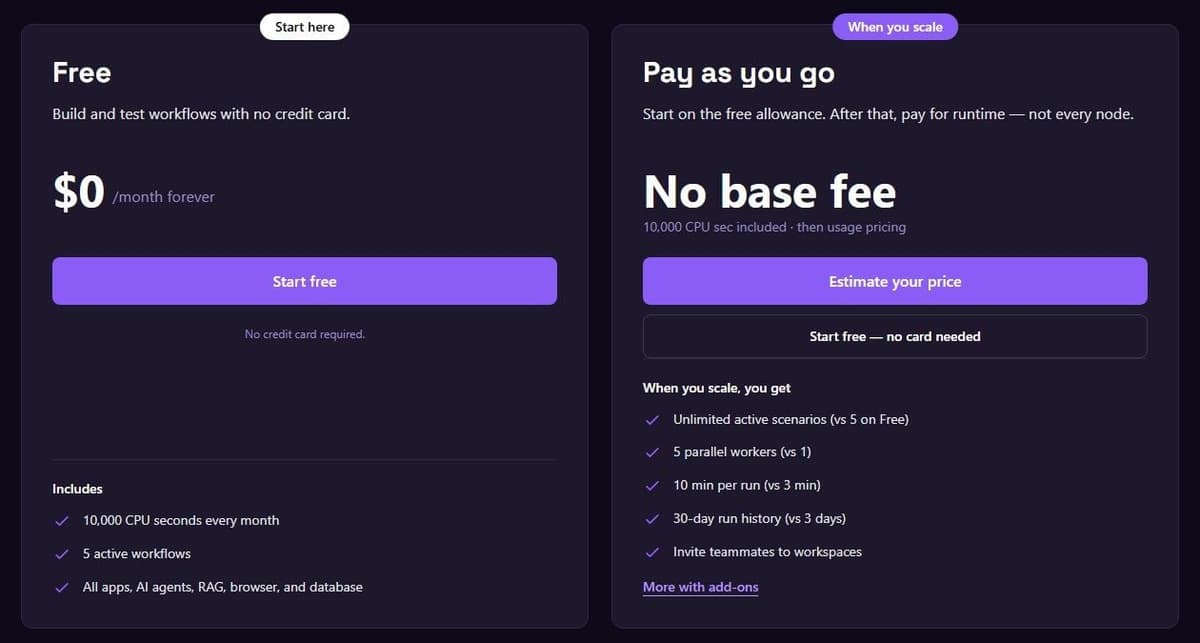
Latenode bills by CPU seconds of workflow runtime, not by operation or step. That matters if your Tray.ai bill grows with every step. The first 10,000 CPU seconds each month are free on both plans. Free costs $0 a month forever, needs no credit card and allows 5 active workflows and 3 minutes per run. Pay as you go has no base fee and allows unlimited active scenarios and 10 minutes per run. It charges $0.00012 per CPU second from 10,001 to 100,000, $0.00011 from 100,001 to 200,000 and $0.00010 from 200,001 to 300,000 CPU seconds a month. Nodes that call paid external providers add PnP tokens at $1 per token on top.
The trade-off: cost tracks runtime, so long-running workflows cost more. The Free plan also stops each run at 3 minutes.
Alternatives to Tray Embedded
Tray Embedded lets a SaaS vendor publish workflows as Solutions that end users configure in Tray's Config Wizard, and the vendor's own code calls Tray's GraphQL APIs. Tray's documentation says the Embedded bundle is an optional add-on for Enterprise customers, yet the Embedded page's header links to the iPaaS free trial, so confirm access with Tray's sales team. Tray publishes no price.
Pick an embedded iPaaS when each customer needs its own configured integrations and your team owns the workflow logic. In that group, Prismatic fits code-first or low-code builds priced by active instance, and Paragon fits TypeScript workflows and an action API for agents. Cyclr has connector-based plans with starting prices on the page, and Workato Embedded offers managed, branded or fully embedded models. When you need the same kind of data from many apps in one category, such as CRM or HR, pick a unified API like Merge. For a deeper comparison, see our embedded iPaaS guide.
Tools from older lists that changed
Two names on older lists of Tray alternatives no longer lead to a live product. Integromat is now Make. Make's page 'Integromat evolves to Make' describes a new brand identity and a new platform, and its press page dates the announcement to February 22, 2022. The Integromat platform shut down on September 30, 2023. Notion announced on September 8, 2021 that it was acquiring Automate.io, and Automate.io announced on May 3, 2022 that it would close the product on October 31, 2022. Lists written before then still recommend both.
"February 22, 2022 Integromat evolves to Make, expanding its vision to empower creators to innovate without limits October 14, 2020 Celonis acquires Czech startup Integromat to accelerate move to process automation"
Source: make.com
When staying on Tray.ai makes sense
Tray.ai can still be the right call. On security and compliance, Tray's homepage says Tray.ai is SOC 1 and SOC 2 Type 2 audited and HIPAA and GDPR compliant, with region-specific hosting and on-premise connectivity available on the Enterprise plan. Per Tray's pricing page, HIPAA itself is included in Enterprise and otherwise sold as an add-on. For SaaS vendors on Tray Embedded, the Embedded page says Tray maintains the connectors, runtime, auth flows and API changes, so the vendor's own engineers do not. With the Agent Development add-on, the Agent Gateway exposes the 700+ connectors as MCP tools with access control.
The task meter has controls too. Per Tray's usage documentation, automatic connector retries are not charged, a workspace can be capped at a monthly task limit, and usage alerts arrive at 80% and 100% of the task entitlement. If your workflows rely on these points, ask Tray for a renewal quote on your current task volume and set it next to the alternatives before you rebuild anything.
How to choose a Tray.io alternative
- Internal automation or customer-facing integrations. Workato, Make, Zapier, Boomi and Celigo automate your own processes; if customers configure integrations inside your product, compare embedded platforms and unified APIs.
- Workflow automation or data pipelines. If the main job is loading data into a warehouse rather than running workflows between apps, compare the data products. Tray.ai includes data integration on every plan and sells data engineering as an add-on. Workato puts ETL, ELT and reverse ETL in Business MCP, and data pipelines and event streams in Enterprise MCP. Boomi sells Data Integration as a separate product, with Base, Professional, Professional Plus and Enterprise editions, as listed on Boomi's pricing page in September 2026. Dedicated ELT services are covered in data pipeline tools compared. Our explainer on what a data pipeline is covers the difference.
- Who builds. Business users can start in visual builders such as Make and Zapier. Developers may prefer Paragon's TypeScript workflows or Prismatic's code-first SDK. Cyclr will build a connector for you for an agreed one-off fee.
- Pricing transparency and the meter. Make, Zapier, Cyclr and Merge's Launch plan publish prices; Workato's editions, Celigo, Prismatic and Paragon are quoted. Then check what is counted, from steps and credits to instances, Connected Users or Linked Accounts, and price one real workflow on each meter. For more integration platforms side by side, see our guide to API integration platforms and their pricing meters.
- Governance and SSO. Check the plan, not the product: Workato's Standard edition includes SAML SSO, Celigo Standard offers SSO as an option, and Paragon and Prismatic put SSO on Enterprise.
- Support during the switch. Tray.ai includes business-hours support on every plan and 24/7/365 support with enhanced SLAs on Team and Enterprise. Cyclr's Solutions Architects give 3 months of guidance after signature on Growth and Scale, Prismatic's Scale plan includes a dedicated account manager, and Zapier Enterprise adds a Technical Account Manager, included at a set threshold or as an optional add-on. Per Merge's plan comparison in October 2026, Professional gets a shared Slack channel for the first 90 days.
- AI agent features. Tray.ai sells agent tooling as an add-on, Celigo includes an Agent Builder and MCP Server on every edition, and Workato puts prebuilt MCP servers in Business MCP.
- Migration effort. Tray's documentation describes JSON export and import between Tray workspaces and orgs only, and stored data-table rows, vectors and API policies do not move, so budget time for a rebuild.
Test the shortlist on a real workflow
- Measure what you run today. Tray's usage dashboard, open to Admin and Owner roles, shows task usage, and the Insights Hub compares task usage across workspaces and workflows over time.
- Export the workflows you depend on as JSON. The files hold only structure and definitions, so treat them as a spec for the rebuild.
- Rebuild one live workflow, with its loops and error paths, on two shortlisted tools and run it on real data.
- Compare run history, errors and the bill on each meter, and keep the Tray.ai version live until the new one matches it.